You're using a free limited version of DrugPatentWatch: Upgrade for Complete Access

Last Updated: December 12, 2025

PHOSLO Drug Patent Profile


✉ Email this page to a colleague

« Back to Dashboard


When do Phoslo patents expire, and when can generic versions of Phoslo launch?

Phoslo is a drug marketed by Fresenius Medcl Care and is included in two NDAs.

The generic ingredient in PHOSLO is calcium acetate. There are two hundred and eighty-two drug master file entries for this compound. Twenty-three suppliers are listed for this compound. Additional details are available on the calcium acetate profile page.

DrugPatentWatch® Litigation and Generic Entry Outlook for Phoslo

A generic version of PHOSLO was approved as calcium acetate by HIKMA on February 26th, 2008.

  Get Started Free

AI Deep Research
Questions you can ask:
  • What is the 5 year forecast for PHOSLO?
  • What are the global sales for PHOSLO?
  • What is Average Wholesale Price for PHOSLO?
Drug patent expirations by year for PHOSLO
Drug Prices for PHOSLO

See drug prices for PHOSLO

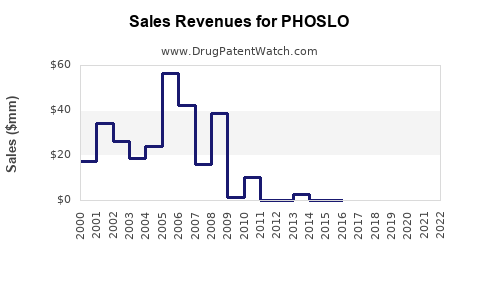
Drug Sales Revenue Trends for PHOSLO

See drug sales revenues for PHOSLO

Recent Clinical Trials for PHOSLO

Identify potential brand extensions & 505(b)(2) entrants

SponsorPhase
AmgenN/A
Azienda Ospedaliera Sant'AnnaN/A
Genzyme, a Sanofi CompanyPhase 4

See all PHOSLO clinical trials

US Patents and Regulatory Information for PHOSLO

Applicant Tradename Generic Name Dosage NDA Approval Date TE Type RLD RS Patent No. Patent Expiration Product Substance Delist Req. Exclusivity Expiration
Fresenius Medcl Care PHOSLO calcium acetate CAPSULE;ORAL 021160-001 Apr 2, 2001 DISCN No No ⤷  Get Started Free ⤷  Get Started Free ⤷  Get Started Free
Fresenius Medcl Care PHOSLO GELCAPS calcium acetate CAPSULE;ORAL 021160-003 Apr 2, 2001 DISCN Yes No ⤷  Get Started Free ⤷  Get Started Free ⤷  Get Started Free
Fresenius Medcl Care PHOSLO calcium acetate CAPSULE;ORAL 021160-002 Apr 2, 2001 DISCN No No ⤷  Get Started Free ⤷  Get Started Free ⤷  Get Started Free
Fresenius Medcl Care PHOSLO calcium acetate TABLET;ORAL 019976-001 Dec 10, 1990 DISCN Yes No ⤷  Get Started Free ⤷  Get Started Free ⤷  Get Started Free
>Applicant >Tradename >Generic Name >Dosage >NDA >Approval Date >TE >Type >RLD >RS >Patent No. >Patent Expiration >Product >Substance >Delist Req. >Exclusivity Expiration

Expired US Patents for PHOSLO

Applicant Tradename Generic Name Dosage NDA Approval Date Patent No. Patent Expiration
Fresenius Medcl Care PHOSLO calcium acetate CAPSULE;ORAL 021160-001 Apr 2, 2001 ⤷  Get Started Free ⤷  Get Started Free
Fresenius Medcl Care PHOSLO calcium acetate TABLET;ORAL 019976-001 Dec 10, 1990 ⤷  Get Started Free ⤷  Get Started Free
Fresenius Medcl Care PHOSLO calcium acetate CAPSULE;ORAL 021160-002 Apr 2, 2001 ⤷  Get Started Free ⤷  Get Started Free
>Applicant >Tradename >Generic Name >Dosage >NDA >Approval Date >Patent No. >Patent Expiration

Supplementary Protection Certificates for PHOSLO

Patent Number Supplementary Protection Certificate SPC Country SPC Expiration SPC Description
0521471 SPC/GB03/033 United Kingdom ⤷  Get Started Free PRODUCT NAME: ROSUVASTATIN OPTIONALLY IN THE FORM OF A NON-TOXIC PHARMACEUTICALLY ACCEPTABLE SALT, PARTICULARLY THE CALCIUM SALT.; REGISTERED: NL 26872 20021106; NL 26873 20021106; NL 26874 20021106; UK PL 17901/0201 20030321; UK PL 17901/0202 20030321; UK PL 17901/0203 20030321
2957286 132019000000021 Italy ⤷  Get Started Free PRODUCT NAME: PATIROMER SORBITEX CALCIUM E QUALSIASI SUO SALE O DERIVATO(VELTASSA); AUTHORISATION NUMBER(S) AND DATE(S): EU/1/17/1179, 20170721
0720599 CR 2014 00050 Denmark ⤷  Get Started Free PRODUCT NAME: EZETIMIBE AND ATORVASTATIN OR PHARMACEUTICALLY ACCEPTABLE SALTS THEREOF, INCLUDING ATORVASTATIN AS ATORVASTATIN CALCIUM TRIHYDRATE; REG. NO/DATE: DE/H/3895-3898/001-004/DC 20140910
2365988 CA 2018 00006 Denmark ⤷  Get Started Free PRODUCT NAME: PATIROMER SORBITEX CALCIUM AND ANY SALTS AND DERIVATIVES THEREOF; REG. NO/DATE: EU/1/17/1179/001-009 20170721
0933372 PA2008006 Lithuania ⤷  Get Started Free PRODUCT NAME: FOSAMPRENAVIR CALCIUM; REGISTRATION NO/DATE: EU/1/04/282/001-002 20040712
>Patent Number >Supplementary Protection Certificate >SPC Country >SPC Expiration >SPC Description

Market Dynamics and Financial Trajectory for PHOSLO (Salmon Calcitonin)

Last updated: July 29, 2025

Introduction

PHOSLO, marketed under the generic name salmon calcitonin, is a therapeutic agent primarily indicated for osteoporosis, hypercalcemia, and certain types of Paget’s disease. As a synthetic version of the endogenous hormone calcitonin derived from salmon, it boasts higher potency and longer half-life compared to human calcitonin, making it a valuable treatment option. Over the past decade, PHOSLO’s market landscape has experienced significant shifts driven by evolving clinical preferences, regulatory frameworks, competitive dynamics, and emerging therapeutic innovations. This analysis delineates the key market factors influencing PHOSLO's position and projects its financial trajectory within the broader pharmaceutical industry.

Market Overview

Indications and Therapeutic Positioning

PHOSLO's primary utilization lies in managing osteoporosis—particularly in postmenopausal women at high fracture risk—alongside treatment for hypercalcemia, a condition often arising from malignancies or other metabolic disturbances, and Paget’s disease. Its mode of action involves inhibiting osteoclast-mediated bone resorption, thereby reducing bone turnover. Despite its established efficacy, PHOSLO’s market share has faced pressure from alternative agents such as bisphosphonates, denosumab, and newer bone anabolic therapies.

Market Size and Segmentation

The global osteoporosis therapeutics market was valued at approximately USD 11.5 billion in 2022, with protein-based agents including calcitonins, bisphosphonates, and monoclonal antibodies capturing a significant subset. The hypercalcemia segment remains niche but critical, particularly in oncology-related contexts. The Paget’s disease market is declining due to improved diagnosis and therapeutic advancements; however, PHOSLO continues to serve select patient populations.

Regulatory Status and Prescribing Trends

Various regulatory agencies have prioritized newer, more effective, and better-tolerated options, leading to fluctuating approval statuses for calcitonin-based therapies. Notably, the U.S. FDA relegated salmon calcitonin’s status to a less-preferred alternative in osteoporosis prevention due to marginal efficacy benefits and safety concerns, resulting in decreased prescriptions. Conversely, some emerging markets maintain stable demand, often due to cost considerations and existing prescribing habits.

Market Drivers

Clinical Efficacy and Safety Profile

While PHOSLO demonstrates specific benefits in reducing osteoporotic fracture risk, clinical data has highlighted limited efficacy compared to bisphosphonates and denosumab. Moreover, safety concerns such as cancer risk implications (“salmon calcitonin and increased malignancy risk,” as per FDA warnings) have reduced its prestige among clinicians. This has been compounded by the availability of superior therapies with more robust evidence bases.

Reimbursement and Healthcare Policies

Insurance coverage constraints and evolving reimbursement policies in major markets influence product adoption. Countries with national health systems that favor cost-effectiveness prioritize newer agents, decreasing reliance on PHOSLO unless specifically indicated.

Emerging Therapeutic Landscape

Innovations in osteoporosis treatment—particularly monoclonal antibodies like romosozumab and repeatedly administered bisphosphonates—have challenged calcitonin’s niche. The expansion of anabolic agents offers more promising outcomes for severe cases, further marginalizing PHOSLO.

Manufacturing and Supply Chain Factors

Manufacturing complexities specific to salmon calcitonin—such as sourcing from marine organisms and biotechnological production—pose supply risks and cost fluctuations, impacting market stability and pricing strategies.

Competitive Landscape

PHOSLO's principal competitors include oral bisphosphonates (e.g., alendronate, risedronate), injectable denosumab, and emerging anabolic agents. While calcitonin retains niche applications, its diminishing prominence is evident, fueled by:

  • Efficacy comparisons: Superior fracture risk reduction with bisphosphonates and denosumab.
  • Safety profiles: Concerns regarding possible increased cancer risk and allergic reactions.
  • Patient preferences: Preference for oral administration over injections and nasal sprays.

In some regions, compounded or off-label use persists, but formal prescriptions are declining.

Financial Trajectory Projections

Revenue Trends

Given the declining global market share, PHOSLO’s revenue trajectories are projected to diminish over the next five years, especially in developed markets. Forecasts incorporate:

  • Decrease in prescriptions: An annual compound decline rate (CDR) of approximately 8-10% in mature markets due to clinician preference shifts.
  • Market share erosion: Loss to more effective, approved therapies, with PHOSLO’s share expected to normalize at below 15% of its peak levels from 2010–2015.

Pricing Dynamics

Pricing pressures are intensifying, driven by generic competition, cost-containment policies, and regulatory constraints. Price erosion estimates align with a CAGR of -5% to -7% over the next five years in key markets.

Global Market Potential

While current revenues are projected to decline, niche markets—such as certain emerging countries or specific patient populations—may sustain modest revenues. Moreover, in hormone-replacement indications or off-label uses, current supply could see slight upticks owing to localized clinical practices.

Strategic Implications

Biopharmaceutical entities may consider repositioning or developing combination therapies, investing in new formulations, or pivoting toward derivative biotechnologies to sustain profitability or offset declining revenues.

Regulatory and Patent Outlook

Patent expirations and biosimilar developments are poised to accelerate revenue declines. While salmon calcitonin’s manufacturing history complicates biosimilar entry, regulatory pathways such as abbreviated biosimilar approvals could facilitate competitive entries by 2025, further compressing profit margins.

Conclusions

The market dynamics for PHOSLO are characterized by a gradual decline, driven by clinical efficacy concerns, evolving treatment standards, and regulatory adjustments. Financial projections underscore diminishing revenues, compounded by price competition and biosimilar entry. Strategic repositioning, innovation, and tailored marketing may mitigate some impacts but are unlikely to reverse the overarching negative trajectory.


Key Takeaways

  • Declining Market Share: PHOSLO’s position has eroded significantly owing to superior alternatives, safety concerns, and evolving clinical guidelines.

  • Revenue Contraction: Expect a compound annual decline of approximately 8-10% in mature markets over the next five years due to decreasing prescriptions and pricing pressures.

  • Competitive Pressures: Entry of biosimilars and new therapeutics will intensify competition, further reducing profitability.

  • Regulatory Risks: Patent expirations and biosimilar pathways pose ongoing threats to exclusivity and market power.

  • Strategic Focus: Companies may explore niche markets, formulations, or combination therapies to sustain revenues amid the declining trend.


FAQs

1. What are the primary clinical limitations of PHOSLO compared to newer osteoporosis treatments?
PHOSLO offers modest efficacy in fracture risk reduction relative to bisphosphonates and denosumab. Safety concerns, such as increased malignancy risk, and limited convenience due to administration routes further diminish its clinical appeal.

2. How are regulatory bodies affecting the market prospects of PHOSLO?
Regulatory agencies have downgraded PHOSLO’s standing based on safety and efficacy concerns, reducing its prescription levels. Potential biosimilar entry, facilitated by regulatory pathways, could accelerate market decline.

3. Can PHOSLO maintain any significant market niche in the future?
Yes, in specific regions with limited access to newer therapies, or for patients intolerant to other agents, PHOSLO may sustain minor niche markets, though overall demand will shrink.

4. What strategies can manufacturers employ to prolong PHOSLO’s market viability?
Developing new formulations (e.g., long-acting nasal sprays), exploring combination therapies, or targeting underserved patient populations can provide short-term stabilization.

5. What is the outlook for biosimilar versions of salmon calcitonin?
Biosimilar development faces technological and regulatory hurdles but could enter the market by mid-2020s, leading to significant price erosion and further commercialization challenges for branded PHOSLO.


References

[1] MarketResearch.com, "Global Osteoporosis Therapeutics Market," 2022.
[2] FDA Drug Alerts, "Salmon Calcitonin and Cancer Risk," 2019.
[3] IQVIA, "Global Pharmaceutical Sales Data," 2022.
[4] Grand View Research, "Bone Metabolism Market Analysis," 2023.

More… ↓

⤷  Get Started Free

Make Better Decisions: Try a trial or see plans & pricing

Drugs may be covered by multiple patents or regulatory protections. All trademarks and applicant names are the property of their respective owners or licensors. Although great care is taken in the proper and correct provision of this service, thinkBiotech LLC does not accept any responsibility for possible consequences of errors or omissions in the provided data. The data presented herein is for information purposes only. There is no warranty that the data contained herein is error free. We do not provide individual investment advice. This service is not registered with any financial regulatory agency. The information we publish is educational only and based on our opinions plus our models. By using DrugPatentWatch you acknowledge that we do not provide personalized recommendations or advice. thinkBiotech performs no independent verification of facts as provided by public sources nor are attempts made to provide legal or investing advice. Any reliance on data provided herein is done solely at the discretion of the user. Users of this service are advised to seek professional advice and independent confirmation before considering acting on any of the provided information. thinkBiotech LLC reserves the right to amend, extend or withdraw any part or all of the offered service without notice.