Last updated: September 2, 2026
Pamelor is the legacy brand name for nortriptyline hydrochloride, a tricyclic antidepressant approved in the United States in the 1960s. Its commercial value has shifted from branded pharmaceutical revenue to low-cost generic volume. The product has no meaningful remaining composition-of-matter exclusivity, no relevant biosimilar pathway, and limited patent-based protection. Current market dynamics are driven by generic pricing, supplier availability, prescription persistence, and competition from newer antidepressants.
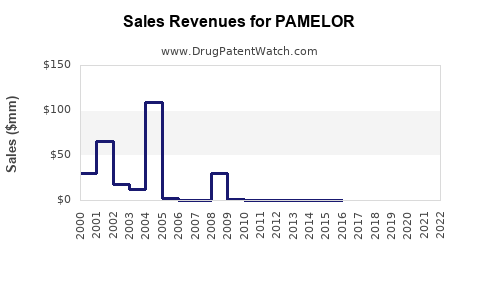
Standalone Pamelor revenue is not publicly disclosed by major pharmaceutical companies. Financial exposure is therefore best assessed through nortriptyline prescription volume, generic reimbursement, product availability, and the continuing decline of the branded segment.
What is Pamelor and how is nortriptyline used?
Pamelor contains nortriptyline hydrochloride, a secondary-amine tricyclic antidepressant. The FDA-approved indication is the relief of symptoms of depression, particularly endogenous depression. Nortriptyline is also prescribed off label for neuropathic pain, migraine prevention, insomnia associated with pain, and selected functional pain syndromes, although those uses are not the basis of Pamelor’s original FDA approval.[1]
What formulations does Pamelor have?
The branded product has historically been marketed as oral capsules in several strengths:
| Dosage form |
Common strengths |
| Pamelor capsules |
10 mg, 25 mg, 50 mg, 75 mg |
| Generic nortriptyline capsules |
Commonly 10 mg, 25 mg, 50 mg, 75 mg |
| Generic nortriptyline tablets |
Available from selected manufacturers |
| Oral liquid |
Availability depends on manufacturer and market |
The generic market supplies most current demand. Pharmacy-level availability can vary by dosage strength, manufacturer and wholesaler inventory.
What are the key clinical constraints?
Nortriptyline carries the safety limitations associated with tricyclic antidepressants. Important risks include overdose-related cardiotoxicity, arrhythmias, anticholinergic effects, orthostatic hypotension, seizure risk and suicidal thinking in younger patients. The FDA label also identifies clinically important interactions involving monoamine oxidase inhibitors and drugs affecting CYP2D6 metabolism.[1]
These risks limit substitution into broad first-line depression treatment. Selective serotonin reuptake inhibitors, serotonin-norepinephrine reuptake inhibitors and newer agents generally dominate initial pharmacologic treatment. Nortriptyline retains use where clinicians value its low cost, prior patient response, sedating properties or utility in pain-related conditions.
When does Pamelor lose exclusivity?
Pamelor lost meaningful U.S. market exclusivity decades ago. Nortriptyline is an old small-molecule active ingredient, and the market has long included multiple abbreviated new drug application products.
| Exclusivity category |
Pamelor status |
| New chemical entity exclusivity |
Expired |
| Orphan-drug exclusivity |
None identified |
| Pediatric exclusivity |
None identified |
| Reference-product exclusivity |
Expired |
| Active U.S. composition-of-matter patent |
No commercially relevant protection identified |
| Generic entry |
Established for decades |
| Biosimilar exclusivity |
Not applicable |
The FDA’s Orange Book framework is relevant because Pamelor is a small-molecule prescription product, not a biologic. Generic nortriptyline products are approved through the ANDA pathway under Section 505(j) of the Federal Food, Drug, and Cosmetic Act.[2]
What are the Pamelor patent expiration dates?
No current Pamelor patent is known to create a material barrier to generic entry. The underlying nortriptyline molecule and basic oral dosage forms have been commercially available for many years. Any original patent rights associated with the molecule, early formulations or basic therapeutic use expired long before the current generic market developed.
The practical patent timeline is:
| Patent issue |
Commercial status |
| Original nortriptyline compound protection |
Expired decades ago |
| Original Pamelor formulation protection |
Expired or no longer commercially material |
| Method-of-use patents |
No active protection identified as a market barrier |
| Manufacturing patents |
No identified patent preventing routine generic production |
| Current Orange Book patent listing |
No material listed patent protection identified |
Pamelor’s remaining commercial position does not depend on patent exclusivity.
What is the FDA and Orange Book status of Pamelor?
Pamelor is an FDA-approved prescription product containing nortriptyline hydrochloride. The FDA-approved reference product and generic nortriptyline products are listed within the FDA’s drug approval and Orange Book systems, although the commercial marketing status of individual branded presentations can change over time.[2,3]
FDA status should be separated from commercial availability. An approved product may have an active regulatory record even when a particular branded package, strength or manufacturer is no longer widely distributed.
How many generic products compete with Pamelor?
Nortriptyline has multiple generic suppliers across capsules and, in some markets, tablets. The exact number of active suppliers changes as manufacturers enter, exit, or discontinue specific strengths. Generic competition is therefore fragmented rather than controlled by a single successor brand.
The commercial consequences are:
- Low barriers to substitution at the pharmacy level.
- Limited pricing power for any individual supplier.
- Periodic vulnerability to shortage or wholesaler disruption if several manufacturers discontinue a strength.
- Higher relative margin potential for suppliers with reliable inventory and efficient manufacturing.
- Little ability to recover branded-style prices through formulation differentiation.
What is the financial trajectory for Pamelor?
Pamelor’s financial trajectory follows the standard lifecycle of an older small-molecule medicine: initial branded revenue, patent-driven erosion, generic substitution, and eventual conversion into a low-price maintenance market.
Historical trajectory
| Period |
Market phase |
Financial effect |
| 1960s to early branded period |
New antidepressant launch and physician adoption |
Brand-led revenue |
| 1980s and later |
Generic competition expands |
Rapid branded share erosion |
| 1990s to 2010s |
Mature generic market |
Low unit prices, fragmented suppliers |
| Current market |
Stable but limited demand |
Volume persists; brand value remains low |
Public companies do not generally report Pamelor sales as a separate revenue line. Nortriptyline is typically grouped into broader generic pharmaceutical portfolios, and Pamelor itself does not have a separately disclosed public revenue stream. Publicly available FDA and company materials therefore support market-structure analysis but not a reliable standalone Pamelor revenue forecast.
What drives current revenue?
Current economic value is concentrated in generic nortriptyline rather than the Pamelor brand. The main variables are:
- Prescription volume in depression and off-label pain management.
- Generic reimbursement rates and pharmacy acquisition cost.
- Number of active suppliers by strength.
- Contracting with wholesalers, health systems and pharmacy benefit managers.
- Manufacturing continuity and regulatory compliance.
- The substitution rate from nortriptyline to newer antidepressants.
Because unit prices are low, revenue growth is unlikely to come from price expansion. A supplier’s performance is more likely to depend on maintaining market share, avoiding stockouts and controlling manufacturing cost.
How does Pamelor compare with competing antidepressants?
Nortriptyline competes in two separate markets: depression treatment and low-cost off-label pain management.
| Product |
Class |
Market position relative to nortriptyline |
| Amitriptyline |
Tricyclic antidepressant |
Strong competitor in neuropathic pain and migraine; generally more sedating |
| Desipramine |
Tricyclic antidepressant |
Less sedating but smaller commercial market |
| Imipramine |
Tricyclic antidepressant |
Older generic with declining depression use |
| Sertraline |
SSRI |
Common first-line depression competitor |
| Escitalopram |
SSRI |
Broad primary-care use and strong generic presence |
| Duloxetine |
SNRI |
Competes in depression, anxiety and neuropathic pain |
| Venlafaxine |
SNRI |
Competes in depression and anxiety |
| Gabapentin and pregabalin |
Neuropathic-pain agents |
Compete with nortriptyline in pain-related prescribing |
Nortriptyline’s competitive advantages are low cost, long clinical experience and established use in selected pain patients. Its disadvantages are overdose toxicity, anticholinergic burden, drug interactions and lower acceptance as a first-line antidepressant.
What generic entry risks exist for Pamelor?
Generic launch risk is already realized rather than prospective. Multiple generic versions have entered the market, eliminating the principal economic value of Pamelor exclusivity.
What would a new generic launch do to Pamelor?
A new entrant could reduce prices or displace incumbent generic suppliers, but it would have limited effect on the branded product because generic substitution is already established. The more important risks are:
- Further price compression in high-volume strengths.
- Loss of formulary or wholesaler share.
- Reduced supply reliability if manufacturers exit low-margin presentations.
- Greater dependence on contract manufacturing.
- Product-specific recalls or manufacturing observations.
A generic company may still find the product commercially viable if it has efficient production, a reliable API source and a distribution agreement. The opportunity is operational rather than patent-driven.
Is there biosimilar risk for Pamelor?
No. Biosimilar risk does not apply to Pamelor because nortriptyline is a chemically synthesized small molecule. Competitive products are conventional generics approved through ANDAs, not biosimilars approved under the Public Health Service Act.
The relevant regulatory risks are bioequivalence, manufacturing compliance, labeling, stability and supply continuity. There is no biologic interchangeability issue.
What patent litigation and Paragraph IV challenges affect Pamelor?
No material current Paragraph IV dispute is associated with Pamelor’s commercial position. Paragraph IV litigation generally matters when a generic applicant challenges an unexpired Orange Book patent. Pamelor’s underlying patent protection is long expired, and generic nortriptyline has been available for decades.
| Legal issue |
Pamelor assessment |
| Current Paragraph IV threat to the brand |
Low |
| Brand patent litigation risk |
Low |
| Generic patent litigation risk |
Low |
| Settlement agreement affecting launch |
No material settlement identified |
| Formulation patent risk |
Low |
| Method-of-use patent risk |
Low |
| Manufacturing patent risk |
Low |
The main legal exposure for suppliers is ordinary pharmaceutical enforcement involving manufacturing quality, labeling, promotion, supply contracts or product liability, rather than exclusivity litigation.
What licensing deals affect Pamelor?
No material current licensing transaction is publicly associated with Pamelor as a growth asset. The product is an established generic-era medicine rather than a strategic branded platform.
Licensing economics are more likely to involve:
- Generic distribution rights.
- Contract manufacturing.
- API supply agreements.
- Private-label pharmacy arrangements.
- Portfolio acquisitions involving multiple mature products.
A Pamelor-specific licensing deal would have limited strategic value unless bundled with other mature generic products or supported by a differentiated dosage form.
What geographic markets offer the strongest opportunity?
The United States remains a large pharmaceutical market but is highly price competitive for nortriptyline. The strongest commercial opportunity is usually in markets where:
- Generic substitution is established.
- Public reimbursement covers chronic prescriptions.
- Local manufacturing or distribution reduces supply risk.
- Nortriptyline remains accepted for neuropathic pain or depression.
- Competitors have reduced product availability.
Geographic expansion is constrained by local registration, pharmacovigilance, controlled distribution requirements where applicable, pricing regulation and the low value-to-volume ratio of the product. International opportunity is therefore more suitable for a broad generic portfolio than for a standalone Pamelor strategy.
How strong is the Pamelor patent estate?
The patent estate is commercially weak because it is effectively exhausted. Pamelor has:
- No meaningful remaining exclusivity.
- No defensible premium based on the molecule itself.
- No identified active Orange Book patent blocking generic entry.
- No biologic or biosimilar barrier.
- No apparent manufacturing patent that prevents routine production.
- Limited opportunity to create durable differentiation through the legacy capsule formulation.
Any defensible commercial position would need to come from execution, supply reliability, a novel delivery system, a combination product or a regulatory strategy unrelated to the original Pamelor brand. Those opportunities would require separate development and would not inherit the economic protection of the legacy product.
Key Takeaways
- Pamelor is the legacy brand for nortriptyline hydrochloride.
- Its U.S. exclusivity expired decades ago.
- Generic nortriptyline supplies most current market demand.
- No material active patent, Paragraph IV or biosimilar risk is associated with the product.
- Standalone Pamelor revenue is not publicly disclosed.
- Financial value is concentrated in low-price generic volume and supply reliability.
- Depression use faces competition from SSRIs and SNRIs.
- Off-label neuropathic pain use provides a continuing niche.
- The main commercial risks are price compression, supplier exit, stockouts and manufacturing disruption.
- Any new investment case would need to rely on operational efficiency or product differentiation rather than legacy patent rights.
FAQs About Pamelor Market Dynamics
Is Pamelor still sold as a branded drug?
Pamelor has an FDA regulatory history as a branded nortriptyline product, but current pharmacy availability depends on the manufacturer, package and dosage strength. Generic nortriptyline is the dominant commercial source.
Is nortriptyline a profitable generic drug?
Nortriptyline can generate recurring generic revenue, but low unit prices and multiple suppliers limit margins. Profitability depends on manufacturing cost, supply continuity and contracting.
Can a company launch a generic Pamelor without patent litigation?
Generic entry is already established. A new supplier would generally face regulatory and commercial execution requirements rather than a significant Pamelor patent barrier.
Does Pamelor have extended-release protection?
The legacy Pamelor product is associated primarily with immediate-release oral formulations. No commercially material active extended-release patent estate has been identified as protecting the brand.
What would increase the value of nortriptyline?
Value could increase through reliable supply, shortage-driven pricing, a differentiated delivery system, improved tolerability, or a new approved indication. None of those factors is inherent in the legacy Pamelor brand.
References
-
U.S. Food and Drug Administration. (2015). Pamelor (nortriptyline hydrochloride) capsules, prescribing information. FDA/DailyMed labeling.
-
U.S. Food and Drug Administration. (2024). Approved drug products with therapeutic equivalence evaluations: Orange Book. https://www.accessdata.fda.gov/scripts/cder/ob/
-
U.S. Food and Drug Administration. (2024). Drugs@FDA: FDA-approved drugs. https://www.accessdata.fda.gov/scripts/cder/daf/