OTREXUP Drug Patent Profile
✉ Email this page to a colleague
Which patents cover Otrexup, and when can generic versions of Otrexup launch?
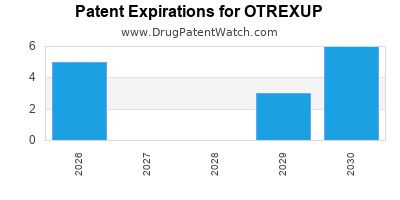
Otrexup is a drug marketed by Cosette and is included in one NDA. There are fifteen patents protecting this drug.
The generic ingredient in OTREXUP is methotrexate. There is one drug master file entry for this compound. Three suppliers are listed for this compound. Additional details are available on the methotrexate profile page.
DrugPatentWatch® Generic Entry Outlook for Otrexup
By analyzing the patents and regulatory protections it appears that the earliest date
for generic entry will be March 19, 2030. This may change due to patent challenges or generic licensing.
There have been three patent litigation cases involving the patents protecting this drug, indicating strong interest in generic launch. Recent data indicate that 63% of patent challenges are decided in favor of the generic patent challenger and that 54% of successful patent challengers promptly launch generic drugs.
Indicators of Generic Entry
AI Deep Research
Questions you can ask:
- What is the 5 year forecast for OTREXUP?
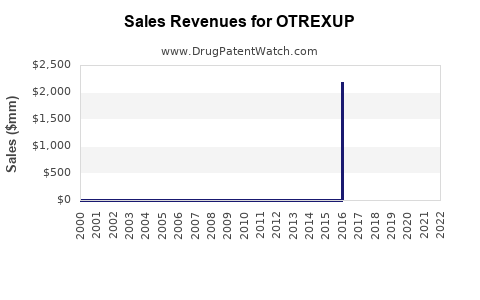
- What are the global sales for OTREXUP?
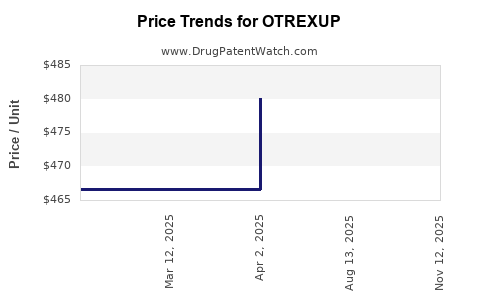
- What is Average Wholesale Price for OTREXUP?
Summary for OTREXUP
| US Patents: | 15 |
| Applicants: | 1 |
| NDAs: | 1 |
| Finished Product Suppliers / Packagers: | 1 |
| Raw Ingredient (Bulk) Api Vendors: | 100 |
| Clinical Trials: | 7 |
| Patent Applications: | 5,022 |
| Drug Prices: | Drug price information for OTREXUP |
| Patent Litigation and PTAB cases: | See patent lawsuits and PTAB cases for OTREXUP |
| What excipients (inactive ingredients) are in OTREXUP? | OTREXUP excipients list |
| DailyMed Link: | OTREXUP at DailyMed |
DrugPatentWatch® Estimated Loss of Exclusivity (LOE) Date for OTREXUP
Generic Entry Date for OTREXUP*:
Constraining patent/regulatory exclusivity:
NDA:
Dosage:
SOLUTION;SUBCUTANEOUS |
*The generic entry opportunity date is the latter of the last compound-claiming patent and the last regulatory exclusivity protection. Many factors can influence early or later generic entry. This date is provided as a rough estimate of generic entry potential and should not be used as an independent source.
Recent Clinical Trials for OTREXUP
Identify potential brand extensions & 505(b)(2) entrants
| Sponsor | Phase |
|---|---|
| Virginia Commonwealth University | Phase 1 |
| Pfizer | Phase 1 |
| Vanderbilt University | Phase 1 |
Pharmacology for OTREXUP
| Drug Class | Folate Analog Metabolic Inhibitor |
| Mechanism of Action | Folic Acid Metabolism Inhibitors |
US Patents and Regulatory Information for OTREXUP
OTREXUP is protected by fifteen US patents.
Based on analysis by DrugPatentWatch, the earliest date for a generic version of OTREXUP is ⤷ Start Trial.
This potential generic entry date is based on patent 11,497,753.
Generics may enter earlier, or later, based on new patent filings, patent extensions, patent invalidation, early generic licensing, generic entry preferences, and other factors.
| Applicant | Tradename | Generic Name | Dosage | NDA | Approval Date | TE | Type | RLD | RS | Patent No. | Patent Expiration | Product | Substance | Delist Req. | Exclusivity Expiration |
|---|---|---|---|---|---|---|---|---|---|---|---|---|---|---|---|
| Cosette | OTREXUP | methotrexate | SOLUTION;SUBCUTANEOUS | 204824-007 | Mar 24, 2016 | DISCN | Yes | No | 9,629,959 | ⤷ Start Trial | Y | ⤷ Start Trial | |||
| Cosette | OTREXUP | methotrexate | SOLUTION;SUBCUTANEOUS | 204824-008 | Mar 24, 2016 | DISCN | Yes | No | 12,357,642 | ⤷ Start Trial | Y | ⤷ Start Trial | |||
| Cosette | OTREXUP | methotrexate | SOLUTION;SUBCUTANEOUS | 204824-006 | Mar 24, 2016 | DISCN | Yes | No | 8,562,564 | ⤷ Start Trial | Y | ⤷ Start Trial | |||
| Cosette | OTREXUP | methotrexate | SOLUTION;SUBCUTANEOUS | 204824-006 | Mar 24, 2016 | DISCN | Yes | No | 8,579,865 | ⤷ Start Trial | Y | ⤷ Start Trial | |||
| Cosette | OTREXUP | methotrexate | SOLUTION;SUBCUTANEOUS | 204824-003 | Oct 11, 2013 | DISCN | Yes | No | 11,497,753 | ⤷ Start Trial | Y | ⤷ Start Trial | |||
| Cosette | OTREXUP | methotrexate | SOLUTION;SUBCUTANEOUS | 204824-004 | Oct 11, 2013 | DISCN | Yes | No | 11,497,753 | ⤷ Start Trial | Y | ⤷ Start Trial | |||
| >Applicant | >Tradename | >Generic Name | >Dosage | >NDA | >Approval Date | >TE | >Type | >RLD | >RS | >Patent No. | >Patent Expiration | >Product | >Substance | >Delist Req. | >Exclusivity Expiration |
Expired US Patents for OTREXUP
| Applicant | Tradename | Generic Name | Dosage | NDA | Approval Date | Patent No. | Patent Expiration |
|---|---|---|---|---|---|---|---|
| Cosette | OTREXUP | methotrexate | SOLUTION;SUBCUTANEOUS | 204824-001 | Oct 11, 2013 | RE44846 | ⤷ Start Trial |
| Cosette | OTREXUP | methotrexate | SOLUTION;SUBCUTANEOUS | 204824-001 | Oct 11, 2013 | 9,629,959 | ⤷ Start Trial |
| Cosette | OTREXUP | methotrexate | SOLUTION;SUBCUTANEOUS | 204824-002 | Oct 11, 2013 | RE44846 | ⤷ Start Trial |
| Cosette | OTREXUP | methotrexate | SOLUTION;SUBCUTANEOUS | 204824-001 | Oct 11, 2013 | 9,533,102 | ⤷ Start Trial |
| Cosette | OTREXUP | methotrexate | SOLUTION;SUBCUTANEOUS | 204824-001 | Oct 11, 2013 | 8,562,564 | ⤷ Start Trial |
| Cosette | OTREXUP | methotrexate | SOLUTION;SUBCUTANEOUS | 204824-007 | Mar 24, 2016 | 9,533,102 | ⤷ Start Trial |
| >Applicant | >Tradename | >Generic Name | >Dosage | >NDA | >Approval Date | >Patent No. | >Patent Expiration |
EU/EMA Drug Approvals for OTREXUP
| Company | Drugname | Inn | Product Number / Indication | Status | Generic | Biosimilar | Orphan | Marketing Authorisation | Marketing Refusal |
|---|---|---|---|---|---|---|---|---|---|
| Nordic Group B.V. | Nordimet | methotrexate | EMEA/H/C/003983Nordimet is indicated for the treatment of:active rheumatoid arthritis in adult patients,polyarthritic forms of severe, active juvenile idiopathic arthritis (JIA), when the response to nonsteroidal anti-inflammatory drugs (NSAIDs) has been inadequate,moderate to severe plaque psoriasis in adults who are candidates for systemic therapy, and severe psoriatic arthritis in adult patients, induction of remission in moderate steroid-dependent Crohn's disease in adult patients, in combination with corticosteroids and for maintenance of remission, as monotherapy, in patients who have responded to methotrexate. | Authorised | no | no | no | 2016-08-18 | |
| Therakind (Europe) Limited | Jylamvo | methotrexate | EMEA/H/C/003756In rheumatological and dermatological diseasesActive rheumatoid arthritis in adult patients.Polyarthritic forms of active, severe juvenile idiopathic arthritis (JIA) in adolescents and children aged 3 years and over when the response to non-steroidal anti-inflammatory drugs (NSAIDs) has been inadequate.Severe, treatment-refractory, disabling psoriasis which does not respond sufficiently to other forms of treatment such as phototherapy, psoralen and ultraviolet A radiation (PUVA) therapy and retinoids, and severe psoriatic arthritis in adult patients.In oncologyMaintenance treatment of acute lymphoblastic leukaemia (ALL) in adults, adolescents and children aged 3 years and over. | Authorised | no | no | no | 2017-03-29 | |
| >Company | >Drugname | >Inn | >Product Number / Indication | >Status | >Generic | >Biosimilar | >Orphan | >Marketing Authorisation | >Marketing Refusal |
International Patents for OTREXUP
When does loss-of-exclusivity occur for OTREXUP?
Based on analysis by DrugPatentWatch, the following patents block generic entry in the countries listed below:
Australia
Patent: 10226442
Patent: Hazardous agent injection system
Estimated Expiration: ⤷ Start Trial
Canada
Patent: 55779
Patent: SYSTEME D'INJECTION D'AGENTS DANGEREUX (HAZARDOUS AGENT INJECTION SYSTEM)
Estimated Expiration: ⤷ Start Trial
China
Patent: 2612381
Patent: Hazardous agent injection system
Estimated Expiration: ⤷ Start Trial
European Patent Office
Patent: 08493
Patent: SYSTÈME D'INJECTION D'AGENTS DANGEREUX (HAZARDOUS AGENT INJECTION SYSTEM)
Estimated Expiration: ⤷ Start Trial
Patent: 27737
Patent: SYSTÈME D'INJECTION DE SUBSTANCES DANGEREUSES (HAZARDOUS AGENT INJECTION SYSTEM)
Estimated Expiration: ⤷ Start Trial
Japan
Patent: 32039
Estimated Expiration: ⤷ Start Trial
Patent: 68976
Estimated Expiration: ⤷ Start Trial
Patent: 12521224
Patent: 危険有害性薬剤の注入システム
Estimated Expiration: ⤷ Start Trial
Patent: 15042270
Patent: 危険有害性薬剤の注入システム (HAZARDOUS AGENT INJECTION SYSTEM)
Estimated Expiration: ⤷ Start Trial
Patent: 16104214
Patent: 危険有害性薬剤の注入システム (INJECTION SYSTEM OF DANGEROUS AND ADVERSE AGENT)
Estimated Expiration: ⤷ Start Trial
South Korea
Patent: 1597672
Estimated Expiration: ⤷ Start Trial
Patent: 120028294
Patent: 위험 약제 주사 장치 (HAZARDOUS AGENT INJECTION SYSTEM)
Estimated Expiration: ⤷ Start Trial
Spain
Patent: 88196
Estimated Expiration: ⤷ Start Trial
Generics may enter earlier, or later, based on new patent filings, patent extensions, patent invalidation, early generic licensing, generic entry preferences, and other factors.
See the table below for additional patents covering OTREXUP around the world.
| Country | Patent Number | Title | Estimated Expiration |
|---|---|---|---|
| Canada | 2718053 | DISPOSITIF DE SECURITE POUR INJECTEUR (INJECTOR SAFETY DEVICE) | ⤷ Start Trial |
| European Patent Office | 2268342 | DISPOSITIF DE SÉCURITÉ POUR INJECTEUR (INJECTOR SAFETY DEVICE) | ⤷ Start Trial |
| European Patent Office | 2990067 | DISPOSITIF DE SÉCURITÉ D'INJECTEUR (INJECTOR SAFETY DEVICE) | ⤷ Start Trial |
| European Patent Office | 3636301 | DISPOSITIF DE SÉCURITÉ D'INJECTEUR (INJECTOR SAFETY DEVICE) | ⤷ Start Trial |
| Spain | 2548447 | ⤷ Start Trial | |
| Spain | 2752152 | ⤷ Start Trial | |
| >Country | >Patent Number | >Title | >Estimated Expiration |
OTREXUP market dynamics and financial trajectory (Q2 2026 status)
More… ↓
Make Better Decisions: Try a trial or see plans & pricing
Drugs may be covered by multiple patents or regulatory protections. All trademarks and applicant names are the property of their respective owners or licensors. Although great care is taken in the proper and correct provision of this service, thinkBiotech LLC does not accept any responsibility for possible consequences of errors or omissions in the provided data. The data presented herein is for information purposes only. There is no warranty that the data contained herein is error free. We do not provide individual investment advice. This service is not registered with any financial regulatory agency. The information we publish is educational only and based on our opinions plus our models. By using DrugPatentWatch you acknowledge that we do not provide personalized recommendations or advice. thinkBiotech performs no independent verification of facts as provided by public sources nor are attempts made to provide legal or investing advice. Any reliance on data provided herein is done solely at the discretion of the user. Users of this service are advised to seek professional advice and independent confirmation before considering acting on any of the provided information. thinkBiotech LLC reserves the right to amend, extend or withdraw any part or all of the offered service without notice.
ISSN: 2162-2639

Privacy and Cookies
Terms & Conditions
Site Map
DrugPatentWatch Alternatives
LOE / Major Patent Expirations 2026 - 2027
NCE-1 Patent Challenge Dates 2026 - 2027
Friedman, Yali. "DrugPatentWatch" DrugPatentWatch, thinkBiotech, 2026, www.DrugPatentWatch.com.
See Primary Research Papers Citing DrugPatentWatch