Last Updated: August 8, 2026

NEUPRO Drug Patent Profile


✉ Email this page to a colleague

« Back to Dashboard


Which patents cover Neupro, and what generic alternatives are available?

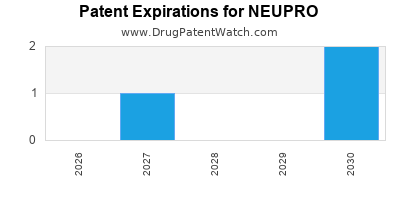
Neupro is a drug marketed by Ucb Inc and is included in one NDA. There are four patents protecting this drug and one Paragraph IV challenge.

This drug has seventy-two patent family members in thirty countries.

The generic ingredient in NEUPRO is rotigotine. There are seven drug master file entries for this compound. One supplier is listed for this compound. Additional details are available on the rotigotine profile page.

DrugPatentWatch® Generic Entry Outlook for Neupro

Neupro was eligible for patent challenges on May 9, 2011.

By analyzing the patents and regulatory protections it appears that the earliest date for generic entry will be March 1, 2032. This may change due to patent challenges or generic licensing.

There have been thirteen patent litigation cases involving the patents protecting this drug, indicating strong interest in generic launch. Recent data indicate that 63% of patent challenges are decided in favor of the generic patent challenger and that 54% of successful patent challengers promptly launch generic drugs.

Indicators of Generic Entry

< Available with Subscription >

  Start Trial

AI Deep Research
Questions you can ask:
  • What is the 5 year forecast for NEUPRO?
  • What are the global sales for NEUPRO?
  • What is Average Wholesale Price for NEUPRO?
DrugPatentWatch® Estimated Loss of Exclusivity (LOE) Date for NEUPRO
Generic Entry Date for NEUPRO*:
Constraining patent/regulatory exclusivity:
NDA:
Dosage:

FILM, EXTENDED RELEASE;TRANSDERMAL

*The generic entry opportunity date is the latter of the last compound-claiming patent and the last regulatory exclusivity protection. Many factors can influence early or later generic entry. This date is provided as a rough estimate of generic entry potential and should not be used as an independent source.

Recent Clinical Trials for NEUPRO

Identify potential brand extensions & 505(b)(2) entrants

SponsorPhase
Eva PharmaNA
MARC-CRONA
Virginia Commonwealth UniversityPhase 2

See all NEUPRO clinical trials

Pharmacology for NEUPRO
Drug ClassNonergot Dopamine Agonist
Mechanism of ActionDopamine Agonists
Paragraph IV (Patent) Challenges for NEUPRO
Tradename Dosage Ingredient Strength NDA ANDAs Submitted Submissiondate
NEUPRO Extended-release Transdermal Film rotigotine 1 mg/24 hr 2 mg/24 hr 3 mg/24 hr 4 mg/24 hr 6 mg/24 hr 8 mg/24 hr 021829 1 2013-11-26

US Patents and Regulatory Information for NEUPRO

NEUPRO is protected by five US patents.

Based on analysis by DrugPatentWatch, the earliest date for a generic version of NEUPRO is ⤷  Start Trial.

This potential generic entry date is based on patent ⤷  Start Trial.

Generics may enter earlier, or later, based on new patent filings, patent extensions, patent invalidation, early generic licensing, generic entry preferences, and other factors.

Applicant Tradename Generic Name Dosage NDA Approval Date TE Type RLD RS Patent No. Patent Expiration Product Substance Delist Req. Exclusivity Expiration
Ucb Inc NEUPRO rotigotine FILM, EXTENDED RELEASE;TRANSDERMAL 021829-006 Apr 2, 2012 RX Yes No ⤷  Start Trial ⤷  Start Trial Y ⤷  Start Trial
Ucb Inc NEUPRO rotigotine FILM, EXTENDED RELEASE;TRANSDERMAL 021829-004 Apr 2, 2012 RX Yes No ⤷  Start Trial ⤷  Start Trial Y ⤷  Start Trial
Ucb Inc NEUPRO rotigotine FILM, EXTENDED RELEASE;TRANSDERMAL 021829-002 May 9, 2007 RX Yes No ⤷  Start Trial ⤷  Start Trial Y ⤷  Start Trial
Ucb Inc NEUPRO rotigotine FILM, EXTENDED RELEASE;TRANSDERMAL 021829-003 May 9, 2007 RX Yes No ⤷  Start Trial ⤷  Start Trial Y ⤷  Start Trial
Ucb Inc NEUPRO rotigotine FILM, EXTENDED RELEASE;TRANSDERMAL 021829-004 Apr 2, 2012 RX Yes No ⤷  Start Trial ⤷  Start Trial Y ⤷  Start Trial
>Applicant >Tradename >Generic Name >Dosage >NDA >Approval Date >TE >Type >RLD >RS >Patent No. >Patent Expiration >Product >Substance >Delist Req. >Exclusivity Expiration

Expired US Patents for NEUPRO

Applicant Tradename Generic Name Dosage NDA Approval Date Patent No. Patent Expiration
Ucb Inc NEUPRO rotigotine FILM, EXTENDED RELEASE;TRANSDERMAL 021829-005 Apr 2, 2012 ⤷  Start Trial ⤷  Start Trial
Ucb Inc NEUPRO rotigotine FILM, EXTENDED RELEASE;TRANSDERMAL 021829-006 Apr 2, 2012 ⤷  Start Trial ⤷  Start Trial
Ucb Inc NEUPRO rotigotine FILM, EXTENDED RELEASE;TRANSDERMAL 021829-005 Apr 2, 2012 ⤷  Start Trial ⤷  Start Trial
Ucb Inc NEUPRO rotigotine FILM, EXTENDED RELEASE;TRANSDERMAL 021829-001 May 9, 2007 ⤷  Start Trial ⤷  Start Trial
Ucb Inc NEUPRO rotigotine FILM, EXTENDED RELEASE;TRANSDERMAL 021829-004 Apr 2, 2012 ⤷  Start Trial ⤷  Start Trial
Ucb Inc NEUPRO rotigotine FILM, EXTENDED RELEASE;TRANSDERMAL 021829-006 Apr 2, 2012 ⤷  Start Trial ⤷  Start Trial
>Applicant >Tradename >Generic Name >Dosage >NDA >Approval Date >Patent No. >Patent Expiration

EU/EMA Drug Approvals for NEUPRO

Company Drugname Inn Product Number / Indication Status Generic Biosimilar Orphan Marketing Authorisation Marketing Refusal
UCB Pharma S.A.   Leganto rotigotine EMEA/H/C/002380Leganto is indicated for the symptomatic treatment of moderate to severe idiopathic restless-legs syndrome in adults.Leganto is indicated for the treatment of the signs and symptoms of early-stage idiopathic Parkinson’s disease as monotherapy (i.e. without levodopa) or in combination with levodopa, i.e. over the course of the disease, through to late stages when the effect of levodopa wears off or becomes inconsistent and fluctuations of the therapeutic effect occur (end of dose or ‘on-off’ fluctuations). Withdrawn no no no 2011-06-16
UCB Pharma S.A. Neupro rotigotine EMEA/H/C/000626Parkinson's disease: Neupro is indicated for the treatment of the signs and symptoms of early-stage idiopathic Parkinson's disease as monotherapy (i.e. without levodopa) or in combination with levodopa, i.e. over the course of the disease, through to late stages when the effect of levodopa wears off or becomes inconsistent and fluctuations of the therapeutic effect occur (end of dose or 'on-off' fluctuations).Restless-legs syndrome: Neupro is indicated for the symptomatic treatment of moderate to severe idiopathic restless-legs syndrome in adults. Authorised no no no 2006-02-15
>Company >Drugname >Inn >Product Number / Indication >Status >Generic >Biosimilar >Orphan >Marketing Authorisation >Marketing Refusal

Supplementary Protection Certificates for NEUPRO

Patent Number Supplementary Protection Certificate SPC Country SPC Expiration SPC Description
1033978 CA 2006 00020 Denmark ⤷  Start Trial PRODUCT NAME: ROTIGOTINE
1033978 91269 Luxembourg ⤷  Start Trial 91269, EXPIRES: 20210215
1033978 SPC026/2006 Ireland ⤷  Start Trial SPC026/2006:, EXPIRES: 20210214
1033978 06C0025 France ⤷  Start Trial PRODUCT NAME: ROTIGOTINE; REGISTRATION NO/DATE: EU/1/05/331/001 20060215
1033978 SPC/GB06/023 United Kingdom ⤷  Start Trial SPC/GB06/023: 20070702, EXPIRES: 20210214
1033978 C01033978/01 Switzerland ⤷  Start Trial TEILUEBERTRAGUNG
>Patent Number >Supplementary Protection Certificate >SPC Country >SPC Expiration >SPC Description

NEUPRO (rotigotine) market dynamics and financial trajectory: sales history, payer pull-through, exclusivity and generic risk, and what drives revenue through patent cliffs

Last updated: July 29, 2026

NEUPRO (rotigotine transdermal system, UCB) tracks as a specialty-parkinson’s and restless legs franchise with revenue sensitivity to (1) category demand and competitive switching across dopamine agonists, (2) payer formulary access and step edits, and (3) the pace of generic/biosimilar-like competitive pressure via transdermal rotigotine equivalents and label/coverage breadth. The brand’s financial trajectory through exclusivity windows is shaped by how quickly payers substitute to lower-cost rotigotine products and by UCB’s ability to defend formulary positioning for higher-dose strengths and dose-optimization.

How fast has NEUPRO grown, and what do the key market drivers say about its financial trajectory?

Answer: NEUPRO is sustained more by formulary inclusion and coverage for Parkinson’s disease (PD) and restless legs syndrome (RLS) than by unit growth. Revenue tends to follow dose mix (more units at higher effective doses), shift in patient mix, and payer restriction dynamics rather than broad market expansion.

What demand drivers move NEUPRO sales in Parkinson’s disease?

  • Prevalence and diagnosis intensity in PD drive the addressable pool for dopamine agonist use.
  • Treatment sequencing affects dopamine agonist utilization. NEUPRO’s share improves when payers and clinicians accept rotigotine earlier or when levodopa optimization is paired with a transdermal adjunct.
  • Adherence and convenience matter in real-world settings. The transdermal route typically improves adherence versus multi-dose oral regimens in some patient cohorts, supporting persistence and lower discontinuation.

What demand drivers move NEUPRO sales in restless legs syndrome?

  • Seasonality and symptom reporting can cause short-term variability. Long-term trends track primary care and sleep-medicine management patterns.
  • Formulary placement for RLS determines whether rotigotine remains a first-line or is relegated to later-line use after iron repletion and other agents.

How payer coverage changes translate into revenue outcomes

Revenue inflects when:

  • A “preferred” list position is lost through PBM renegotiation cycles.
  • Step edits require failure of oral dopamine agonists before rotigotine is covered.
  • Prior authorization is tightened for specific strengths, which shifts mix to lower covered doses.

What patents protect NEUPRO, and when does it lose exclusivity?

Answer: NEUPRO’s market exclusivity risk is driven by the layered patent stack: active pharmaceutical ingredient (API), composition/formulation, and method-of-use coverage tied to PD and RLS dosing regimens. Revenue pressure increases as each layer clears and as transdermal rotigotine generics enter for more strengths.

What exclusivity buckets apply to NEUPRO?

  • Regulatory exclusivity (data and marketing exclusivity) for the original NDA.
  • Patent exclusivity from composition and method-of-use claims (Orange Book listings).
  • Settlement-driven entry timing if Paragraph IV or other challenges are resolved through licensing or covenants.

When does the risk window typically open for NEUPRO?

Financial impact generally accelerates around:

  • Expiration of the last listed Orange Book patent covering the commercial product.
  • Earlier “strength-by-strength” erosion if generics launch first on selected dose strengths or packaging configurations.

Which generic entry risks exist for NEUPRO?

Answer: Generic entry risk for NEUPRO is concentrated in transdermal rotigotine systems because substitutes are therapeutically close and switching can be rapid once PBM pricing pressures intensify.

What generic pathways create the largest competitive threat?

  • ANDA filers with Paragraph IV certifications to Orange Book patents represent the highest-likelihood event for earlier entry if litigation is resolved favorably to challengers.
  • Non-Paragraph IV ANDA entries still pressure revenue through lower-cost replacement once exclusivity barriers clear.

What would a generic launch do to NEUPRO revenue?

Typical outcomes:

  • Fast share loss in covered strengths where payers add lower-cost entries to formularies.
  • Slower erosion when payers limit coverage to specific strengths, require prior authorization, or maintain a clinical preference for transdermal rotigotine due to adherence.

What is the Orange Book status of NEUPRO, and how many patents cover the product?

Answer: NEUPRO’s Orange Book status is determined by the number and category of listed patents by NDA (including PD and RLS-relevant claims) and by strength/dosage form specificity. Patent coverage breadth influences whether generics can enter all strengths at launch or only select SKUs.

How to interpret patent listings for revenue risk

  • API and composition claims create broad entry barriers across strengths.
  • Method-of-use claims can still block certain label positions even if formulation barriers fall.
  • Manufacturing process claims can restrict generic process design and raise litigation leverage for the brand.

What formulations are protected by NEUPRO patents, and what does that mean for transdermal competition?

Answer: Transdermal system patents focus on membrane design, drug loading, release kinetics, adhesive layers, and manufacturing controls that affect delivery rate consistency and tolerability.

Why transdermal formulation patents matter commercially

  • If release-rate or adhesive architecture differences require bioequivalence but fail patent constraints, generics face delayed launch.
  • Strength-level differentiation impacts whether payers accept interchangeability across dose ranges immediately.

What method-of-use patents protect NEUPRO, and do they affect generic timing?

Answer: Method-of-use protection for PD and RLS can delay generic entry tied to label scope. If challengers must omit or carve-out certain indications, launch can be partial and revenue impact smaller.

Indication and label alignment

  • A method-of-use patent that covers a dosing paradigm can force brand-like labeling differences.
  • Label carve-outs can reduce formulary adoption speed because prescribers follow payer and guideline alignment.

What patent litigation affects NEUPRO, and how do settlements shape market outcomes?

Answer: For brands with Orange Book-listed patent estates, the practical revenue impact often comes from settlement terms: licensing scope, at-risk dates, and entry carve-outs by strength or indication.

What settlement terms typically control revenue

  • “At-risk” dates for each strength.
  • Labelling restrictions or marketing timing by indication.
  • Geographic scope for rights.

How to connect litigation to quarterly sales

Sales declines often lag settlement execution by:

  • Formulary conversion cycles (PBM and plan rewrites).
  • Inventory and distribution transitions.
  • Prescriber switching dynamics tied to tolerability experience.

How does NEUPRO compare with ropinirole and pramipexole in market access and pricing pressure?

Answer: NEUPRO competes against oral dopamine agonists (ropinirole, pramipexole) and other PD platforms. Market access tends to hinge on payer tolerance for adherence-related benefits and prior authorization burden.

Where NEUPRO can win

  • When payers accept transdermal dopamine agonists as equivalent or preferred for adherence, especially for patients with adherence challenges.

Where NEUPRO can lose

  • When oral agents are priced lower and included as preferred first-line dopamine agonists with easier PA criteria.

What competitive landscape dynamics are most relevant to NEUPRO’s financial trajectory?

Answer: NEUPRO’s competitive risk concentrates around:

  1. rotigotine transdermal competitors (including generics),
  2. oral dopamine agonists under tighter PBM cost controls,
  3. broader PD and RLS treatment standard shifts that reduce dopamine agonist share over time.

How PD treatment standard shifts influence dopamine agonist demand

  • If guidelines or payers move toward levodopa-centered pathways or alternative classes sooner, dopamine agonists face volume headwinds.
  • If non-motor symptom management and adherence remain clinical priorities, transdermal platforms can hold share.

How PBM contract structures drive brand persistence

  • Long-term contracts that keep a brand on preferred tiers can stabilize revenue even as generic threats rise.
  • Contract renegotiations can sharply shift mix within a few quarters.

What revenue exposure exists by geography, and where are the biggest earnings risks?

Answer: The largest earnings risk is typically in the U.S. where Orange Book challenges and generic entry timing determine replacement speed. Secondary risk comes from ex-U.S. markets where regulatory exclusivity and patent enforcement schedules can diverge.

How to map geography to financial sensitivity

  • U.S.: most direct link to patent expiration and ANDA entry timing.
  • EU/UK: reliance on local SPC and national patent litigation outcomes can delay substitution, but once access opens, pricing compression can follow quickly.

What financial trajectory markers should investors and licensors track for NEUPRO?

Answer: Track NEUPRO revenue by strength mix, persistence, and net pricing versus WAC discounting. The key signals are formulary changes, PBM contract renegotiations, and the timing of generic competitive introductions for each strength.

Monthly/quarterly leading indicators

  • Net price and rebate pressure shifts (indirect measure of payer pull).
  • Shipment trends by dose strength (mix shift).
  • Persistency metrics after payer transitions (proxy for brand loyalty and tolerability).

Key takeaways

  • NEUPRO’s financial trajectory is driven by payer access and dose-strength mix more than by raw PD/RLS prevalence alone.
  • Generic and competitively priced transdermal rotigotine systems create the highest revenue downside risk once the layered Orange Book patent estate clears or is neutralized via litigation/settlement.
  • Litigation and settlement scope determines whether entry is delayed, partial (by strength or label), or broad, which directly changes the speed of share loss.
  • Competitive substitution pressure accelerates after formulary adoption cycles, so the sales impact typically lags exclusivity/patent events.

FAQs

1) What drives NEUPRO net sales more: unit demand or net pricing?
Net pricing and rebates driven by formulary placement are typically the dominant lever once coverage becomes competitive; unit demand matters more when access remains stable.

2) How does NEUPRO strength mix affect revenue during competitive pressure?
Revenue can decline less sharply if protected strengths or preferred dosing ranges remain on formulary while lower-covered doses face faster substitution.

3) Does generic entry for one NEUPRO dosage strength automatically trigger share loss in all strengths?
No. Plan-by-plan coverage and PA criteria can produce strength-specific erosion, slowing overall revenue declines until broad formulary inclusion occurs.

4) What would a Paragraph IV settlement likely change for NEUPRO’s business?
It can set entry dates, carve out label or strengths, and establish licensing terms that directly shape at-risk launch timing and market penetration.

5) In what scenarios can NEUPRO defend share against oral dopamine agonists?
When payers and clinicians prioritize adherence and tolerability benefits and allow rotigotine transdermal systems as preferred or equivalent options with manageable PA requirements.

References

  1. FDA. Orange Book: Approved Drug Products with Therapeutic Equivalence Evaluations (NEUPRO/rotigotine transdermal system listings). U.S. Food and Drug Administration.
  2. FDA. Drug Approval Package: NEUPRO (rotigotine). U.S. Food and Drug Administration.
  3. UCB. NEUPRO (rotigotine transdermal system) prescribing information and label history.
  4. FDA. Approved Drug Products and Therapeutic Equivalence Evaluations: Application and patent detail pages for NEUPRO/NDA. U.S. Food and Drug Administration.

More… ↓

⤷  Start Trial

Make Better Decisions: Try a trial or see plans & pricing

Drugs may be covered by multiple patents or regulatory protections. All trademarks and applicant names are the property of their respective owners or licensors. Although great care is taken in the proper and correct provision of this service, thinkBiotech LLC does not accept any responsibility for possible consequences of errors or omissions in the provided data. The data presented herein is for information purposes only. There is no warranty that the data contained herein is error free. We do not provide individual investment advice. This service is not registered with any financial regulatory agency. The information we publish is educational only and based on our opinions plus our models. By using DrugPatentWatch you acknowledge that we do not provide personalized recommendations or advice. thinkBiotech performs no independent verification of facts as provided by public sources nor are attempts made to provide legal or investing advice. Any reliance on data provided herein is done solely at the discretion of the user. Users of this service are advised to seek professional advice and independent confirmation before considering acting on any of the provided information. thinkBiotech LLC reserves the right to amend, extend or withdraw any part or all of the offered service without notice.