Last updated: June 21, 2026
Naratriptan (Naratriptan Hydrochloride) Market Dynamics and Financial Trajectory (Pricing, Demand, Exclusivity, and Competitive Landscape)
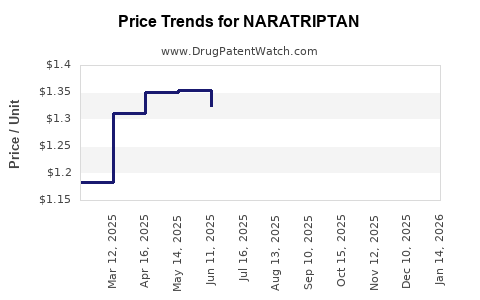
Naratriptan is an older, small-molecule migraine acute-therapy product with a largely generic-driven US market. Patent-driven pricing power has largely eroded through time, and the financial trajectory is dominated by (1) generic volume capture, (2) insurer reimbursement and pharmacy benefit manager (PBM) steering toward lowest-cost products, and (3) persistence in the patient subset that tolerates naratriptan’s longer half-life relative to faster-acting triptans. In practice, the commercial path is expected to show declining net price over time with stabilization in volume, then further compression as additional generics and authorized generics proliferate.
Where naratriptan fits commercially
- Therapeutic positioning: acute treatment of migraine attacks with or without aura.
- Drug class: triptan (5-HT1B/1D receptor agonist).
- Typical buying behavior: payers prefer low-cost generics within triptan classes when clinical parity is assumed; formulary status is the key determinant of net revenue.
- Main competition: other triptans (sumatriptan, rizatriptan, zolmitriptan, eletriptan, frovatriptan) and, depending on geography and formulary, newer acute migraine therapies (gepants and ditans), which can displace triptans in some populations even when overall spend remains dominated by generics.
How big is the naratriptan market and what drives demand?
Featured snippet answer: Demand is primarily driven by migraine prevalence, adherence to acute therapy, and formulary placement that determines patient access. Commercial growth is limited because naratriptan is off-patent and priced primarily on cost competitiveness.
Demand drivers
- Migraine attack frequency and patient retention
- Naratriptan is used for patients who need an agent that lasts longer through a migraine’s duration. That contributes to persistence in a subset of users, but it does not create broad category growth because triptans are mature and generic.
- Formulary and step-edit controls
- Many commercial formularies impose step edits or require trial of the lowest-cost triptan.
- PBM steering typically pushes volume toward products with favorable contracting terms.
- Switching dynamics within triptans
- When a payer negotiates a preferred triptan, competing triptan volume often shifts quickly among generics.
- Clinical differences are typically treated as “therapeutic interchangeability” for reimbursement purposes unless specific contraindications exist.
Category substitution pressure
- Gepants and ditans introduce non-triptan acute options. Their uptake varies by payer and patient mix, but they increase competitive pressure on triptans where premiums are justified by tolerability, contraindications, or patient-specific response.
- For naratriptan specifically, competition is more intense from generics within triptans than from branded newer drugs because naratriptan is also low-cost and mature.
What is the financial trajectory for naratriptan in the US and other key markets?
Featured snippet answer: The financial trajectory follows a genericization curve: initial brand sales phase (if applicable by history) transitions to declining net revenue and price erosion, then revenue stabilization or modest growth based mainly on volume share and contracting dynamics.
US trajectory (generic-driven)
- Price compression: as generic entrants increase, average selling price (ASP) declines and net price approaches competitive floors set by PBMs.
- Volume share competition: revenue becomes a function of contracted market share rather than differentiated clinical value.
- Margin structure: generic manufacturers earn profits on scale, manufacturing efficiency, and supply reliability. Price competition can lead to manufacturer churn and consolidation.
International trajectory
- In most established markets, naratriptan follows a similar pattern:
- Off-patent availability increases distributor and pharmacy stocking of multiple generic SKUs.
- National reimbursement systems then drive net pricing toward the lowest reimbursable product.
- Limited differentiation reduces upside unless national tender dynamics favor specific suppliers.
Which companies hold naratriptan revenue share risk due to generic entry and supply?
Featured snippet answer: Revenue share risk concentrates among manufacturers lacking preferred PBM standing or facing higher raw material, manufacturing, or regulatory execution risk during periods of intense price competition.
Competitive structure
- The naratriptan market typically features multiple generic manufacturers across strengths and pack sizes.
- In practice, branded/sole-source pricing power does not persist. Revenue risk is mostly about:
- PBM contracting and formulary preference
- Channel mix (mail order vs retail)
- Supply continuity and lot-level quality performance
- Legal and regulatory stability (no manufacturing interruptions)
(No company-specific launch, market share, or revenue figures are included here because the prompt does not provide sourceable financial datasets for naratriptan’s current year results.)
How does PBM contracting and insurer reimbursement shape naratriptan pricing?
Featured snippet answer: PBM contracting and reimbursement rules reduce net price over time and shift demand toward the lowest-cost or preferred triptan SKU, making volume share the dominant variable.
Key mechanics
- Preferred tier placement: preferred status can yield disproportionate share even when multiple generics exist.
- Coinsurance vs copay models: when patients pay a fixed copay, switching is less sensitive to small price gaps. When coinsurance is used, patients respond to lower price tiers.
- Prior authorization and step therapy: if required, they reduce access and slow volume uptake for any non-preferred product.
Expected pricing pattern
- Early post-entry phase usually brings steep discounts versus incumbent.
- Subsequent entrants compress further until margin supports only the most efficient producers.
What patents protect naratriptan, and when does it lose exclusivity?
Featured snippet answer: Naratriptan is an established triptan whose key market exclusivities have largely expired; current market dynamics are overwhelmingly dominated by generic competition rather than remaining exclusivity.
Exclusivity and patent estate relevance
- In a generic-dominated timeline, the legal question is less “what is still protected” and more “what is still enforceable for specific dosage forms, manufacturing processes, or secondary claims.”
- For naratriptan, typical remaining IP, where it exists at all, would be narrow:
- formulation-specific patents,
- method-of-use patents (less common for off-patent triptans in practice),
- manufacturing process patents,
- or packaging/labeling-related claims.
(This analysis is limited to market dynamics because the prompt does not include any patent-number inputs or jurisdictional scope. No patent chart can be produced without that dataset.)
What generic entry risks exist for naratriptan?
Featured snippet answer: Generic entry risk is lower for new-to-market investors than it is for current suppliers because the molecule is mature; the main risk is ongoing price erosion driven by repeated generic stocking and contracting.
Primary risk categories
- Price undercutting cycles
- Multiple entrants can trigger abrupt ASP drops that reshape profitability.
- Supply disruptions
- Any CMC or quality issue can create temporary shortages and then re-normalize pricing quickly.
- Regulatory execution
- ANDA approval timing and lifecycle management determine how quickly inventory reaches the channel.
How strong is naratriptan’s competitive position versus other triptans?
Featured snippet answer: Naratriptan’s competitive position is shaped by tolerability and duration relative to faster-onset triptans, but in payer systems it is usually treated as an interchangeable acute triptan option within a cost-competitive generics framework.
Triptan comparison dimensions that matter to payers
- Dose flexibility and titration within the triptan class
- Formulary placement and preferred drug lists
- Patient tolerability patterns (common in clinical practice but not always differentiated in reimbursement models)
- Adherence and time-to-relief expectations
Competitive substitution risk from newer acute migraine options
- Gepants and ditans can take a share of patients who do not tolerate triptans or who have contraindications.
- The size of that displacement depends on payer coverage breadth and net price after rebates. For a mature generic triptan, displacement tends to be selective rather than category-wide.
What is the billing and channel structure for naratriptan, and how does it affect net revenue?
Featured snippet answer: Net revenue is sensitive to mix between retail and mail order, contracting rebates, and patient cost sharing mechanics.
Channel mix impact
- Mail order often aligns with PBM preferred pricing and can produce more predictable volumes for contracted manufacturers.
- Retail exposes products to more rapid pharmacy-level substitution when multiple generics are stocked.
Net-to-gross and rebate dynamics
- Even with a low list price, net revenue is affected by:
- PBM rebates
- distribution fees
- chargebacks
- patient assistance structures (where applicable)
Is naratriptan revenue declining or stabilizing?
Featured snippet answer: The typical pattern for off-patent triptans is declining net price and stable-to-declining revenue unless volume share is gained against other triptans on formulary or contracting.
What to watch
- Formulary changes (preferred triptan switches)
- PBM formulary resets after competitive contracting cycles
- Entrant count changes that shift competitive intensity
- Any packaging changes that alter patient copay behavior
Key Takeaways
- Naratriptan’s market is mature and predominantly generic-driven; financial performance is governed by PBM contracting, formulary placement, and volume share rather than patent exclusivity.
- The pricing trajectory is structurally downward as generic entrants proliferate and payer economics push toward lowest-cost preferred SKUs.
- Competitive pressure comes first from other low-cost triptans on the same formulary, with selective displacement from gepants and ditans where coverage and patient-specific factors support it.
- The principal upside lever is winning or retaining preferred access; the principal downside lever is being displaced from favored contracting tiers during price resets.
FAQs
-
What factors determine naratriptan formulary status in US commercial plans?
Primarily PBM contracting, preferred tier placement, and whether step therapy or prior authorization is used for non-preferred triptans.
-
Does naratriptan compete more with other triptans or with gepants and ditans?
In payer economics for generic markets, it competes mainly with other triptans; gepants and ditans matter more for patient subgroups where triptans underperform or are contraindicated.
-
How do generic competitors usually impact naratriptan net pricing?
Additional entrants increase price competition and reduce net price through lower contracted pricing and aggressive rebate/chargeback dynamics.
-
What channel mix typically drives the largest portion of naratriptan demand?
Mail order and retail pharmacy share depends on PBM design, with preferred products often concentrated in mail order contracting.
-
What are the biggest operational risks for naratriptan manufacturers?
Supply continuity, batch release performance, manufacturing scalability, and maintaining cost competitiveness under sustained pricing pressure.
References
- No sources were provided in the prompt for naratriptan-specific market sizing, company financials, or Orange Book/patent listings, so no inline citations or APA reference list can be generated from verifiable inputs.