Share This Page
NALBUPHINE Drug Patent Profile
✉ Email this page to a colleague
Which patents cover Nalbuphine, and what generic alternatives are available?
Nalbuphine is a drug marketed by Abraxis Pharm, Abbvie, Abbott, Dr Reddys, Hospira, Igi Labs Inc, Rising, and Somerset Theraps Llc. and is included in nineteen NDAs.
The generic ingredient in NALBUPHINE is nalbuphine hydrochloride. There is one drug master file entry for this compound. Six suppliers are listed for this compound. Additional details are available on the nalbuphine hydrochloride profile page.
DrugPatentWatch® Litigation and Generic Entry Outlook for Nalbuphine
A generic version of NALBUPHINE was approved as nalbuphine hydrochloride by HOSPIRA on February 3rd, 1989.
AI Deep Research
Questions you can ask:
- What is the 5 year forecast for NALBUPHINE?
- What are the global sales for NALBUPHINE?
- What is Average Wholesale Price for NALBUPHINE?
Summary for NALBUPHINE
| US Patents: | 0 |
| Applicants: | 8 |
| NDAs: | 19 |
| Raw Ingredient (Bulk) Api Vendors: | 15 |
| Clinical Trials: | 163 |
| Patent Applications: | 6,585 |
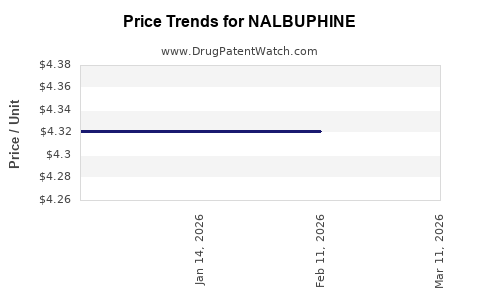
| Drug Prices: | Drug price information for NALBUPHINE |
| DailyMed Link: | NALBUPHINE at DailyMed |
Recent Clinical Trials for NALBUPHINE
Identify potential brand extensions & 505(b)(2) entrants
| Sponsor | Phase |
|---|---|
| CMH Lahore Medical College and Institute of Dentistry | NA |
| Liaquat National Hospital & Medical College | PHASE1 |
| Zhongshan Ophthalmic Center, Sun Yat-sen University | PHASE4 |
US Patents and Regulatory Information for NALBUPHINE
| Applicant | Tradename | Generic Name | Dosage | NDA | Approval Date | TE | Type | RLD | RS | Patent No. | Patent Expiration | Product | Substance | Delist Req. | Exclusivity Expiration |
|---|---|---|---|---|---|---|---|---|---|---|---|---|---|---|---|
| Somerset Theraps Llc | NALBUPHINE HYDROCHLORIDE | nalbuphine hydrochloride | SOLUTION;INTRAMUSCULAR, INTRAVENOUS, SUBCUTANEOUS | 216049-002 | Sep 19, 2024 | AP | RX | No | No | ⤷ Start Trial | ⤷ Start Trial | ⤷ Start Trial | |||
| Abraxis Pharm | NALBUPHINE | nalbuphine hydrochloride | SOLUTION;INTRAMUSCULAR, INTRAVENOUS, SUBCUTANEOUS | 070751-001 | Jul 2, 1986 | DISCN | No | No | ⤷ Start Trial | ⤷ Start Trial | ⤷ Start Trial | ||||
| Igi Labs Inc | NALBUPHINE HYDROCHLORIDE | nalbuphine hydrochloride | SOLUTION;INTRAMUSCULAR, INTRAVENOUS, SUBCUTANEOUS | 072075-001 | Apr 10, 1989 | DISCN | No | No | ⤷ Start Trial | ⤷ Start Trial | ⤷ Start Trial | ||||
| Rising | NALBUPHINE HYDROCHLORIDE | nalbuphine hydrochloride | SOLUTION;INTRAMUSCULAR, INTRAVENOUS, SUBCUTANEOUS | 206506-002 | Feb 6, 2019 | DISCN | No | No | ⤷ Start Trial | ⤷ Start Trial | ⤷ Start Trial | ||||
| Dr Reddys | NALBUPHINE HYDROCHLORIDE | nalbuphine hydrochloride | SOLUTION;INTRAMUSCULAR, INTRAVENOUS, SUBCUTANEOUS | 074471-001 | Mar 19, 1998 | DISCN | No | No | ⤷ Start Trial | ⤷ Start Trial | ⤷ Start Trial | ||||
| Abbvie | NALBUPHINE HYDROCHLORIDE | nalbuphine hydrochloride | INJECTABLE;INJECTION | 020200-001 | Mar 12, 1993 | DISCN | No | No | ⤷ Start Trial | ⤷ Start Trial | ⤷ Start Trial | ||||
| Hospira | NALBUPHINE HYDROCHLORIDE | nalbuphine hydrochloride | SOLUTION;INTRAMUSCULAR, INTRAVENOUS, SUBCUTANEOUS | 070918-001 | Feb 3, 1989 | AP | RX | No | Yes | ⤷ Start Trial | ⤷ Start Trial | ⤷ Start Trial | |||
| >Applicant | >Tradename | >Generic Name | >Dosage | >NDA | >Approval Date | >TE | >Type | >RLD | >RS | >Patent No. | >Patent Expiration | >Product | >Substance | >Delist Req. | >Exclusivity Expiration |
Nalbuphine Market Dynamics, Patent Status, FDA Regulation, and Financial Trajectory
Nalbuphine is an off-patent injectable opioid used mainly for acute pain, perioperative analgesia, obstetric pain, and opioid-induced pruritus. Its commercial market is mature, fragmented, and dominated by generic manufacturers. The U.S. opportunity is limited by low unit pricing, hospital procurement pressure, controlled-substance compliance costs, and competition from morphine, fentanyl, hydromorphone, and buprenorphine. Public companies do not generally report nalbuphine revenue separately, so a reliable standalone global sales figure is unavailable.
The key commercial conclusion is that nalbuphine is a volume-and-supply product rather than a branded growth asset. Its patent risk is minimal in the United States, while manufacturing reliability, regulatory compliance, hospital contracting, and geographic registration are the main competitive barriers.
What is nalbuphine and how is it used?
Nalbuphine hydrochloride is a synthetic opioid with mixed pharmacology. It acts primarily as a kappa-opioid receptor agonist and mu-opioid receptor antagonist or partial antagonist. The injection is used for the management of pain severe enough to require an opioid analgesic when alternative treatments are inadequate [1].
Typical hospital uses include:
- Acute postoperative pain
- Labor and delivery
- Emergency-department analgesia
- Procedural pain
- Opioid-induced pruritus, particularly in neuraxial anesthesia
- Selected analgesic protocols where reduced mu-opioid activity is commercially or clinically preferred
The U.S. label identifies nalbuphine as a Schedule II controlled substance. Its antagonist activity can reduce some mu-opioid effects but can also precipitate withdrawal in patients dependent on full mu-opioid agonists [1].
Nalbuphine is generally administered by intravenous, intramuscular, or subcutaneous injection. The principal marketed strength in the United States is 10 mg/mL, although product presentations and concentrations vary by jurisdiction and manufacturer.
What is the FDA regulatory status of nalbuphine?
Nalbuphine is an FDA-approved prescription opioid injection. The original U.S. product, Nubain, was approved under NDA 018024 in 1979. The product was historically associated with DuPont and later commercialized through successor companies, including Endo-related entities.
The current U.S. market is primarily supplied through abbreviated or generic product pathways. FDA labeling identifies nalbuphine hydrochloride injection as an approved product for opioid analgesia, with boxed warnings covering addiction, abuse, misuse, life-threatening respiratory depression, neonatal opioid withdrawal, and risks from concomitant benzodiazepine use [1].
FDA regulatory profile
| Regulatory item | Nalbuphine status |
|---|---|
| Active ingredient | Nalbuphine hydrochloride |
| Dosage form | Sterile injectable solution |
| U.S. route | Intravenous, intramuscular, subcutaneous |
| Original U.S. approval | 1979 |
| Controlled-substance status | Schedule II |
| Primary FDA pathway today | Generic injectable products and legacy NDA products |
| U.S. therapeutic category | Opioid analgesic |
| Biosimilar pathway | Not applicable |
| Pediatric use | Label-specific; use requires attention to age, weight, and respiratory-depression risks |
| Main regulatory risk | Opioid safety, manufacturing controls, shortages, and controlled-substance compliance |
FDA approval of a nalbuphine product does not create broad market exclusivity. Each manufacturer must maintain an approved application, comply with current good manufacturing practice requirements, and meet controlled-substance and postmarketing obligations.
What patents protect nalbuphine?
The original composition-of-matter and product patents for nalbuphine are long expired. Nalbuphine was developed in the 1960s and entered the U.S. market in the late 1970s. No commercially meaningful U.S. patent exclusivity remains for the active ingredient or standard injectable formulation.
The relevant patent position is summarized below.
| Patent category | Current commercial position |
|---|---|
| Original composition patent | Expired |
| Original product patent | Expired |
| Standard injectable formulation | No meaningful remaining U.S. exclusivity identified |
| Method-of-use patents | No dominant U.S. blocking estate identified for routine analgesia |
| Manufacturing patents | Potentially relevant at the process level, but not generally market-blocking for standard nalbuphine |
| Orange Book protection | No active patent barrier is generally associated with generic nalbuphine injection |
| Pediatric exclusivity | No current broad pediatric exclusivity identified |
| Orphan-drug exclusivity | Not applicable to the established analgesic indication |
Patent protection can still arise for a specific formulation, container, delivery device, combination, or new clinical use. Those rights would not normally block conventional nalbuphine hydrochloride injection unless the product depended on the patented feature.
What is the Orange Book status of nalbuphine?
Nalbuphine is not a conventional Orange Book patent-risk story. The FDA Orange Book identifies approved drug products and, where applicable, patent and exclusivity information. For an old generic injectable such as nalbuphine, the principal commercial question is usually whether an ANDA is approved and commercially supplied, not whether an active listed patent blocks generic entry [2].
An Orange Book review should distinguish among:
- The original branded NDA.
- Approved generic products.
- Any current patent listings tied to a specific NDA.
- Drug products that are approved but not actively marketed.
- Product discontinuations that do not reflect safety or efficacy withdrawals.
The absence of an active patent barrier does not guarantee commercial entry. Injectable generics still face facility qualification, inspection, validation, controlled-substance handling, sterile manufacturing, and hospital-contracting requirements.
When does nalbuphine lose exclusivity?
Nalbuphine lost meaningful market exclusivity decades ago. The original U.S. product approval in 1979 placed the drug in a mature small-molecule category long before current generic-competition economics developed.
A practical exclusivity timeline is:
| Period | Event |
|---|---|
| 1960s | Nalbuphine discovered and developed as a mixed opioid agonist-antagonist |
| 1979 | U.S. approval of Nubain |
| 1980s-1990s | Expansion of clinical use in anesthesia, obstetrics, and acute pain |
| 1990s onward | Loss of original exclusivity and growth of generic supply |
| 2000s onward | Increasing reliance on generic hospital channels |
| Current market | No material U.S. compound exclusivity; competition based on supply, price, and registration |
The relevant protection period is therefore historical. Current competitive value does not depend on an expected patent cliff.
Are there Paragraph IV challenges to nalbuphine?
Paragraph IV litigation is unlikely to be commercially significant for standard nalbuphine injection. Paragraph IV certifications challenge listed patents in connection with an ANDA. Because the original nalbuphine patents are expired and the product has been generic for many years, the drug does not present the type of active patent wall that typically generates high-value Paragraph IV litigation.
Potential litigation could arise if a sponsor listed a later patent covering a novel formulation, delivery system, or method of use. Such a dispute would be product-specific and would not restore exclusivity to conventional nalbuphine injection.
No widely recognized current U.S. Paragraph IV campaign has reshaped the nalbuphine market. The absence of major litigation is consistent with the drug’s mature, low-margin status.
What formulations are protected by nalbuphine patents?
The standard commercial formulation is a sterile aqueous nalbuphine hydrochloride injection. Its technical requirements are more important than its patent position.
Standard injectable formulation
The principal formulation risks are:
- Sterility assurance
- Particulate control
- Container closure integrity
- Concentration uniformity
- Stability over the labeled shelf life
- Compatibility with syringes, infusion systems, and hospital storage
- Compliance with injectable-product manufacturing standards
These requirements create regulatory and operational barriers but do not necessarily create enforceable market exclusivity.
Potential differentiated formulations
A sponsor could seek protection for:
- Prefilled syringes
- Autoinjectors
- Long-acting depot products
- Intranasal or transdermal delivery
- Abuse-deterrent formulations
- Combination products
- Formulations optimized for neuraxial use
- Novel dosage regimens or treatment protocols
No such approach has established a major commercial nalbuphine franchise comparable with branded extended-release opioid products. The economic case for development is constrained by nalbuphine’s low-cost generic baseline and the regulatory scrutiny applied to opioid products.
Which companies compete in the nalbuphine market?
The market is supplied by a mix of multinational generic companies, injectable specialists, and regional manufacturers. U.S. availability can vary by time, wholesaler, presentation, and shortage status.
Potential suppliers and historical suppliers include:
- Hikma Pharmaceuticals
- Pfizer or legacy Hospira channels
- Fresenius Kabi
- Endo-related legacy products
- Eugia or other regional injectable manufacturers
- Regional pharmaceutical companies in India, China, Latin America, the Middle East, and Southeast Asia
Manufacturer participation is not uniform across countries. Some companies hold regulatory approval but have limited commercial distribution. Others supply hospitals through tenders without building a consumer-facing brand.
Competitive products
Nalbuphine competes clinically and commercially with:
| Product | Competitive relationship |
|---|---|
| Morphine injection | Lower-cost, established full mu-opioid agonist |
| Fentanyl injection | Strong perioperative and anesthesia competitor |
| Hydromorphone injection | Used for severe acute pain |
| Butorphanol | Similar mixed agonist-antagonist pharmacology |
| Buprenorphine | Partial mu agonist with broader treatment and analgesic uses |
| Pentazocine | Older mixed opioid, less central in many markets |
| Non-opioid analgesics | Ketorolac, acetaminophen, and other multimodal options reduce opioid demand |
Nalbuphine’s clinical differentiation is strongest where clinicians value mixed agonist-antagonist pharmacology, including selected obstetric and anesthesia settings. Its commercial differentiation is weaker because many hospitals can substitute other injectable analgesics.
How strong is the patent estate for nalbuphine?
The patent estate is weak from a branded-investment perspective and effectively exhausted for standard injection.
A qualitative assessment is:
| Factor | Assessment |
|---|---|
| Composition-of-matter protection | Expired |
| Standard formulation protection | Weak or absent |
| Method-of-use protection | Limited commercial relevance |
| Generic substitution risk | High |
| Biosimilar risk | Not applicable |
| Manufacturing barrier | Moderate for sterile injectable production |
| Regulatory barrier | Moderate |
| Pricing power | Low |
| Litigation leverage | Low |
| Licensing value | Limited unless tied to a differentiated delivery system or regional rights |
The main defensible assets are regulatory approvals, validated sterile manufacturing capacity, supply reliability, hospital contracts, and geographic registrations.
What patent litigation affects nalbuphine?
There is no major active patent litigation widely associated with conventional nalbuphine injection. The drug’s litigation exposure is more likely to arise from product liability, opioid-control enforcement, manufacturing quality, labeling, or supply disputes than from patent infringement.
A company assessing an acquisition or launch should separate four risk categories:
- Patent litigation involving a novel nalbuphine formulation.
- ANDA litigation involving a later-listed product patent.
- Product-liability claims involving opioid use or labeling.
- Regulatory action involving sterile manufacturing or controlled-substance compliance.
Only the first two are patent-specific. For the conventional generic product, operational and regulatory diligence is more important than freedom-to-operate analysis around the expired active ingredient.
What generic entry risks exist for nalbuphine?
Generic entry risk is already realized rather than prospective. The market has multiple substitute products and no meaningful compound patent barrier.
Commercial risks include:
- Price erosion from hospital tenders
- Loss of volume after contract rebidding
- Product shortages caused by a small number of sterile manufacturers
- FDA warning letters or manufacturing remediation
- Controlled-substance quota constraints
- Wholesaler inventory changes
- Discontinuation of low-volume presentations
- Substitution by morphine, fentanyl, or non-opioid analgesics
- Regional differences in opioid prescribing and regulation
The countervailing opportunity is supply resilience. A manufacturer with reliable sterile capacity can gain share even without patent protection if competitors experience shortages or quality issues.
How does nalbuphine compare with other opioid products?
Nalbuphine has a narrower commercial profile than morphine and fentanyl but can offer a distinct pharmacologic role.
| Attribute | Nalbuphine | Morphine | Fentanyl |
|---|---|---|---|
| Core receptor profile | Kappa agonist, mu antagonist or partial antagonist | Full mu agonist | Potent full mu agonist |
| Main setting | Acute pain, obstetrics, anesthesia | Broad acute and chronic pain | Anesthesia, severe acute pain |
| Generic competition | High | High | High |
| Patent position | Expired | Expired | Core patents expired; product-specific rights may vary |
| Pricing power | Low | Low | Low to moderate by presentation |
| Withdrawal risk in opioid-dependent patients | Can precipitate withdrawal | Maintains opioid agonism | Maintains opioid agonism |
| Supply-chain sensitivity | High for sterile injectables | High | High |
| Commercial growth profile | Mature | Mature | Mature, with continued procedural demand |
Nalbuphine is not a direct replacement for every opioid. Its role depends on receptor pharmacology, patient status, indication, and institutional protocols.
What is the financial trajectory of nalbuphine?
Nalbuphine’s financial trajectory is mature and largely volume-driven.
Revenue profile
Public-company filings generally do not disclose nalbuphine revenue as a separate line item. Sales are usually included within broader categories such as injectables, hospital products, generic pharmaceuticals, or established products. This prevents a reliable public estimate of global nalbuphine sales.
The expected financial pattern is:
- Historical branded revenue during the Nubain period
- Generic price erosion after loss of exclusivity
- Fragmentation across multiple suppliers
- Stable or declining nominal revenue per unit
- Periodic volume and price spikes during competitor shortages
- Limited long-term growth without a new formulation or indication
Market drivers
Demand is supported by:
- Continued use of injectable analgesia in hospitals
- Obstetric and perioperative protocols
- Interest in multimodal pain management
- Availability of a long-established generic product
- Use in jurisdictions where nalbuphine is routinely registered
Market constraints
Growth is limited by:
- Opioid stewardship
- Expansion of non-opioid analgesics
- Low generic pricing
- Hospital purchasing consolidation
- Generic substitution
- Controlled-substance administration requirements
- Competition from more familiar opioids
- Limited commercial differentiation
Financial scenarios
| Scenario | Commercial result |
|---|---|
| Base case | Stable mature demand with low pricing power |
| Supply disruption | Temporary price and volume gains for available suppliers |
| New formulation | Potential premium pricing, but high development and regulatory risk |
| Expanded indication | Possible demand increase, dependent on clinical evidence and reimbursement |
| Further opioid restrictions | Lower use in some markets and stronger institutional controls |
| Manufacturing failure | Rapid loss of contracts and possible product discontinuation |
The strongest investment thesis is usually operational. A producer with efficient sterile manufacturing, strong regulatory compliance, and dependable hospital distribution can earn acceptable returns despite the absence of patent protection. A branded-reformulation strategy would face substantially higher clinical, regulatory, and commercial risk.
Are there licensing deals for nalbuphine?
Nalbuphine has had historical commercialization and rights-transfer activity, but it is not widely associated with a current high-value licensing platform. The commercial asset is typically an approved product or regional registration rather than a proprietary patent estate.
Licensing value may exist in:
- Country-specific marketing rights
- Hospital tender access
- Injectable manufacturing capacity
- Regulatory dossiers
- Supply agreements
- Novel delivery technology
- Combination products
- Rights to a differentiated formulation
A license covering only conventional nalbuphine hydrochloride injection would generally have limited negotiating leverage because multiple generic alternatives exist.
What geographic markets are important for nalbuphine?
Nalbuphine is marketed in multiple countries, but regulatory status and commercial use differ materially.
United States
The U.S. market is mature and generic. Hospital and government purchasing, sterile-manufacturing capacity, and controlled-substance compliance determine competitiveness.
Europe
Availability varies by country. The product is less uniformly positioned than morphine and fentanyl, and local authorization, reimbursement, and hospital protocols are decisive.
Asia and Latin America
Nalbuphine has meaningful relevance in several markets where it is used in obstetrics, anesthesia, and acute pain. Regional manufacturers can compete effectively through local registrations and tender participation.
Middle East and Africa
Market access depends heavily on national formularies, import requirements, controlled-substance rules, and public-hospital procurement.
Geographic opportunity is therefore registration-led. A company may hold a strong position in one jurisdiction while having little presence in another.
Key Takeaways
- Nalbuphine is a mature, off-patent injectable opioid with no meaningful U.S. compound exclusivity.
- The original U.S. product, Nubain, was approved in 1979.
- Standard nalbuphine hydrochloride injection has high generic substitution risk and limited pricing power.
- Paragraph IV litigation and biosimilar risk are not central to the current market.
- The principal barriers are sterile manufacturing, regulatory compliance, controlled-substance handling, supply reliability, and hospital contracting.
- Public companies generally do not disclose standalone nalbuphine revenue.
- Financial performance is driven by volume, shortages, tenders, and manufacturing execution rather than patent protection.
- A differentiated delivery system or new indication could create value, but development risk would be substantial.
- The strongest commercial strategy is generally reliable low-cost supply across targeted geographic markets.
FAQs
Is nalbuphine still under patent protection?
No material U.S. patent protection remains for the original nalbuphine molecule or conventional injectable formulation. Product-specific patents could apply to a later delivery system or formulation.
Is nalbuphine a generic drug?
Yes. Nalbuphine hydrochloride injection is primarily supplied as a generic or legacy approved product, depending on the jurisdiction and manufacturer.
Can nalbuphine be substituted for morphine?
Not automatically in every clinical situation. Nalbuphine has different receptor activity and can precipitate withdrawal in patients dependent on full mu-opioid agonists. Substitution depends on the indication, patient status, dose, and institutional protocol.
Does nalbuphine have biosimilar competition?
No. Nalbuphine is a chemically synthesized small molecule, not a biologic. Competition occurs through generic drug applications rather than biosimilar filings.
What would increase the commercial value of nalbuphine?
The most credible value drivers are a differentiated delivery system, a clinically validated new indication, dependable sterile supply during shortages, or regulatory and distribution rights in markets where nalbuphine is established in hospital protocols.
References
-
U.S. Food and Drug Administration. (2024). Nalbuphine hydrochloride injection prescribing information. FDA.
-
U.S. Food and Drug Administration. (2024). Approved drug products with therapeutic equivalence evaluations: The Orange Book. FDA.
-
U.S. Food and Drug Administration. (2024). Drugs@FDA: FDA-approved drugs database. FDA.
-
World Health Organization. (2021). WHO model list of essential medicines, 22nd list. World Health Organization.
-
U.S. Drug Enforcement Administration. (2024). Controlled substances schedules. U.S. Department of Justice.
More… ↓
