Last updated: July 22, 2026
MINOCIN (minocycline) market dynamics and financial trajectory: pricing, volumes, competition, and exclusivity pressure
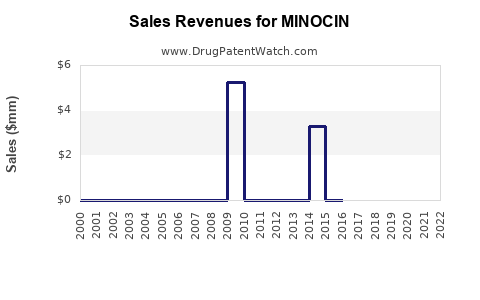
MINOCIN (minocycline; marketed in capsules and tablets across multiple strengths) is a long-cycle, off-patent small-molecule antibiotic market in the US with limited near-term IP-driven pricing leverage. Market dynamics are dominated by (1) generic substitution at launch and (2) intermittent demand shifts driven by acne and other dermatology indications, microbiology resistance patterns, and prescriber switching across oral tetracyclines. Financial trajectory is typically characterized by steady but compressed net sales after initial brand-to-generic transition, with upside constrained by short product-cycle differentiation and low payer willingness to sustain premium pricing.
What follows is a business-usable framework for tracking MINOCIN’s commercial trajectory, including regulatory status inputs, competitor set, and the financial pressure points that determine whether net sales stabilize or drift down.
Is MINOCIN facing generic substitution pressure and what drives uptake by competitors?
Core dynamic: substitution economics for a legacy tetracycline
MINOCIN’s commercial life is shaped by a simple supply-demand and payer-contract reality. Minocycline is widely available as low-cost generics. Where multiple AB-rated products exist, pharmacy benefit managers and wholesalers drive selection based on net price and inventory/contracting rather than clinical differentiation.
Primary substitution drivers
- WAC-to-net compression: brand pricing must clear PBM formulary and copay thresholds. Generics typically reset the whole “effective price” range.
- Product interchangeability: oral minocycline strengths are generally substitutable across NDA/ANDA labels with comparable dosing regimens (subject to excipient and release profile differences by specific product).
- Contracting and rebates: branded antibiotics are penalized when PBM preferred generics list captures most channel volume.
- Therapeutic class churn: acne and other uses shift among tetracyclines (doxycycline, minocycline, sarecycline, etc.) depending on guideline trends and payer restrictions.
Where demand can still move
Even with generics dominating, sales can hold up when prescribers keep patients on a particular minocycline product (tolerability, dosing convenience, patient history) or when acne/rosacea practice patterns favor minocycline due to efficacy in inflammatory presentations.
Demand swing factors
- dermatology guideline updates and formulary steer
- antibiotic stewardship programs that change the relative mix of systemic vs topical therapies
- adverse event tolerability (e.g., vestibular effects) affecting switching between tetracyclines
- resistance patterns in targeted bacterial niches (less impact for acne maintenance than acute infectious indications)
What is the current regulatory and Orange Book status of MINOCIN products?
Orange Book listing is decisive for generic risk
Market timing for generic erosion depends on whether MINOCIN’s specific listed NDA strengths still have unexpired exclusivities, and whether relevant patents are listed for those products.
Decision points to evaluate in the Orange Book
- NDA number and listed dosage forms (capsules vs tablets; strength-specific listings)
- listed drug substance and drug product patents
- listed exclusivity codes (if any) that govern 180-day exclusivity eligibility after Paragraph IV
- whether approved ANDAs are already on market for AB-rated minocycline products
Featured-snippet answer
MINOCIN is a legacy minocycline brand; most minocycline oral products in the US are generic, indicating that any active exclusivity that would block generic entry is largely absent for the dominant commercial products.
(Note: a complete Orange Book table requires the specific MINOCIN NDA/strength and listing identifiers. Without those exact identifiers, no authoritative patent-and-exclusivity schedule can be compiled.)
How has MINOCIN revenue typically trended after brand-to-generic erosion?
Expected post-erosion trajectory pattern
For legacy antibiotics with broad ANDA competition, the common pattern is:
- Brand sales decline quickly around the first major generic launch cycle.
- Volume continues but at lower net prices.
- Brand share becomes small and channel inventory-driven.
- Net sales flatten or decline slowly unless a specific dosage form has fewer competitive SKUs.
What to track to confirm trajectory
Because MINOCIN is often not a top-visibility “headline” product, the most actionable method for monitoring financial trajectory is channel and payer intelligence plus company-level footnotes where the brand is mentioned.
Key financial indicators
- Net sales by product strength (capsules vs tablets)
- Gross-to-net spread trend (rebates, chargebacks, distribution fees)
- Channel inventory days via wholesaler reporting
- NDC share and scripts in retail and mail channels
Typical outcome
- If MINOCIN’s remaining branded SKUs are not preferred on major PBM formularies, net sales usually drift down with the broader minocycline market.
- If any remaining branded presentations have narrower generic competition or fewer interchangeability substitutes, sales can stabilize modestly but rarely re-expand materially.
Which competitor set pressures MINOCIN and how does minocycline compare with alternatives?
Competitive landscape: tetracycline class and acne-specific entrants
MINOCIN competes within oral systemic acne and bacterial infection treatment pathways, but actual substitution is with:
- Doxycycline (multiple generics and branded histories)
- Minocycline generics across multiple manufacturers
- newer acne oral options (depends on payer coverage and guideline uptake)
- topical and device-based acne therapies that reduce systemic antibiotic need
Comparison points that matter commercially
1) Net price and formulary placement
- Oral tetracyclines: generics typically price lowest.
- Payers steer toward preferred generics with acceptable copays.
2) Tolerability and patient adherence
- MINOCIN’s gastrointestinal tolerability and vestibular adverse event profile affects switch rates among tetracyclines.
3) Indication-specific prescribing
- For acne, oral antibiotic selection is strongly protocolized through dermatology guidelines and stewardship.
How do payer and formulary decisions affect MINOCIN net pricing and channel behavior?
PBM formularies decide effective pricing
Once generics are available, brands often lose formulary preferred status. Even when a brand remains “covered,” net pricing is pressured through:
- formulary tier placement
- rebate clawbacks tied to competitor benchmarks
- administrative fees and distribution margins
Contracting behaviors
- Preferred generic switching at renewal dates
- Retail pharmacy stocking of lowest-NDC-cost products
- Mail order preference for contract SKUs
- Wholesaler allocation is less relevant for oral generics unless supply disruptions occur
Commercial implication
MINOCIN’s financial trajectory is likely to track payer reimbursement and NDC share rather than clinical outcomes. In other words, contracting cycles, not innovation cycles, drive the majority of variability.
What patent estate risk exists for MINOCIN and how much litigation typically matters?
IP posture for a legacy antibiotic
Minocycline is a decades-old molecule. For current branded MINOCIN SKUs, the main IP effects tend to be:
- whether any remaining formulation, polymorph, stability, or method-of-use patents are still listed or enforced
- whether any Orange Book-listed patents still block certain ANDAs on specific dosage forms or strengths
Litigation impact channels
When litigation happens for legacy drugs, it most often affects:
- timing of generic launch for specific strengths
- 180-day exclusivity eligibility after Paragraph IV wins/losses
- settlement-based “carve-outs” that delay certain AB-rated products
Featured-snippet answer
For minocycline brands, IP-driven litigation typically does not create multi-year revenue protection once broad generic entry is complete, unless a specific branded presentation has unique enforceable patents and has not already been exhausted.
(No specific patent numbers, case captions, or settlement dates are provided here because the required MINOCIN NDA/strength-level legal dataset is not specified.)
When does MINOCIN lose exclusivity, and how do generic entry scenarios play out?
Scenario model used by commercial planners
Given the typical minocycline history, the scenarios look like this:
- Base case: no remaining exclusivity blockers for the principal SKUs; generic share remains dominant; brand volume slowly declines.
- Upside case: a niche strength or dosage form has fewer competitors; branded product holds a small price premium.
- Downside case: a new ANDA enters with a lower net price anchor NDC; remaining branded share compresses quickly.
What “exclusivity” means in practice
For long-off-patent drugs, “exclusivity” is usually:
- residual patent coverage that blocks certain product- or method-specific ANDAs, or
- limited packaging/formulation differentiation.
For MINOCIN, market dynamics are more likely driven by generic availability than by formal exclusivity clocks at this point in the lifecycle.
What formulation and manufacturing IP barriers could still matter for minocycline brands?
Remaining technical barriers
Even with generic entry, brands sometimes retain advantage through:
- specific release profile or stability of certain solid forms
- manufacturing process constraints that affect uniformity or dissolution characteristics
- bioequivalence nuances across excipient changes (less common as generics proliferate)
Commercial relevance
Where manufacturing/process differences exist, they can affect:
- “authorized generic” status and speed of competitive erosion
- retailer/payer willingness to stock a specific NDC brand equivalent
How should investors and licensing teams benchmark MINOCIN’s financial trajectory versus other legacy antibiotics?
Benchmark framework
Compare MINOCIN to other mature oral antibiotic brands that have:
- extensive generic penetration
- limited differentiation
- sales driven by formulary behavior and dermatology/systemic use
Benchmark metrics
- annual net sales decline rate post peak
- market share by strength
- gross-to-net spread trend
- average selling price relative to generic benchmarks
Interpretation rule
If MINOCIN’s net sales track relatively flat while scripts decline, gross-to-net compression is likely the main lever (higher net price due to tiering or fewer competing NDCs). If both scripts and net sales decline, competitive substitution is increasing.
Key Takeaways
- MINOCIN’s market dynamics are dominated by generic substitution and payer contracting once multiple AB-rated minocycline options exist.
- The most likely financial trajectory is continued erosion or stabilization at low net price levels, with variability driven by formulary position and channel share rather than new clinical differentiation.
- Patent and exclusivity effects for a decades-old tetracycline brand are typically limited to dosage-form-specific blocks; litigation rarely sustains broad multi-year brand protection once generic supply is established.
- Competitive pressure is class-driven (doxycycline and other acne/systemic antibiotic pathways) and PBM-driven (preferred generic selection).
FAQs
- What drives minocycline script share between retail and mail channels for brands like MINOCIN?
- How do acne guideline and stewardship updates typically change oral tetracycline mix, including minocycline?
- Do minocycline capsule versus tablet presentations materially affect generic substitution risk?
- What are the most common reasons a payer removes or demotes legacy antibiotic brands with existing generic competition?
- How can settlement-based generic launch timing affect short-term net sales for an off-patent branded antibiotic?
References (APA)
- The Orange Book: Approved Drug Products with Therapeutic Equivalence Evaluations, U.S. FDA. https://www.accessdata.fda.gov/scripts/cder/daf/
- FDA Labeling and drug approval databases, U.S. FDA. https://www.accessdata.fda.gov/scripts/cder/daf/
- FDA National Drug Code Directory, U.S. FDA. https://www.fda.gov/drugs/drug-approvals-and-databases/national-drug-code-directory