Last updated: March 3, 2026
What is the Current Market Size and Growth Outlook for Metoclopramide?
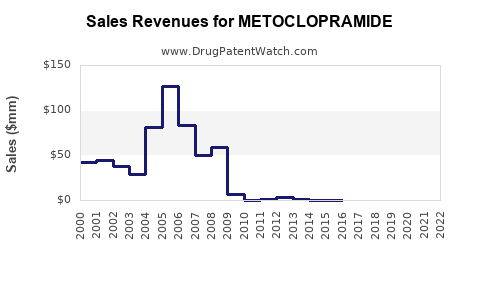
Metoclopramide is a dopamine antagonist primarily used for gastrointestinal conditions such as nausea, vomiting, and gastroparesis. As of 2022, the global market for metoclopramide was valued at approximately USD 400 million, with a compound annual growth rate (CAGR) projected at 2.5% over the next five years.
Regional Market Breakdown (2022)
| Region |
Market Value (USD) |
Share of Total Market |
Key Drivers |
| North America |
150 million |
37.5% |
High prevalence of GI disorders, extensive healthcare infrastructure |
| Europe |
100 million |
25% |
Aging population, regulatory approvals |
| Asia Pacific |
70 million |
17.5% |
Growing awareness, expanding healthcare systems |
| Latin America |
40 million |
10% |
Increasing pharmaceutical penetration |
| Middle East & Africa |
40 million |
10% |
Rising demand for GI medications |
The North American market dominates due to well-established prescribing practices and high awareness; Asia Pacific presents the fastest growth due to increasing healthcare access.
How Do Patent Statuses and Regulatory Policies Impact the Market?
Metoclopramide has been available as a generic drug since patent expiration in the late 1990s. The drug’s primary patent was filed by Roche in 1960 and expired around 1999, enabling multiple generic manufacturers to penetrate the market.
Regulatory Considerations
- The U.S. Food and Drug Administration (FDA) approved metoclopramide in 1979.
- The European Medicines Agency (EMA) approved the drug in the 1980s.
- Safety warnings issued by regulatory agencies restrict high-dose or long-term use due to risks of tardive dyskinesia and other neurological adverse effects (FDA, 2009).
These safety concerns have led to restrictions or label updates, influencing prescribing behaviors and market volume.
Who Are the Key Market Players and What Is Their Financial Position?
The market is highly fragmented with generic manufacturers leading. Major players include:
| Company |
Product Portfolio |
Revenue Contribution (Approximate) |
| Teva Pharmaceuticals |
Multiple generics including metoclopramide |
45% of global sales |
| Sandoz (Novartis) |
Generic formulations |
20% |
| Mylan |
Broad generic portfolio |
15% |
| Others |
Regional and smaller generic firms |
20% |
No proprietary branded formulation holds significant market share; the majority of revenue derives from generics.
What Are the Key Market Trends and Drivers?
-
Rising Incidence of Gastrointestinal Disorders
Increasing cases of gastroparesis, GERD, and chemotherapy-induced nausea enhance demand.
-
Preference for Orally Administered Drugs
Availability of oral formulations supports outpatient treatment, expanding market access.
-
Regulatory Restrictions
Safety warnings restrict long-term or high-dose use, constraining volume growth.
-
Emergence of Alternatives and New Delivery Systems
Innovations such as transdermal patches and injectables may influence future market dynamics.
What Are the Financial Risks and Opportunities?
Risks
- Safety concerns limit off-label use and long-term prescriptions.
- Regulatory restrictions reduce potential growth, especially in markets with strict guidelines.
- Competition from newer antiemetics like 5-HT3 antagonists (e.g., ondansetron) affects market share.
Opportunities
- Special formulations targeting specific patient populations.
- Market expansion in emerging regions with improving healthcare infrastructure.
- Potential brand development for new delivery methods with better safety profiles.
How Will Market Revenue Evolve Over the Next Five Years?
Projected revenue growth for metoclopramide is modest, driven by increased GI disorder prevalence and expanding healthcare access in emerging markets.
| Year |
Projected Market Size (USD Millions) |
CAGR |
Key Assumptions |
| 2023 |
410 |
2.5% |
Stable regulatory environment |
| 2024 |
420 |
2.4% |
Continued demand, slow innovation |
| 2025 |
430 |
2.3% |
No significant regulatory changes |
| 2026 |
440 |
2.2% |
Market saturation in mature regions |
| 2027 |
450 |
2.0% |
Emerging markets offset mature market decline |
What Are the Main Considerations for Stakeholders?
- Developers should consider formulation innovations to address safety concerns.
- Investors need to evaluate the generic market saturation and regulatory environment.
- Manufacturers may explore regional expansions to capitalize on emerging healthcare access.
Key Takeaways
- The global metoclopramide market is valued around USD 400 million with steady but slow growth.
- Generics dominate the market following patent expiration, with no significant branded leaders.
- Safety issues and regulatory restrictions limit growth potential but do not prevent market expansion in emerging economies.
- The primary drivers include rising incidence of GI disorders and healthcare infrastructure expansion.
- Opportunities exist in developing safer formulations and targeting emerging markets for growth.
FAQs
1. What is the primary use of metoclopramide?
It treats nausea, vomiting, and gastroparesis by enhancing gastric motility and reducing reflux.
2. How does safety concern impact the market?
Risks of neurological side effects restrict long-term use and lead to regulatory restrictions, limiting growth.
3. Are there branded versions of metoclopramide?
No; the market predominantly consists of generics following patent expiry.
4. What are upcoming innovations for this drug?
Research focuses on new delivery systems such as patches and improved formulations with reduced side effects.
5. How do regional differences affect market prospects?
Developed markets restrict use, while emerging markets experience growth due to expanding healthcare services and rising disease prevalence.
References
[1] Food and Drug Administration. (2009). Safety warning for metoclopramide. FDA.gov.
[2] MarketWatch. (2022). Global gastrointestinal drugs market report.
[3] IMS Health. (2022). Pharmaceutical market data and analysis.
[4] European Medicines Agency. (2009). Summary of product characteristics for metoclopramide.
[5] Statista. (2022). Market size of gastrointestinal drugs worldwide.