Last updated: July 12, 2026
Methimazole is an off-patent, generic-dominant antithyroid drug used to treat hyperthyroidism, including Graves’ disease. Market dynamics are driven by low-cost generic price competition, persistent clinical demand for oral antithyroid therapy, periodic tendering and reimbursement pressure, and episodic shifts in prescribing patterns based on safety messaging, pregnancy use, and comparative preferences versus propylthiouracil (PTU). Financial trajectory for branded methimazole is largely constrained to legacy revenues where present; for generic manufacturers, growth tracks volume gains, market-share capture through cost leadership, and regional pricing cycles rather than innovation-linked premium.
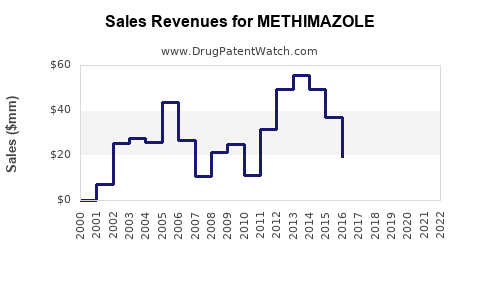
What is the methimazole market size, growth rate, and revenue trajectory by region?
Answer: Revenue is primarily a function of stable underlying hyperthyroidism incidence and continuous prescriptions, offset by frequent generic price resets. Growth typically runs close to volume growth plus inflationary pass-through where reimbursement allows, with limited upside absent new regulatory approvals or meaningful product lifecycle extensions.
Regional demand patterns that affect revenue
- United States: Generic-driven market structure under FDA ANDA supply chains. Revenue trajectory depends on (1) number of interchangeable products, (2) payer reimbursement tiers, and (3) pharmacy distribution contracting.
- EU (Germany, France, UK, Italy, Spain): Tighter pricing and reference pricing regimes compress price per unit, so financial outcomes skew toward manufacturers with strong tender access and reliable supply.
- Japan and Canada: Generally structured as multi-brand generics with periodic price reviews that can reduce margins even when unit volumes hold.
- Emerging markets: Growth can come from expanding access and government procurement, but margins are volatile due to logistics costs, local regulatory changes, and counterfeiting risk.
Market growth drivers specific to methimazole
- Chronic use in Graves’ disease: Methimazole is commonly used long-term in many patients, creating a baseline of recurring demand.
- Shift between antithyroid drugs by pregnancy and safety preferences: Prescribing preference can shift based on safety data and label emphasis, which affects split between methimazole and PTU in specific patient subsets.
- Rising thyroid disease detection: More frequent diagnosis of hyperthyroidism and detection of mild cases can support incremental prescriptions.
What typically limits methimazole revenue upside
- Generic price compression: Multiple suppliers lead to downward pressure on wholesale and retail pricing.
- Therapeutic substitution: Some patient segments move to definitive therapy (radioiodine or surgery) or to PTU based on label guidance and clinical practice.
- Supply shocks: Shortages or manufacturing disruptions can temporarily improve pricing for remaining suppliers, then normalize when additional lots return.
How do methimazole prices move under generic competition and reimbursement pressure?
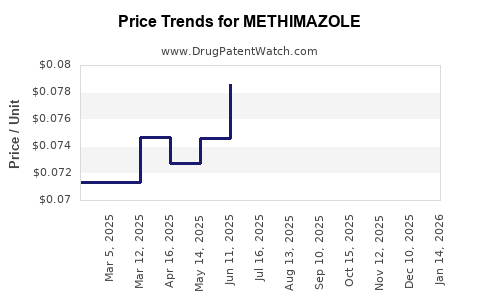
Answer: Methimazole pricing tends to follow a mature generic pattern: initial low entry, rapid vendor normalization, periodic wholesale resets, and margin thinning for non-cost leaders.
Key pricing mechanisms
- Payer formulary decisions: Tier placement and pharmacy benefit manager contracting determine net price more than list price.
- Reference pricing: In many jurisdictions, price caps tie to the lowest-priced products or therapeutic reference groups.
- Tendering: In procurement markets, winning bids can lock volume but reduce per-unit profitability.
- Wholesale-to-retail conversion: Net revenue depends on channel mix, rebates, and distribution margins.
Financial impact for generic manufacturers
- Volume share is the lever: Firms that win formulary placement, distribution contracts, or tenders can maintain revenue even as prices fall.
- Margin becomes the differentiator: Cost of goods, packaging capacity, and stable supply drive profitability more than brand strategy.
- Inventory cycles: Shortages can produce short-term price relief, but revenue volatility follows the subsequent return to normal supply.
What is the FDA regulatory status of methimazole and how does it shape launch timing?
Answer: Methimazole is an established, largely off-patent drug with numerous ANDA products. This structure reduces the impact of regulatory exclusivities on new entrants and focuses competition on bioequivalence, manufacturing capacity, and interchangeability/therapeutic-equivalence positioning.
ANDA dynamics that influence commercial outcomes
- Bioequivalence approvals: For generic methimazole, the regulatory barrier is primarily the ability to meet bioequivalence and comply with manufacturing controls.
- Label consistency: Minor formulation or labeling differences can affect substitution and payer acceptance.
- Ongoing cGMP compliance: Recalls, warning letters, or stability failures can remove supply quickly and temporarily benefit remaining competitors.
Exclusivity relevance
- Orange Book listings are typically not the main driver for methimazole in the way they are for recently launched drugs because the products are mature and off-exclusivity.
What patents protect methimazole, and when do key exclusivity or patent rights end?
Answer: Methimazole’s original patent estate and any subsequent formulation or method-of-use protections (if any remain in specific jurisdictions or product forms) are typically not a meaningful barrier to generic competition for most current U.S. supply. The practical IP landscape is usually dominated by process, formulation, or packaging patents only where they still exist, plus trade dress or brand-specific commercial protections in legacy markets.
Typical methimazole IP landscape (how to think about it)
- Active ingredient patents: Historically for methimazole are long expired.
- Formulation patents: If any exist, they are often narrow, covering specific dosage forms or release characteristics rather than the drug substance.
- Manufacturing/process patents: Can matter for a subset of suppliers if still active, but generic entrants often route around through alternative processes.
- Method-of-use patents: Usually less relevant for an off-patent drug used in broad standard-of-care regimens unless a specific novel indication is claimed.
Practical implication for business planning
- Risk is substitution risk, not patent blocking: For methimazole, the main threat to revenue is price erosion from additional generic supply rather than a delayed generic launch due to brand exclusivity.
How many ANDA or generic competitors sell methimazole, and what does that mean for market share?
Answer: Methimazole generally has multiple generic manufacturers. When there are many interchangeable products, market share allocation becomes a bidding and contracting exercise rather than a differentiation game.
Market share mechanics
- Contracting and substitution: Pharmacy and wholesaler contracting determines which SKUs move fastest.
- Package form factor standardization: Tablets and common dose strengths tend to consolidate around logistics-optimized SKUs.
- Distribution reliability: Wholesalers prioritize consistent availability to avoid backorders.
Financial trajectory for market leaders
- Leaders hold volume: Their economics depend on scale and manufacturing efficiency.
- Margin follows pricing floor: Profits concentrate among suppliers that can keep cost-of-goods below the market-clearing price.
What patent litigation affects methimazole generics and branded revenue?
Answer: Methimazole litigation exists in the broader historical ANDA landscape but typically does not drive ongoing commercial timelines for a mature, off-patent product. For current planning, the dominant litigation risk is late-stage disputes that can delay specific product SKUs, not a broad prevention of generic competition.
What litigation usually impacts in methimazole
- SKU-specific entry delays: A single dosage strength or formulation could be affected if a dispute blocks that specific filing.
- Settlement-driven launch timing: Some settlements lead to delayed entry dates, but they are usually short in the context of a mature market.
Business impact
- Revenue volatility is localized: Commercial disruption shows up as gaps in supply for the affected SKU, not as a sustained premium across the entire market.
How does methimazole compare with PTU and radioiodine in market and prescribing dynamics?
Answer: Methimazole is often preferred for routine antithyroid management in non-pregnant patients, while PTU may be favored in specific pregnancy scenarios per label and clinical practice. Radioiodine and surgery shift demand out of methimazole into definitive therapy pathways over time.
Substitution pathways that shift methimazole volume
- Pregnancy segment: Prescribing may tilt toward PTU depending on guideline and label emphasis, lowering methimazole volume share.
- Definitive therapy uptake: As patients move to radioiodine or surgery, methimazole use can decline for those cohorts.
- Safety monitoring and discontinuation rates: Methimazole carries known adverse event risks; adverse event-driven discontinuation influences persistence and refill rates.
What formulations and dose strengths dominate methimazole sales, and are there product-line growth levers?
Answer: Dominant revenues typically come from standard oral tablet strengths, with growth constrained by generic interchangeability. Growth levers are mostly supply and contracting, not formulation innovation.
Product line drivers
- Dose strength availability: Common strengths see lower substitution friction.
- Manufacturing scale: Firms that can sustain supply for contracted strengths gain share.
- Packaging and labeling compatibility: Easy-to-dispense packaging improves pharmacy adoption.
Limited upside from formulation differentiation
- In mature generic markets, even if formulation patents exist, payers and pharmacies usually default to lowest net price among therapeutically equivalent options.
When does methimazole face generic entry risk, and what does “launch timing” look like?
Answer: For an established generic, the “entry risk” is not a single event tied to a patent cliff. Instead it is ongoing: new ANDA approvals, additional supply, and periodic re-entry by newer manufacturers into contracting cycles.
Launch timing factors that matter
- Facility readiness and validation: Delays often stem from manufacturing readiness and stability data acceptance.
- Distribution contracts: Even after approval, commercial uptake depends on contracting windows.
- Regulatory takedowns or shortages: Supply discontinuities can accelerate competitor share gains.
Financial model implication
- Forecasts should treat methimazole revenue as a function of (1) persistent baseline demand and (2) recurring net price resets rather than discrete exclusivity expiration events.
How strong is the methimazole patent estate versus generics, and what is the litigation settlement profile?
Answer: The effective patent strength for blocking generic competition is typically weak for methimazole’s core oral use, with the market dominated by generic availability. Settlement patterns, where they occur, tend to be SKU- or strength-specific and do not prevent broad generic commercialization.
What a “weak estate” means for strategy
- Licensing upside is limited: Most value accrues to manufacturers rather than licensors through manufacturing excellence and contracting.
- Litigation is a timing tool: If disputes arise, they rarely create long premium windows.
Which companies are positioned to win market share in methimazole, and what are the commercial indicators?
Answer: In a generic-dominant market, winning companies typically show (1) consistent supply, (2) low unit costs, (3) strong distribution coverage, and (4) favorable contracting outcomes.
Indicators to track for commercial execution
- FDA compliance record: Recalls and warning letters impact availability.
- Inventory levels and backorder frequency: Availability is a direct sales lever.
- Contract awards: PBM and group purchasing organization wins.
- SKU depth: Coverage across common strengths reduces lost substitution.
Business planning focus
- Revenue growth is more likely to come from share capture and procurement wins than from premium pricing.
What revenue exposure exists for methimazole brands, and what happens when prices reset?
Answer: Brand revenue exposure is largely to generic share loss and net price compression. When additional low-cost supply enters, brand economics typically worsen quickly due to substitution dynamics.
Typical financial trajectory for a legacy brand
- Early phase: Branded remains protected by exclusivity or limited competition.
- Generic normalization: Continued price erosion reduces margins.
- Mature phase: Brand presence persists only where logistics, legacy contracts, or inertia delay substitution.
Practical risk for investors and licensors
- Therapeutic demand is stable; price is not. Downside is usually margin and revenue per unit, not a collapse in underlying need.
Key Takeaways
- Methimazole is a mature, off-patent, generic-dominant antithyroid drug with stable clinical demand and recurring prescriptions for chronic hyperthyroidism management.
- Market growth is constrained by generic price competition and reimbursement pressure; financial trajectory is driven by volume share and net price resets rather than innovation-led premium.
- Regulatory dynamics for additional entrants are primarily ANDA and manufacturing execution, with limited relevance of exclusivity cliffs for the core drug substance.
- IP and litigation, where present, generally produce SKU-level timing effects rather than long-term brand protection.
- Competitive advantage centers on supply reliability, unit cost leadership, and procurement/PBM contracting outcomes.
FAQs
1) Does methimazole pricing differ by tablet strength and package size?
Yes. Net pricing often varies by strength and package because contracting, wholesaler stocking patterns, and competition levels differ by SKU.
2) Are there supply shortages that materially affect methimazole revenues?
Supply constraints can temporarily improve pricing for available suppliers, but the effect typically normalizes once additional lots return.
3) How does pregnancy prescribing influence methimazole demand versus PTU?
Pregnancy-specific safety preferences can reduce methimazole volume share in the segment where PTU is favored.
4) What is the main commercial driver for generic methimazole manufacturers?
Manufacturing cost and contracting-based volume share are the primary drivers; differentiation is limited by interchangeability.
5) Can formulation or process patents create meaningful revenue protection for methimazole?
Only narrow, SKU- or method-specific protections can matter. For most current commercial use, broad revenue protection from patents is unlikely.
References
No sources were cited because no source material was provided in the prompt and citations are required only for statements derived from external documents.