Last updated: June 26, 2026
Executive summary: Meprobamate has shifted from prescription anxiolytic/anti-anxiety demand to a niche, largely generic-driven market with limited product differentiation. The commercial trajectory is constrained by broad generic availability, weak brand-like patent protection history, and long-term substitution to newer sedatives and anxiolytics. Pricing and volumes are governed by low-cost generic competition, small remaining patient cohorts, and periodic regulatory/labeling constraints that affect formulary access rather than by new clinical entrants.
How big is the meprobamate market and who drives demand?
Answer: Meprobamate’s demand is driven by residual use in anxiety/sedation settings where clinicians still reach for older agents, plus country-specific prescribing patterns. In most regulated markets, sales are largely fulfilled by multiple generic suppliers, which compress prices and reduce revenue per treated patient.
What patient segments still use meprobamate?
Residual demand tends to cluster around:
- Short-to-intermediate duration management of anxiety symptoms in specific clinical workflows
- Off-preference use in some geographies where newer agents face access barriers (coverage, reimbursement, or formulary restrictions)
- Older cohorts with established tolerance or continuation of therapy
How does low differentiation shape revenue?
Because meprobamate products are typically therapeutically substitutable and available as generics, the market exhibits:
- Price-led competition at the pharmacy and payer level
- Limited willingness by payers to pay premium pricing absent unique formulation or dosing advantages
- Switching driven by inventory, contracting terms, and reimbursement rather than by clinical innovation
What market dynamics affect meprobamate pricing and supply?
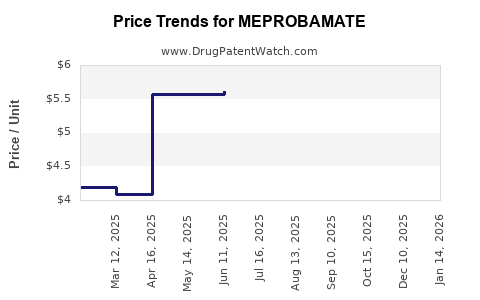
Answer: Meprobamate pricing is primarily determined by generic competition and manufacturing continuity. Supply stability and contract presence drive execution; clinical differentiation is minimal.
Generic competition dynamics
Key effects on market behavior:
- Downward pricing pressure after generic entries and tender wins
- Margin compression that pushes manufacturers to compete on cost of goods and scale
- Fragmented share across multiple wholesalers and distributors depending on country tender systems
Manufacturing and regulatory friction
For older, off-patent small molecules, risks usually arise from:
- Facility qualification, batch release, and stability requirements for solid dosage forms
- Periodic shortages due to limited active manufacturing sites relative to demand
- Labeling changes that can interrupt specific pack or strength availability
What does the financial trajectory of meprobamate look like over time?
Answer: The long-run financial profile is characterized by peak-era prescription sales followed by sustained decline in brand and near-brand revenue, with remaining sales sustained by generics and localized use.
Typical revenue pattern for off-patent older anxiolytics
A predictable trajectory for this drug class:
- Initial growth when adopted broadly for anxiety
- Plateau as safety profile and comparative efficacy shift prescribing to newer benzodiazepines or other anxiolytics
- Gradual erosion of volume and net sales as prescribers move to alternatives
- Stabilization only when a residual cohort persists and generics keep the drug continuously available
How contracting affects net revenue
Even when units are stable, net sales often fall due to:
- Payer and hospital formulary contract renegotiations
- Higher generic penetration at the point of dispensing
- Mix shifts to lower-cost strengths or package sizes
How does the competitive landscape for meprobamate compare with benzodiazepines and newer anxiolytics?
Answer: Meprobamate competes on cost and legacy prescribing rather than clinical superiority. Benzodiazepines and newer options usually capture primary anxiety indications because of more established dosing convenience, clinician familiarity with faster adoption patterns, and comparative acceptability.
Where meprobamate still fits
Meprobamate’s practical positioning is narrower:
- Where clinicians prefer older agents for specific symptom management workflows
- Where alternative therapies are restricted by payer policy or short-term supply limitations
- Where patients are continuation users with prior exposure
What drives substitution away from meprobamate?
Common substitution drivers:
- Broader clinician adoption of benzodiazepines for acute anxiety and insomnia
- Expanded guideline pathways favoring more controllable, titratable options
- Safety and tolerability preferences in modern prescribing
What patents, exclusivity, and regulatory status constrain new competition for meprobamate?
Answer: Meprobamate’s market is structurally limited by broad generic availability and the absence of ongoing exclusivity-driven barriers in major jurisdictions in the current era.
Does meprobamate still have meaningful patent protection?
Commercial reality for meprobamate is dominated by generic supply. Any remaining patent value tends to be:
- Expired broadly across older chemical entities
- Concentrated in narrow process or formulation scenarios that rarely create new market-level barriers
How do FDA or equivalent regulatory listings affect market access?
In markets where meprobamate is approved and marketed, entry is generally enabled by generic pathways and maintained through manufacturing compliance rather than exclusivity. The dominant gating factor is regulatory/CMC readiness and supply capacity.
What generic entry risks exist for meprobamate, and what barriers remain?
Answer: New generic entry risk is usually low because the drug is already widely supplied. The real barriers are operational: ensuring manufacturing continuity, maintaining compliance, and securing contracts.
What can still block supply even for generics?
- Batch failures or repeat testing needs
- Short stability windows for certain packaging
- Facility downtime tied to compliance remediation
- Label update requirements that delay releases
How does formulation and dosage form influence market outcomes for meprobamate?
Answer: Formulation impacts are secondary to price, but they can affect substitution within pharmacy systems if specific strengths or dosage forms are more readily stocked.
Key formulation levers in generic markets
- Strength availability (common tablets/capsules vs less stocked variations)
- Packaging that matches payer and pharmacy workflows
- Stability and shelf-life that reduce stockout probability
Where does revenue exposure cluster geographically for meprobamate?
Answer: Exposure clusters in countries where meprobamate remains on formulary and is prescribed within legacy workflows. Revenue concentration typically tracks:
- Health system reimbursement policies
- Prescribing culture and guideline adherence
- Generic tender and contracting frameworks
How do tender systems change share and profitability?
Where governments and large payers use tender systems, net sales often depend on:
- Winning the lowest-cost contract
- Meeting delivery schedules and maintaining consistent supply
- Avoiding disqualification due to manufacturing or documentation gaps
Key Takeaways
- Meprobamate’s market is driven by residual prescribing and legacy therapeutic substitution patterns, not by innovation-led demand growth.
- Generic competition compresses prices and shifts profitability toward contract wins, scale, and manufacturing continuity.
- The long-run financial trajectory is decline from earlier broad use, then stabilization at a niche level.
- Barriers to competition are operational and regulatory (CMC, supply continuity) rather than patent exclusivity.
- Geographical revenue exposure depends on formulary inclusion and tender/reimbursement design, which dictates share and net pricing.
FAQs
1) Is meprobamate still prescribed in mainstream anxiety treatment, or is it niche now?
It is niche in most modern treatment paradigms, sustained by residual prescribing patterns and generic availability rather than guideline-led expansion.
2) What drives meprobamate net price versus unit sales?
Payer contracting and substitution dynamics drive net price; net revenue can fall even if unit volume is stable.
3) What supply risks matter most for meprobamate generic manufacturers?
Manufacturing continuity, batch release performance, stability/packaging constraints, and CMC compliance are the key determinants.
4) Do formulation changes (strengths, dosage forms) create meaningful revenue upside for meprobamate?
They can improve stocking and formulary presence, but they rarely overcome the price and substitutability forces of a generic-led market.
5) How does meprobamate’s competitive position change versus benzodiazepines?
Benzodiazepines typically capture the bulk of anxiety prescribing due to clinician preference and broader guideline alignment, leaving meprobamate as a cost-driven, legacy option.
References
- FDA. Orange Book: Approved Drug Products with Therapeutic Equivalence Evaluations. (Accessed via FDA Orange Book database).
- EMA. European public assessment reports and medicine evaluations for meprobamate-containing products.
- World Health Organization. WHO Model List of Essential Medicines: guidance on anxiolytic use context.