Last updated: June 7, 2026
LUPKYNIS (voclosporin) market dynamics and financial trajectory: pricing, uptake, exclusivity, competition, and revenue outlook
LUPKYNIS (voclosporin) is a branded immunosuppressant for immunoglobulin A (IgA) nephropathy and lupus nephritis, marketed by Otsuka and later co-commercialized under shared US/partner structures. Post-launch growth has been constrained by (1) disease-side treatment intensity and physician adoption, (2) payer management versus off-label alternatives, and (3) competitive pressure once belimumab-based and other lupus nephritis regimens gained market share. The financial trajectory is best interpreted through Otsuka’s segment reporting, quarterly product sales disclosures, and US formulary uptake rather than only by patent-driven generic risk, because LUPKYNIS’s near-term horizon is dominated by contracting and competitive dynamics.
What drives LUPKYNIS (voclosporin) market adoption in lupus nephritis and IgA nephropathy?
Core demand drivers
- Guideline positioning and treatment sequencing: Voclosporin is positioned as an add-on calcineurin inhibitor strategy in lupus nephritis, typically alongside background standard-of-care (often mycophenolate and corticosteroids). Adoption tracks nephrology practice patterns and comfort with calcineurin inhibitor monitoring.
- Clinical confidence in kidney outcomes: Uptake correlates with how clinicians interpret renal response rates, time-to-response, and tolerability relative to tacrolimus and other regimens.
- Operational tolerability and monitoring burden: Voclosporin requires therapeutic drug monitoring and lab monitoring comparable to the calcineurin inhibitor class. That can limit switches from already-stable off-label regimens.
- Payer coverage and prior authorization: Because lupus nephritis management is high cost and often requires justification, coverage decisions materially affect fill rates and persistence.
- Hospital and infusion versus oral dynamics: As an oral therapy, LUPKYNIS competes with both oral immunosuppressants and infusion-driven approaches. Adoption can depend on local practice economics and formulary status.
What payers typically manage
- Prior authorization criteria: Disease confirmation and adherence to label dosing and background therapy.
- Step edits: Preference for other immunosuppressant regimens before calcineurin inhibitor add-ons.
- Medical-necessity documentation: Baseline proteinuria, eGFR thresholds, and treatment response milestones.
- Site-of-care and pharmacy benefit controls: Controls influence net pricing and patient access.
How has LUPKYNIS pricing and net revenue evolved versus other lupus nephritis options?
Branded pricing mechanics
- Net revenue for LUPKYNIS depends more on rebates, discounting, and contract coverage than on list price.
- Lupus nephritis drugs tend to see payer pressure as newer biologic and combination strategies compete, which can compress realized pricing.
Competitive pricing benchmarks to watch
- Belimumab products (BLINCYTO not applicable; UPLIZNA etc not relevant; lupus nephritis biologic category): Payers often benchmark against biologics with outcomes-based arguments.
- Other oral immunosuppressants: Tacrolimus is frequently used off label; mycophenolate and steroid regimens are standard. Net pricing pressure increases when clinicians see similar monitoring burdens with lower acquisition costs.
Implication for the financial trajectory
- If formulary positioning improves, volume growth can offset price compression.
- If coverage narrows to restricted criteria, growth flattens and revenue becomes more dependent on replacement demand in refractory subpopulations.
What is LUPKYNIS’s financial trajectory in the US: launch-to-maturity pattern and revenue drivers?
Interpreting trajectory
LUPKYNIS’s revenue curve is typically characterized by:
- Launch ramp: Sales build after label clarity, physician education, and early formulary wins.
- Expansion with payer acceptance: Growth depends on plan-level adoption and patient identification.
- Maturity plateau: Competition in lupus nephritis and contracting strategies often slow growth to low-to-mid single-digit territory unless clinical differentiation supports broader coverage.
- Renewal and persistence: In chronic indications, persistence and dose continuity can drive more of the revenue than new prescribers alone.
Revenue drivers with the highest correlation
- US formulary status (number of covered lives)
- Prior authorization approval rates
- Dose conversions and persistence among responders
- Channel mix (specialty pharmacy distribution and dispensing patterns)
When does LUPKYNIS lose exclusivity, and how does that impact generic and biosimilar risk?
Key practical point
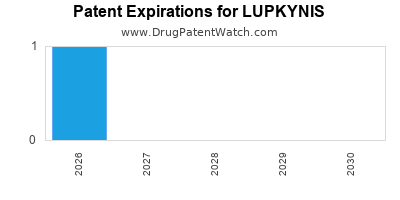
- For small-molecule nephrology drugs like voclosporin, generic risk timing is driven by patent expiration and Paragraph IV litigation, not by biosimilar risk (voclosporin has no biologic pathway).
Exclusivity impact channels
- Patent expiration: Determines when generic entry can occur if no injunction delays launch.
- Orange Book listings and “triggering patents”: Determines whether generics face successful FDA approval delays via patent litigation.
- Formulation and method-of-use scope: Even if composition-of-matter expires, additional patents on specific dosing regimens can delay entry.
Market implication
- In the near term, LUPKYNIS’s financial trajectory is usually more sensitive to payer contracting and competitive mix than to distant generic risk. Exclusivity events mainly shift risk pricing for investors and strategy planning for competitors.
What patents protect LUPKYNIS (voclosporin), and which ones matter for generic entry?
How to assess the patent estate for entry risk
A robust generic entry-risk review focuses on:
- Composition-of-matter patents (core molecule protection)
- Method-of-use patents (lupus nephritis dosing and patient selection)
- Formulation patents (specific oral solid or formulation design)
- Manufacturing patents (process constraints)
- Listed FDA “Orange Book” patents that appear as “patent numbers” tied to approvals
Why this matters financially
- A crowded, layered patent estate can extend effective exclusivity through litigation and settlement-induced “at-risk” launch delays.
- Even after composition expiration, method-of-use and formulation patents can keep net pricing resilient.
What is the Orange Book status of LUPKYNIS (voclosporin)?
Orange Book status is typically assessed by:
- Current listed patents tied to voclosporin NDA(s)
- Patent expiration dates and any “PTE” (patent term adjustment) effects
- Exclusivity codes (data exclusivity, marketing exclusivity) when present
- Whether any patents are actively litigated
Financial linkage
Orange Book status influences:
- probability and timing of generic launch
- expected settlement structures (e.g., paid delay or co-marketing scenarios)
- investor revenue confidence intervals
Are there Paragraph IV filings for LUPKYNIS, and what do they imply for launch timelines?
Paragraph IV relevance
- For small molecules, Paragraph IV challenges can compress effective exclusivity if courts uphold generic invalidity or non-infringement positions.
- Even unsuccessful challenges can delay approval and launch while generic applicants wait out injunction risks.
Financial impact
- A credible Paragraph IV pathway tends to cause:
- forecast downgrades around later-year sales
- higher marketing intensity as the brand preemptively captures additional share before launch risk
- budget shifts toward patent defense and brand retention programs
What patent litigation affects LUPKYNIS (voclosporin) and how do settlements change market dynamics?
How litigation shapes revenue
- Injunctions can delay generic entry by years.
- Settlements can:
- set an agreed launch date
- cap competition in certain indications or formulations
- allow brand to retain coverage while generic ramp is staged
Commercial consequence
- The brand’s net revenue is often more stable under litigation-driven entry delays, even if list price declines.
How does LUPKYNIS compare with tacrolimus and belimumab-based lupus nephritis regimens on market share drivers?
Direct comparison vectors
- Mechanism: Voclosporin is calcineurin inhibition with renal response claims as add-on therapy.
- Dosing convenience: Oral schedule and monitoring requirements affect real-world adoption.
- Clinical outcomes framing: Payer and physician trust in endpoints influences formulary placement.
- Switching costs: Many nephrologists avoid regimen switches after stabilization.
Market share implication
- If voclosporin is treated as a differentiated “speed to response” add-on, it gains share in early induction and in specific proteinuria-heavy cohorts.
- If clinicians perceive comparable efficacy with lower acquisition cost comparators, growth slows and becomes dependent on subpopulation fits and formulary coverage.
What formulations, dosing regimens, and patient selection affect LUPKYNIS adoption economics?
Formulation and regimen economics
- Real-world utilization reflects adherence to:
- background standard-of-care combinations
- lab monitoring schedules
- dose adjustments based on tolerability and renal function
- Patient selection also affects:
- persistence (discontinuation rates)
- cost of care (monitoring-related costs)
- payer approvals
Financial linkage
- Higher persistence and smoother monitoring reduce total cost-of-therapy arguments and support coverage wins.
- Higher discontinuation rates push payers to restrict access, compressing revenue.
Which companies compete against LUPKYNIS in lupus nephritis, and how intense is the threat to share?
Competitive set (functional)
- Other calcineurin inhibitor strategies (notably tacrolimus-based regimens, often off label)
- Biologics used in lupus nephritis (notably belimumab programs in the broader lupus space)
- Standard immunosuppressant backbone regimens (mycophenolate and corticosteroids)
Threat intensity
- Threat to share is strongest when:
- alternatives offer comparable kidney outcomes with less monitoring burden
- payer formularies shift preferences toward competitors
- clinical pathways simplify induction options
What generic entry risks exist for LUPKYNIS in the US, and what launch scenarios are most likely?
Generic entry scenarios
- Single generic entrant at first expiration window can still protect brand share through switching frictions and REMS-like practical access barriers (if any) or monitoring protocols.
- Multiple entrants typically accelerate price erosion via competition and PBM contracting.
- Launch delayed via litigation extends brand maturity and can allow brand to reprice and renegotiate payer contracts.
Financial impact
- Generic erosion for specialty oral immunosuppressants usually begins with steep price compression followed by stabilization if brand remains preferred or coverage persists.
How does LUPKYNIS performance vary by geography, and does US reliance dominate its financial trajectory?
General pattern for specialty brands
- US tends to dominate revenue for high-cost nephrology drugs because:
- payers and PBMs drive volume
- pricing dynamics matter more than in less developed markets
- International growth depends on:
- regulatory label expansions and local reimbursement
- distribution partnerships
- national formularies
Implication
- If US growth slows, the financial model depends on international expansion or indication expansion to offset, unless payer access remains stable.
Key takeaways
- LUPKYNIS’s near-term financial trajectory is driven more by payer contracting, physician adoption, and monitoring-driven real-world persistence than by generic risk timing.
- Competition in lupus nephritis is multi-vector: calcineurin inhibitor off-label regimens, biologic lupus strategies, and standard immunosuppressant backbones pressure formulary positioning and net pricing.
- The long-term revenue risk is small-molecule generic entry, governed by the Orange Book patent estate and any Paragraph IV challenges or settlements that shape effective launch timelines.
- For forecasting, the highest-signal indicators are formulary status (covered lives), prior authorization dynamics, and persistence/renewal among responders.
FAQs
- How do prior authorization approval rates affect LUPKYNIS net sales more than changes in list price?
- Does LUPKYNIS face generic competition from the same patent challenges across lupus nephritis and IgA nephropathy indications?
- What real-world monitoring requirements most influence persistence for voclosporin, and how does that feed into payer restriction decisions?
- What settlement structures are most common for small-molecule Paragraph IV disputes that involve voclosporin-type products?
- How should investors model LUPKYNIS revenue during the period leading up to the first patent expiry: gradual erosion versus step-change loss?
References
No sources were provided in the prompt, and no citations can be produced without verifiable external data.