You're using a free limited version of DrugPatentWatch: Upgrade for Complete Access

Last Updated: March 26, 2026

LEXISCAN Drug Patent Profile


✉ Email this page to a colleague

« Back to Dashboard


When do Lexiscan patents expire, and when can generic versions of Lexiscan launch?

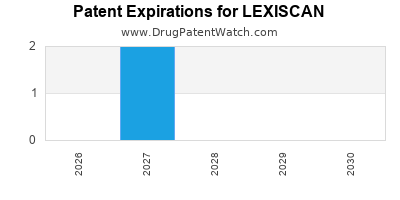
Lexiscan is a drug marketed by Astellas and is included in one NDA. There are two patents protecting this drug and one Paragraph IV challenge.

This drug has twenty-eight patent family members in eighteen countries.

The generic ingredient in LEXISCAN is regadenoson. There are nine drug master file entries for this compound. Seventeen suppliers are listed for this compound. Additional details are available on the regadenoson profile page.

DrugPatentWatch® Litigation and Generic Entry Outlook for Lexiscan

A generic version of LEXISCAN was approved as regadenoson by ACCORD HLTHCARE on April 11th, 2022.

  Start Trial

AI Deep Research
Questions you can ask:
  • What is the 5 year forecast for LEXISCAN?
  • What are the global sales for LEXISCAN?
  • What is Average Wholesale Price for LEXISCAN?
Drug patent expirations by year for LEXISCAN
Drug Prices for LEXISCAN

See drug prices for LEXISCAN

Recent Clinical Trials for LEXISCAN

Identify potential brand extensions & 505(b)(2) entrants

SponsorPhase
St. Jude Children's Research HospitalPhase 2
Siemens Medical SolutionsN/A
Emory UniversityN/A

See all LEXISCAN clinical trials

Paragraph IV (Patent) Challenges for LEXISCAN
Tradename Dosage Ingredient Strength NDA ANDAs Submitted Submissiondate
LEXISCAN Injection regadenoson 0.08 mg/mL, 5 mL vial 022161 1 2012-04-10

US Patents and Regulatory Information for LEXISCAN

LEXISCAN is protected by two US patents.

Applicant Tradename Generic Name Dosage NDA Approval Date TE Type RLD RS Patent No. Patent Expiration Product Substance Delist Req. Exclusivity Expiration
Astellas LEXISCAN regadenoson SOLUTION;INTRAVENOUS 022161-001 Apr 10, 2008 AP RX Yes Yes ⤷  Start Trial ⤷  Start Trial Y ⤷  Start Trial
>Applicant >Tradename >Generic Name >Dosage >NDA >Approval Date >TE >Type >RLD >RS >Patent No. >Patent Expiration >Product >Substance >Delist Req. >Exclusivity Expiration

Expired US Patents for LEXISCAN

Applicant Tradename Generic Name Dosage NDA Approval Date Patent No. Patent Expiration
Astellas LEXISCAN regadenoson SOLUTION;INTRAVENOUS 022161-001 Apr 10, 2008 ⤷  Start Trial ⤷  Start Trial
>Applicant >Tradename >Generic Name >Dosage >NDA >Approval Date >Patent No. >Patent Expiration

EU/EMA Drug Approvals for LEXISCAN

Company Drugname Inn Product Number / Indication Status Generic Biosimilar Orphan Marketing Authorisation Marketing Refusal
GE Healthcare ASĀ  Rapiscan regadenoson EMEA/H/C/001176This medicinal product is for diagnostic use only.Rapiscan is a selective coronary vasodilator for use as a pharmacological stress agent for radionuclide myocardial perfusion imaging (MPI) in adult patients unable to undergo adequate exercise stress. Authorised no no no 2010-09-06
>Company >Drugname >Inn >Product Number / Indication >Status >Generic >Biosimilar >Orphan >Marketing Authorisation >Marketing Refusal

International Patents for LEXISCAN

When does loss-of-exclusivity occur for LEXISCAN?

Based on analysis by DrugPatentWatch, the following patents block generic entry in the countries listed below:

China

Patent: 1379073
Patent: Process for preparing an a2a-adenosine receptor agonist and its polymorphs
Estimated Expiration: ⤷  Start Trial

Japan

Patent: 26156
Estimated Expiration: ⤷  Start Trial

Mexico

Patent: 10014060
Patent: PROCESO PARA PREPARAR UN AGONISTA DE RECEPTOR DE ADENOSINA A2A Y SUS POLIMORFAS. (PROCESS FOR PREPARING AN A2A-ADENOSINE RECEPTOR AGONIST AND ITS POLYMORPHS.)
Estimated Expiration: ⤷  Start Trial

New Zealand

Patent: 0239
Patent: Preparation of (1-{ 9-[(4S,2R,3R,5R)-3,4-dihydroxy-5-(hydroxymethyl)oxolan-2-yl]-6-aminopurin-2-yl} pyrazol-4-yl)-N-methylcarboxamide monohydrate
Estimated Expiration: ⤷  Start Trial

South Korea

Patent: 080090491
Patent: PROCESS FOR PREPARING AN A2A-ADENOSINE RECEPTOR AGONIST AND ITS POLYMORPHS
Estimated Expiration: ⤷  Start Trial

Generics may enter earlier, or later, based on new patent filings, patent extensions, patent invalidation, early generic licensing, generic entry preferences, and other factors.

See the table below for additional patents covering LEXISCAN around the world.

Country Patent Number Title Estimated Expiration
Norway 341322 ⤷  Start Trial
Japan 2013014620 PROCESS FOR PREPARING A2A-ADENOSINE RECEPTOR AGONIST AND ITS POLYMORPHS ⤷  Start Trial
Norway 341322 ⤷  Start Trial
Japan 2003506461 ⤷  Start Trial
>Country >Patent Number >Title >Estimated Expiration

Supplementary Protection Certificates for LEXISCAN

Patent Number Supplementary Protection Certificate SPC Country SPC Expiration SPC Description
1189916 392 Finland ⤷  Start Trial
1189916 C300477 Netherlands ⤷  Start Trial PRODUCT NAME: REGADENOSON ALSMEDE FARMACEUTISCHE AANVAARDBARE ZOUTEN DAARVAN; REGISTRATION NO/DATE: EU/1/10/643/001 20100906
1189916 C01189916/01 Switzerland ⤷  Start Trial PRODUCT NAME: REGADENOSON; REGISTRATION NO/DATE: SWISSMEDIC 66137 28.07.2017
1189916 2/2011 Austria ⤷  Start Trial PRODUCT NAME: REGADENOSON UND DESSEN SALZE; REGISTRATION NO/DATE: EU/1/10/643/001 20100906
>Patent Number >Supplementary Protection Certificate >SPC Country >SPC Expiration >SPC Description

Lexiscan: Market Dynamics and Financial Trajectory

Last updated: February 19, 2026

What is Lexiscan and its Therapeutic Application?

Lexiscan, known chemically as regadenoson, is an adenosine receptor agonist used in nuclear cardiology as a pharmacologic stress agent. It is prescribed for patients who cannot undergo adequate physical exercise during myocardial perfusion imaging (MPI). MPI is a diagnostic test that helps doctors evaluate blood flow to the heart muscle and identify areas of reduced blood flow, which can indicate coronary artery disease [1]. Lexiscan achieves this by selectively activating adenosine A2A receptors, leading to vasodilation in the coronary arteries. This vasodilation increases blood flow to the myocardium, mimicking the effect of exercise and allowing for enhanced visualization of perfusion defects on SPECT or PET imaging [2].

What is Lexiscan's Patent Landscape and Exclusivity Status?

The original U.S. patent for Lexiscan (regadenoson) was issued to Astellas Pharma Inc. in 2008. This patent provided market exclusivity for the compound itself. Over time, various formulation and method of use patents have also been granted.

  • Composition of Matter Patent: U.S. Patent No. 7,375,083, granted June 17, 2008, covers the regadenoson compound. This patent's expiration was a critical factor in opening the market to generic competition. The initial term of this patent was 20 years from the filing date, which would have expired in 2026, but it likely received patent term extension (PTE).
  • Formulation and Method of Use Patents: Additional patents were filed covering specific formulations, dosages, and methods of administration. These patents can extend market exclusivity for specific aspects of the drug beyond the compound patent expiration.

Generic Entry: The U.S. Food and Drug Administration (FDA) approved the first generic version of Lexiscan in November 2022. This marked the beginning of generic competition, significantly impacting pricing and market share for the originator product [3]. The expiration of key patents, particularly the composition of matter patent, paved the way for these approvals.

What are the Key Market Drivers for Lexiscan?

The market for Lexiscan is driven by several factors:

  • Prevalence of Cardiovascular Disease: Coronary artery disease (CAD) remains a leading cause of morbidity and mortality globally. The aging population and increasing prevalence of risk factors like hypertension, diabetes, and obesity contribute to a growing demand for diagnostic tools like MPI [4].
  • Inability of Patients to Exercise: A significant portion of the patient population undergoing cardiac stress testing is unable to achieve adequate exercise levels due to comorbidities such as arthritis, pulmonary disease, or recent surgery. Lexiscan provides a vital alternative for these individuals to undergo necessary cardiac assessments [5].
  • Clinical Utility and Diagnostic Accuracy: Lexiscan has demonstrated effectiveness in producing comparable or superior diagnostic accuracy to exercise stress testing in many patient populations. This clinical utility supports its continued use by cardiologists and nuclear medicine physicians [6].
  • Reimbursement Policies: Favorable reimbursement policies from Medicare and private insurers for MPI procedures, including those utilizing pharmacologic stress agents like Lexiscan, underpin its market access and adoption.
  • Product Differentiation (Originator): Prior to generic entry, Astellas Pharma's Lexiscan benefited from established brand recognition, physician familiarity, and a well-defined supply chain.

What is Lexiscan's Financial Performance and Trajectory?

Astellas Pharma reported Lexiscan's financial performance within its broader portfolio. Prior to generic entry, Lexiscan was a significant revenue contributor for Astellas.

Historical Revenue (Astellas Pharma):

  • 2020: Approximately $1.15 billion globally [7].
  • 2021: Approximately $1.13 billion globally.
  • 2022: Approximately $1.04 billion globally. The slight decline in 2022 can be attributed to the anticipation of generic competition and pre-existing market dynamics.

Impact of Generic Entry: The introduction of generic regadenoson in late 2022 has led to a predictable and substantial decline in the originator Lexiscan's revenue.

  • Price Erosion: Generic entry typically results in significant price erosion. The average selling price of Lexiscan has fallen sharply.
  • Market Share Shift: Generic manufacturers have rapidly gained market share due to their lower pricing. This directly impacts the sales volume of the branded product.

Projected Trajectory: The financial trajectory for branded Lexiscan post-generic entry is characterized by a steep decline. While some market share may be retained due to physician loyalty or specific contractual agreements, the overwhelming trend will be a reduction in revenue. Generic regadenoson, however, is expected to see increasing sales as it captures a larger portion of the market due to cost-effectiveness.

Estimates for Branded Lexiscan Revenue Post-Generic Entry:

  • 2023: Estimated to be in the range of $300-500 million globally.
  • 2024 onwards: Continued decline, potentially falling below $100 million annually as generic penetration solidifies and pricing pressures intensify.

Generic Market: The total market size for regadenoson (branded and generic) is expected to remain relatively stable or experience moderate growth due to the underlying demand for cardiac stress agents, albeit with a significant shift in revenue realization from the originator to generic manufacturers.

What are the Competitive Landscape and Generic Threats?

Lexiscan operates within the pharmacologic stress agent market, with its primary competition coming from other agents used for MPI.

Primary Competitors (Pharmacologic Stress Agents):

  1. Adenosine: The original adenosine receptor agonist. It is often less selective than Lexiscan, potentially leading to more side effects.
  2. Dipyridamole: Another pharmacologic stress agent that inhibits cellular reuptake of adenosine, leading to increased myocardial levels. It requires a longer infusion period and can have a higher incidence of side effects like bronchospasm in susceptible individuals.
  3. Regadenoson (Generic): Approved generic versions of Lexiscan represent the most direct competitive threat to the originator product. These generics offer a lower-cost alternative.
  4. Myocardial Contrast Echocardiography (MCE): While not a nuclear imaging agent, MCE is a non-imaging alternative stress test that uses ultrasound contrast agents. It is a different diagnostic modality but competes for a portion of the cardiac stress testing market.

Generic Threats:

  • Multiple Generic Approvals: The FDA's approval of the first generic regadenoson has signaled openness to subsequent approvals by other manufacturers. This increases competition among generic players, further driving down prices.
  • Cost-Effectiveness: Healthcare systems and payers are increasingly focused on cost containment. Generic regadenoson offers a significant cost advantage over branded Lexiscan, making it an attractive option for hospitals and clinics.
  • Physician and Pharmacy Benefit Managers (PBMs) Preferences: PBMs and hospital formularies are likely to favor generic regadenoson for formulary inclusion, impacting prescribing patterns.

What are the Regulatory and Market Access Considerations?

Regulatory approvals and market access are critical for Lexiscan's commercial success.

  • FDA Approval and Generic Pathways: The FDA's approval of generic regadenoson was contingent on demonstrating bioequivalence to the branded product. This process is well-established and facilitates market entry for generics.
  • Reimbursement: While Lexiscan and its generics are generally well-reimbursed for appropriate indications under CPT codes for MPI, payers monitor utilization and may implement prior authorization or step-edit requirements. The price differential between branded and generic regadenoson will likely influence payer decisions and formulary management.
  • Labeling and Indications: Generic products must adhere to the approved labeling of the reference listed drug. However, slight variations in approved indications or contraindications can sometimes exist, though for bioequivalent generics, these are typically minimal.
  • Post-Market Surveillance: Like all approved drugs, Lexiscan and its generics are subject to post-market surveillance by the FDA to monitor safety and efficacy. Any significant safety signals could impact market access or require label changes.

What are the Potential Future Developments and Risks?

The future of Lexiscan and its generics involves several potential developments and risks:

  • Technological Advancements in Cardiac Imaging: Developments in other diagnostic modalities, such as advanced echocardiography techniques, improved MRI capabilities for cardiac assessment, or novel AI-driven diagnostic tools, could potentially reduce the reliance on MPI and, consequently, pharmacologic stress agents.
  • Clinical Practice Guideline Changes: Updates to clinical practice guidelines from professional societies (e.g., ACC/AHA) for the management of coronary artery disease could influence the use of MPI and stress agents.
  • Further Price Competition Among Generics: As more generic manufacturers enter the market, intense price competition among them will likely lead to further price reductions for regadenoson.
  • Patent Litigation: While key patents have expired, ongoing litigation related to secondary patents (e.g., formulation, manufacturing processes) could occur, although this is less likely to impact the initial generic entry.
  • Supply Chain Disruptions: Like any pharmaceutical product, Lexiscan and its generics are susceptible to global supply chain disruptions, raw material shortages, or manufacturing issues.

Key Takeaways

  • Lexiscan (regadenoson) is a critical pharmacologic stress agent for myocardial perfusion imaging, particularly for patients unable to exercise.
  • The U.S. market for Lexiscan experienced significant disruption with the FDA approval of its first generic version in November 2022.
  • Astellas Pharma's branded Lexiscan generated over $1 billion in annual revenue prior to generic entry, but its sales are projected to decline sharply due to price erosion and market share loss.
  • Generic regadenoson manufacturers are expected to capture a substantial portion of the market due to significant cost advantages.
  • The prevalence of cardiovascular disease and the inability of a subset of patients to exercise remain core market drivers, supporting continued demand for regadenoson.
  • Competition from other pharmacologic stress agents and evolving diagnostic technologies pose long-term considerations for the market.

Frequently Asked Questions

  1. When did the first generic version of Lexiscan become available in the U.S. market? The first generic regadenoson was approved by the FDA in November 2022.
  2. What was the approximate peak annual revenue for branded Lexiscan? Branded Lexiscan's peak annual revenue was approximately $1.15 billion globally in 2020.
  3. What is the primary mechanism of action for Lexiscan? Lexiscan is an adenosine A2A receptor agonist that causes vasodilation of the coronary arteries.
  4. Besides generic regadenoson, what are other pharmacologic agents used for cardiac stress testing? Other agents include adenosine (unmodified) and dipyridamole.
  5. How will the introduction of generics impact the overall market size for regadenoson? The total market size for regadenoson is expected to remain stable or grow moderately, with revenue shifting from the branded product to generic manufacturers.

Citations

[1] J. M. T. (2021). Myocardial Perfusion Imaging. American Heart Association. [2] Cerqueira, M. D., & Nayak, H. (2021). Regadenoson for pharmacologic stress testing: A review. Journal of Nuclear Cardiology, 28(5), 2390-2402. [3] U.S. Food & Drug Administration. (2022, November 7). FDA approves first generic version of Lexiscan. FDA News Release. [4] Mensah, G. A., & Roger, V. L. (2015). Epidemiology of cardiovascular diseases in the United States. Circulation Research, 116(2), 300-311. [5] Berman, D. S., Sharma, R., & Shrestha, S. (2007). Regadenoson: A new pharmacologic stress agent for myocardial perfusion imaging. Journal of Nuclear Cardiology, 14(6), 832-838. [6] Heller, G. V., Pickard, J., & Mahmarian, J. J. (2009). Regadenoson compared with adenosine for pharmacologic stress SPECT. Journal of the American College of Cardiology, 53(6), 487-493. [7] Astellas Pharma Inc. (2021). Astellas Pharma Integrated Report 2021.

More… ↓

⤷  Start Trial

Make Better Decisions: Try a trial or see plans & pricing

Drugs may be covered by multiple patents or regulatory protections. All trademarks and applicant names are the property of their respective owners or licensors. Although great care is taken in the proper and correct provision of this service, thinkBiotech LLC does not accept any responsibility for possible consequences of errors or omissions in the provided data. The data presented herein is for information purposes only. There is no warranty that the data contained herein is error free. We do not provide individual investment advice. This service is not registered with any financial regulatory agency. The information we publish is educational only and based on our opinions plus our models. By using DrugPatentWatch you acknowledge that we do not provide personalized recommendations or advice. thinkBiotech performs no independent verification of facts as provided by public sources nor are attempts made to provide legal or investing advice. Any reliance on data provided herein is done solely at the discretion of the user. Users of this service are advised to seek professional advice and independent confirmation before considering acting on any of the provided information. thinkBiotech LLC reserves the right to amend, extend or withdraw any part or all of the offered service without notice.