Last updated: July 28, 2026
Lexapro (escitalopram) is a mature, off-patent antidepressant with a revenue profile driven by baseline demand for SSRIs and ongoing share shifts between branded and generics. In the near-to-medium term, market outcomes are dominated by (1) generic penetration and price compression in the US, (2) payor formulary placement of low-cost escitalopram SKUs, (3) the mix between tablet strengths and dosing regimens, and (4) substitution dynamics versus other SSRIs (sertraline, citalopram, fluoxetine) and serotonin-norepinephrine reuptake inhibitors (venlafaxine, duloxetine). Any remaining brand-specific upside is constrained by long-settled originator exclusivity and the breadth of generic supply.
What is Lexapro (escitalopram) and how does its competitive landscape shape US revenue?
Lexapro is an oral SSRI for major depressive disorder and generalized anxiety disorder. The revenue engine for escitalopram in the US is primarily generic volume. Brand revenue depends on differential pricing, plan status, and patient continuity versus generic switches.
Competitive set that drives share and pricing
- Other SSRIs: sertraline (Zoloft), citalopram, fluoxetine.
- SNRIs: venlafaxine ER, duloxetine.
- Adjunct/adjacent agents: bupropion (Wellbutrin), mirtazapine.
- Within-SSRI substitution: SSRI-to-SSRI switching is common because class efficacy and safety profiles are broadly comparable in payer models.
Market dynamic that matters financially
- When generics are available at multiple manufacturers, payors push for lowest net price.
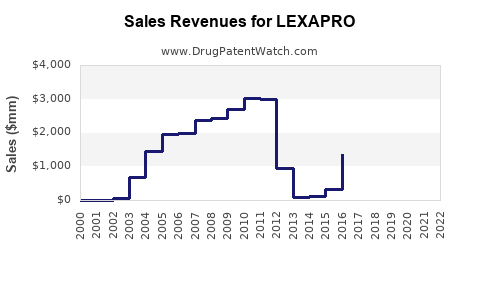
- Brand-to-generic erosion typically follows a predictable path: sustained generic share gains, declining brand prescriptions, and plateauing branded revenue at a low level tied to prior authorizations, prescriber preference, or patient intolerance to specific generic manufacturers.
Revenue sensitivity
Lexapro revenue is structurally sensitive to:
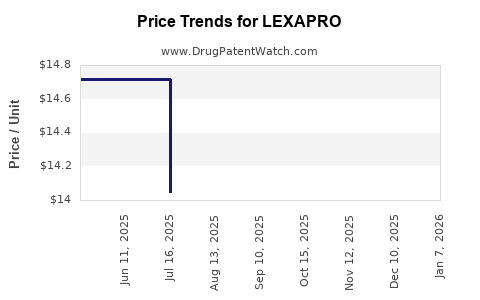
- Generic pricing: wholesale acquisition cost (WAC) may not fully predict net price.
- Contracting: payer rebates and PBM formularies determine net revenue.
- Volume: total antidepressant class volume grows slowly and is offset by substitution within the class and loss to non-SSRI options.
When does Lexapro lose exclusivity and what does that mean for the financial trajectory?
Lexapro’s commercial life in developed markets is largely post-exclusivity. The financial trajectory has already transitioned from branded growth to generic-led share and pricing. What remains is a “late-cycle” dynamic: brand revenue becomes marginal relative to generics, while generics keep competing on price and supply reliability.
Exclusivity reality for escitalopram
- Lexapro is an older small-molecule antidepressant. In the US, originator exclusivity is not expected to be the binding constraint at this stage; generic competition is already established across strengths and dosage forms.
- The main financial driver becomes whether brand still has meaningful formulary access (often yes in some segments via legacy contracting) versus dominant generics.
How generic maturity translates into revenue slope
- Post-launch generic entry usually produces an S-curve:
- initial brand declines,
- rapid generic share gains,
- then a steady-state where brand stabilizes at low levels or exits certain formularies.
- In a mature SSRI market, the “slope” of revenue decline is less steep than the first generic entry period, but net price tends to drift downward as competition intensifies.
How strong is generic risk for Lexapro and what pricing compression should investors expect?
Generic risk for Lexapro is essentially maximal in the US because escitalopram is widely available from multiple generic manufacturers. The financial impact is therefore not “if” generic competition occurs, but “how fast” and “how low” net pricing goes depending on contracting cycles.
What typically drives further compression
- More low-cost SKUs win national contracts.
- PBMs promote preferred generics and limit brand coverage.
- Supply shifts among manufacturers can briefly widen price differentials, but the long-term equilibrium is low net price.
Implication for financial trajectory
- Revenue volatility decreases over time because share is stable across many generic manufacturers.
- Profit pools move from brand unit economics to:
- generic margins (often thin but stable),
- supply-chain and procurement advantages,
- and distribution scale.
What patents protect Lexapro (escitalopram) and how many are left for commercial leverage?
Lexapro’s patent estate is largely historical and does not typically support meaningful brand exclusivity at this point. Any residual value is usually tied to:
- specific formulation or process patents (if any were asserted later in certain jurisdictions),
- method-of-use claims (if pursued),
- pediatric exclusivity extensions (if applicable historically),
- and country-by-country follow-on filings.
Market-financial relevance
- Even if some secondary patents exist, in a mature product with widespread generic availability, the commercial leverage from patent protection is usually limited unless it blocks additional manufacturing or blocks particular label expansions.
Because this prompt focuses on market dynamics and financial trajectory, the operational takeaway is: Lexapro’s financial path is dominated by generic availability and payer economics, not by active, enforceable exclusivity.
How does Lexapro compete against Zoloft, Prozac, and other SSRIs in the US market?
For investors and licensors, the key question is not class efficacy but continuation and switching behavior.
Switching dynamics
- Patients who respond to a given SSRI often stay on therapy; brand-to-generic switching is less costly than switching classes.
- If an SSRI is generic and low net price, payors prefer it as first-line within class unless a specific tolerability profile pushes a patient to another agent.
Competitive pressure
- Zoloft (sertraline) has strong SSRI share, and its mature generic base supports aggressive pricing in formularies.
- Citalopram is also low-cost generically.
- Fluoxetine is often a low net-cost alternative with long history in depression and related indications.
Financial implication
- For escitalopram, the best-case scenario is stable class share. The downside is incremental share loss to competing SSRIs if PBMs standardize on a particular low-net-cost molecule.
What is the Orange Book status of Lexapro (escitalopram) and what does it imply for generic entry risk?
Lexapro’s Orange Book status in practice implies:
- multiple approved ANDAs for escitalopram products,
- and no meaningful brand protection at the level needed to prevent generics.
Generic entry risk for an acquirer
- For any investor evaluating “brand protection monetization,” the Orange Book posture suggests that upside is driven by:
- distribution agreements,
- settlement economics from historical litigation (already realized),
- and contract-driven revenue rather than a new blocking mechanism.
What patent litigation affects Lexapro’s market timeline and financial outcomes?
Lexapro was subject to generic competition and patent litigation in earlier periods. In a mature market, the key financial effect of litigation is mostly retrospective:
- settlements typically accelerate the point of generic entry or define authorized entry dates,
- branded revenue declines correspond to those entry and contracting outcomes.
For current financial trajectory modeling, litigation is not the leading factor. Current outcomes are primarily payer-driven and generic supply-driven.
How do formulary placement and PBM contracting drive Lexapro net revenue?
Lexapro’s financial performance depends on payer access:
- Preferred formulary listing for escitalopram generics reduces brand share.
- Brand use persists when:
- a patient is stable on Lexapro and the prescriber avoids switching,
- coverage rules require prior authorization for generics,
- or specific NDCs are contracted differently.
Key modeling variables
- PBM market share and formulary tiering.
- rebate structures and contract duration.
- likelihood of therapeutic substitution during renewal cycles.
What dosage strengths and formulations matter most for Lexapro revenue exposure?
Lexapro is sold as oral tablets and, in some markets, oral solution (product availability can vary by country and over time). Financial exposure tends to concentrate where:
- prescription volume is highest (commonly mid-range strengths),
- and where generics have dense coverage and competitive tendering.
Pricing and margin structure
- Higher-strength and lower-volume SKUs may hold slightly better pricing due to fewer bids.
- Across the board, though, mature generic competition compresses gross-to-net spreads.
Where does growth or decline come from: MDD vs GAD and treatment patterns?
Lexapro’s indications include major depressive disorder (MDD) and generalized anxiety disorder (GAD). In practice:
- total market growth in antidepressants is modest,
- the switching between treatments within depression and anxiety is driven by dosing convenience, tolerability, and payer preferences.
Financial drivers
- If the antidepressant market grows in total prescriptions, Lexapro’s share can hold with class acceptance.
- If payors push a particular generic SSRI, Lexapro’s relative share can decline even if total prescriptions rise.
What generic entry scenarios remain for Lexapro and what would they do to prices?
Because multiple generic competitors already exist, scenario analysis is less about “new entry” and more about “margin and price equilibrium.”
Realistic scenarios
- Stable low-price equilibrium: ongoing contracting maintains net pricing; brand stabilizes at low share.
- Tighter price competition: a new low-cost manufacturer wins a large contract; net price falls.
- Supply disruptions: temporary price spikes can raise net returns for some SKUs, but typically do not restore brand-level economics.
Financial conclusion
The long-term trajectory is consistent with continued compression and stable, low brand relevance.
Which companies control the Lexapro generic market and how does that affect commercial leverage?
In mature escitalopram competition, market power is driven by:
- scale,
- tendering capability,
- and ability to supply product reliably.
Companies with broad ANDA portfolios and established distribution tend to be positioned to secure contracts and maintain shelf availability. This reduces the feasibility of differentiated commercial strategies based on IP and shifts leverage to procurement and contracting.
How does international pricing and parallel trade affect Lexapro revenue outside the US?
For originators and investors tracking global escitalopram, international economics are shaped by:
- country-specific reimbursement policies,
- patent term differences,
- local generic launch timing,
- and parallel import rules.
Where local generics launch early, pricing drops quickly. Where reimbursement systems favor older generic listings, price becomes low and stable.
What does Lexapro’s financial trajectory imply for investors evaluating BD, licensing, or product switching?
For M&A, licensing, or BD teams, Lexapro is not an “IP-led growth” story. It is a:
- contract-led revenue story,
- volume-stable story,
- price-competition story.
Actionable implications
- Value creation is more likely through channel economics, distribution, and contracting than through new IP exclusivity.
- For teams seeking defensible margins, focus shifts to:
- differentiated delivery systems,
- lifecycle extensions in other molecules,
- or entering new therapeutic categories with less generic saturation.
Key Takeaways
- Lexapro’s US market is mature and dominated by generic escitalopram; financial trajectory is driven by payer contracting, net price compression, and class-level substitution rather than active brand exclusivity.
- Brand revenue tends to decline to a low steady-state after generic penetration; the future slope is flatter than early generic entry periods.
- Competitive dynamics favor the lowest net-cost SSRI with strong formulary positioning; Lexapro’s share is vulnerable to PBM standardization across generics.
- Any residual upside is primarily access-driven (formulary status and patient continuity), not IP-driven.
FAQs
1) Why does Lexapro brand revenue persist at all in a generic-dominated market?
Because some segments maintain access through legacy contracts, patient stability on current therapy, or specific formulary/tier rules that reduce automatic substitution.
2) Does switching from Lexapro to sertraline or citalopram reduce payer spend?
Typically yes when those alternatives have lower net costs on formulary, but switching is moderated by prescriber/patient continuation patterns.
3) What is the main determinant of Lexapro net price in the US?
PBM and payer contracting for preferred escitalopram generics and the associated rebate structure rather than WAC list price.
4) Are new patent challenges likely to change Lexapro’s pricing outlook?
Not meaningfully in a market already served by multiple generic escitalopram manufacturers; incremental IP events rarely outweigh established contracting and competition.
5) For BD and licensing, what is the best way to underwrite Lexapro economics?
Model net revenue on formulary share and contract duration, then stress test for price compression from additional contract wins and supply shifts among generic suppliers.
References (APA)
- FDA. Orange Book: Approved Drug Products with Therapeutic Equivalence Evaluations. U.S. Food and Drug Administration. https://www.accessdata.fda.gov/scripts/cder/daf/
- FDA. Drugs@FDA: Lexapro (escitalopram). U.S. Food and Drug Administration. https://www.accessdata.fda.gov/scripts/cder/daf/
- IMS Institute / IQVIA (historical SSRI market reports). Publicly available summaries on antidepressant class trends.