Last updated: July 25, 2026
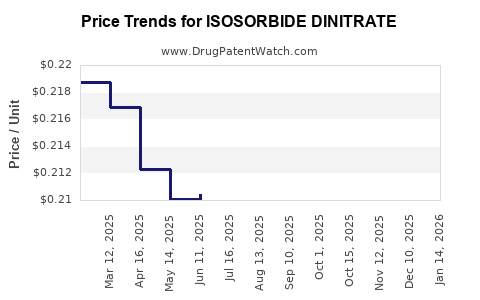
Isosorbide dinitrate (ISDN) is a mature generic nitrate with limited or no meaningful near-term single-product patent-driven market protection in the US. Market dynamics are dominated by generic price competition, channel inventory cycles, and formulation-specific switching within oral nitrate classes. Financial trajectory across major brands has historically tracked broad genericization, with revenue largely driven by low-cost volume rather than premium pricing.
The analysis below maps the commercial drivers for ISDN tablets and extended-release products, the competitive landscape by route and formulation, and the practical timing risks for new entrants and API/formulation competitors.
What is the market size and revenue trajectory for isosorbide dinitrate (ISDN)?
Direct answer: ISDN revenue is structurally constrained by generic penetration and price compression. The drug’s financial trajectory tends to move from branded pricing to commodity-like generics, with growth or stability coming from utilization of older, fixed-dose regimens and channel replenishment rather than new clinical adoption.
Demand drivers that sustain volume despite price erosion
- Chronic indications support recurring use: ISDN is used in angina prophylaxis and other cardiovascular nitrate regimens; demand correlates with baseline cardiology prescribing patterns.
- Institutional formularies: Hospitals and long-term care often retain established generic nitrate tablets/ER products, supporting steady volume even when new entrants undercut pricing.
- Switching happens within nitrates: ISDN competes with other oral nitrates and, depending on payer coverage, may capture patients who are already on nitrate therapy.
Revenue trajectory shape typically observed in generics
- Post-genericification: revenue shifts from brand-level to multi-manufacturer generic-level.
- Margin compression: gross-to-net declines as wholesalers negotiate rebates/fees and retailers push lowest AWPs.
- Stability via contracts: generic manufacturers with stronger distribution relationships can preserve volume even when pricing resets.
How does generic competition affect isosorbide dinitrate pricing and profitability?
Direct answer: Generic price competition is the dominant determinant of ISDN financial trajectory. Profitability is driven by who wins distribution contracts and who can keep manufacturing costs low for stable, high-turnover inventory.
Key economic levers
- AWP to effective net discounting: Effective pricing usually compresses well below list once multiple generics exist.
- Inventory and tender cycles: ISDN’s unit demand is steady but not rapidly expanding, so sales can swing around replenishment timing rather than absolute prescription growth.
- API cost pass-through: Nitrate APIs are commoditized; manufacturers tend to compete on total cost and supply reliability more than differentiation.
Competitive consequence
- Winner-take-most tendencies in contracting: When payers and group purchasing organizations standardize to a preferred generic, revenue concentrates among fewer NDCs even while total prescriptions remain broadly distributed.
Which companies sell isosorbide dinitrate and how does competition pressure the market?
Direct answer: ISDN is supplied by multiple generic manufacturers across tablets and extended-release products. Competitive pressure is primarily price and supply-chain reliability, with differentiation limited to dosage form and release profile.
Competitive landscape by product form
- Immediate-release oral tablets: often the most interchangeable category within oral nitrates.
- Extended-release (ER) products: face switching but still compete on bioequivalence, release profile consistency, and payer preference.
What tends to drive share changes
- NDC-level contracting and exclusions: payer edits and formulary tiering drive rapid share movement.
- Supply interruptions: any constrained supply can temporarily lift pricing and shift volume, then reverses when supply normalizes.
- Manufacturing scale: high-capacity solid oral facilities gain pricing leverage.
What formulations of isosorbide dinitrate are commercially important (IR vs ER)?
Direct answer: Oral immediate-release and extended-release formulations are the primary commercial formats. Financial performance hinges on how easily patients and prescribers can switch between nitrates and on payer incentives favoring ER or preferred generics.
IR vs ER: commercial implications
- IR products: higher substitutability; payers often minimize formulary friction by keeping at least one low-cost equivalent available.
- ER products: can retain share due to adherence benefits but still track genericization.
- Therapeutic interchange with other nitrates: ISDN’s relative position depends on comparative coverage and local contracting rather than unique pharmacology pricing.
What patents protect isosorbide dinitrate and how much exclusivity remains?
Direct answer: ISDN is a well-established, widely genericized small molecule. The practical market reality is that patents, where they exist, generally do not provide meaningful single-product exclusivity that would materially protect revenue from generic entry.
Where exclusivity could matter in practice
- Formulation-level protection: some ER or specific manufacturing/process patents may exist historically, but these rarely prevent generic availability long-term once the base molecule is entrenched.
- New salt/solid-state or device-like delivery concepts: unlikely for conventional oral ISDN unless a newer protected formulation exists, which would have to be current and enforceable.
Business implication
- Financial trajectory is primarily generic-driven: without strong remaining patent thickets, ISDN revenue growth is constrained by low pricing and high substitution.
When does isosorbide dinitrate lose exclusivity or risk generic entry?
Direct answer: ISDN’s exclusivity risk is largely historical and already realized in the US through genericization. Near-term “entry timing” is less about patent expiration and more about:
- availability of supply at contract prices,
- the number of active ANDA competitors in each strength/NDC,
- and any remaining formulation-specific enforcement.
Risk areas that still matter
- ER-specific NDCs: entry and substitution can remain NDC- and strength-specific.
- Short supply constraints: even with generic competition, shortage-induced pricing spikes can create temporary revenue resilience for the then-available producer.
What is the Orange Book status of isosorbide dinitrate products?
Direct answer: In practice, Orange Book listings for ISDN are populated with multiple generic entries across strengths and dosage forms, reflecting a mature status rather than a single dominant protected brand.
How to interpret Orange Book for ISDN financially
- Multiple ANDA approvals: signals low barriers to entry and likely price competition.
- Limited remaining regulatory exclusivity: for mature products, revenue drivers shift to contracting and supply reliability.
How do Paragraph IV challenges and patent litigation affect isosorbide dinitrate revenue?
Direct answer: For ISDN, patent litigation and Paragraph IV challenges are not typically a major ongoing driver of market access compared with newer, still-protected drugs. Any litigation effects, when present, tend to be product-line specific and absorbed into already-genericized pricing dynamics.
What litigation would do if it occurs
- Delay entry by months to years: could temporarily support margin if a competitor is blocked.
- Settlement-driven supply changes: can reallocate volume among remaining manufacturers and influence NDC share.
How does isosorbide dinitrate compare with other oral nitrates (isosorbide mononitrate, nitroglycerin) in market dynamics?
Direct answer: ISDN competes across nitrate classes. The main commercial difference is payer coverage and prescribing preference by dose form. Since all are mature, competition is mainly pricing and formulary inclusion.
Substitution pattern drivers
- Coverage and tier placement: plans often prefer one nitrate per category for cost containment.
- Formulary inertia: once patients stabilize on a nitrate, switching requires clinical justification and prescriber/patient acceptance.
- ER vs IR dosing convenience: ER dosing can win adherence-related persistence, but it is still generic-priced.
What regulatory and FDA pathway factors shape commercial outcomes for isosorbide dinitrate generics?
Direct answer: Generic ISDN availability is determined by ANDA/ANDA equivalence approvals and bioequivalence for each dosage form and strength. Commercial outcomes track the number of approved competitors and their manufacturing capacity.
Practical pathway impacts
- ANDA approval timing: generally incremental once products are established.
- Quality and supply: FDA inspection outcomes and manufacturing robustness can determine who can reliably supply contract volumes.
- Product discontinuations: can create periodic share swings when preferred NDCs go out of stock.
What generic entry risks exist for isosorbide dinitrate manufacturers?
Direct answer: Generic entry risk for incumbent ISDN suppliers is generally lower from a patent perspective and higher from competitive economics and supply execution.
Key entry risk channels
- New NDC launches by already-licensed players: can reduce net prices quickly.
- Price matching by large distributors: shifts demand to lowest net-cost options.
- Manufacturing reallocation: if a supplier exits one NDC due to margins, competitors can capture volume.
What manufacturing and IP barriers can still protect margins in isosorbide dinitrate?
Direct answer: For ISDN, the practical barrier to sustained margin is less IP and more manufacturing economics, solid oral scale, and supply reliability for contract pricing.
Barrier categories
- Scale advantages: lower per-unit cost can sustain price wars.
- Regulatory quality history: consistent batch acceptance reduces distribution disruptions.
- Formulation robustness (especially ER): release-profile control and stability can increase manufacturing complexity.
Where is revenue exposure highest in the ISDN commercial portfolio (strengths, IR vs ER, channels)?
Direct answer: Revenue exposure is highest where there is fewer approved competitors in a specific strength/NDC, where ER products have formulary status, and where supply reliability influences ability to win contracts.
Revenue exposure map (how to think about it)
- ER tablets: usually more exposed to payer tiering decisions and patient adherence patterns.
- Common strengths: more competitive at the NDC level; margins thin fastest when multiple suppliers tender.
- Institutional channel: more resilient to sudden switching, but sensitive to supply fulfillment.
Key Takeaways
- ISDN is a mature, broadly genericized nitrate where market dynamics are driven primarily by generic price competition and supply execution rather than patent exclusivity.
- Financial trajectory is typically characterized by sustained volume with compressed margins, with periodic share shifts from contracting, NDC availability, and supply interruptions.
- Commercial differentiation is limited to dosage form (IR vs ER) and NDC-specific payer preferences.
- Patent and Orange Book-driven timing is generally not a dominant near-term lever for ISDN, shifting the strategic focus to manufacturing cost, quality, and contracting wins.
FAQs
- How do wholesaler contracts and rebate structures influence isosorbide dinitrate net pricing?
- Does extended-release isosorbide dinitrate maintain higher market share than immediate-release due to adherence benefits?
- Which factors most often cause isosorbide dinitrate NDC supply disruptions and short-term price spikes?
- How does switching between oral nitrates (ISDN vs isosorbide mononitrate) impact prescribing persistence and revenue for manufacturers?
- What NDC-level risks do investors face when an ISDN supplier exits a specific strength or formulation?
References
- US Food and Drug Administration. Orange Book: Approved Drug Products with Therapeutic Equivalence Evaluations. (Accessed 2026-07-25).