Last updated: October 27, 2026
Gilotrif, the brand name for afatinib, is a mature targeted oncology product marketed by Boehringer Ingelheim for EGFR-mutated non-small-cell lung cancer. Its commercial position has weakened as osimertinib, sold as Tagrisso, became the preferred first-line EGFR therapy because of stronger central nervous system activity, broad mutation coverage, and adjuvant use. Gilotrif retains demand in first-line metastatic disease, uncommon EGFR mutations, and price-sensitive markets.
Boehringer Ingelheim does not disclose standalone worldwide Gilotrif revenue in its public financial reporting. The product is no longer a major disclosed growth driver, and its financial trajectory is best characterized as mature to declining in developed markets, with residual commercial value in international markets and selected genomic subgroups.
What is Gilotrif and how does afatinib work?
Gilotrif is an oral, irreversible tyrosine kinase inhibitor. Its active ingredient, afatinib dimaleate, inhibits signaling through the ErbB receptor family, including EGFR, HER2, and HER4. The FDA approved Gilotrif on July 12, 2013, for metastatic non-small-cell lung cancer with specific EGFR exon 19 deletions, exon 21 L858R substitutions, and other non-resistant EGFR mutations detected by an FDA-approved test [1].
The drug is administered once daily at a standard dose of 40 mg, with dose reductions available for adverse reactions. Common toxicities include diarrhea, rash, acneiform dermatitis, paronychia, stomatitis, and decreased appetite. These tolerability issues affect persistence and physician preference, particularly when alternatives offer more favorable safety profiles.
What indications does Gilotrif have?
Gilotrif is used primarily for:
- First-line treatment of metastatic NSCLC with EGFR exon 19 deletions or exon 21 L858R substitutions.
- First-line treatment of metastatic NSCLC with other non-resistant EGFR mutations, including selected uncommon alterations.
- EGFR-mutated metastatic NSCLC in patients for whom afatinib remains clinically suitable.
The label does not give afatinib the same treatment positioning as osimertinib in the modern standard-of-care pathway. Clinical guidelines generally favor osimertinib for common sensitizing EGFR mutations because of superior CNS control and overall survival data [2].
When did Gilotrif lose exclusivity?
Gilotrif’s five-year new chemical entity exclusivity expired in July 2018. That date blocked submission of an ANDA before expiration but did not itself determine the end of patent protection.
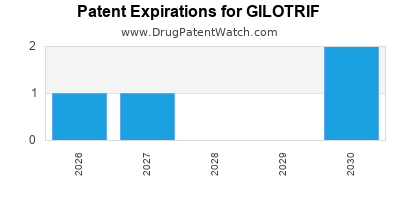
Patent protection is more complex. Afatinib is covered by Orange Book-listed patents and related intellectual-property rights covering the active compound, salts, pharmaceutical compositions, and use claims. The relevant expiration dates depend on the specific patent, patent-term adjustment, terminal disclaimers, and any pediatric or regulatory extensions listed by the FDA [3].
What is the Orange Book status of Gilotrif?
The FDA Orange Book lists patents associated with Gilotrif. The operative commercial question is whether a generic applicant can obtain final approval and launch after:
- Patent expiration;
- A successful Paragraph IV challenge;
- A settlement permitting an earlier launch;
- A court ruling that the asserted claims are invalid or not infringed; or
- A licensing arrangement with the originator.
A current Orange Book review is required for a definitive patent-by-patent expiration schedule because listings and patent-term calculations can change. Afatinib’s regulatory exclusivity has expired, but patent barriers may continue to affect final generic entry.
Does Gilotrif have biosimilar risk?
No. Gilotrif is a chemically synthesized small molecule, not a biologic. It is exposed to conventional generic competition under the abbreviated new drug application pathway, not biosimilar competition under the Biologics Price Competition and Innovation Act.
The relevant risk is therefore generic afatinib tablets. Generic developers must demonstrate pharmaceutical equivalence and bioequivalence, address the drug’s narrow dosing and toxicity-management requirements, and resolve Orange Book patent certifications.
How many patents cover Gilotrif?
The Gilotrif estate includes multiple patent categories rather than a single protection right:
| Protection category |
Commercial purpose |
Competitive relevance |
| Afatinib compound patents |
Protect the active molecular entity or related chemical classes |
Usually the strongest barrier if unexpired |
| Salt and solid-state patents |
Protect afatinib dimaleate or other pharmaceutical forms |
Can complicate generic formulation strategies |
| Pharmaceutical composition patents |
Cover tablet compositions and dosage forms |
Relevant where formulation claims are not easily designed around |
| Method-of-use patents |
Cover treatment of EGFR-mutated NSCLC or mutation-defined populations |
More difficult to enforce against a skinny-label generic |
| Manufacturing patents |
Cover synthesis, purification, or crystallization processes |
Usually less effective against a non-infringing manufacturing route |
The estate’s practical strength is lower than the number of patents may suggest. Composition claims generally provide the highest barrier. Method-of-use claims may have limited commercial effect because generic labels can omit patented indications, and physicians may still prescribe the product under applicable substitution and medical-practice rules.
What formulations are protected by Gilotrif patents?
Gilotrif is marketed as immediate-release oral tablets containing afatinib dimaleate. The relevant formulation protection may cover:
- The dimaleate salt;
- Tablet dosage strengths;
- Excipients and tablet composition;
- Stability characteristics;
- Manufacturing and crystallization processes.
A generic applicant can sometimes avoid formulation claims by using a different excipient system, manufacturing process, or solid-state form, provided the resulting product meets bioequivalence and quality requirements. This makes formulation patents a secondary barrier unless the claims are broad and difficult to design around.
What method-of-use patents protect afatinib?
Afatinib method-of-use protection is centered on treating patients with tumors containing activating EGFR mutations. The commercial value of those claims depends on their scope and enforceability.
Method-of-use claims may cover:
- Exon 19 deletion-positive NSCLC;
- L858R-positive NSCLC;
- Less common activating EGFR mutations;
- Dosing and treatment-selection methods;
- Particular lines of therapy.
A generic applicant may submit a Paragraph IV certification against listed use patents or use a section viii statement to omit a patented indication from its label. The effectiveness of a skinny-label strategy depends on whether the remaining label still encourages infringement of the patented use.
Which companies are challenging Gilotrif?
Publicly visible ANDA activity for afatinib has been less commercially prominent than generic challenges against larger oncology products. The main potential challengers are generic manufacturers with oral oncology manufacturing capabilities, including companies that have filed afatinib ANDAs or may enter after relevant patent barriers expire.
The absence of a prominent public challenge does not eliminate generic risk. Generic entry can occur after patent expiry without litigation, and ANDA filings may remain confidential until regulatory milestones or litigation make them public.
What Paragraph IV risks exist for Gilotrif?
Paragraph IV risk can arise when an ANDA applicant asserts that a listed patent is invalid, unenforceable, or not infringed. A Paragraph IV notice can trigger a 30-month stay of FDA approval if the patent holder files suit within the statutory period [4].
For Gilotrif, the most material litigation risks would involve:
- Validity of compound or salt claims;
- Obviousness of afatinib over earlier quinazoline kinase inhibitors;
- Written-description and enablement issues;
- Infringement by a proposed generic salt or formulation;
- Whether a proposed label induces infringement of a method-of-use claim.
No major, widely reported settlement has established a clearly public generic-launch date comparable with settlements involving larger blockbuster drugs. The commercial outcome remains tied to the current Orange Book listings and any confidential ANDA activity.
What is Gilotrif’s FDA regulatory status?
Gilotrif has full FDA approval for its labeled EGFR-mutated NSCLC indications. Its regulatory history reflects the shift toward biomarker-defined oncology:
| Date |
FDA milestone |
| July 12, 2013 |
Initial approval for metastatic NSCLC with specified EGFR mutations |
| 2013 onward |
Companion diagnostic-based patient selection |
| Subsequent years |
Label refinements covering additional non-resistant EGFR mutations and safety information |
| 2018 |
Expiration of five-year NCE exclusivity |
| Current status |
Approved product with mature regulatory and commercial positioning |
Afatinib was approved alongside mutation testing requirements, making diagnostic adoption a central component of its market access. The product competes in a treatment environment where next-generation sequencing and liquid biopsy increasingly determine therapy selection.
How does Gilotrif compare with Tagrisso, Iressa, Tarceva, and Vizimpro?
| Drug |
Active ingredient |
Main differentiator |
Current competitive position |
| Gilotrif |
Afatinib |
Irreversible ErbB blockade; activity in selected uncommon mutations |
Mature product with niche and price-based demand |
| Tagrisso |
Osimertinib |
Strong CNS activity, T790M history, first-line and adjuvant use |
Market leader for common EGFR mutations |
| Iressa |
Gefitinib |
First-generation EGFR inhibitor |
Generic and largely commoditized |
| Tarceva |
Erlotinib |
First-generation EGFR inhibitor |
Mature and heavily exposed to generic competition |
| Vizimpro |
Dacomitinib |
Irreversible EGFR-family inhibition |
Limited share because of tolerability and competition |
The most important competitive displacement has come from Tagrisso. The FLAURA trial demonstrated a progression-free and overall-survival advantage for osimertinib over first-generation EGFR inhibitors, including gefitinib and erlotinib [5]. Afatinib was not the direct comparator in that trial, but the results changed treatment sequencing across the class.
Gilotrif’s remaining differentiation is strongest in patients with uncommon sensitizing EGFR alterations, including certain exon 18 and exon 20 mutations that may respond better to afatinib than to older first-generation agents. The product remains relevant where physicians prioritize broad ErbB inhibition or where osimertinib access is restricted.
What is the financial trajectory of Gilotrif?
Boehringer Ingelheim is privately held and does not provide a complete, recurring product-level revenue series for Gilotrif. Public company reporting emphasizes major franchises such as Jardiance, Ofev, Spiriva, and Pradaxa rather than disclosing detailed annual Gilotrif sales [6].
The commercial trajectory can be divided into four stages:
2013 to 2016: launch and expansion
Gilotrif entered the market as a biomarker-selected targeted therapy during rapid growth in EGFR testing. Initial uptake benefited from its first-line positioning and activity across a broader group of EGFR mutations than some first-generation alternatives.
2017 to 2019: competitive pressure
Osimertinib’s clinical adoption began to reduce the addressable first-line market for afatinib. Physicians increasingly selected osimertinib because of CNS efficacy, improved treatment sequencing, and broader guideline support.
2020 to 2022: mature-market erosion
COVID-era diagnostic disruption, increased use of molecular testing, and the continued shift toward osimertinib limited growth. Gilotrif remained commercially relevant but lacked a major new indication to offset competitive losses.
2023 onward: residual and regional value
The product’s value is concentrated in:
- Markets with limited access to osimertinib;
- Lower-cost treatment pathways;
- Patients with uncommon EGFR mutations;
- Countries where generic competition is delayed;
- Patients who cannot tolerate or access preferred alternatives.
Gilotrif is unlikely to return to high-growth status without a new clinical indication, a meaningful price advantage, or evidence establishing superior activity in a defined molecular subgroup.
What revenue exposure does Gilotrif create for Boehringer Ingelheim?
Gilotrif is strategically less important than Boehringer’s leading respiratory, diabetes, and antifibrotic assets. Its revenue exposure is limited by:
- Declining share in common EGFR-mutated NSCLC;
- No publicly disclosed standalone sales growth;
- Small-molecule substitution risk;
- A mature regulatory profile;
- Strong competition from osimertinib;
- Limited ability to expand beyond EGFR-driven NSCLC.
The product still generates cash flow, especially in markets where branded targeted therapies retain pricing power. Its financial role is more consistent with a mature portfolio asset than a core growth engine.
What generic launch scenarios exist for Gilotrif?
Three scenarios are most relevant.
| Scenario |
Timing driver |
Market effect |
| Delayed launch |
Remaining patents or litigation remain effective |
Brand retains substantial share |
| At-risk launch |
Generic launches before final patent resolution |
Rapid price erosion and possible damages exposure |
| Post-expiry launch |
Generic enters after patent protection ends |
Steep price decline, with brand retention in selected patients |
Afatinib’s oral tablet format creates relatively low distribution complexity. Once a generic receives final approval and clears patent barriers, substitution can occur quickly through oncology pharmacies, integrated delivery networks, and payer formulary controls.
Brand Gilotrif could preserve a portion of demand through physician familiarity, patient-support programs, supply reliability, and use in uncommon mutations. Those defenses generally do not prevent material price erosion after multiple generic entrants.
How strong is the Gilotrif patent estate?
The estate is moderate rather than dominant.
Its strengths are:
- Regulatory approval for a defined biomarker-positive population;
- Multiple possible patent categories;
- Clinical differentiation in selected uncommon mutations;
- Manufacturing and formulation know-how;
- Existing physician and diagnostic infrastructure.
Its weaknesses are:
- Expired NCE exclusivity;
- Substitution by osimertinib in common EGFR mutations;
- Potential design-around options for formulation claims;
- Limited enforcement leverage for some use claims;
- Generic applicants’ ability to use skinny-label strategies;
- Lack of a biologic-style manufacturing barrier.
The estate can delay or complicate generic entry, but it is unlikely to support long-term monopoly economics comparable with a protected biologic or a product with continuing regulatory exclusivity.
What patent litigation affects Gilotrif?
No widely reported, market-defining patent decision has reset the commercial outlook for Gilotrif in the way that major patent rulings have affected some blockbuster medicines. The principal litigation risk remains prospective: ANDA filers may challenge listed patents as they approach commercial approval.
The most important indicators are:
- New Orange Book patent listings;
- Paragraph IV notices;
- District-court complaints filed by Boehringer;
- 30-month stay dates;
- Paragraph IV settlements;
- FDA approval dates for afatinib ANDAs;
- First-filer eligibility and forfeiture events.
Key Takeaways
- Gilotrif is afatinib, an irreversible ErbB tyrosine kinase inhibitor approved for EGFR-mutated metastatic NSCLC.
- FDA approval began in July 2013; five-year NCE exclusivity expired in July 2018.
- Patent protection may continue beyond regulatory exclusivity, but the exact launch barrier depends on current Orange Book listings and patent-term calculations.
- Tagrisso is the primary commercial competitor and has displaced Gilotrif in many common EGFR-mutated cases.
- Gilotrif retains value in uncommon EGFR mutations, access-constrained markets, and price-sensitive treatment settings.
- Boehringer Ingelheim does not publicly disclose a detailed standalone Gilotrif revenue series.
- Generic afatinib is the relevant competitive risk; biosimilar competition does not apply.
- The product is a mature cash-generating asset with declining strategic importance rather than a major growth franchise.
FAQs
Is Gilotrif still used as first-line treatment for EGFR-mutated lung cancer?
Yes. It remains an approved first-line option, particularly for selected uncommon EGFR mutations or where osimertinib is unavailable, unsuitable, or unaffordable.
Is afatinib more effective than osimertinib?
There is no broad clinical basis for treating afatinib as superior to osimertinib in common EGFR mutations. Osimertinib generally has stronger CNS activity and a more favorable modern treatment position.
Can a generic manufacturer market afatinib for every Gilotrif indication?
Not necessarily. A generic applicant may omit patented indications through a section viii statement, creating a label that excludes some uses while retaining non-patented indications.
Does Gilotrif have orphan-drug exclusivity?
Gilotrif’s principal commercial protection has been based on patents and standard drug exclusivity rather than a broadly material orphan-drug exclusivity period.
What would most improve Gilotrif’s commercial outlook?
The strongest potential catalysts would be clinical evidence in uncommon EGFR mutations, materially lower pricing than osimertinib, expanded access in emerging markets, or a new indication that does not directly compete with the established osimertinib pathway.
References
- U.S. Food and Drug Administration. (2013). Gilotrif (afatinib) prescribing information.
- National Comprehensive Cancer Network. (2024). NCCN clinical practice guidelines in oncology: Non-small cell lung cancer.
- U.S. Food and Drug Administration. (2024). Approved drug products with therapeutic equivalence evaluations: Orange Book.
- U.S. Food and Drug Administration. (2024). Hatch-Waxman amendments and abbreviated new drug applications.
- Soria, J.-C., Ohe, Y., Vansteenkiste, J., et al. (2018). Osimertinib in untreated EGFR-mutated advanced non-small-cell lung cancer. New England Journal of Medicine, 378(2), 113-125.
- Boehringer Ingelheim. (2023). Annual report and financial information.