Last updated: September 7, 2026
Fosinopril sodium is a mature, off-patent ACE inhibitor with limited commercial growth potential. Bristol-Myers Squibb introduced the branded product Monopril in the United States in the early 1990s. Fosinopril sodium tablets are now supplied primarily through generic manufacturers, with competition centered on price, formulary access, manufacturing reliability, and wholesaler contracts rather than product differentiation. The product has no meaningful remaining branded exclusivity, no biologic or biosimilar exposure, and limited standalone revenue visibility.
What is fosinopril sodium used for?
Fosinopril sodium is an orally administered prodrug converted to fosinoprilat, an angiotensin-converting enzyme inhibitor. FDA-approved uses include treatment of hypertension and heart failure as an adjunct to standard therapy.[1]
| Attribute |
Fosinopril sodium |
| Drug class |
ACE inhibitor |
| Active moiety |
Fosinoprilat |
| Common strengths |
10 mg, 20 mg, 40 mg tablets |
| Original U.S. brand |
Monopril |
| Original sponsor |
Bristol-Myers Squibb |
| FDA dosage forms |
Oral tablets |
| Main indications |
Hypertension; heart failure |
| Regulatory category |
Small-molecule prescription drug |
| Current commercial model |
Generic multisource supply |
| Biosimilar relevance |
None |
| Main competitors |
Lisinopril, enalapril, ramipril, benazepril, quinapril, losartan and other antihypertensives |
Fosinopril has a pharmacokinetic characteristic that distinguishes it from several competing ACE inhibitors: elimination occurs through both hepatic and renal pathways. The FDA label identifies this dual elimination as relevant to patients with impaired renal function, although clinical prescribing remains dependent on renal function, potassium levels, blood pressure, and tolerability.[1]
When did fosinopril lose exclusivity?
Fosinopril lost practical market exclusivity many years ago. Its commercial protection ended through the expiration of the original patent and associated regulatory exclusivity period, followed by approval of multiple generic versions.
The product’s commercial lifecycle can be summarized as follows:
| Period |
Commercial event |
Market effect |
| Early 1990s |
Monopril introduced in the United States |
Premium branded pricing and physician promotion |
| Mid-to-late 1990s |
Expansion of ACE inhibitor competition |
Pressure from lisinopril, enalapril and other agents |
| Late 1990s to early 2000s |
Generic entry |
Rapid reduction in average selling price |
| 2000s |
Broad multisource generic availability |
Brand substitution and formulary-driven purchasing |
| 2010s onward |
Mature generic market |
Low unit pricing, limited innovation and fragmented supply |
A precise commercial loss date is less useful than the market result: fosinopril is no longer protected by a commercially meaningful exclusivity position in the United States. Original composition and product patents are expired, and the product is not protected by current new chemical entity exclusivity.
What patents protect fosinopril sodium?
No active patent estate is generally associated with commercial exclusivity for standard fosinopril sodium tablets. The relevant historical patent estate covered the fosinopril molecule, related ACE-inhibitory compounds, and pharmaceutical compositions developed during the original branded product lifecycle.
The practical patent position is:
| Patent category |
Current commercial relevance |
| Original compound patents |
Expired |
| Original composition patents |
Expired |
| Formulation patents for standard tablets |
No known active barrier to ordinary generic supply |
| Method-of-use patents |
No meaningful current barrier for labeled hypertension or heart-failure use |
| Manufacturing patents |
Potentially relevant to individual suppliers, but not a broad market barrier |
| Pediatric exclusivity |
Not a current market constraint |
| Orphan-drug exclusivity |
Not applicable |
| Patent-term extension |
No current exclusivity effect |
The absence of an active patent barrier does not eliminate intellectual-property risk for every manufacturer. A supplier could hold process patents, contractual technology rights, or jurisdiction-specific rights involving a particular manufacturing route. Those rights would not normally prevent ordinary generic competition across the broader fosinopril market.
What is the FDA regulatory status of fosinopril sodium?
Fosinopril sodium is an FDA-approved small-molecule prescription drug available through abbreviated new drug applications. Generic products must demonstrate pharmaceutical equivalence and bioequivalence to the reference product under the ANDA pathway.[2]
The regulatory profile differs from a biologic:
- No biosimilar pathway applies.
- No reference-product interchangeability debate comparable to biologics exists.
- Generic approval depends on equivalence to the reference listed drug.
- Product availability can change when manufacturers withdraw an ANDA, transfer ownership, or encounter manufacturing problems.
- Discontinuation of a particular generic does not necessarily indicate discontinuation of the active ingredient.
FDA labeling identifies contraindications and warnings relevant to ACE inhibitors, including pregnancy-related fetal toxicity, angioedema, hypotension, hyperkalemia, and renal-function changes.[1] These safety considerations support continued regulatory monitoring but do not create a commercial exclusivity opportunity.
What is the Orange Book status of fosinopril sodium?
The FDA Orange Book historically identified Monopril as the reference listed drug for fosinopril sodium tablets and identified approved generic equivalents through ANDA listings.[2] The branded product’s commercial importance has declined substantially, and the market is now driven by generic approvals rather than brand competition.
For commercial diligence, the important Orange Book conclusions are:
- The product is a conventional multisource tablet.
- Standard generic substitution is the dominant channel.
- There is no major active patent listing expected to block routine generic supply.
- Product-specific availability depends on current ANDA marketing status and manufacturer supply.
- Historical Paragraph IV activity has little current effect on market access.
Because generic portfolios change through discontinuations and ownership transfers, the number of active suppliers should not be treated as fixed. The commercially relevant metric is the number of manufacturers shipping consistently into wholesalers and large pharmacy channels, not the number of approvals ever issued.
How many patents cover fosinopril sodium?
The number of historically related patents is larger than the number of patents with current commercial force. Older patent families may include compound, salt, composition, process, and therapeutic-use claims. For current market analysis, the effective count of blocking patents is approximately zero for standard fosinopril sodium tablets.
| Question |
Assessment |
| Are original product patents active? |
No meaningful U.S. exclusivity remains |
| Are standard tablet formulations blocked? |
No |
| Are labeled uses blocked by active patents? |
No meaningful barrier identified |
| Can process patents affect a particular supplier? |
Yes |
| Can foreign patents differ? |
Yes, depending on jurisdiction |
| Is a patent challenge central to current competition? |
No |
This distinction matters in licensing and acquisition analysis. A historical patent count does not indicate current pricing power or launch protection.
Which companies are challenging the fosinopril market?
Competition is no longer structured primarily around patent challengers. It is structured around generic manufacturers, contract manufacturers, distributors, and pharmacy-benefit formulary placement.
Typical competitor groups include:
- Large multinational generic companies with broad cardiovascular portfolios.
- Regional generic manufacturers supplying selected strengths.
- Contract manufacturers producing for private-label distributors.
- Wholesalers and pharmacy chains purchasing on low-price tenders.
- Therapeutic substitutes such as lisinopril, enalapril, ramipril, benazepril, and angiotensin-receptor blockers.
The competitive threat from lisinopril is particularly important. Lisinopril has extensive clinical familiarity, broad generic availability, low pricing, and strong guideline recognition. Fosinopril therefore competes less on clinical differentiation and more on patient continuity, prescriber preference, formulary position, and supply availability.
What formulation patents protect fosinopril sodium?
Standard immediate-release fosinopril sodium tablets have limited formulation differentiation. The commercial product is not generally associated with an active extended-release, controlled-release, transdermal, inhaled, or injectable platform.
Potential technical barriers are more likely to arise from manufacturing execution than from product formulation:
- Control of salt form and active pharmaceutical ingredient quality.
- Tablet compression and dissolution specifications.
- Stability under moisture and temperature stress.
- Packaging that preserves assay and dissolution performance.
- Validation of impurity controls.
- Reliable sourcing of fosinopril sodium API.
These factors can affect approval, batch release, and supply continuity. They do not normally support premium pricing once several equivalent tablet suppliers are established.
Are there Paragraph IV challenges for fosinopril sodium?
Paragraph IV litigation was relevant during the original generic-entry period, when ANDA applicants could challenge listed patents as invalid, unenforceable, or not infringed. That phase has passed for fosinopril sodium.
Current implications are limited:
- No active Paragraph IV event is central to the U.S. commercial outlook.
- Any historical litigation would primarily explain the timing of early generic entry.
- The market does not depend on a future first-filer exclusivity event.
- New entrants face commercial pricing pressure rather than patent litigation as the principal barrier.
For investors, a Paragraph IV strategy has little apparent value unless a company develops a differentiated formulation, combination product, or new delivery system with a separately protectable claim set.
What patent litigation affects fosinopril sodium?
Fosinopril sodium is not currently a major U.S. pharmaceutical litigation market. The principal legal risks are ordinary generic-industry risks:
- FDA manufacturing or quality enforcement.
- Product-liability claims involving ACE inhibitor adverse events.
- Supply and distribution disputes.
- ANDA ownership or transfer issues.
- Patent disputes involving a specific process or reformulated product.
- Foreign-market patent differences.
There is no apparent active litigation framework comparable to the patent disputes surrounding newer oncology, immunology, diabetes, or rare-disease medicines.
What licensing deals involve fosinopril sodium?
Fosinopril’s principal historical commercial relationship was associated with Bristol-Myers Squibb’s development and commercialization of Monopril. The mature generic market has limited licensing value because the active ingredient is off patent and interchangeable products compete primarily on price.
Potential licensing transactions would more likely involve:
- Regional commercialization rights.
- Private-label supply agreements.
- API manufacturing.
- Portfolio acquisitions involving several cardiovascular generics.
- Authorized-generic distribution arrangements.
- Manufacturing technology or regulatory files.
A standalone license for fosinopril sodium is unlikely to command material upfront consideration unless bundled with a broader product portfolio or linked to a supply-constrained geography.
How strong is the fosinopril patent estate?
The patent estate is weak for current commercial purposes. Its strength is best assessed as follows:
| Dimension |
Rating |
Analysis |
| Composition-of-matter protection |
Low |
Historical protection has expired |
| Formulation protection |
Low |
Standard tablet is readily substitutable |
| Method-of-use protection |
Low |
Core indications are mature and broadly practiced |
| Manufacturing protection |
Moderate for individual routes |
May affect a supplier but not the whole market |
| Regulatory exclusivity |
None material |
No current NCE or orphan exclusivity |
| Litigation leverage |
Low |
No apparent blocking patent position |
| Revenue defense |
Very low |
Pricing depends on generic supply conditions |
The product can remain commercially useful despite weak intellectual-property protection. Its value lies in recurring demand, established prescribing, and low-cost production rather than exclusivity.
What is the market size and financial trajectory for fosinopril sodium?
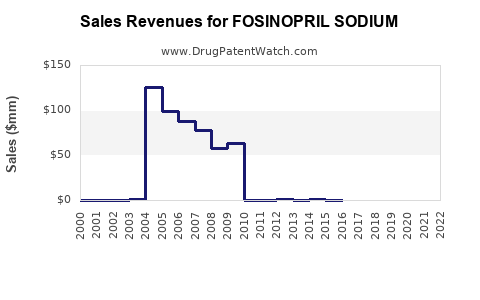
Public company filings generally do not report fosinopril sodium revenue as a standalone line item. Generic manufacturers group it within larger cardiovascular or mature-products portfolios. As a result, no reliable audited global revenue figure can be assigned to fosinopril sodium alone from public filings.
The financial trajectory is clear even without a standalone revenue series:
- Branded revenue was highest during the Monopril exclusivity period.
- Generic entry caused a steep decline in price and brand share.
- Unit demand persisted because hypertension and heart failure remain chronic conditions.
- Revenue per tablet fell as additional suppliers entered.
- Mature-market sales stabilized at low margins.
- Profitability became dependent on manufacturing scale, procurement, and supply reliability.
| Financial variable |
Historical direction |
| Prescription demand |
Relatively stable but mature |
| Average selling price |
Sharply down after generic entry |
| Brand share |
Collapsed after generic substitution |
| Gross margin |
Compressed |
| Promotional spending |
Minimal |
| Working-capital intensity |
Low to moderate |
| Manufacturing concentration risk |
Potentially material |
| Revenue growth potential |
Low |
| Price erosion risk |
Persistent |
| Strategic value |
Portfolio and supply continuity |
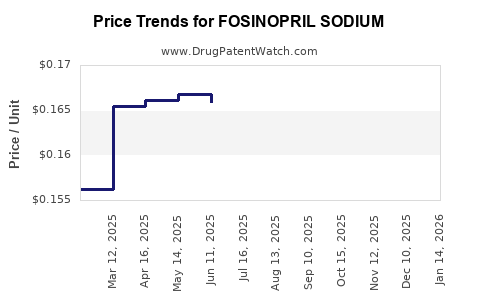
Fosinopril is unlikely to produce meaningful standalone revenue growth in developed markets. Revenue can still increase temporarily if competitors exit, a shortage develops, or a manufacturer obtains favorable formulary placement. Those gains are usually market-share transfers rather than expansion of the underlying category.
What generic entry risks exist for fosinopril sodium?
Generic entry risk is largely historical, but commercial risk remains through ongoing price competition and supply instability.
Price erosion
Multiple suppliers create tender-based competition. Retail and institutional buyers can switch among equivalent products when a manufacturer offers lower pricing or better availability.
Supplier consolidation
If manufacturers exit because margins become uneconomic, remaining suppliers may gain temporary pricing power. Consolidation can also increase shortage risk if API or finished-dose capacity is concentrated.
Regulatory compliance
FDA inspection findings, manufacturing deviations, data-integrity issues, or recalls can remove a supplier from the market. For a low-margin generic, remediation costs can exceed the value of the product line.
Therapeutic substitution
Fosinopril competes with inexpensive ACE inhibitors and ARBs. Physicians can select alternatives when a product is unavailable or when patients experience cough, angioedema, hypotension, hyperkalemia, or renal-function concerns.
How does fosinopril compare with competing ACE inhibitors?
| Drug |
Commercial position |
Competitive advantage |
| Lisinopril |
Dominant mature generic |
Broad use, low cost, strong familiarity |
| Enalapril |
Mature generic |
Extensive clinical history and broad availability |
| Ramipril |
Mature generic |
Strong cardiovascular-risk and heart-failure positioning |
| Benazepril |
Mature generic |
Established hypertension use |
| Fosinopril |
Niche mature generic |
Dual hepatic and renal elimination; established product |
| Quinapril |
Reduced commercial relevance |
Historical ACE inhibitor with market withdrawal and supply issues in some periods |
Fosinopril’s dual elimination pathway can be clinically relevant, but it has not created a durable commercial premium. Prescribing decisions are usually determined by guideline preference, patient response, formulary cost, and availability.
What is the outlook for fosinopril sodium revenue?
The base-case outlook is flat to declining revenue in developed markets, with occasional short-term price increases caused by supplier exits or shortages. Growth opportunities are limited to geographic expansion, contract manufacturing, private-label distribution, or bundled generic portfolios.
| Scenario |
Revenue outlook |
Main driver |
| Base case |
Flat to modest decline |
Stable demand and continued price pressure |
| Upside case |
Temporary increase |
Competitor withdrawal or supply shortage |
| Downside case |
Faster decline |
Additional entrants, formulary exclusion, or demand substitution |
| Strategic case |
Stable portfolio contribution |
Bundling with cardiovascular generics |
A company evaluating fosinopril should underwrite it as a low-growth, low-exclusivity product. The key diligence questions concern cost of goods, supplier concentration, API sourcing, FDA compliance, annual volume, customer concentration, and contribution margin. Patent value should receive little weight.
Key Takeaways
- Fosinopril sodium is a mature generic ACE inhibitor with no meaningful remaining branded exclusivity.
- Monopril’s historical commercial value has been replaced by low-price multisource supply.
- Standard fosinopril sodium tablets have no apparent active U.S. patent barrier that materially limits generic competition.
- Paragraph IV litigation and first-filer dynamics are no longer central to the product’s outlook.
- No biosimilar risk applies because fosinopril sodium is a small molecule.
- Public companies generally do not disclose standalone fosinopril revenue.
- Financial performance depends on volume, manufacturing cost, supply continuity, and formulary contracts.
- The strongest competitive pressure comes from lisinopril, enalapril, ramipril, benazepril, and low-cost ARBs.
- The main risks are price erosion, manufacturer withdrawal, quality enforcement, and therapeutic substitution.
- Commercial upside is limited and is more likely to come from supply disruptions or portfolio bundling than from market expansion.
Frequently Asked Questions
Is fosinopril sodium still commercially available?
Yes. Fosinopril sodium remains available as a generic prescription tablet, although the active manufacturer and product availability can vary by market and dosage strength.
Is fosinopril sodium a generic drug?
Yes. Fosinopril sodium is marketed primarily through generic products following the loss of Monopril exclusivity.
Does fosinopril sodium have an active U.S. patent?
No meaningful active U.S. patent barrier is generally associated with standard fosinopril sodium tablets. Individual manufacturing processes or reformulated products can raise separate patent issues.
Can fosinopril sodium support a new pharmaceutical investment?
Only in limited circumstances. The strongest opportunities involve low-cost manufacturing, reliable API supply, contract supply, private-label distribution, or acquisition as part of a larger mature-generic portfolio.
Why might fosinopril sodium pricing rise despite being generic?
Prices can increase when manufacturers exit, production is interrupted, API supply tightens, or wholesalers face short-term inventory shortages. These increases usually reflect supply conditions rather than renewed intellectual-property protection.
References
-
U.S. Food and Drug Administration. (2023). Fosinopril sodium prescribing information. FDA-approved labeling.
-
U.S. Food and Drug Administration. (2024). Approved drug products with therapeutic equivalence evaluations: Orange Book. U.S. Department of Health and Human Services.
-
U.S. Food and Drug Administration. (2024). Abbreviated new drug application (ANDA) process. U.S. Department of Health and Human Services.
-
Bristol-Myers Squibb Company. (1990s). Monopril (fosinopril sodium) prescribing information. Historical U.S. product labeling.