Last updated: August 14, 2026
Fosamax Plus D is a prescription combination of alendronate sodium and vitamin D3, marketed by Merck for postmenopausal osteoporosis and osteoporosis in men. Its commercial position has shifted from branded growth product to mature, generic-exposed therapy. The principal market forces are low-cost generic alendronate, competing osteoporosis drugs, adherence concerns with oral bisphosphonates, and the absence of separately reported product revenue from Merck.
What is Fosamax Plus D and how does it work?
Fosamax Plus D combines the bisphosphonate alendronate with cholecalciferol, the active form of vitamin D3 used in the product.
| Product attribute |
Detail |
| Brand |
Fosamax Plus D |
| Active ingredients |
Alendronate sodium and cholecalciferol |
| Common strengths |
70 mg/2,800 IU and 70 mg/5,600 IU |
| Dosage form |
Oral tablet |
| Primary use |
Osteoporosis treatment |
| Originator |
Merck & Co. |
| U.S. regulatory pathway |
New drug application |
| U.S. approval |
2005 |
| Administration |
Once weekly |
| Key competitors |
Generic alendronate, alendronate plus vitamin D, risedronate, ibandronate, denosumab, teriparatide and romosozumab |
Alendronate reduces bone resorption by inhibiting osteoclast activity. Vitamin D3 supports calcium absorption and bone mineralization. The combination was designed to simplify dosing and address vitamin D insufficiency among osteoporosis patients.
The product’s weekly schedule is commercially useful, but the tablet still carries the administration requirements associated with oral bisphosphonates. Patients must take it with plain water, remain upright, and avoid food or other medicines for a specified period. These restrictions limit persistence for some patients and support the use of injectable alternatives.
When did Fosamax Plus D lose exclusivity?
Fosamax Plus D lost meaningful U.S. exclusivity after the expiration of its primary formulation and combination-product patent protection. Generic competition subsequently reduced the product’s pricing power.
The original Fosamax alendronate franchise had already entered a mature, generic-exposed phase before Fosamax Plus D was introduced. Fosamax Plus D did not receive the commercial protection associated with a new active pharmaceutical ingredient because alendronate and vitamin D3 were known compounds.
| Milestone |
Approximate timing |
Commercial effect |
| Fosamax active ingredient launched |
1990s |
Established alendronate as a leading osteoporosis treatment |
| Fosamax Plus D U.S. approval |
2005 |
Added combination convenience |
| Initial U.S. regulatory exclusivity |
Expired during the late 2000s |
Opened the route for generic development |
| Core U.S. patent protection |
Expired or became commercially ineffective by the early 2020s |
Removed the principal branded barrier |
| Current market |
Generic-dominated |
Low average selling prices and limited brand leverage |
The exact patent landscape depends on the jurisdiction, listed patent, pediatric extensions, and whether a patent covered the product, a formulation, or a manufacturing process. The FDA Orange Book remains the controlling source for U.S. listed patents and regulatory exclusivity. [1]
What patents protect Fosamax Plus D?
Fosamax Plus D was protected primarily through combination-product and formulation claims rather than a new-molecule patent.
The relevant patent categories include:
- Combination claims covering alendronate with vitamin D3.
- Tablet formulation claims governing the physical composition and stability of the product.
- Dosing or administration claims covering weekly use.
- Manufacturing claims covering the preparation of the combination tablet.
- Regulatory exclusivity associated with approval of the fixed-dose combination.
The commercial value of these claims declined after generic manufacturers developed products that could avoid or invalidate the listed claims. Product-level patent protection is now unlikely to prevent U.S. generic substitution.
What formulations are protected by Fosamax Plus D patents?
The protected formulations were designed to deliver alendronate and vitamin D3 in a stable oral tablet. Formulation protection can be valuable when the active ingredients have different stability, particle-size, or dissolution characteristics.
For Fosamax Plus D, formulation patents had less durable commercial value than a composition-of-matter patent would have provided. Generic manufacturers could compete through alternative excipient systems, manufacturing processes, or non-infringing formulations, subject to FDA bioequivalence requirements.
What is the Orange Book status of Fosamax Plus D?
The FDA Orange Book identifies approved drug products, therapeutic equivalence ratings, listed patents and regulatory exclusivity. Fosamax Plus D should be evaluated by reviewing the relevant NDA entry and the specific strength being assessed. [1]
A key commercial distinction is that an Orange Book patent listing does not guarantee that a patent remains enforceable through its full nominal term. Paragraph IV litigation, patent disclaimers, terminal disclaimers, settlements, and claim construction can change the practical launch date.
What is the FDA regulatory status of Fosamax Plus D?
Fosamax Plus D is an FDA-approved prescription product. Its regulatory position is mature, and the principal U.S. competitive pathway is an abbreviated new drug application rather than a biosimilar application.
Generic applicants must demonstrate pharmaceutical equivalence and bioequivalence to the reference-listed drug. The combination product creates more testing and manufacturing requirements than a single-ingredient alendronate tablet, but those requirements are manageable for established generic manufacturers.
The product does not have biosimilar risk. Biosimilars apply to biological products, while Fosamax Plus D contains chemically synthesized small molecules. Its competitive risk comes from generics and therapeutic substitutes.
Which companies are challenging Fosamax Plus D?
The principal challengers are generic drug manufacturers with capabilities in oral solid-dose products. Generic alendronate and alendronate-vitamin D products have been marketed by companies such as Teva, Sandoz, Mylan, Apotex and other manufacturers, depending on the country and product strength.
Competition occurs through:
- ANDA approvals and Paragraph IV certifications.
- Authorized or private-label generic supply.
- Pharmacy benefit manager substitution.
- Hospital and health-system purchasing.
- International generic equivalents.
Publicly available information does not support treating any single generic manufacturer as the dominant global competitor. Market shares vary materially by country, payer channel and strength.
What patent litigation affects Fosamax Plus D?
Fosamax Plus D is not currently associated with a major active U.S. patent dispute comparable to litigation involving high-revenue biologics or specialty drugs. The key litigation risk occurred during the period when generic manufacturers sought approval while listed patents remained active.
Paragraph IV challenges would have alleged that listed patents were invalid, unenforceable or not infringed. A successful Paragraph IV challenge could have allowed an early generic launch, while a successful patent suit could have delayed launch until patent expiration or settlement terms permitted entry.
The litigation profile is now commercially less important because the relevant exclusivity period has passed and multiple generic alternatives are available.
How strong is the Fosamax Plus D patent estate?
The patent estate is weak as a current commercial barrier.
| Patent-estate factor |
Assessment |
| New chemical entity protection |
None for the combination |
| Active-ingredient patent strength |
Expired for commercial purposes |
| Combination protection |
Historically relevant, now largely exhausted |
| Formulation protection |
Potentially narrow and design-around risk was material |
| Method-of-use protection |
Limited value where generic labels support the same indication |
| Manufacturing protection |
Relevant to individual suppliers, not a broad market barrier |
| Current generic blocking power |
Low |
The estate may still have relevance in countries with different patent terms or enforcement practices. It is unlikely to support premium U.S. pricing or materially constrain generic substitution.
How has the Fosamax Plus D market evolved?
The market has moved through four phases.
Branded osteoporosis expansion
Fosamax initially benefited from the expansion of osteoporosis diagnosis and treatment, rising awareness of fracture prevention, and acceptance of oral bisphosphonates as first-line therapy. Merck’s broader Fosamax franchise reached substantial annual sales before generic erosion. Industry reports placed Fosamax franchise sales in the multi-billion-dollar range at its peak, although Merck did not separately report Fosamax Plus D revenue. [2]
Combination-product adoption
Fosamax Plus D offered a convenience proposition: one weekly tablet instead of separate alendronate and vitamin D supplementation. The product benefited from the existing Fosamax brand and physician familiarity.
Its growth was constrained by the fact that vitamin D supplementation is inexpensive and widely available separately. The combination therefore had limited ability to sustain a large premium over generic alendronate.
Generic substitution
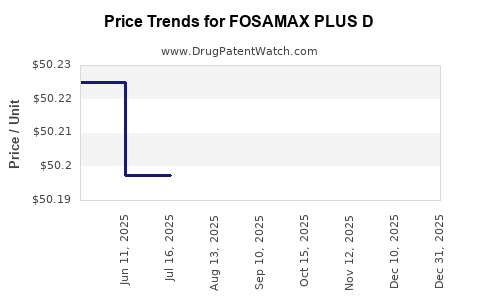
After loss of effective exclusivity, payers and pharmacies shifted patients toward lower-cost alendronate and alendronate-vitamin D alternatives. The generic products reduced net prices and compressed the branded product’s share.
Therapeutic substitution
Fosamax Plus D also competes with products that avoid oral administration. Prolia, marketed by Amgen, is administered every six months. Reclast, also based on zoledronic acid, is administered intravenously at longer intervals. Forteo, Tymlos and Evenity target higher-risk patients, while oral agents such as Actonel and Boniva compete within the bisphosphonate category.
What is the financial trajectory of Fosamax Plus D?
Fosamax Plus D’s financial trajectory is one of maturity, price erosion and declining strategic importance to Merck.
Merck has not consistently disclosed Fosamax Plus D revenue as a standalone line item. Reported Fosamax sales historically included the broader Fosamax franchise, making product-specific revenue reconstruction unreliable. Current product-level revenue should therefore be analyzed through prescription volume, average selling price, generic share and channel mix rather than through Merck’s consolidated financial statements.
| Financial driver |
Historical effect |
Current effect |
| Existing Fosamax brand recognition |
Supported launch and physician adoption |
Limited differentiation after generic entry |
| Weekly dosing |
Improved convenience |
Still constrained by oral administration rules |
| Vitamin D combination |
Supported adherence and positioning |
Easily substituted by separate low-cost vitamin D |
| Generic entry |
Reduced net price and market share |
Primary market condition |
| OTC vitamin D availability |
Increased price pressure |
Weakens combination-product premium |
| Injectable alternatives |
Reduced use in selected patients |
Supports therapeutic substitution |
| Merck portfolio priorities |
Shifted toward newer medicines |
Low strategic emphasis on mature Fosamax products |
A reasonable commercial conclusion is that Fosamax Plus D is a low-growth, low-margin mature product rather than a meaningful future revenue driver. Its remaining value is more likely to arise from residual branded prescriptions, licensing or supply arrangements, and international sales than from U.S. innovation-based pricing.
What generic entry risks exist for Fosamax Plus D?
Generic entry risk is already realized in the United States and other developed markets.
The remaining commercial risks are:
- Further price deflation as additional suppliers enter.
- Pharmacy-level substitution away from the Merck label.
- Loss of formulary preference.
- Parallel trade and country-specific reference pricing.
- Substitution with generic alendronate plus separate vitamin D.
- Physician movement toward injectable therapies for adherence or fracture-risk reasons.
A generic launch does not require the competitor to reproduce the exact commercial package. A manufacturer can compete with a therapeutically equivalent tablet, a different packaging configuration, or a lower-cost supply agreement.
How does Fosamax Plus D compare with competing osteoporosis drugs?
| Product/category |
Administration |
Main advantage |
Main commercial weakness |
| Fosamax Plus D |
Weekly oral tablet |
Low-cost combination therapy |
Administration restrictions and generic erosion |
| Generic alendronate |
Weekly oral tablet |
Lowest-cost established option |
Same oral tolerability and adherence limitations |
| Actonel/generic risedronate |
Oral or intermittent dosing |
Alternative bisphosphonate |
Generic competition |
| Boniva/generic ibandronate |
Monthly oral or injectable forms |
Less frequent dosing |
Narrower fracture-evidence profile in some settings |
| Prolia |
Six-month injection |
Convenience and adherence |
Higher cost and discontinuation management |
| Reclast |
Periodic IV infusion |
Long dosing interval |
Infusion logistics and acute-phase reactions |
| Forteo/Tymlos |
Daily injection |
Anabolic treatment for high-risk patients |
High cost and injection burden |
| Evenity |
Monthly injection |
Anabolic and antiresorptive activity |
Specialist use, cardiovascular warnings and cost |
Fosamax Plus D remains competitive where low price is the primary purchasing criterion. It is less competitive when adherence, gastrointestinal tolerability, severe fracture risk or convenience drives treatment choice.
What licensing deals affect Fosamax Plus D?
No major recent licensing transaction is publicly associated with Fosamax Plus D. Merck’s historical commercial rights and manufacturing arrangements are more relevant than a current innovation license.
International commercialization may involve local distributors, affiliates or third-party supply arrangements. Those agreements can preserve market access without changing the weak U.S. patent position.
What is the geographic coverage of Fosamax Plus D?
The product and equivalent alendronate-vitamin D combinations have been marketed in multiple jurisdictions, but approval status, brand ownership and patent terms vary by country.
The United States is a generic market. European and other developed markets also have substantial generic exposure, often intensified by reference pricing and national reimbursement controls. Emerging markets may retain branded sales in selected channels, but local generic manufacturing and price regulation create similar pressure.
Manufacturing is not a major structural barrier. Alendronate and cholecalciferol tablets use established oral solid-dose technologies, and multiple contract manufacturers can produce comparable products. Regulatory compliance, impurity control, stability, dissolution and supply reliability remain operational requirements rather than durable competitive moats.
Key Takeaways
- Fosamax Plus D is a mature alendronate-vitamin D combination product marketed by Merck.
- Its U.S. commercial exclusivity has expired, and generic competition is established.
- The patent estate focused on combination, formulation and related claims rather than new-molecule protection.
- Current patent strength is low as a barrier to generic substitution.
- Fosamax Plus D does not face biosimilar risk because it is a small-molecule drug.
- Merck does not separately disclose Fosamax Plus D revenue, so product-level financial estimates are inherently limited.
- The product’s value is concentrated in low-cost osteoporosis treatment, not premium branded growth.
- Injectable therapies and newer anabolic or dual-action agents create therapeutic substitution risk.
- The most likely market trajectory is continued volume retention in price-sensitive patients accompanied by further branded-price erosion.
FAQs
Is Fosamax Plus D still patented?
Its meaningful U.S. exclusivity has expired for commercial purposes. Historical patents may remain relevant in specific jurisdictions or for narrow claims, but they do not appear to block established U.S. generic competition.
Is Fosamax Plus D available over the counter?
Fosamax Plus D is a prescription product. Generic alendronate and vitamin D supplements are also prescription or nonprescription products depending on the formulation and jurisdiction.
Is generic alendronate the same as Fosamax Plus D?
Generic alendronate is therapeutically related but does not necessarily contain vitamin D3. Alendronate-vitamin D combination generics are closer substitutes for Fosamax Plus D.
Can Fosamax Plus D be replaced by vitamin D alone?
Vitamin D alone does not provide the antiresorptive action of alendronate. Substitution decisions depend on the patient’s fracture risk, bone density, calcium and vitamin D status, and clinician assessment.
Does Fosamax Plus D have meaningful investment value for Merck?
Its direct growth contribution is likely limited. The product is a mature, generic-exposed asset and is unlikely to materially influence Merck’s consolidated financial trajectory compared with the company’s newer oncology, immunology, vaccine and infectious-disease products.
References
- U.S. Food and Drug Administration. (n.d.). Approved drug products with therapeutic equivalence evaluations: Orange Book. https://www.accessdata.fda.gov/scripts/cder/ob/
- Merck & Co., Inc. (2008). Annual report. https://www.merck.com/financials/annual-reports/
- U.S. Food and Drug Administration. (2005). Fosamax Plus D prescribing information. https://www.accessdata.fda.gov/
- U.S. Food and Drug Administration. (n.d.). Drugs@FDA: FDA-approved drugs. https://www.accessdata.fda.gov/scripts/cder/daf/
- National Osteoporosis Foundation. (2022). Clinician’s guide to prevention and treatment of osteoporosis. Osteoporosis International, 33, 2049-2102.