Last updated: September 8, 2026
Fluvastatin sodium is a mature, off-patent statin with limited commercial momentum. The drug entered the U.S. market as Novartis’ Lescol and later Lescol XL, but lost most brand value after generic entry. Its current market is driven by low-cost generic supply, physician familiarity, and niche use where interaction profile or tolerability influences prescribing. Atorvastatin, rosuvastatin, and simvastatin have stronger scale, broader guideline use, and greater commercial importance.
Public company filings do not separately report current fluvastatin sodium revenue. The financial trajectory is therefore best assessed through FDA approval history, loss of exclusivity, brand sales disclosures, generic entry, pricing pressure, and the drug’s position within the statin class.
What is fluvastatin sodium and how is it used?
Fluvastatin sodium is the sodium salt of fluvastatin, an HMG-CoA reductase inhibitor used to reduce low-density lipoprotein cholesterol and total cholesterol. In the United States, the approved dosage forms have included 20 mg and 40 mg capsules and an 80 mg extended-release tablet.
The original brand was Lescol. Lescol XL provided once-daily extended-release dosing. The FDA approved Lescol in December 1993 and Lescol XL in June 2000 (U.S. Food and Drug Administration [FDA], n.d.-a, n.d.-b).
| Attribute |
Fluvastatin sodium |
| Drug class |
HMG-CoA reductase inhibitor |
| Primary indication |
Hypercholesterolemia and mixed dyslipidemia |
| Original U.S. brand |
Lescol |
| Extended-release brand |
Lescol XL |
| Original sponsor |
Sandoz, later Novartis |
| Typical strengths |
20 mg, 40 mg, and 80 mg extended release |
| Administration |
Oral |
| Current commercial status |
Generic, mature, low-growth market |
| Main competitors |
Atorvastatin, rosuvastatin, simvastatin, pravastatin, pitavastatin |
Fluvastatin is generally viewed as less potent on a milligram-for-milligram basis than atorvastatin and rosuvastatin. Its commercial role is consequently concentrated in patients requiring a lower-intensity statin, patients with tolerability concerns, or cases in which clinicians consider its drug-interaction profile advantageous.
When did fluvastatin sodium lose exclusivity?
Fluvastatin sodium lost meaningful U.S. brand exclusivity in the early 2010s. Generic approvals followed the expiration or practical exhaustion of the key Lescol and Lescol XL patent position.
The original compound patent was issued in the 1980s, placing basic compound protection well before the U.S. launch. Subsequent formulation and extended-release protection supported the Lescol XL product, but did not prevent eventual generic competition.
| Milestone |
Approximate timing |
Commercial effect |
| Original fluvastatin patent filings |
1980s |
Established compound protection |
| Lescol FDA approval |
December 1993 |
U.S. brand launch |
| Lescol XL FDA approval |
June 2000 |
Added extended-release product |
| First major generic competition |
Early 2010s |
Accelerated brand erosion |
| Current status |
Mature generic market |
Low pricing power and limited innovation |
The exact economic loss-of-exclusivity date depends on the product, patent, pediatric extension, regulatory exclusivity, and the ANDA applicant’s certification. The practical commercial outcome is clear: fluvastatin has been exposed to generic competition for more than a decade.
What patents protect fluvastatin sodium?
The historical fluvastatin estate included compound patents, process patents, and formulation patents. The most important commercial protection covered the active pharmaceutical ingredient and the extended-release dosage form.
Compound patents
The original fluvastatin patent family protected the active compound and related chemical forms. Those rights were central to the early Lescol franchise but expired long before the current market period.
Formulation patents
Lescol XL depended on extended-release formulation technology. Formulation claims can protect release profile, excipient composition, tablet structure, or manufacturing parameters. These patents may delay generic entry when they remain listed or enforceable, but they do not necessarily preserve long-term pricing after alternative formulations and generic challenges become available.
Method-of-use patents
Fluvastatin has been used for lipid lowering and cardiovascular risk reduction, but its principal U.S. commercial indications are established statin indications rather than a high-value, late-cycle method-of-use franchise. Method-of-use claims have not created a material current barrier to generic substitution.
Patent strength
The current patent estate is commercially weak because:
- The principal compound protection is expired.
- Generic products have been marketed for years.
- The therapeutic category has multiple substitutable products.
- Formulation differentiation has limited economic value after extended-release competition.
- Payers and pharmacies have strong incentives to substitute lower-cost products.
The patent estate may still contain residual process or formulation claims in particular jurisdictions, but those rights do not support a credible U.S. branded exclusivity strategy.
What is the Orange Book status of fluvastatin sodium?
The FDA Orange Book historically listed Lescol and Lescol XL under Novartis-related new drug applications. The product’s regulatory profile is now primarily relevant to generic substitution, ANDA referencing, and historical patent certifications rather than active brand protection.
| Regulatory issue |
Assessment |
| Reference listed drug |
Lescol and Lescol XL |
| FDA pathway for competitors |
Abbreviated New Drug Application |
| Bioequivalence requirement |
Required for generic approval |
| Current brand exclusivity |
No meaningful market exclusivity |
| Orange Book importance |
Historical patent and reference-product analysis |
| Biosimilar pathway |
Not applicable |
Because fluvastatin sodium is a small-molecule drug, competitors use the ANDA pathway rather than the biosimilar pathway. FDA approval depends on pharmaceutical equivalence and bioequivalence, not clinical-trial replication of the originator’s entire development program (FDA, 2017).
Which companies are challenging fluvastatin sodium exclusivity?
Generic manufacturers have challenged and replaced the original Lescol franchise. Publicly visible market participants have included major generic companies such as Apotex, Mylan, Sandoz, and Teva, although product availability varies by country, strength, dosage form, and time period.
The competitive structure differs between immediate-release capsules and the 80 mg extended-release tablet. A manufacturer may hold an approval without maintaining active commercial supply. Wholesaler inventory, manufacturing economics, and reimbursement rates determine whether an approved generic remains visible in the market.
There is no biosimilar risk because fluvastatin is a chemically synthesized small molecule. The relevant competitive risks are:
- Additional ANDA approvals.
- Price competition among generic suppliers.
- Pharmacy substitution.
- Formulary preference for other statins.
- Manufacturing interruptions or supplier exits.
- Therapeutic substitution to atorvastatin or rosuvastatin.
What patent litigation affects fluvastatin sodium?
Fluvastatin’s major patent litigation risk was concentrated around the original generic-entry period. The product is no longer in the commercial phase in which Paragraph IV litigation would normally create substantial value for the innovator.
A Paragraph IV certification challenges the validity, enforceability, or infringement of an Orange Book-listed patent. For a mature drug such as fluvastatin, a new Paragraph IV event would have limited economic significance unless it targeted a newly listed, commercially meaningful formulation or a narrowly defined high-value indication.
The litigation profile can be summarized as follows:
| Litigation factor |
Current commercial implication |
| Compound-patent litigation |
Historical, not a current barrier |
| Formulation-patent litigation |
Potentially narrow and product-specific |
| Paragraph IV risk |
Low strategic importance |
| 30-month stay potential |
Relevant only to an active listed patent and pending ANDA |
| Settlement leverage |
Limited because the market is generic and mature |
| Injunction value |
Low unless supply is concentrated |
No current settlement agreement has a material effect on the broad fluvastatin sodium market based on the established generic status of the product.
How does fluvastatin compare with atorvastatin and rosuvastatin?
Fluvastatin is commercially disadvantaged against the highest-volume statins because it offers less LDL reduction at commonly used doses and has weaker guideline-driven demand.
| Drug |
Relative commercial position |
Generic status |
Competitive advantage |
| Fluvastatin |
Niche, mature |
Generic |
Tolerability and interaction considerations |
| Atorvastatin |
High-volume standard |
Generic |
Potency, extensive outcomes data, broad use |
| Rosuvastatin |
High-value generic |
Generic |
High potency and strong LDL reduction |
| Simvastatin |
Mature high-volume generic |
Generic |
Low cost and historical familiarity |
| Pravastatin |
Niche generic |
Generic |
Lower interaction concerns in some patients |
| Pitavastatin |
Smaller branded/generic segment |
Mixed by market |
Potency and metabolic profile positioning |
The strongest substitution pressure comes from atorvastatin and rosuvastatin. Both have broad guideline support and are routinely selected for moderate- or high-intensity lipid lowering. Fluvastatin’s remaining demand is more sensitive to physician preference, patient history, formulary design, and tolerability.
What drives the fluvastatin sodium market?
The market is primarily a low-price, prescription-volume market. Growth depends less on new patient adoption than on continued generic availability.
Price erosion
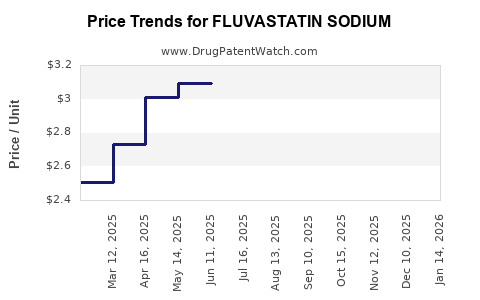
Generic entry sharply reduces average selling prices. The first generic entrants may earn acceptable margins, but prices normally decline as additional suppliers enter. Fluvastatin has limited ability to sustain premium pricing because therapeutic alternatives are abundant.
Therapeutic substitution
Pharmacists and payers can replace fluvastatin with another statin when the prescriber permits substitution. This reduces the addressable market for fluvastatin even when generic supply is stable.
Clinical niche demand
Demand persists where clinicians value:
- A lower-intensity statin regimen.
- Prior tolerability with fluvastatin.
- A specific interaction profile.
- Continuity for established patients.
- Local formulary or procurement preferences.
Supply concentration
The principal operational risk is not patent exclusion but supplier withdrawal. Low-volume generic products may become commercially unattractive if manufacturing costs, regulatory requirements, or active ingredient procurement costs increase.
What is the financial trajectory for fluvastatin sodium?
The financial trajectory has four phases.
1. Brand growth phase
Lescol benefited from the expansion of statin treatment during the 1990s and early 2000s. Novartis promoted the product as part of its cardiovascular portfolio, and the brand generated substantial revenue before broad generic substitution.
2. Extended-release defense phase
Lescol XL extended the franchise through once-daily dosing and formulation differentiation. This strategy supported brand retention but did not create a durable long-term barrier against generic competition.
3. Generic-entry phase
Generic approvals caused the expected decline in brand volume and pricing. Novartis’ financial disclosures subsequently reflected a much smaller contribution from the product, with the franchise becoming immaterial relative to the company’s larger pharmaceutical assets (Novartis, 2000-2013).
4. Mature generic phase
The current market generates value mainly for manufacturers with efficient production, reliable supply, and low operating costs. Revenue is fragmented across suppliers and is not generally disclosed as a standalone line item.
| Financial metric |
Current assessment |
| Branded revenue growth |
Negative or immaterial |
| Generic unit demand |
Stable to declining |
| Generic pricing |
Low and competitive |
| Gross-margin profile |
Dependent on scale and supply efficiency |
| Innovation premium |
Minimal |
| Licensing value |
Low |
| Acquisition value |
Usually limited to portfolio fit or manufacturing scale |
| Revenue exposure for originator |
Negligible |
A company evaluating fluvastatin sodium today would generally underwrite the product as a portfolio generic, not as a growth asset. Value would come from manufacturing efficiency, bundled pharmacy contracting, geographic reach, or supply reliability rather than patent exclusivity.
What licensing deals involve fluvastatin sodium?
Fluvastatin’s principal commercial licensing activity occurred during the originator development and commercialization period. The product was associated with Sandoz and later Novartis corporate ownership. There is no evident current licensing thesis comparable to a launch-stage specialty drug or a platform technology.
Potential transaction value is limited to:
- Regional marketing rights.
- Generic product acquisitions.
- Contract manufacturing arrangements.
- Portfolio transfers involving multiple cardiovascular products.
- Licensing of formulation or process technology in jurisdictions where rights remain relevant.
A standalone U.S. fluvastatin license would likely have limited strategic value unless attached to a broader generic portfolio.
What generic launch scenarios exist for fluvastatin sodium?
The most likely market scenarios are:
| Scenario |
Probability profile |
Market outcome |
| Stable generic supply |
Most favorable for patients and payers |
Continued low-price access |
| Supplier consolidation |
Plausible |
Fewer manufacturers and greater shortage sensitivity |
| Additional price erosion |
Likely over time |
Lower supplier margins |
| Product withdrawal |
Possible for low-volume strengths |
Intermittent availability |
| Branded relaunch |
Unlikely |
Limited reimbursement and weak differentiation |
| New formulation launch |
Low probability |
Requires a clear adherence or tolerability advantage |
A generic manufacturer could still pursue value through an authorized generic, 80 mg extended-release product, or regional supply agreement. The commercial ceiling remains low because clinicians can switch to alternative statins.
What is the geographic coverage of fluvastatin sodium?
Fluvastatin has had international availability under Lescol and generic names, but the product’s commercial significance varies by market. Europe historically supported stronger statin utilization and broader generic substitution. Emerging markets may retain demand where fluvastatin is included in formularies or where price-sensitive physicians favor older statins.
Geographic risks include:
- Different patent expiration dates.
- Country-specific generic approvals.
- National reimbursement decisions.
- Local manufacturing requirements.
- Tender-driven price compression.
- Market withdrawal by low-volume suppliers.
The broadest commercial opportunity is in markets with established generic reimbursement and predictable procurement. High-income markets offer volume but intense price competition. Lower-income markets may offer demand growth but weaker pricing and more variable distribution.
What manufacturing and intellectual-property barriers remain?
Manufacturing barriers are moderate rather than high. Fluvastatin sodium does not require biologic production, cold-chain distribution, or complex device technology. The key requirements are active ingredient quality, impurity control, solid-dose formulation capability, dissolution performance, and validated bioequivalence.
Potential barriers include:
- Reliable active pharmaceutical ingredient supply.
- Control of stereochemistry and impurities.
- Extended-release dissolution specifications.
- Scale economics for low-volume strengths.
- FDA and international good manufacturing practice compliance.
- Stability data across packaging configurations.
Intellectual-property barriers are substantially weaker than manufacturing and regulatory execution barriers. The remaining competitive advantage lies in cost, supply continuity, and regulatory discipline.
Key Takeaways
- Fluvastatin sodium is a mature generic statin with limited current brand value.
- Lescol was FDA-approved in 1993, and Lescol XL followed in 2000.
- The commercially important compound and formulation protections have expired or lost practical market significance.
- Generic competition has displaced the original Novartis franchise.
- The drug has no biosimilar risk because it is a chemically synthesized small molecule.
- Paragraph IV litigation and settlement risk are primarily historical.
- Atorvastatin and rosuvastatin exert the strongest therapeutic substitution pressure.
- Current financial value depends on generic manufacturing scale, supply reliability, and portfolio economics.
- Standalone licensing or branded relaunch potential is low.
- The main present risk is supplier withdrawal or intermittent availability, not patent exclusion.
FAQs About Fluvastatin Sodium
Is fluvastatin sodium still sold in the United States?
Yes. Fluvastatin sodium has been available as a generic prescription product, although availability can vary by dosage strength, manufacturer, wholesaler inventory, and pharmacy purchasing decisions.
Is fluvastatin sodium interchangeable with atorvastatin?
The products are not dose-for-dose interchangeable. Atorvastatin is generally more potent at commonly prescribed doses. Any substitution should follow the prescriber’s selected intensity and clinical objective.
Does fluvastatin sodium have a live U.S. composition-of-matter patent?
The original compound protection is expired. Any remaining rights would be product-specific process or formulation rights rather than a meaningful composition-of-matter barrier to ordinary generic supply.
Can a company obtain FDA approval for a new fluvastatin sodium generic?
Yes. A manufacturer can pursue an ANDA for an eligible reference product, subject to FDA requirements for pharmaceutical equivalence, bioequivalence, chemistry, manufacturing controls, labeling, and facility compliance.
Is fluvastatin sodium commercially attractive for a pharmaceutical acquisition?
Usually only as part of a broader generic portfolio. Its low price, extensive competition, limited differentiation, and weak patent position make it unattractive as a standalone branded acquisition.
References
-
Novartis AG. (2000-2013). Annual reports. Novartis.
-
U.S. Food and Drug Administration. (2017). Guidance for industry: ANDAs for certain highly purified synthetic peptides. U.S. Department of Health and Human Services.
-
U.S. Food and Drug Administration. (n.d.-a). Drugs@FDA: Lescol, NDA 020702. U.S. Department of Health and Human Services.
-
U.S. Food and Drug Administration. (n.d.-b). Drugs@FDA: Lescol XL, NDA 021366. U.S. Department of Health and Human Services.
-
U.S. Food and Drug Administration. (n.d.-c). Approved drug products with therapeutic equivalence evaluations: Orange Book. U.S. Department of Health and Human Services.