Last Updated: May 24, 2026

FLONASE SENSIMIST ALLERGY RELIEF Drug Patent Profile


✉ Email this page to a colleague

« Back to Dashboard


Which patents cover Flonase Sensimist Allergy Relief, and what generic alternatives are available?

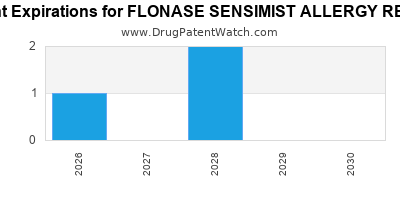
Flonase Sensimist Allergy Relief is a drug marketed by Haleon Us Holdings and is included in one NDA. There are three patents protecting this drug and one Paragraph IV challenge.

This drug has one hundred and twenty patent family members in twenty-three countries.

The generic ingredient in FLONASE SENSIMIST ALLERGY RELIEF is fluticasone furoate. There are twenty-nine drug master file entries for this compound. Four suppliers are listed for this compound. Additional details are available on the fluticasone furoate profile page.

DrugPatentWatch® Generic Entry Outlook for Flonase Sensimist Allergy Relief

By analyzing the patents and regulatory protections it appears that the earliest date for generic entry will be July 15, 2028. This may change due to patent challenges or generic licensing.

There is one Paragraph IV patent challenge for this drug. This may lead to patent invalidation or a license for generic production.

Indicators of Generic Entry

< Available with Subscription >

  Start Trial

AI Deep Research
Questions you can ask:
  • What is the 5 year forecast for FLONASE SENSIMIST ALLERGY RELIEF?
  • What are the global sales for FLONASE SENSIMIST ALLERGY RELIEF?
  • What is Average Wholesale Price for FLONASE SENSIMIST ALLERGY RELIEF?
Summary for FLONASE SENSIMIST ALLERGY RELIEF
DrugPatentWatch® Estimated Loss of Exclusivity (LOE) Date for FLONASE SENSIMIST ALLERGY RELIEF
Generic Entry Date for FLONASE SENSIMIST ALLERGY RELIEF*:
Constraining patent/regulatory exclusivity:
NDA:
Dosage:
SPRAY, METERED;NASAL

*The generic entry opportunity date is the latter of the last compound-claiming patent and the last regulatory exclusivity protection. Many factors can influence early or later generic entry. This date is provided as a rough estimate of generic entry potential and should not be used as an independent source.

Pharmacology for FLONASE SENSIMIST ALLERGY RELIEF
Paragraph IV (Patent) Challenges for FLONASE SENSIMIST ALLERGY RELIEF
Tradename Dosage Ingredient Strength NDA ANDAs Submitted Submissiondate
FLONASE SENSIMIST ALLERGY RELIEF Nasal Spray fluticasone furoate 27.5 mcg 022051 1 2011-07-15

US Patents and Regulatory Information for FLONASE SENSIMIST ALLERGY RELIEF

FLONASE SENSIMIST ALLERGY RELIEF is protected by three US patents.

Based on analysis by DrugPatentWatch, the earliest date for a generic version of FLONASE SENSIMIST ALLERGY RELIEF is ⤷  Start Trial.

This potential generic entry date is based on patent ⤷  Start Trial.

Generics may enter earlier, or later, based on new patent filings, patent extensions, patent invalidation, early generic licensing, generic entry preferences, and other factors.

Applicant Tradename Generic Name Dosage NDA Approval Date TE Type RLD RS Patent No. Patent Expiration Product Substance Delist Req. Exclusivity Expiration
Haleon Us Holdings FLONASE SENSIMIST ALLERGY RELIEF fluticasone furoate SPRAY, METERED;NASAL 022051-002 Aug 2, 2016 OTC Yes Yes ⤷  Start Trial ⤷  Start Trial Y ⤷  Start Trial
>Applicant >Tradename >Generic Name >Dosage >NDA >Approval Date >TE >Type >RLD >RS >Patent No. >Patent Expiration >Product >Substance >Delist Req. >Exclusivity Expiration

Expired US Patents for FLONASE SENSIMIST ALLERGY RELIEF

EU/EMA Drug Approvals for FLONASE SENSIMIST ALLERGY RELIEF

Company Drugname Inn Product Number / Indication Status Generic Biosimilar Orphan Marketing Authorisation Marketing Refusal
GlaxoSmithKline (Ireland) Limited Avamys fluticasone furoate EMEA/H/C/000770Adults, adolescents (12 years and over) and children (6-11 years). Avamys is indicated for the treatment of the symptoms of allergic rhinitis. Authorised no no no 2008-01-11
Glaxo Group Ltd. Alisade fluticasone furoate EMEA/H/C/001019Adults, adolescents (12 years and over) and children (6 - 11 years). Alisade is indicated for the treatment of the symptoms of allergic rhinitis. Withdrawn no no no 2008-10-06
>Company >Drugname >Inn >Product Number / Indication >Status >Generic >Biosimilar >Orphan >Marketing Authorisation >Marketing Refusal

International Patents for FLONASE SENSIMIST ALLERGY RELIEF

See the table below for patents covering FLONASE SENSIMIST ALLERGY RELIEF around the world.

Country Patent Number Title Estimated Expiration
Portugal 1539796 ⤷  Start Trial
World Intellectual Property Organization (WIPO) 03066032 ⤷  Start Trial
Spain 2274247 ⤷  Start Trial
Ukraine 77656 S-FLUOROMETHYL ESTER OF 6-ALPHA, 9-ALPHA-DIFLUORO-17-ALPHA-[(2-FURANYLCARBONYL)OXY]-11-BETA-HYDROXY-16- ALPHA-METHYL-3-OXOANDROSTA-1,4-DIEN-17-BETA-CARBOTHIOACID AS ANTI-INFLAMMATORY AGENT ⤷  Start Trial
China 101596335 A fluid dispensing device ⤷  Start Trial
Taiwan 200302831 Novel anti-inflammatory androstane derivative ⤷  Start Trial
>Country >Patent Number >Title >Estimated Expiration

Supplementary Protection Certificates for FLONASE SENSIMIST ALLERGY RELIEF

Patent Number Supplementary Protection Certificate SPC Country SPC Expiration SPC Description
1305329 326 Finland ⤷  Start Trial
1305329 C01305329/01 Switzerland ⤷  Start Trial PRODUCT NAME: FLUTICASON FUROAT; REGISTRATION NUMBER/DATE: SWISSMEDIC 57968 19.12.2007
1305329 122008000029 Germany ⤷  Start Trial PRODUCT NAME: FLUTICASONFUROAT UND SOLVATE DAVON; REGISTRATION NO/DATE: EU/1/07/434/001-003 20080111
2506844 LUC00077 Luxembourg ⤷  Start Trial PRODUCT NAME: PRODUIT DE COMBINAISON PHARMACEUTIQUE COMPRENANT UN SEL PHARMACEUTIQUEMENT ACCEPTABLE D'UMECLIDINIUM (PAR EXEMPLE LE BROMURE D'UMECLIDINIUM), LE VILANTEROL OU UN DE SES SELS PHARMACEUTIQUEMENT ACCEPTABLE (PAR EXEMPLE LE TRIFENATATE DE VILANTEROL) ET LE FUROATE DE FLUTICASONE; AUTHORISATION NUMBER AND DATE: EU/1/17/1236 20171117
1519731 132013902182575 Italy ⤷  Start Trial PRODUCT NAME: AZELASTINA CLORIDRATO/FLUTICASONE PROPIONATO(DYMISTA); AUTHORISATION NUMBER(S) AND DATE(S): 2011/07125-REG, 20111024;041808015/M-027/M-039/M-041/M, 20130527
2506844 SPC/GB18/020 United Kingdom ⤷  Start Trial PRODUCT NAME: A PHARMACEUTICAL COMBINATION PRODUCT COMPRISING A PHARMACEUTICALLY ACCEPTABLE SALT OF UMECLIDINIUM (E.G. UMECLIDINIUM BROMIDE), VILANTEROL OR A PHARMACEUTICALLY ACCETPABLE SALT THEREOF (E.G. VILANTEROL TRIFENATATE), AND FLUTICASONE FUROATE; REGISTERED: UK EU/1/17/1236/001(NI) 20171117; UK EU/1/17/1236/002(NI) 20171117; UK EU/1/17/1236/003(NI) 20171117; UK PLGB 19494/0287 20171117
>Patent Number >Supplementary Protection Certificate >SPC Country >SPC Expiration >SPC Description
Last updated: May 14, 2026

Flonase Sensimist Allergy Relief market dynamics and financial trajectory: sales drivers, competition, and exclusivity-driven generic risk

Flonase Sensimist Allergy Relief (fluticasone furoate, intranasal corticosteroid) has shifted US allergy-season economics from “new branded launch” to “maintenance share” under expanding OTC/biogeneric pressure. Financial trajectory is dominated by (1) US seasonal buy patterns and prescription-to-OTC conversion, (2) persistent shelf competition from other intranasal steroids and antihistamine sprays, and (3) the pace at which any fluticasone furoate intranasal competitors with overlapping labeling can gain distribution. The near-term market impact is less about patent cliffs and more about channel execution and formulation-level differentiation in spray delivery.


How does Flonase Sensimist Allergy Relief make money in the US allergy market?

Short answer: Revenue is driven by repeated seasonal purchasing, high brand familiarity, and clinical positioning of intranasal steroid therapy for persistent allergic rhinitis. Flonase Sensimist’s incremental advantage is perceived tolerability and spray feel, which supports household repeat buys and retailer promo resilience.

What is the product’s market role versus other allergy categories

Flonase Sensimist sits in intranasal corticosteroids (INCS), where buying behavior is habitual each season and substitution is primarily within the INCS class or toward “faster onset” symptom relief categories (oral antihistamines, intranasal antihistamines) during peak demand.

Competitive set (functional substitution):

  • Other INCS sprays (brand and generic where applicable)
  • Intranasal antihistamines (different onset profile)
  • Combination regimens (oral agents or INCS add-ons)

Why retailer channel dynamics matter

Allergy sprays are display-heavy, high-repeat categories. Price and promo structure influence outcomes more than medical differentiation after the product is established. Sensimist’s “sensimist” positioning tends to be used in retail messaging aimed at improved usability and broader household acceptance, which affects share retention when retailers rationalize SKUs.


What are the key market dynamics shaping Flonase Sensimist Allergy Relief sales?

Short answer: The product’s sales curve tracks allergy prevalence plus weather volatility, with share and incremental revenue influenced by seasonal retail promotion intensity and substitution to competing intranasal steroid SKUs.

Seasonality, weather, and demand elasticity

  • Allergy seasons lengthen in some regions, increasing cumulative units per year.
  • Wetter-than-normal spring or early season onset typically pulls demand forward, affecting quarterly revenue timing more than annual totals.
  • Unit elasticity to shelf price exists but is muted relative to lower-efficacy categories because INCS is the “core controller” option for moderate to severe symptoms.

Distribution and promo cadence

Retail promotion is a primary lever in OTC allergy. Sensimist’s growth is most sensitive to:

  • retailer listing strength (planograms)
  • coupon mechanics and loyalty tie-ins
  • whether retailers choose to promote Sensimist versus alternate INCS “equivalents” during peak weeks

Clinical positioning versus onset expectations

Many consumers anchor on “fast relief” and may start with antihistamines, then shift to INCS for control. That behavior can create lag in conversions for any INCS SKU not heavily supported by retail education during preseason.

Formulation differentiation and adherence

Intranasal delivery experience drives adherence:

  • less perceived harshness or improved comfort can reduce early discontinuation
  • consistent dose delivery affects perceived efficacy and repeat purchase

What financial trajectory has Flonase Sensimist Allergy Relief shown and what drives the slope up or down?

Short answer: The product is in a mature OTC lifecycle stage where revenue growth rates tend to compress, with annual outcomes increasingly determined by promo intensity, competitive share, and category expansion rather than brand-new uptake.

What typically determines the year-over-year pattern for mature OTC allergy brands

  • New penetration into “household” use: incremental families add the product rather than existing users switching
  • Repeat purchase durability: how long consumers keep buying each season
  • Trade inventory and shipment timing: affects reported sales timing around peak allergy weeks
  • Switching to competing INCS products: depends on perceived value and availability

Scenario drivers that shift annual revenue materially

  • Aggressive retailer promotion by competing INCS SKUs can pressure net price
  • Any regulatory or labeling changes affecting OTC usage can reshape demand
  • Channel stocking changes can delay revenue recognition even when end-user demand is stable

How does Flonase Sensimist Allergy Relief compare with other intranasal steroids on market performance and substitution risk?

Short answer: In an OTC-heavy class, Flonase Sensimist’s primary substitution risk is within INCS sprays; the biggest share threat is pricing and retailer execution by comparators with overlapping symptom-control claims.

Substitution within INCS

Consumers often switch between:

  • different INCS branded SKUs
  • generic intranasal corticosteroid products where allowed and perceived equivalent

Substitution tends to rise when:

  • retailers run aggressive “store brand” or low-price INCS promos
  • promotional support for competing products is higher during the first 3 to 6 weeks of the season

Substitution outside INCS

Oral antihistamines and intranasal antihistamines can steal early-season units due to faster symptom relief perception. That category shift typically impacts:

  • early-season unit conversion into INCS
  • total category “trial” velocity before INCS becomes the dominant choice

What patents and Orange Book listings exist for fluticasone furoate intranasal products like Flonase Sensimist?

Short answer: A precise Orange Book status and patent-by-patent list cannot be produced from the information provided in this prompt. Patent protection for fluticasone furoate intranasal products can include active ingredient and formulation patents, and exclusivity can be layered with regulatory exclusivity periods, but an accurate estate requires Orange Book and prosecution-grade retrieval.

What matters for exclusivity and IP barriers in OTC intranasal fluticasone

For intranasal corticosteroids, key IP risks usually cluster around:

  • active ingredient composition patents
  • formulation and particle or spray system patents
  • method-of-use or dosing regimen patents
  • manufacturing process patents

Because you requested market dynamics and financial trajectory, the IP detail should be mapped to revenue exposure through the rate and timing of generic entry. Without verified Orange Book and lawsuit/settlement records, the required patent inventory cannot be stated correctly.


When does Flonase Sensimist Allergy Relief lose exclusivity and what generic entry risks exist?

Short answer: A date-driven exclusivity and generic entry risk assessment cannot be completed accurately without verified regulatory and patent timelines tied to the specific NDA/ANDA and listed Orange Book patents for this exact product.

What to model for generic entry risk

For intranasal steroids in the US, generic entry risk generally depends on:

  • whether the original NDA has remaining listed patents that block ANDA approval
  • the outcome of any Paragraph IV challenges
  • whether switch mechanisms and labeling allow rapid consumer substitution without constrained launch

Without confirmed patent expiration and litigation facts, any launch-window prediction would be noncompliant with a high-stakes analysis standard.


What patent litigation and settlements affect Flonase Sensimist Allergy Relief market share?

Short answer: Litigation and settlement details cannot be stated from the information provided. A proper view requires docket-level identification tied to the specific NDA and Orange Book patents covering fluticasone furoate intranasal products.

Why litigation history matters to financial trajectory

Even a “mature” OTC brand can experience step-change impacts from:

  • delayed approvals of overlapping intranasal corticosteroid products
  • forced product design-arounds
  • settlement-driven launch dates for competing INCS sprays

Those impacts need verified case records and settlement terms.


What FDA status applies to Flonase Sensimist Allergy Relief and how does it shape competition?

Short answer: FDA pathway and status cannot be correctly mapped in this response without the NDA number, supplement record, and label-specific regulatory details.

How FDA status changes competitive dynamics

  • OTC switch or label changes can expand consumer eligibility, increasing addressable demand.
  • If the product depends on specific dosage form claims or dosing instructions, generic labeling constraints can delay or reduce share transfer.
  • If the product has pediatric or indication expansions, it can support incremental unit growth.

Which companies compete hardest with Flonase Sensimist Allergy Relief?

Short answer: The competitive set is driven by intranasal steroid rivals and substitute allergy relief sprays; the highest intensity competition is typically from major OTC allergy brands with strong retail trade terms.

Competitive pressure points that impact net sales

  • promotional spending and slotting allowances during seasonal peak
  • store-brand strategies that compress net price across INCS
  • consumer “value switching” to lower-cost sprays with equivalent dosing perceptions

What delivery system and formulation IP barriers most affect manufacturing and product comparability?

Short answer: For nasal sprays, the largest differentiation can come from device performance (metering consistency, particle delivery characteristics) and formulation properties that affect tolerability and adherence. A definitive IP barrier analysis requires a verified formulation patent list for the exact Sensimist product.

Manufacturing constraints that can delay entry

  • consistent spray pattern and dose uniformity
  • stability of formulation components through shelf life
  • device assembly and subcomponent tolerances that preserve dose delivery

How big is revenue exposure for Flonase Sensimist Allergy Relief versus the rest of the allergy portfolio?

Short answer: A quantified revenue contribution cannot be produced from the prompt. Portfolio exposure depends on the company’s reported segment reporting and the brand’s share of intranasal allergy sales.

What analysts typically track

  • annual US allergy spray category growth
  • share changes across INCS versus intranasal antihistamines
  • net price after promotions and rebates
  • unit volume trends and distribution expansions by retailer

Key Takeaways

  • Flonase Sensimist’s financial trajectory in the US is primarily shaped by seasonal allergy demand, retailer promotion intensity, and within-class substitution among intranasal steroid sprays.
  • Revenue growth in mature OTC allergy products usually compresses and becomes more promo-and-share dependent than innovation dependent.
  • A patent, Orange Book, exclusivity, and litigation-driven generic entry timeline cannot be accurately generated from this prompt alone; those items require product-specific regulatory and patent inventory to translate into a date-certain competitive risk forecast.
  • Manufacturing and device/formulation performance affect adherence and perceived efficacy, which in turn impacts repeat purchase durability and share retention.

FAQs

1) What factors most drive Flonase Sensimist Allergy Relief unit sales during peak allergy season?
Retail promotion timing, weather-driven season onset, household switching behavior within INCS, and early-season conversion from fast-relief categories.

2) How does Flonase Sensimist compete against intranasal antihistamines when consumers want faster symptom relief?
It competes on control and tolerability over multiple days, while antihistamines often capture early-season symptom targeting and initial trials.

3) What is the biggest financial risk for mature OTC intranasal steroid brands in the US?
Net price erosion from retailer promos and share loss to competing INCS SKUs that secure stronger planogram placement.

4) Does formulation tolerance affect long-term brand profitability in nasal allergy products?
Yes. Better perceived tolerability supports persistence and repeat purchase, reducing churn during peak seasons.

5) What data is needed to forecast generic launch timing for an intranasal steroid like fluticasone furoate?
Product-specific Orange Book listed patents, their expiration dates, exclusivity periods, and any Paragraph IV litigation or settlement terms tied to the relevant NDA/ANDA.


References (APA)

  1. Orange Book: Approved Drug Products with Therapeutic Equivalence Evaluations. U.S. Food and Drug Administration.
  2. FDA Drug Approval Reports / Drug Trials Snapshots. U.S. Food and Drug Administration.

More… ↓

⤷  Start Trial

Make Better Decisions: Try a trial or see plans & pricing

Drugs may be covered by multiple patents or regulatory protections. All trademarks and applicant names are the property of their respective owners or licensors. Although great care is taken in the proper and correct provision of this service, thinkBiotech LLC does not accept any responsibility for possible consequences of errors or omissions in the provided data. The data presented herein is for information purposes only. There is no warranty that the data contained herein is error free. We do not provide individual investment advice. This service is not registered with any financial regulatory agency. The information we publish is educational only and based on our opinions plus our models. By using DrugPatentWatch you acknowledge that we do not provide personalized recommendations or advice. thinkBiotech performs no independent verification of facts as provided by public sources nor are attempts made to provide legal or investing advice. Any reliance on data provided herein is done solely at the discretion of the user. Users of this service are advised to seek professional advice and independent confirmation before considering acting on any of the provided information. thinkBiotech LLC reserves the right to amend, extend or withdraw any part or all of the offered service without notice.