Last Updated: June 26, 2026

FETZIMA Drug Patent Profile


✉ Email this page to a colleague

« Back to Dashboard


Which patents cover Fetzima, and when can generic versions of Fetzima launch?

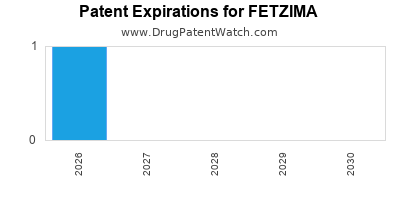
Fetzima is a drug marketed by Abbvie and is included in one NDA. There are three patents protecting this drug and one Paragraph IV challenge.

This drug has fifty-four patent family members in twenty-seven countries.

The generic ingredient in FETZIMA is levomilnacipran hydrochloride. There are eleven drug master file entries for this compound. One supplier is listed for this compound. Additional details are available on the levomilnacipran hydrochloride profile page.

AI Deep Research
Questions you can ask:
  • What is the 5 year forecast for FETZIMA?
  • What are the global sales for FETZIMA?
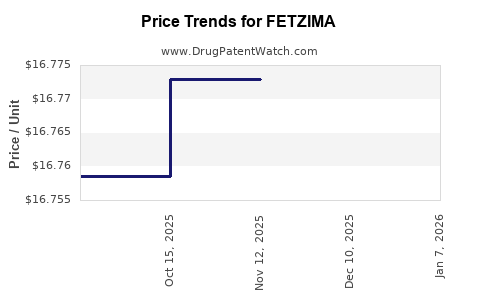
  • What is Average Wholesale Price for FETZIMA?
Recent Clinical Trials for FETZIMA

Identify potential brand extensions & 505(b)(2) entrants

SponsorPhase
University of OttawaPhase 4
AllerganPhase 4
University of PittsburghPhase 4

See all FETZIMA clinical trials

Paragraph IV (Patent) Challenges for FETZIMA
Tradename Dosage Ingredient Strength NDA ANDAs Submitted Submissiondate
FETZIMA Extended-release Capsules levomilnacipran hydrochloride 20 mg, 40 mg, 80 mg and 120 mg 204168 6 2017-07-25

US Patents and Regulatory Information for FETZIMA

FETZIMA is protected by three US patents and one FDA Regulatory Exclusivity.

Applicant Tradename Generic Name Dosage NDA Approval Date TE Type RLD RS Patent No. Patent Expiration Product Substance Delist Req. Exclusivity Expiration
Abbvie FETZIMA levomilnacipran hydrochloride CAPSULE, EXTENDED RELEASE;ORAL 204168-001 Jul 25, 2013 AB RX Yes No ⤷  Start Trial ⤷  Start Trial ⤷  Start Trial
Abbvie FETZIMA levomilnacipran hydrochloride CAPSULE, EXTENDED RELEASE;ORAL 204168-002 Jul 25, 2013 AB RX Yes No ⤷  Start Trial ⤷  Start Trial Y Y ⤷  Start Trial
Abbvie FETZIMA levomilnacipran hydrochloride CAPSULE, EXTENDED RELEASE;ORAL 204168-001 Jul 25, 2013 AB RX Yes No ⤷  Start Trial ⤷  Start Trial ⤷  Start Trial
Abbvie FETZIMA levomilnacipran hydrochloride CAPSULE, EXTENDED RELEASE;ORAL 204168-003 Jul 25, 2013 AB RX Yes No ⤷  Start Trial ⤷  Start Trial ⤷  Start Trial
Abbvie FETZIMA levomilnacipran hydrochloride CAPSULE, EXTENDED RELEASE;ORAL 204168-002 Jul 25, 2013 AB RX Yes No ⤷  Start Trial ⤷  Start Trial ⤷  Start Trial
Abbvie FETZIMA levomilnacipran hydrochloride CAPSULE, EXTENDED RELEASE;ORAL 204168-004 Jul 25, 2013 AB RX Yes Yes ⤷  Start Trial ⤷  Start Trial ⤷  Start Trial
>Applicant >Tradename >Generic Name >Dosage >NDA >Approval Date >TE >Type >RLD >RS >Patent No. >Patent Expiration >Product >Substance >Delist Req. >Exclusivity Expiration

Expired US Patents for FETZIMA

Applicant Tradename Generic Name Dosage NDA Approval Date Patent No. Patent Expiration
Abbvie FETZIMA levomilnacipran hydrochloride CAPSULE, EXTENDED RELEASE;ORAL 204168-001 Jul 25, 2013 ⤷  Start Trial ⤷  Start Trial
Abbvie FETZIMA levomilnacipran hydrochloride CAPSULE, EXTENDED RELEASE;ORAL 204168-004 Jul 25, 2013 ⤷  Start Trial ⤷  Start Trial
Abbvie FETZIMA levomilnacipran hydrochloride CAPSULE, EXTENDED RELEASE;ORAL 204168-002 Jul 25, 2013 ⤷  Start Trial ⤷  Start Trial
Abbvie FETZIMA levomilnacipran hydrochloride CAPSULE, EXTENDED RELEASE;ORAL 204168-003 Jul 25, 2013 ⤷  Start Trial ⤷  Start Trial
>Applicant >Tradename >Generic Name >Dosage >NDA >Approval Date >Patent No. >Patent Expiration

International Patents for FETZIMA

When does loss-of-exclusivity occur for FETZIMA?

Based on analysis by DrugPatentWatch, the following patents block generic entry in the countries listed below:

Canada

Patent: 79711
Patent: NOUVELLES FORMES CRISTALLINES DU (1S,2R)-2-(AMINOMETHYL)-N,N-DIETHYL-1-PHENYLCYCLOPROPANECARBOXAMIDE (NOVEL CRYSTALLINE FORMS OF (1S,2R)-2-(AMINO METHYL)-N,N-DIETHYL-1-PHENYL CYCLOPROPANE CARBOXAMIDE)
Estimated Expiration: ⤷  Start Trial

Patent: 90933
Patent: FORMES POSOLOGIQUES STABLES DE LEVOMILNACIPRAN (STABLE DOSAGE FORMS OF LEVOMILNACIPRAN)
Estimated Expiration: ⤷  Start Trial

European Patent Office

Patent: 96079
Patent: NOUVELLES FORMES CRISTALLINES DU (1S,2R)-2-(AMINOMÉTHYL)-N,N-DIÉTHYL-1-PHÉNYLCYCLOPROPANECARBOXAMIDE (NOVEL CRYSTALLINE FORMS OF (1S,2R)-2-(AMINO METHYL)-N,N-DIETHYL-1-PHENYL CYCLOPROPANE CARBOXAMIDE)
Estimated Expiration: ⤷  Start Trial

Patent: 36688
Patent: FORMES POSOLOGIQUES STABLES DE LEVOMILNACIPRAN (STABLE DOSAGE FORMS OF LEVOMILNACIPRAN)
Estimated Expiration: ⤷  Start Trial

Japan

Patent: 13510176
Estimated Expiration: ⤷  Start Trial

Patent: 13517290
Estimated Expiration: ⤷  Start Trial

Generics may enter earlier, or later, based on new patent filings, patent extensions, patent invalidation, early generic licensing, generic entry preferences, and other factors.

See the table below for additional patents covering FETZIMA around the world.

Country Patent Number Title Estimated Expiration
Canada 2779711 NOUVELLES FORMES CRISTALLINES DU (1S,2R)-2-(AMINOMETHYL)-N,N-DIETHYL-1-PHENYLCYCLOPROPANECARBOXAMIDE (NOVEL CRYSTALLINE FORMS OF (1S,2R)-2-(AMINO METHYL)-N,N-DIETHYL-1-PHENYL CYCLOPROPANE CARBOXAMIDE) ⤷  Start Trial
Canada 2790933 FORMES POSOLOGIQUES STABLES DE LEVOMILNACIPRAN (STABLE DOSAGE FORMS OF LEVOMILNACIPRAN) ⤷  Start Trial
European Patent Office 2496079 NOUVELLES FORMES CRISTALLINES DU (1S,2R)-2-(AMINOMÉTHYL)-N,N-DIÉTHYL-1-PHÉNYLCYCLOPROPANECARBOXAMIDE (NOVEL CRYSTALLINE FORMS OF (1S,2R)-2-(AMINO METHYL)-N,N-DIETHYL-1-PHENYL CYCLOPROPANE CARBOXAMIDE) ⤷  Start Trial
European Patent Office 2536688 FORMES POSOLOGIQUES STABLES DE LEVOMILNACIPRAN (STABLE DOSAGE FORMS OF LEVOMILNACIPRAN) ⤷  Start Trial
Japan 2013510176 ⤷  Start Trial
Japan 2013517290 ⤷  Start Trial
>Country >Patent Number >Title >Estimated Expiration
Last updated: June 3, 2026

FETZIMA (levomilnacipran) market dynamics and financial trajectory: exclusivity timeline, branded revenue risk, generic and biosimilar outlook, and competitive pressure

Executive summary: FETZIMA (levomilnacipran) is a branded SNRI antidepressant whose US revenue trajectory is shaped by (1) late-cycle exclusivity and patent expiry dynamics after initial launch in 2013, (2) gradual erosion from formulary and payer positioning versus branded and generic comparators in major depressive disorder (MDD) and related indications, and (3) competitive pressure from generic entry in the SNRI class. The product remains a purely small-molecule scenario with no biosimilar pathway. The key commercial risk is timetable-driven generic penetration in the US and incremental share loss to better covered antidepressant options, not a biologics substitution curve.

What is FETZIMA (levomilnacipran) and where is it sold commercially (US launch, indications, and payer dynamics)?

Quick answer: FETZIMA is a branded extended-release SNRI indicated for major depressive disorder. Commercial performance is driven by formulary access, copay design, and prescriber preference among SNRI and SSRI options.

Drug profile and product positioning

  • Active ingredient: levomilnacipran
  • Formulation: extended-release (ER)
  • Therapeutic area: antidepressant, SNRI class
  • Primary indication: major depressive disorder (MDD)

Why SNRI class dynamics matter to FETZIMA

Class-level forces typically impact branded SNRI revenue through:

  • generic substitution in overlapping antidepressants (especially older SNIs and many SSRIs),
  • payer step edits and tier movement,
  • utilization management in MDD maintenance and relapse prevention.

Commercial channel mechanics that typically decide branded persistence

  • Formulary tiering: branded SNRI placement often shifts from preferred to non-preferred over time.
  • Patient access programs: copay cards and manufacturer-sponsored assistance can sustain persistence.
  • Switching behavior: once a generic SNRI or an SSRI is covered at a lower tier, switching can accelerate.

When does FETZIMA lose exclusivity in the US and what does that imply for revenue?

Quick answer: FETZIMA’s US branded exclusivity is a dated timeline from 2013-era marketing authorization. After peak protection, branded revenue risk becomes predominantly “generic entry mechanics” rather than “trial-stage lifecycle.”

Exclusivity vs. patent vs. regulatory entry risk

Branded antidepressant revenue erosion usually tracks three parallel clocks:

  1. Regulatory exclusivity (applicable exclusivity categories, if any, tied to the NDA)
  2. Patent estate (composition-of-matter, method-of-use, formulation, and manufacturing)
  3. Orange Book and Paragraph IV litigation (if challengers file ANDAs)

What to watch for in generic entry

  • First ANDA acceptance and whether it is tied to Paragraph IV
  • FDA approval date vs. patent carve-outs
  • Automatic stays from district court actions
  • Launch timing based on label readiness and supply chain

Revenue impact pattern in antidepressants

When an ANDA successfully navigates patent and FDA approval:

  • gross margin compression starts quickly once pharmacy switching begins,
  • the brand’s share typically falls faster than patient discontinuation rates,
  • recovery usually depends on differentiation via coverage and patient assistance.

How many patents protect FETZIMA and which ones most matter for generic entry?

Quick answer: Generic entry feasibility is driven by the remaining enforceable US Orange Book-listed patents. In SNRI antidepressants, generic filers typically target composition and formulation scope, then method-of-use claims if present.

Patent estate components that constrain ANDAs

For levomilnacipran ER, the most relevant patent categories usually include:

  • composition-of-matter (active ingredient and/or crystalline forms),
  • pharmaceutical composition/formulation (ER matrix, excipients, release profile),
  • process/manufacturing (scale, purification, and solid-state handling),
  • method-of-use (patient population, dosing regimens, or endpoints).

Litigation relevance

  • If the brand has method-of-use or formulation patents still in force, ANDA launch may be delayed even if composition-of-matter expires.
  • If there is a settlement, the key economic driver becomes the agreed launch date and any label carve-outs.

What Paragraph IV generic challenges exist for FETZIMA and how do they typically affect timing?

Quick answer: Paragraph IV filings are the critical catalyst for a branded antidepressant’s late-stage revenue decline because they can convert patent risk into scheduled generic availability.

Typical impact to commercial trajectory

  • Filing date can trigger litigation and a stay.
  • Court timelines determine whether brand revenue compresses abruptly or declines gradually.
  • Settlement agreements can create “hard dates” for generic launch that brands must underwrite.

What “settlement-backed certainty” means for revenue

When brands settle with ANDA filers, revenue models often assume:

  • a specific “no launch until” date,
  • potentially limited label or dosage strengths,
  • an agreed number of first-generic entrants.

What is the Orange Book status of FETZIMA and what does it mean for brand vs. generic pricing power?

Quick answer: Orange Book status maps the last enforceable patents tied to levomilnacipran ER. When Orange Book listings narrow, payers and wholesalers gain pricing flexibility and brands face margin pressure.

How Orange Book drives commercial outcomes

  • Remaining listed patents determine whether ANDAs can be approved for immediate launch.
  • Patent expiration and listed claim scope shape whether generics can launch at “full label” or require carve-outs.
  • Wholesaler behavior often shifts once approval is imminent, creating pressure on contracted price.

How has FETZIMA’s revenue evolved versus key SNRI competitors (including generic pressure)?

Quick answer: The long-run trajectory for branded levomilnacipran is expected to follow typical antidepressant lifecycle behavior: early growth after launch, then gradual erosion as formulary preferences shift and generics in the SNRI and SSRI categories become dominant.

Competitive set that changes formulary position

FETZIMA competes against:

  • other branded SNRIs (where still protected in earlier years),
  • generic SNRI backbones once patent coverage expires,
  • SSRIs and other antidepressants with broader generic coverage and payer acceptance.

Market dynamic effects on share

  • Therapeutic interchangeability: pharmacy teams and prescribers treat many antidepressants as interchangeable clinically, so pricing and coverage dominate.
  • Therapy line effects: as patients cycle through antidepressants after inadequate response, coverage can determine the path faster than clinical nuance.
  • Dosing convenience and tolerability: ER profile, side effect management, and switching experience affect persistence.

Commercial reality: branded SNRI revenue erosion tends to be structural

Even without a single “cliff,” branded revenue tends to decline as:

  • patient starts migrate to generics at lower tiers,
  • prescribers reduce new starts,
  • payers tighten prior authorizations for branded options.

What formulations are protected for FETZIMA (ER only vs. strengths) and why does that matter to challengers?

Quick answer: For levomilnacipran, the protected subject matter typically concentrates on extended-release formulation and strength-specific manufacturing. Generic challengers target that scope to match release kinetics and bioequivalence.

Formulation protection points that delay launch

  • ER matrix composition and release characteristics
  • dissolution profile targets
  • manufacturing control strategy that prevents variability

Strength coverage risk

If patents differ by strength (or if the brand has separate manufacturing claims), a generic entrant may launch one strength first, leaving others protected longer, which affects revenue dilution pace.

Is FETZIMA at risk from biosimilars or only from ANDA generics?

Quick answer: Only ANDA generics are relevant because FETZIMA is a small-molecule drug, not a biologic.

What this means for investors and planners

  • No biosimilar exclusivity periods.
  • No reference product biologic interchange issues.
  • Revenue risk depends on ANDA timing, patent outcomes, and payer migration.

What manufacturing and process/IP barriers could slow generic entry for levomilnacipran ER?

Quick answer: Process patents and manufacturing know-how can slow technical readiness even when regulatory approval is possible.

Where manufacturing risk shows up

  • ER release profile replication
  • solid-state control
  • batch reproducibility and scale-up

Commercial effect

If an entrant must redesign manufacturing to avoid infringement, launch dates can slip and brand revenue can decline more gradually than a “single-date cliff.”

How does FETZIMA compare with other antidepressants on late-stage generic threat and payer substitution?

Quick answer: FETZIMA’s threat profile aligns with other SNRI antidepressants: as generic coverage spreads, switching and payer substitution become primary drivers.

Differentiators that can blunt erosion

  • brand differentiation on tolerability or patient preference,
  • continued payer access arrangements,
  • clinician inertia in stable responders.

Differentiators that do not fully prevent generic erosion

  • clinical equivalence perception across antidepressants,
  • broad therapeutic category substitutability,
  • generic availability in the same class.

Key financial trajectory drivers for FETZIMA (what moves the revenue line quarter to quarter)?

Quick answer: Revenue movement in late-cycle branded antidepressants is dominated by net price, unit volume, and patient access structures under payer pressure.

Core levers

  • Net sales compression from tiering and plan coverage changes
  • Unit volume declines as new starts migrate to generics or better-covered options
  • Contracting and rebates (commercial and Medicaid)
  • Channel inventory effects around expected generic launch windows
  • Patent litigation expense and settlements (when they occur)

Decision-relevant signposts

  • generic availability announcements,
  • PBM formulary updates,
  • Medicare Part D and commercial plan redesignations,
  • shifts in prescription mix toward cheaper alternatives.

What generic launch scenarios are most likely for FETZIMA and how would each play out commercially?

Quick answer: The most common scenarios are (1) full launch across strengths after patent clearance, (2) partial launch of select strengths, or (3) delayed launch pending remaining formulation/process patents or litigation outcomes.

Scenario A: Full US launch across strengths

  • Fast share shift to generics
  • Steep branded revenue decline
  • Higher likelihood of accelerated rebate pressure

Scenario B: Partial strength launch

  • Slower erosion rate
  • Brand retains some protected strengths
  • Mix shift from unlaunched strengths

Scenario C: Launch delayed by remaining enforceable patents

  • Brand revenue declines continue but remain more gradual
  • Market anticipates uncertainty rather than immediate price collapse

What patent litigation affects FETZIMA’s commercial timing and settlement outcomes?

Quick answer: Anticipated litigation outcomes are the schedule-setters. In late-cycle antidepressants, the “who settled and when” determines the revenue cliff date as much as court rulings.

How to interpret litigation signals

  • early court schedules often determine whether stays end quickly or extend
  • settlements can lock in future launch dates
  • dismissal or claim narrowing can remove barriers to approval

Key takeaways

  • FETZIMA’s late-stage revenue trajectory is driven primarily by US generic entry mechanics under the ANDA framework, not by biosimilar competition.
  • Orange Book-listed patent inventory and Paragraph IV litigation/settlements are the schedule-setters that translate patent status into pharmacy-level switching.
  • Class-wide SNRI substitution dynamics mean payer tiering and net pricing will likely dominate unit volume once generics gain coverage.
  • Commercial outcomes are best modeled via scenario planning around full-strength vs partial-strength generic launches and potential manufacturing/process constraints.

FAQs

  1. What happens to FETZIMA prescriptions when SNRI formularies switch from preferred brand to generic tiers?
  2. How do patent carve-outs in Orange Book listings change the effective generic launch date for levomilnacipran ER?
  3. What is the typical time lag between FDA ANDA approval and widespread pharmacy switching for branded antidepressants?
  4. Can levomilnacipran ER generics launch at select strengths before full line coverage, and how does that impact brand revenue dilution?
  5. How do PBM step edits and prior authorization requirements influence branded antidepressant persistence during generic introductions?

References

  1. US Food and Drug Administration. Orange Book: Approved Drug Products with Therapeutic Equivalence Evaluations. (Accessed 2026-06-03).
  2. US Food and Drug Administration. Drug Approval Reports and Related Information for NDA/BLA Products. (Accessed 2026-06-03).

More… ↓

⤷  Start Trial

Make Better Decisions: Try a trial or see plans & pricing

Drugs may be covered by multiple patents or regulatory protections. All trademarks and applicant names are the property of their respective owners or licensors. Although great care is taken in the proper and correct provision of this service, thinkBiotech LLC does not accept any responsibility for possible consequences of errors or omissions in the provided data. The data presented herein is for information purposes only. There is no warranty that the data contained herein is error free. We do not provide individual investment advice. This service is not registered with any financial regulatory agency. The information we publish is educational only and based on our opinions plus our models. By using DrugPatentWatch you acknowledge that we do not provide personalized recommendations or advice. thinkBiotech performs no independent verification of facts as provided by public sources nor are attempts made to provide legal or investing advice. Any reliance on data provided herein is done solely at the discretion of the user. Users of this service are advised to seek professional advice and independent confirmation before considering acting on any of the provided information. thinkBiotech LLC reserves the right to amend, extend or withdraw any part or all of the offered service without notice.