Last updated: September 23, 2026
Entresto, Novartis’s sacubitril/valsartan combination, is one of the largest cardiovascular products in global pharmaceutical sales. Revenue rose from approximately $2.5 billion in 2020 to about $7.8 billion in 2024, driven by guideline adoption, broader heart-failure treatment, increased diagnosis and continued use in patients with reduced and preserved ejection fraction. The commercial outlook changes materially in the United States after the core composition patent expires in July 2025, with pediatric exclusivity extending protection into January 2026. Medicare price negotiation and generic entry are the main medium-term threats. [1][2][3]
What is Entresto and how does it compete in heart failure?
Entresto contains sacubitril and valsartan. Sacubitril inhibits neprilysin after conversion to the active metabolite LBQ657, while valsartan blocks the angiotensin II type 1 receptor. The combination is marketed primarily for heart failure with reduced ejection fraction, or HFrEF.
The FDA approved Entresto in July 2015 for adults with chronic heart failure and reduced ejection fraction. The label later expanded to include pediatric patients with systemic left ventricular systolic dysfunction and adults with chronic heart failure across a broader ejection-fraction range. [4]
Entresto competes across several classes:
| Product or class |
Company |
Competitive role |
| Entresto |
Novartis |
Angiotensin receptor-neprilysin inhibitor, or ARNI |
| Farxiga |
AstraZeneca |
SGLT2 inhibitor used across heart-failure phenotypes |
| Jardiance |
Boehringer Ingelheim and Eli Lilly |
SGLT2 inhibitor with heart-failure indications |
| Generic ACE inhibitors and ARBs |
Multiple manufacturers |
Low-cost foundational therapy |
| Beta blockers and mineralocorticoid receptor antagonists |
Multiple manufacturers |
Standard components of guideline-directed therapy |
| Verquvo |
Bayer and Merck |
Soluble guanylate cyclase stimulator for selected high-risk patients |
Entresto has benefited from treatment guidelines that position an ARNI as a preferred replacement for an ACE inhibitor or ARB in eligible HFrEF patients. Farxiga and Jardiance have expanded the treatment market rather than directly replacing Entresto in all patients. Many patients receive both an ARNI and an SGLT2 inhibitor.
How has Entresto revenue changed over time?
Entresto revenue has expanded at a compound annual growth rate of roughly 33% from 2020 through 2024, based on Novartis reported sales. The largest acceleration occurred after broader prescribing, improved diagnosis and increased use in patients with heart failure beyond classic HFrEF. [1][2]
| Fiscal year |
Approximate global sales |
Year-over-year direction |
| 2020 |
$2.5 billion |
Growth |
| 2021 |
$3.5 billion |
Strong growth |
| 2022 |
$5.3 billion |
Strong growth |
| 2023 |
$6.0 billion |
Strong growth |
| 2024 |
$7.8 billion |
Strong growth |
Novartis reported Entresto as one of its primary growth products in 2023 and 2024. The product has become a core contributor to the company’s Innovative Medicines portfolio, alongside Cosentyx, Kisqali, Kesimpta and Leqvio. [1][2]
What drove the Entresto sales increase?
The principal growth drivers were:
- Increased adoption of guideline-directed medical therapy in HFrEF.
- Greater use in community cardiology and primary-care settings.
- Broader evidence supporting treatment across ejection-fraction subgroups.
- Combination use with SGLT2 inhibitors.
- Improved patient persistence compared with earlier treatment pathways.
- Expansion outside the United States, particularly in Europe and major Asian markets.
- Continued conversion from ACE inhibitors and ARBs.
The commercial opportunity is also supported by underdiagnosis. Heart failure prevalence is increasing with population aging, obesity, diabetes, hypertension and improved survival after myocardial infarction.
When does Entresto lose exclusivity in the United States?
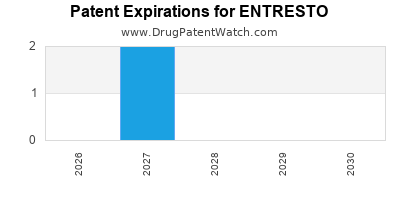
The core U.S. composition patent, U.S. Patent No. 8,853,156, has an expiration date in July 2025. Pediatric exclusivity extends the effective protection period by six months, placing the practical U.S. generic-entry date in January 2026 for products blocked solely by that patent. [5][6]
| Protection element |
Approximate date |
Commercial effect |
| FDA approval |
July 2015 |
Created regulatory market entry |
| Core U.S. composition patent, 8,853,156 |
July 2025 |
Primary U.S. patent barrier |
| Six-month pediatric exclusivity |
January 2026 |
Delays eligible generic entry |
| U.S. Medicare negotiated price |
January 2026 |
Reduces federal program pricing |
| European supplementary protection |
Market-specific, generally later than basic patent expiry |
Delays some European generic launches |
The exact launch position for each generic depends on patent settlements, ANDA approval, regulatory exclusivity and any surviving Orange Book-listed patents. A generic manufacturer may obtain FDA approval before commercial launch but remain restricted by a patent settlement.
What patents protect Entresto?
Entresto’s principal intellectual-property protection comes from patents covering the sacubitril/valsartan combination, pharmaceutical compositions, dosing and methods of treating heart failure.
Core composition patent
U.S. Patent No. 8,853,156 is the central U.S. patent associated with the sacubitril/valsartan combination. The patent claims pharmaceutical compositions containing the two active ingredients and has been the primary focus of generic challenges.
Method-of-use and formulation protection
Additional protection can include:
- Methods of treating heart failure with sacubitril/valsartan.
- Dose regimens and titration approaches.
- Formulation characteristics.
- Use in defined patient populations.
- Pediatric treatment.
- Manufacturing and salt-form technology.
The Orange Book identifies patents listed by the sponsor for the approved product. Not every listed patent creates the same level of practical blocking power. A generic applicant can challenge a patent through a Paragraph IV certification, seek a section viii carve-out for non-patented uses, or accept a launch restriction under a settlement. [5]
What is the Orange Book status of Entresto?
Entresto is an FDA-approved prescription drug listed in the Orange Book as a new drug product containing sacubitril and valsartan. Its U.S. regulatory pathway is an NDA, not a biologics license application. Generic competitors therefore pursue abbreviated new drug applications, or ANDAs, rather than biosimilar applications.
The Orange Book remains the principal source for:
- Listed patent numbers.
- Patent expiration dates.
- Pediatric exclusivity.
- Approved strengths and dosage forms.
- Therapeutic-equivalence designations.
Entresto is marketed in 24/26 mg, 49/51 mg and 97/103 mg tablets, expressed as sacubitril/valsartan strengths. The product is also available as oral pellets for selected pediatric patients.
Which companies are challenging Entresto patents?
Multiple generic manufacturers have pursued sacubitril/valsartan development or patent challenges. The relevant competitive group includes large global generic companies and Indian manufacturers with established cardiovascular portfolios.
Reported participants in the broader Entresto generic landscape include:
- Teva Pharmaceutical Industries.
- Mylan, now part of Viatris.
- Dr. Reddy’s Laboratories.
- Lupin.
- Zydus Lifesciences.
- Torrent Pharmaceuticals.
- Sun Pharmaceutical Industries.
- Alembic Pharmaceuticals.
- Amneal Pharmaceuticals.
- Hetero and other ANDA applicants.
The commercial significance of each challenger depends on whether it has final FDA approval, a tentative approval, an enforceable launch date under settlement, and access to all required strengths and dosage forms.
What Paragraph IV challenges affect Entresto?
A Paragraph IV certification states that a listed patent is invalid, unenforceable or not infringed by the proposed generic product. Filing a Paragraph IV certification can trigger patent litigation under the Hatch-Waxman Act.
For Entresto, Paragraph IV activity has focused on the core combination patent and related Orange Book listings. Patent litigation can impose a statutory 30-month stay on FDA approval, although the stay can expire earlier through court decisions, settlement or other procedural outcomes. [7]
The main legal questions are:
- Whether the generic formulation falls within the claims of the composition patent.
- Whether the patent is valid in view of prior art.
- Whether the proposed label induces infringement.
- Whether a generic can carve out certain heart-failure uses.
- Whether later-filed formulation or method patents remain enforceable.
- Whether a settlement creates an agreed launch date.
Entresto’s patent estate is commercially meaningful but narrower than the estate of a complex biologic. The active ingredients are chemically defined small molecules, and an ANDA pathway allows direct generic substitution after applicable barriers expire.
How strong is the Entresto patent estate?
Entresto has a moderate-to-strong historical patent estate, but its highest-value U.S. protection is approaching expiry.
| Patent-estate factor |
Assessment |
| Core composition protection |
Strong historically; expires in 2025 before pediatric extension |
| Regulatory exclusivity |
Completed for the original adult approval |
| Pediatric exclusivity |
Delays U.S. entry by six months |
| Formulation and method patents |
May support litigation, carve-outs or later entry restrictions |
| Manufacturing barriers |
Limited relative to biologics |
| Substitution risk |
High after authorized generic or ANDA entry |
| Biosimilar protection |
Not applicable |
| International protection |
Varies by country and supplementary protection certificate |
The estate is weaker against generic erosion than a product protected by long-dated formulation, device or biologic manufacturing patents. Entresto’s main defense has been the value of the combination patent, regulatory execution and the time required for generic manufacturers to secure approval across multiple strengths.
What is the impact of Medicare price negotiation on Entresto?
Entresto was selected for the first cycle of Medicare drug-price negotiation under the Inflation Reduction Act. The negotiated maximum fair price for 2026 was reported at approximately $295 for a 30-day supply, compared with a substantially higher list-price benchmark. [8]
The impact will be concentrated in Medicare Part D. It will not automatically reset commercial insurance pricing, Medicaid pricing or international prices. The commercial effects include:
- Lower federal program revenue per prescription.
- Pressure on gross-to-net economics.
- Greater payer leverage in formulary negotiations.
- Reduced value of late-life patent protection.
- Potential acceleration of generic substitution once available.
Medicare negotiation is material because older heart-failure patients represent a large share of Entresto’s treated population. The timing also overlaps with U.S. patent expiry, creating two simultaneous pricing pressures.
What generic entry risks exist for Entresto?
The U.S. generic-entry risk is high after January 2026, subject to final approvals and settlement restrictions. Entresto is a small-molecule tablet, which makes it more exposed to automatic or pharmacy-level substitution than an injectable biologic.
Early generic-launch scenario
One or more manufacturers launch soon after pediatric exclusivity ends. Novartis responds with price reductions, contracting and an authorized-generic strategy. U.S. sales decline rapidly, with the first-year erosion potentially reaching 30% to 50% depending on the number of entrants and discount levels.
Staggered-launch scenario
Settlements produce different launch dates for different generic companies. Novartis retains substantial share during the initial period, but price erosion increases as additional manufacturers enter.
Delayed-launch scenario
Litigation, regulatory deficiencies or manufacturing delays limit generic availability. Entresto maintains a larger revenue base through 2026, but Medicare negotiation still reduces U.S. net price.
The likely erosion pattern is more severe than for a product with one authorized generic or a highly differentiated delivery system. Sacubitril/valsartan tablets have limited manufacturing complexity, and multiple generic companies have commercial incentives to enter.
How does Entresto compare with Farxiga and Jardiance?
Entresto, Farxiga and Jardiance are all major heart-failure products, but their patent and market profiles differ.
| Factor |
Entresto |
Farxiga |
Jardiance |
| Active ingredient |
Sacubitril/valsartan |
Dapagliflozin |
Empagliflozin |
| Drug class |
ARNI |
SGLT2 inhibitor |
SGLT2 inhibitor |
| Primary heart-failure role |
Foundational neurohormonal therapy |
Broad heart-failure and renal therapy |
Broad heart-failure and diabetes therapy |
| Generic risk |
High after U.S. 2025/2026 protection window |
Later, depending on patents and settlements |
Later, depending on patents and settlements |
| Biosimilar risk |
None |
None |
None |
| Main commercial threat |
Generic entry and Medicare negotiation |
SGLT2 competition and later generic entry |
SGLT2 competition and later generic entry |
| Use with other products |
Often combined with SGLT2 inhibitors |
Often combined with ARNI therapy |
Often combined with ARNI therapy |
Entresto’s near-term vulnerability is greater because its principal U.S. patent cliff arrives earlier than the expected erosion period for several competing branded cardiovascular products. Its clinical role remains complementary to SGLT2 inhibitors, which may limit immediate therapeutic displacement but will not prevent generic price erosion.
What is the international exclusivity outlook for Entresto?
International protection is fragmented. Patent expiry, supplementary protection certificates, pediatric extensions, national litigation and local regulatory rules differ by jurisdiction.
The United States is likely to experience the earliest and most commercially significant generic pressure. European markets may have later entry dates where supplementary protection certificates remain effective. Japan, Canada, Australia and emerging markets require separate analysis because local patent term adjustments and regulatory approval timing vary.
Novartis can protect part of its international revenue through:
- Country-specific patent enforcement.
- Pricing and reimbursement agreements.
- Brand loyalty among cardiologists.
- Supply contracts.
- Authorized or company-controlled generic strategies.
- Continued promotion of guideline-based use.
These measures can slow erosion but generally cannot prevent long-term substitution after broad patent expiry.
What is the Entresto financial trajectory through the late 2020s?
Entresto revenue should remain substantial through 2025 because of continued volume growth and its established role in heart-failure treatment. The trajectory changes in 2026 as Medicare negotiation and generic competition affect U.S. economics.
| Period |
Expected commercial pattern |
| 2024 |
Peak-growth phase, supported by global volume |
| 2025 |
Continued demand, but increasing price and patent pressure |
| 2026 |
Major U.S. inflection point after pediatric exclusivity |
| 2027 |
Broader generic substitution and declining U.S. revenue |
| 2028 and later |
Mature global brand with lower prices and residual international sales |
A reasonable business-case framework is:
- Base case: global revenue declines after 2025, with U.S. erosion partially offset by volume growth outside the United States.
- Downside case: several generics enter promptly, causing steep U.S. price and share erosion.
- Upside case: staggered settlements, delayed approvals and continued international exclusivity extend the high-margin period.
Entresto’s contribution to Novartis earnings will decline after generic entry, but the company’s diversified portfolio reduces dependence on the product. Kisqali, Kesimpta, Cosentyx, Leqvio and radioligand therapies are among the assets expected to offset mature-product pressure.
What licensing and business-development factors affect Entresto?
Entresto was developed through Novartis’s acquisition of the compound rights from the original development program associated with Novartis and the former Novartis pharmaceutical organization. The current commercial asset is controlled by Novartis rather than being dependent on a recent external co-commercialization agreement.
Licensing value now centers on:
- Generic or authorized-generic commercialization.
- Regional distribution rights.
- Combination products containing sacubitril/valsartan.
- Manufacturing technology.
- Pediatric formulations.
- Lifecycle-management opportunities.
The late-stage licensing value of the core molecule is limited by patent expiry. Manufacturing and regional commercialization rights can still have value, but they are unlikely to preserve the original branded margin in the United States.
What is the FDA regulatory status of Entresto?
Entresto has full FDA approval under an NDA and is marketed in multiple tablet strengths and a pediatric oral-pellet formulation. Its regulatory profile is established, with no biosimilar pathway because sacubitril/valsartan is a chemically synthesized small-molecule combination.
The key regulatory issues for competitors are:
- ANDA approval.
- Bioequivalence to the reference listed drug.
- Approval of each strength.
- Labeling and use carve-outs.
- Pediatric dosage-form requirements.
- Patent certifications and litigation stays.
FDA approval alone does not guarantee immediate commercial launch. Patent settlements, court orders and commercial agreements can delay or restrict distribution.
Key Takeaways
- Entresto sales increased from approximately $2.5 billion in 2020 to about $7.8 billion in 2024.
- Novartis benefited from guideline adoption, broader heart-failure treatment and complementary use with SGLT2 inhibitors.
- The core U.S. composition patent, U.S. Patent No. 8,853,156, expires in July 2025, with pediatric exclusivity extending practical protection into January 2026.
- Entresto faces generic rather than biosimilar risk.
- Medicare price negotiation begins in 2026 and adds a major U.S. pricing headwind.
- Multiple generic manufacturers have pursued sacubitril/valsartan products and patent challenges.
- The likely U.S. outcome is substantial revenue and margin erosion after generic entry, although international sales and residual brand demand will extend the product’s commercial life.
- Entresto remains clinically important, but its patent estate no longer supports long-term U.S. exclusivity.
FAQs
Is Entresto a biologic or a small-molecule drug?
Entresto is a small-molecule combination of sacubitril and valsartan. Competitors use the ANDA generic-drug pathway, not the biosimilar pathway.
Will generic Entresto be automatically substitutable?
An FDA-approved generic can receive an Orange Book therapeutic-equivalence rating that supports substitution, but the timing depends on approval, patent restrictions, state pharmacy law and payer policy.
Does Entresto have a pediatric exclusivity extension?
Yes. Pediatric exclusivity adds six months to applicable FDA exclusivity or patent protection, extending the principal U.S. protection period into January 2026.
Can generic manufacturers launch only selected Entresto indications?
Yes. A generic applicant may use a section viii labeling carve-out for patented methods of use, provided the proposed label omits the protected indication and does not otherwise induce infringement.
Will Farxiga and Jardiance replace Entresto after generic entry?
Not entirely. The products have overlapping heart-failure markets but different mechanisms and are frequently used together. Generic sacubitril/valsartan is more likely to reduce Entresto’s price and brand share than eliminate ARNI therapy.
References
-
Novartis AG. (2024). Annual report 2023. Basel, Switzerland: Author.
-
Novartis AG. (2025). Annual report 2024. Basel, Switzerland: Author.
-
Novartis AG. (2024). Fourth-quarter and full-year 2023 results. Basel, Switzerland: Author.
-
U.S. Food and Drug Administration. (2024). Entresto prescribing information. Silver Spring, MD: U.S. Department of Health and Human Services.
-
U.S. Food and Drug Administration. (2025). Approved drug products with therapeutic equivalence evaluations: Orange Book. Silver Spring, MD: U.S. Department of Health and Human Services.
-
United States Patent and Trademark Office. (2014). U.S. Patent No. 8,853,156: Pharmaceutical compositions comprising valsartan and sacubitril. Washington, DC: U.S. Department of Commerce.
-
U.S. Congress. (1984). Drug Price Competition and Patent Term Restoration Act of 1984, 21 U.S.C. § 355(j).
-
Centers for Medicare & Medicaid Services. (2024). Medicare drug price negotiation program: Selected drug prices for initial price applicability year 2026. Baltimore, MD: U.S. Department of Health and Human Services.