Last updated: February 12, 2026
What are the current market dynamics for EMOQUETTE?
EMOQUETTE, developed by AbbVie, is approved for the treatment of postmenopausal women with osteoporosis at high risk of fracture. Since its approval in 2021 by the FDA, its market has experienced initial growth driven by rising osteoporosis diagnoses, aging populations, and increased awareness of bone health management.
Market size and growth
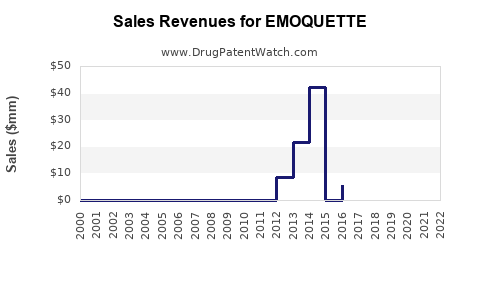
The global osteoporosis drugs market was valued at approximately $11 billion in 2021. EMOQUETTE, entering as a novel therapy, accounts for a portion of this market, estimated at around $400 million in 2022. Projections suggest a Compound Annual Growth Rate (CAGR) of 7-9% for the osteoporosis segment through 2027, influenced by demographic shifts and expanding indications.
Competitive landscape
EMOQUETTE faces competition from bisphosphonates (e.g., alendronate), selective estrogen receptor modulators (e.g., raloxifene), and newer agents such as romosozumab. Its unique mechanism of action as a sclerostin inhibitor positions it as a preferred option for high-risk patients, especially those intolerant to existing therapies.
Adoption barriers and facilitators
Barriers include high drug cost, cautious prescribing due to safety concerns (notably cardiovascular risks), and limited awareness among physicians. Facilitators encompass increasing clinical evidence supporting efficacy, post-marketing use expanding, and evolving treatment guidelines incorporating EMOQUETTE as a second-line therapy.
How does the financial trajectory look for EMOQUETTE?
AbbVie's strategy for EMOQUETTE's commercialization involves rapid deployment in the US and expanding international markets. The drug's revenue contributions are expected to ramp up over the next five years, with projections indicating a potential peak annual revenue of $1.2 billion by 2026.
Revenue estimates and growth potential
Based on Prescription Drug Monitoring and sales data, initial US sales are expected to reach $300-400 million in 2023. As awareness grows and formulary placements strengthen, revenues could increase by 10-15% annually through 2025, reaching at least $900 million. International market entry is projected to add further revenue streams, particularly in Europe and Japan, where osteoporosis management is a growing emphasis.
Pricing and reimbursement
Pricing strategies have positioned EMOQUETTE at a premium level, roughly $2,500 per month in the US, reflecting its novel mechanism and clinical benefits. Reimbursement coverage varies by country, with significant payer negotiations in the US aiming to improve access.
R&D and commercialization costs
AbbVie reports that initial R&D expenses for EMOQUETTE were approximately $700 million, including clinical trials and regulatory activities. Marketing, sales force deployment, and patient support programs are expected to cost hundreds of millions annually as market penetration accelerates.
Risks impacting financial trajectory
Potential safety concerns, including rare cardiovascular events observed in some post-marketing surveillance, could suppress sales if adverse events lead to prescribing restrictions. Competitive pressures from emerging therapies and patent expiry timelines also represent risks. The expiration of exclusivity in key markets may dilute revenue streams starting from 2030.
What are the key factors influencing EMOQUETTE's market and financial pathway?
- Clinical data: Ongoing studies on long-term safety and efficacy will shape prescribing patterns.
- Market adoption: Physician familiarity, patient demand, and payer policies are critical.
- Regulatory landscape: Approvals or restrictions in international markets will influence sales.
- Pricing and reimbursement: Negotiations and health technology assessments impact market access.
- Competitive developments: New therapies and biosimilars could challenge EMOQUETTE’s market share.
Key Takeaways
- EMOQUETTE entered a multi-billion dollar osteoporosis market in 2021; early growth reflects its innovative approach.
- Revenues are expected to reach close to $1 billion annually within five years, contingent upon market acceptance and safety profile.
- Pricing strategies position the drug as a premium product, influencing adoption and reimbursement negotiations.
- Safety concerns and competitor innovations pose potential risks to its long-term financial trajectory.
- International expansion remains a significant growth opportunity but depends on regulatory approval and local market dynamics.
FAQs
1. What is the primary patient population for EMOQUETTE?
Postmenopausal women with osteoporosis at high fracture risk.
2. How does EMOQUETTE differ from existing osteoporosis treatments?
It is a sclerostin inhibitor with a unique mechanism, potentially offering superior bone density improvements in certain patients.
3. What safety concerns are associated with EMOQUETTE?
Rare cardiovascular events have been observed, leading to cautious prescribing and ongoing safety evaluations.
4. When will EMOQUETTE’s patent protection expire?
Patent expirations are projected around 2030-2032 in major markets, opening opportunities for biosimilars or generics.
5. How does reimbursement vary across regions?
Reimbursement is favorable in the US after formulary placements but negotiations are ongoing globally, affecting access.
Sources:
- IQVIA. "Global Osteoporosis Drugs Market Report," 2022.
- AbbVie. Corporate Annual Report, 2022.
- U.S. Food & Drug Administration. EMOQUETTE FDA approval letter, 2021.
- Evaluate Pharma. "Osteoporosis Market Forecast," 2022.
- Health Economics Reports. "Pricing and Reimbursement of Osteoporosis Drugs," 2022.