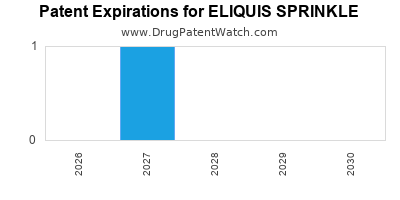
Last updated: July 30, 2026
Executive summary: Eliquis Sprinkle (apixaban oral granules) is positioned as an apixaban pediatric-adapted presentation that extends the franchise’s addressable market in children and supports adherence in patients who cannot swallow tablets. Financial trajectory is driven less by “Sprinkle” standalone volume and more by (i) overall apixaban demand, (ii) pediatric and institutional uptake, (iii) payer policy around anticoagulants, and (iv) exclusivity and generic entry timing for apixaban oral solid dose forms. Near-to-midterm downside hinges on generic competition risk for apixaban formulations not covered by formulation or method patents and on any payer-driven price pressure tied to broader apixaban genericization.
What is Eliquis Sprinkle (apixaban) and how is it used in the market?
Answer: Eliquis Sprinkle is an oral solid apixaban formulation for patients who need granules rather than whole tablets. Commercial adoption is tied to pediatric anticoagulation protocols, hospital formularies, specialty pharmacy distribution, and prescriber comfort with administration.
Which clinical indications support demand?
Eliquis (apixaban) is marketed across multiple anticoagulation use cases that create the franchise’s baseline demand. For “Sprinkle,” the commercial contribution comes from patients in settings where granules are clinically preferred or administratively necessary.
Key apixaban demand drivers that typically translate into platform demand for each presentation:
- Venous thromboembolism (VTE) treatment and prophylaxis
- Stroke prevention in nonvalvular atrial fibrillation (NVAF)
- Reduction of risk of recurrent DVT/PE in extended therapy settings
- Post-surgical thromboprophylaxis contexts
How do pediatric and administration needs affect adoption?
Oral granules expand usability in:
- Pediatric and adolescent patients where tablet swallowing is not feasible
- Institutions that standardize pediatric anticoagulation compounding-free workflows
- Home-care settings that avoid manipulation steps that can increase dosing errors
In practice, “Sprinkle” uptake tends to be incremental on top of existing Eliquis market share. The bigger effect is that it reduces friction for clinicians who would otherwise switch to alternative dosing vehicles.
What market dynamics shape Eliquis Sprinkle pricing, reimbursement, and channel strategy?
Answer: Eliquis Sprinkle pricing and reimbursement track the apixaban brand’s broader contracting dynamics, with additional layer effects from pediatric formularies and granular payer policy on pediatric formulations.
Payer behavior: how do coverage decisions typically impact growth?
Coverage for anticoagulants is shaped by:
- Preferred drug lists (PDLs) in hospital systems for VTE and AF pathways
- Step therapy requirements between DOACs where clinically substitutable
- Prior authorization triggers tied to indication and renal function
- Ingredient reimbursement and manufacturer contract rebates that influence net price
For granule presentations, payers can show:
- Higher willingness to cover if the granules prevent off-label workarounds
- Less tolerance for “special order” SKUs with limited substitution options
Channel and distribution
Oral granules are distributed through:
- Retail and specialty channels where apixaban is already established
- Institutional channels where pediatric anticoagulation programs standardize dosing forms
Net sales sensitivity is driven by:
- Contracted pharmacy benefit manager (PBM) pricing
- Hospital purchasing commitments
- Refill adherence, which is high for DOACs but can still swing with copay changes
How strong is Eliquis’s financial trajectory, and what portion is attributable to the Sprinkle presentation?
Answer: The overall apixaban franchise has historically delivered sustained revenue due to multi-indication adoption and broad physician comfort with DOAC efficacy and safety profiles. Eliquis Sprinkle’s contribution is smaller than total Eliquis sales, but it supports durability by capturing pediatric-appropriate demand that otherwise leaks to alternative anticoagulants or suboptimal dosing forms.
What metrics matter most for the Sprinkle trajectory?
The presentation-level trajectory is best evaluated through:
- Prescriber adoption in pediatric anticoagulation pathways
- Hospital formulary additions for pediatric granular dosing
- Specialty pharmacy script counts tied to pediatric populations
- Price per unit versus net price after rebates
- Refill rates in pediatric or caregiver-administered settings
Why the Sprinkle line is still commercially material
Even if Sprinkle’s sales are not the dominant revenue stream, it can:
- Reduce switching costs for pediatric patients already stable on apixaban
- Improve persistence versus regimens requiring additional administration steps
- Support life-cycle management that preserves apixaban’s overall market position
When does Eliquis Sprinkle face exclusivity loss, and how does that affect apixaban net sales?
Answer: Eliquis’s exposure is governed by the expiration of listed U.S. Orange Book patents that cover the apixaban drug substance and each protected formulation/indication/dosing regimen tied to the approved dosage form. When exclusivity or patents fall away, generic entry can pressure net price and volume through substitution.
What exclusivity typically covers DOAC brand durability?
For branded drugs like apixaban, revenue protection usually comes from a mix of:
- U.S. patents listed in the Orange Book (drug substance, drug product, formulation, and sometimes method-of-use)
- Regulatory exclusivities that block certain types of approval pathways even before patent expiry (where applicable)
How generic entry mechanics usually translate into financial impact
Once legal barriers clear, market share shifts through:
- PBM switching programs
- Pharmacy substitution rules
- Patient affordability dynamics driven by tier changes
- Reduced brand access via contracting
For apixaban, generic entry in any oral solid segment can compress net pricing across the category, even for presentations with thinner direct substitution, because payers benchmark net costs and may push for most cost-effective equivalents.
What patents protect apixaban granules, dosing forms, and methods that matter for Eliquis Sprinkle?
Answer: Eliquis Sprinkle’s Orange Book coverage depends on which patents are listed for the specific granule NDA and strength. Patent protection can include formulation patents, manufacturing process patents, and method-of-use patents.
Patent estate components that drive launch barriers
Patent estates that most often block generic/granule equivalents:
- Drug product/formulation patents (composition, particle size, granule characteristics)
- Dosage-form-specific patents (administration without loss of dose)
- Method-of-use patents (indication-specific claims)
- Process patents (manufacturing steps required for stability and bioavailability)
How to interpret “covered product” risk
A generic filer may attempt:
- Non-infringing formulation changes
- Design-around of manufacturing methods
- Carve-outs tied to unprotected indications or dosage forms
The financial relevance is whether design-around still produces a therapeutically substitutable product that payers will switch to.
What generic and Paragraph IV risks exist for Eliquis Sprinkle (apixaban) and how do they impact timing?
Answer: Generic risk is highest where listed patents cover the specific granule dosage form and where the remaining legal barriers are close to expiry. Paragraph IV challenges target listed patents, seeking approval before those patents expire.
What to watch for in launch timelines
Financial impact typically tracks:
- Filing dates and court schedules in Paragraph IV cases
- Any FDA approval timing tied to exclusivity/child-related regulatory periods
- Settlement agreements that set “launch-at-risk” windows
How settlement agreements usually affect market revenue
Settlements often:
- Delay generic approval or market entry to defined dates
- Permit “at-launch” timelines that can be later than the earliest legal exit
- Keep brand pricing leverage longer than pure patent expiry would imply
What is the Orange Book status of Eliquis Sprinkle and which listings are revenue-critical?
Answer: The Orange Book status is defined by the Orange Book patent listings for the specific Eliquis Sprinkle NDA strength and dosage form. Revenue-critical listings are those with the latest expiration dates that also connect to the commercial formulation and its protected administration profile.
How Orange Book listings translate into business risk
- If a late-expiring formulation patent is listed for the Sprinkle dosage form, generic pressure on that presentation can be delayed even if earlier drug-substance patents lapse.
- If method-of-use patents remain in force for specific indications, generic launch may be constrained to non-covered indications or require carve-outs that reduce volume capture.
How does Eliquis Sprinkle compare with competing apixaban presentations and alternative DOACs?
Answer: Eliquis Sprinkle competes on patient suitability and administration convenience within anticoagulation pathways. Competitive pressure typically comes from:
- Other apixaban brands or generic apixaban oral solids where covered-by-payer formularies
- Alternative DOACs (factor Xa inhibitors and direct thrombin inhibitors)
- Warfarin in some older or complex patient populations
Comparison vectors that drive market share
- Net price and formulary placement
- Pediatric usability and administration protocol fit
- Clinical outcomes perception and guideline adherence
- Hospital adoption cycles and pharmacy benefit contracting
Where Sprinkle differentiates
Sprinkle differentiates primarily in:
- Administration feasibility (granule dosing)
- Pediatric protocol alignment
- Institutional standardization of dosing steps
If competitors offer equivalent pediatric granules with fewer restrictions or lower net price, payer adoption can shift quickly.
Which companies are likely to challenge or supply competing apixaban products affecting Eliquis Sprinkle?
Answer: Generic and biosimilar-style challenges are typically executed by ANDA filers seeking FDA approval for generic apixaban and by challengers tied to apixaban Orange Book listings for each dosage form.
How competitor behavior maps to financial impact
Competitors that:
- File earlier and secure favorable settlement outcomes
- Design around formulation patents successfully
- Achieve high payer access through PBM contracting
tend to capture the fastest volume.
What FDA regulatory milestones influence Eliquis Sprinkle financial performance?
Answer: Regulatory performance for the presentation is driven by:
- Pediatric-related approvals tied to granule dosing
- Label expansions that broaden eligible patient populations
- Ongoing compliance and manufacturing stability approvals that prevent supply interruptions
How supply disruptions affect net sales
For anticoagulants, continuity matters:
- Shortages can trigger substitution and persistence loss
- Even temporary supply issues can shift prescriber habits to other DOACs
Granule SKUs can be especially sensitive where supply constraints exist at specific manufacturing steps or packaging formats.
What manufacturing/IP barriers can delay generic entry for Eliquis Sprinkle?
Answer: Manufacturing and process-related patents and regulatory controls can delay or block ANDA approval if they require exact process replication or if design-around changes affect bioequivalence.
What barriers typically matter
- Process patents controlling granule formation, stability, coating, or dissolution characteristics
- CMC constraints during bioequivalence testing for modified dosage forms
- Patents that claim critical administration steps tied to bioavailability
Revenue exposure analysis: where does Eliquis Sprinkle sit in the apixaban portfolio risk profile?
Answer: Eliquis Sprinkle’s revenue exposure is linked to apixaban’s category economics and the specific legal protection status of the granule dosage form. It usually has less independent protection than the core drug substance but can have separate formulation patent coverage.
Risk ranking framework (business-useful)
- Highest: unexpired formulation patents specifically listed for granule dosage form with late expiry
- Medium: method-of-use patents with carve-out risk that limits generic capture
- Lower: broad drug-substance patents with earlier expiry but potential downstream formulation protections
- Cross-cutting: PBM contract shifts that reduce brand access even absent direct substitution
Key takeaways
- Eliquis Sprinkle is a commercially strategic apixaban presentation that supports pediatric and administration-specific demand, helping preserve apixaban franchise durability rather than acting as a standalone economic engine.
- Financial trajectory is primarily a function of apixaban net pricing dynamics, payer coverage, and category switching once legal barriers for apixaban formulations erode.
- The biggest threats are formulation- and dosage-form-specific patent expirations for the granules and any Paragraph IV litigation or settlements that define the earliest generic entry windows.
- Market share and net sales sensitivity typically increases sharply at the onset of generic access through payer contracting, even for presentations with partial substitution constraints.
FAQs
1) What happens to Eliquis net sales when apixaban generics launch in the U.S.?
Generic apixaban launches usually drive rapid net price compression and share shifts through PBM substitution and tier changes, with brand revenue erosion extending over multiple quarters as contracting updates.
2) Do granule presentations face the same generic substitution risk as tablets?
They can face distinct formulation and dosage-form patent barriers; however, once a cost-effective equivalent is available and formulary accepted, substitution can still occur quickly.
3) How do Paragraph IV filings affect the timing of generic entry for apixaban products?
Paragraph IV challenges can delay FDA approval and market entry through automatic stays, litigation outcomes, and settlements that set defined launch dates.
4) What is the commercial impact of pediatric label expansions for apixaban formulations?
Pediatric expansions can increase eligible patient counts and support new prescribing channels in hospitals and specialty pediatrics, strengthening demand for the presentation aligned with administration needs.
5) Which factors drive payer preferences among DOACs for VTE and NVAF?
Net cost after rebates, formulary tier placement, prior authorization rules, and clinical guideline alignment, including hospital pathway standardization, drive the majority of payer decisions.
References
- FDA. Orange Book: Approved Drug Products with Therapeutic Equivalence Evaluations. U.S. Food and Drug Administration.
- FDA. Drug Approval and Related Documents (NDA/ANDA and labeling information). U.S. Food and Drug Administration.
- FDA. Approved Drug Products: Eliquis (apixaban) and dosage form listings. U.S. Food and Drug Administration.