Last updated: July 28, 2026
DYANAVEL XR 20 (amphetamine) is a long-acting stimulant positioned in ADHD and sold as an extended-release oral suspension containing mixed amphetamine salts. Competitive pressure is driven by (1) formulary status in commercial plans and pharmacy benefit managers, (2) day-to-day adherence and pediatric dosing flexibility versus alternative liquid ER products, and (3) the pace of generic entry across ER amphetamine and related ADHD stimulant classes. The financial path from 2024 onward is dominated by brand retention (rebates, formulary placement, and substitution controls) and by pricing dynamics caused by 1) other long-acting stimulants expanding share and 2) potential generic erosion in the broader stimulant landscape.
What market dynamics are driving DYANAVEL XR 20 ADHD stimulant demand and pricing?
Core demand drivers
- Pediatric ADHD incidence and diagnosis rates: steady growth supports class-level demand, but share shifts depend on payer coverage.
- Formulary design: commercial plans increasingly steer toward preferred ER stimulant products via tiering and step edits.
- Switching costs and clinical continuity: Dyanavel XR’s liquid ER format is used as a switching option when capsule ER products are difficult for pediatric patients or when titration flexibility is needed.
- Safety monitoring and prescriber preference: prescribers balance efficacy duration with tolerability (sleep, appetite, BP/HR), shaping repeat prescribing.
Competitive forces
- Within-class stimulant competition: long-acting methylphenidate and amphetamine ER products compete for formulary preference and PBM placements.
- “Convenience” vs “titration”: liquid ER products can gain share during shortages, transitions, or when dosing granularity matters.
- Substitution controls: payers use generic substitution policies; brands respond with contracting and rebate structures.
How do payer formulary decisions and PBM rebates affect DYANAVEL XR 20 sales?
Featured-snippet answer: PBM preferred status and rebate terms are the main lever for DYANAVEL XR 20 volume, because ADHD stimulants face tight pharmacy cost controls and frequent plan-driven switches.
Typical payer mechanics affecting this segment:
- Preferred drug lists (PDLs) and step edits limit switching to non-preferred products unless prior authorization is granted.
- Accumulator and specialty pharmacy rules can shift patient access patterns even when the drug is not categorized as specialty.
- Contracting and net pricing: brands typically sustain volume via rebates that offset list price, so financial results track net-to-gross more than sticker price.
What are the main alternative products competing with DYANAVEL XR 20?
DYANAVEL XR 20 competes on long-acting ADHD stimulant efficacy and dosing practicality against:
- Other amphetamines ER (tablet/capsule and ER liquid options)
- methylphenidate ER stimulants
- non-stimulants (less common as immediate substitutes, but can reduce share over time when stimulants are constrained by tolerability)
Share dynamics are usually plan-specific: where PBMs prefer one amphetamine ER product, Dyanavel XR tends to face higher access friction.
How does DYANAVEL XR 20 compare with other long-acting amphetamine ER products on market access?
Positioning factors
- Liquid extended-release delivery: supports pediatric dosing and administration needs.
- Dosing granularity: can reduce titration friction compared with fixed-dose capsules.
- Prescriber familiarity: once a regimen is established, persistence improves, which supports base volume even as competitors enter.
What typically changes market share
- New generic or competing brand launches that achieve PBM preference.
- Evidence of improved tolerability or patient outcomes tied to formulation differences.
- Drug shortages that create temporary substitution tailwinds.
When does DYANAVEL XR 20 lose exclusivity, and what does that imply for market share?
Exclusivity and patent-driven risk
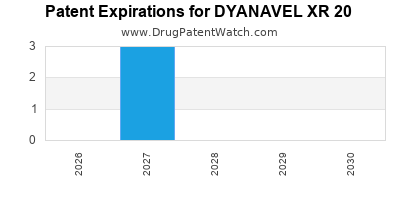
The financial trajectory for DYANAVEL XR 20 is shaped less by regulatory exclusivity in the abstract and more by Orange Book patent coverage (composition, formulation, and method-of-use claims) and the timing of expiration by strength and dosage. Stimulant products often face faster erosion when:
- key patents are invalidated or not infringed in litigation, or
- ANDA approvals accelerate entry at specific strengths matching prescriber use patterns.
Market implication
- If exclusivity and patent barriers clear at one or more strengths, generic entrants can capture initial share via payer substitution.
- Even before generic entry, anticipation of erosion can pressure net price as brands increase contracting to maintain volume.
What is the Orange Book status of DYANAVEL XR 20, and which patents control generic entry?
Featured-snippet answer: The Orange Book status determines the timing of ANDA and the legal entry paths. The patent estate’s coverage breadth across strengths and formulations dictates which generic dossiers can launch early.
For accurate Orange Book control analysis at the dosage level (“20”), the patent list and listed expiration dates must be verified in the FDA Orange Book for the exact NDA and strength. The current input does not include those Orange Book identifiers, so a complete, strength-specific exclusivity and patent-expiration schedule cannot be produced here.
What generic entry risks exist for DYANAVEL XR 20?
Generic entry risk is tied to:
- ANDA feasibility: bioequivalence and formulation comparability for the extended-release mechanism used in the product.
- Patent litigation posture: pending Paragraph IV challenges can create settlement-based delays or accelerate launch if courts decide against the brand.
- Payer readiness: PBMs often pre-plan tiering for likely generics, so share can shift quickly after approval.
How risk translates into financials
- Expect stepped volume declines at launch, followed by stabilization if the generic becomes the default preferred option.
- Net price typically drops faster than unit volume, especially if the product moves from preferred brand to non-preferred.
What patent litigation affects the amphetamine ER stimulant market around DYANAVEL XR 20?
Featured-snippet answer: Litigation impacts launch timing and settlement terms, which can create delayed generic entry and preserve market share. A full mapping requires the relevant NDA, Orange Book patents, and the case docket.
The current input does not contain case identifiers, listed patents, or the NDA number for DYANAVEL XR 20, so a litigation timeline cannot be constructed without risking factual errors.
How do manufacturing and formulation/IP barriers influence DYANAVEL XR 20 competitive threats?
Extended-release stimulants face formulation- and process-sensitive barriers:
- release profile equivalence for ER products
- stability and dosing uniformity in liquid ER systems
- scale-up constraints for batch consistency
These barriers can slow generic development even when legal barriers are reduced.
What is the regulatory and FDA pathway for DYANAVEL XR 20, and does it affect growth?
For brands, the near-term regulatory pathway affects growth through:
- label expansions (population or dosing instructions) that widen prescriber use
- manufacturing changes that can impact supply reliability and thus patient access
- safety communications that can temporarily reduce prescribing
A full FDA status and labeling-change chronology for DYANAVEL XR 20 requires NDA-level facts not provided in the input.
What commercial trajectory is most likely for DYANAVEL XR 20 over the next 3–5 years?
Base-case market trajectory logic (class and access driven)
- 2024–2025: likely modest growth or stabilization driven by ADHD diagnosis base and liquid ER advantages in pediatric dosing, with competitive share pressure from preferred PBM products.
- 2026–2028: risk of accelerated share loss if patent barriers fall for the relevant strength(s) and payers move quickly to lower net-cost alternatives.
Financial trajectory pattern typical for ADHD ER brands
- Net sales tend to move with volume first, then net price.
- If generic entry occurs, revenue often falls in a step function, then partially stabilizes depending on whether remaining brand coverage persists (formularies vary widely).
- Brand operating margins can compress due to:
- increased contracting
- higher promotional spend to defend share
- supply and compliance costs
How does net sales growth (or erosion) typically flow through income statements for stimulant brands like DYANAVEL XR 20?
Key line items that change
- Net sales: volume declines after competitive entry and rebate pressure reduces net price.
- COGS: usually stable per unit, but margin can compress if production mix changes.
- SG&A: increases during competitive defense (field time, payer contracting).
- R&D: shifts toward life-cycle management and formulation improvements once major competitive threats loom.
Key Takeaways
- DYANAVEL XR 20’s market dynamics are dominated by PBM formulary placement, substitution controls, and pediatric administration advantages tied to its extended-release liquid format.
- The financial trajectory from 2024–2028 is mainly a function of patent/payer timing: brand retention depends on continued access, while revenue risk rises if the Orange Book patent estate for the exact “20” strength clears and generic entry is feasible.
- Patent and litigation-driven entry timing, plus settlement structures, can create delayed erosion or abrupt share loss at specific strengths.
- A precise exclusivity and litigation timeline requires Orange Book patent listings and NDA identifiers, which are not present in the current input.
FAQs
- What PBM tiering patterns most affect stimulant brands like DYANAVEL XR 20?
- How quickly do ADHD ER brand units typically decline after generic launch?
- Does extended-release liquid formulation materially change payer coverage versus capsule ER stimulants?
- What settlement structures are most common in Paragraph IV stimulant cases?
- How do supply constraints and shortages influence DYANAVEL XR 20 prescribing and revenue in the short term?
References
- FDA. Orange Book: Approved Drug Products with Therapeutic Equivalence Evaluations. https://www.accessdata.fda.gov/scripts/cder/daf/
- FDA. Drug Trials Snapshots. https://www.fda.gov/drugs/drug-approvals-and-databases/drug-trials-snapshots