Last updated: June 19, 2026
DYANAVEL XR 15 (amphetamine extended-release suspension; prodrug-free stimulant product) is an Adderall XR-adjacent long-acting ADHD option where commercial outcomes track (1) sustained formulary access, (2) prescriber switching relative to generic amphetamine ER and methylphenidate ER peers, and (3) the ability to hold pricing amid FDA-approved generic entry and AMP ER class compression. Its financial trajectory is shaped less by on-label expansion and more by payer policy, step edits, and the competitive pricing of generic equivalents across nationwide commercial and PBM formularies.
What is DYANAVEL XR 15 and where does it compete in ADHD stimulant markets?
DYANAVEL XR 15 is a long-acting central nervous system stimulant formulation of amphetamine used for Attention-Deficit/Hyperactivity Disorder (ADHD) in pediatric and, depending on labeling, adult populations. In practice, it competes in the “long-acting stimulant” segment where payers evaluate: duration of action, dose flexibility, administration method, and net pricing versus generic amphetamine ER and branded methylphenidate ER products.
Product adjacency: therapeutic alternatives that set price floors
DYANAVEL XR 15’s substitution risk comes from three groups:
- Generic amphetamine ER products (direct therapeutic class substitutes)
- Branded long-acting methylphenidate options (same use, different active)
- Other branded amphetamine long-acting formats (where available in a given PBM formulary)
Market dynamics in stimulants often follow PBM tiers: once generic equivalents are widely covered, branded stimulant pricing and volume tend to reset to preserve formulary presence.
How do ADHD stimulant formularies and PBM tactics affect DYANAVEL XR 15 uptake?
Featured-snippet answer: Uptake is primarily limited by formulary tiering, prior authorization criteria, and step edits that favor the lowest-cost covered stimulant.
Key payer mechanics
- Formulary status and tier placement: Tier 1 preferred generics typically suppress branded volume; DYANAVEL XR 15 performance depends on how often it remains preferred or “covered nonpreferred.”
- Prior authorization (PA): PA often targets stimulant naïve patients, inadequate response to preferred options, or documentation requirements for dose titration.
- Step therapy: Many plans prefer a “fail-first” generic amphetamine ER (or methylphenidate ER depending on the plan) before covering branded alternatives.
- Quantity limits (QL): Long-acting stimulants can face max daily dose or max days supply rules aligned to diagnosis and age.
- Exclusions and “therapeutic interchange” policies: Some PBMs encourage substitution within the stimulant category even when prescribers specify a brand, increasing switching risk after initial coverage is lost.
Delivery format as a switching lever
DYANAVEL XR’s suspension format can be relevant for patients who cannot swallow capsules/tablets. That can be a margin-protecting driver in select prescriber networks, but it does not usually overcome broad PBM preference for generics.
What are the main revenue drivers for DYANAVEL XR 15 in the near term?
Revenue trajectory typically depends on a narrow set of variables:
- Net price retention through contracting
- Branded products often win short-term volume by offering PBMs discounts that preserve formulary placement.
- Prescriber channel inertia
- Once a patient stabilizes on a regimen, prescribers may resist switching unless insurance forces a change.
- Dose scaling
- The “15” strength matters commercially only if it aligns with titration patterns and payer edits. If a payer’s step therapy covers a broader range of generic strengths than branded strengths, DYANAVEL XR’s ability to substitute within that restriction is reduced.
- Availability and fill reliability
- Stimulant categories are sensitive to supply consistency; disruptions can temporarily reduce prescriptions and shift stable patients to competitors.
How does generic amphetamine ER competition impact DYANAVEL XR 15 financial performance?
Featured-snippet answer: Generic amphetamine ER competition compresses both unit sales and net pricing once coverage shifts toward lower-cost alternatives.
Commercial impact pathways
- Formulary re-tiering: If PBMs can source broader generic amphetamine ER coverage with favorable rebates, branded amphetamine ER products lose preferred positioning.
- Switching after PA approvals end: Patients initiated during a coverage window can be forced to switch after renewals.
- Gross-to-net deterioration: Branded manufacturers often increase rebate levels to maintain access, lowering realized revenue per script even if volume holds.
Net sales sensitivity
In branded stimulant markets, a common pattern is that volume declines faster than price once generic substitutes gain dominant formulary share. The result is downward pressure on net sales and operating leverage if fixed SG&A remains stable.
When does DYANAVEL XR 15 lose exclusivity, and when can generics enter?
Featured-snippet answer: The date that matters for commercial exposure is the earliest patent or regulatory exclusivity loss that enables generic approval and, separately, the time when generics achieve broad formulary adoption via PBMs.
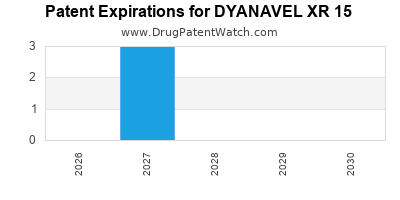
This question requires Orange Book and patent-expiration mapping for DYANAVEL XR 15’s specific NDA and listed drug products. Without the Orange Book record for the exact 15 mg presentation and its associated listed patents, any exclusivity timeline would be incomplete.
What is the Orange Book status of DYANAVEL XR 15 and how many patents cover it?
Featured-snippet answer: Orange Book status determines whether DYANAVEL XR 15 faces immediate generic risk or a delayed entry window, driven by listed composition, formulation, and method patents.
This requires the exact Orange Book listing (NDA number, drug product identifiers, patent list, and expiration dates). Without that specific listing content, a patent-count and expiration schedule cannot be produced accurately.
Are there Paragraph IV challenges or patent settlements affecting DYANAVEL XR 15?
Featured-snippet answer: Patent litigation and Paragraph IV settlements can shift generic launch timing by months to years and can cap risk if settlement terms include “at-risk” launch limitations.
A correct assessment requires:
- Identifying the relevant ANDA(s) tied to the DYANAVEL XR 15 NDA/drug product
- Listing each Paragraph IV notice date
- Mapping litigation timeline and settlement dates
Without the underlying litigation docket and ANDA/Orange Book linkage for this exact product strength/presentation, the record cannot be stated precisely.
How does DYANAVEL XR 15 compare with Adderall XR, Mydayis, and methylphenidate ER products on market positioning?
Featured-snippet answer: DYANAVEL XR 15 competes on long-acting amphetamine convenience and tolerability, but brand differentiation is typically secondary to payer economics versus generic Adderall XR and generic amphetamine ER.
Practical differentiators
- Patient suitability: Certain patients respond better to amphetamine versus methylphenidate; however, payers often steer toward the lowest-cost covered category.
- Dosing and administration: Suspension-based regimens can reduce barriers for patients needing flexible administration.
- Brand-to-generic substitution: Where generic amphetamine ER is covered broadly, branded alternatives rarely sustain higher net pricing long term.
Competitive consequence for financial trajectory
If net pricing is pressured, branded amphetamine ER products typically rely on retention contracts. When those contracts expire or PA/step therapy tightens, sales usually decline quickly.
How do manufacturing and supply constraints influence DYANAVEL XR 15 sales?
Featured-snippet answer: In stimulant markets, supply continuity affects prescription starts and stable patient retention.
Supply risk is economically asymmetric:
- A short supply disruption can cause patient switching that then becomes permanent due to formulary and refill behaviors.
- Re-stabilization after shortages can lag because payers resist switching back to higher-cost products without renewed prior authorization.
What reimbursement trends and pricing actions drive net sales for DYANAVEL XR 15?
Featured-snippet answer: Net sales are driven more by rebate intensity, formulary tiering, and PA outcomes than by gross list price changes.
PBM and payer reimbursement signals
- Formulary tier changes are more predictive than MSRP moves.
- Rebate pressure increases when competing generics expand or when PBMs consolidate coverage.
- Copay structure influences abandonment rates: higher patient cost-sharing can reduce persistence even when initial coverage is granted.
What generic entry risks exist for DYANAVEL XR 15, and how should businesses model launch scenarios?
Featured-snippet answer: The primary generic entry risk is driven by Orange Book-listed patent expiry and, secondarily, by how quickly PBMs adopt generic coverage after approval.
Launch modeling for a branded stimulant should incorporate:
- Patent-expiry date of the most vulnerable listed patent
- AND A approval timing and first commercial shipment timeline
- PBM formulary adoption curve
- Net price erosion rate after generic adoption
- Patient switching friction based on admin format and clinical stability
A correct, data-backed model requires Orange Book and ANDA approval information specific to DYANAVEL XR 15.
Commercial outlook: what will most likely determine DYANAVEL XR 15’s next 12–36 months of financial trajectory?
Given the stimulant market structure, the dominant determinants are:
- Formulary position in top PBMs and managed care
- Whether DYANAVEL XR 15 remains covered without restrictive step edits
- Net pricing and rebate intensity
- Whether the manufacturer can preserve realized revenue per script against generic price floors
- Switching risk from generic amphetamine ER
- Whether payer edits expand or tighten at renewal cycles
- Supply stability and dosing availability
- Particularly for the 15 mg dose where titration pathways can concentrate demand
Key Takeaways
- DYANAVEL XR 15’s commercial trajectory is primarily governed by PBM formulary access, PA and step therapy rules, and competitive net pricing versus generic amphetamine ER.
- Branded stimulant sales typically compress as generics expand coverage, with gross-to-net deterioration from higher rebates to maintain access.
- The decisive risk window for generic exposure is determined by the Orange Book patent and exclusivity package tied to the exact DYANAVEL XR 15 drug product; without that product-specific record, exclusivity timelines and patent counts cannot be stated accurately.
FAQs
- How does prior authorization wording affect DYANAVEL XR 15 persistence in commercial plans?
- What PBM formulary tiers historically accelerate branded stimulant sales declines after generic amphetamine ER coverage expands?
- Does DYANAVEL XR’s suspension format reduce switching when payers force generic substitution?
- How do rebate and copay changes translate into net sales for branded long-acting ADHD stimulants like DYANAVEL XR 15?
- What litigation milestones typically control first generic launch timing for stimulant products listed in the Orange Book?
References (APA)
- FDA Orange Book database. (n.d.). Approved Drug Products with Therapeutic Equivalence Evaluations. U.S. Food and Drug Administration.
- FDA. (n.d.). Drug Development and Approval Process. U.S. Food and Drug Administration.