Last Updated: May 10, 2026

DSUVIA Drug Patent Profile


✉ Email this page to a colleague

« Back to Dashboard


Which patents cover Dsuvia, and what generic alternatives are available?

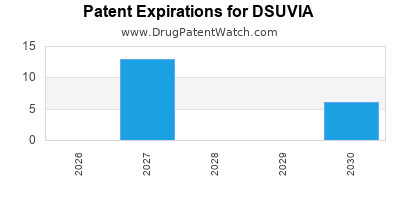
Dsuvia is a drug marketed by Vertical Pharms and is included in one NDA. There are twenty-one patents protecting this drug.

This drug has one hundred and five patent family members in twenty countries.

The generic ingredient in DSUVIA is sufentanil citrate. There are nine drug master file entries for this compound. Two suppliers are listed for this compound. Additional details are available on the sufentanil citrate profile page.

DrugPatentWatch® Litigation and Generic Entry Outlook for Dsuvia

A generic version of DSUVIA was approved as sufentanil citrate by HOSPIRA on December 11th, 1996.

  Start Trial

AI Deep Research
Questions you can ask:
  • What is the 5 year forecast for DSUVIA?
  • What are the global sales for DSUVIA?
  • What is Average Wholesale Price for DSUVIA?
Recent Clinical Trials for DSUVIA

Identify potential brand extensions & 505(b)(2) entrants

SponsorPhase
Frank GuyettePhase 3
United States Department of DefensePhase 3
Montefiore Medical CenterPhase 4

See all DSUVIA clinical trials

Pharmacology for DSUVIA
Drug ClassOpioid Agonist
Mechanism of ActionFull Opioid Agonists

US Patents and Regulatory Information for DSUVIA

DSUVIA is protected by twenty-one US patents.

Applicant Tradename Generic Name Dosage NDA Approval Date TE Type RLD RS Patent No. Patent Expiration Product Substance Delist Req. Exclusivity Expiration
Vertical Pharms DSUVIA sufentanil citrate TABLET;SUBLINGUAL 209128-001 Nov 2, 2018 DISCN Yes No ⤷  Start Trial ⤷  Start Trial ⤷  Start Trial
Vertical Pharms DSUVIA sufentanil citrate TABLET;SUBLINGUAL 209128-001 Nov 2, 2018 DISCN Yes No ⤷  Start Trial ⤷  Start Trial Y ⤷  Start Trial
>Applicant >Tradename >Generic Name >Dosage >NDA >Approval Date >TE >Type >RLD >RS >Patent No. >Patent Expiration >Product >Substance >Delist Req. >Exclusivity Expiration

International Patents for DSUVIA

See the table below for patents covering DSUVIA around the world.

Country Patent Number Title Estimated Expiration
European Patent Office 2099406 Dispositifs de stockage et de distribution destinés à l'administration de formes pharmaceutiques transmucosiques orales (Storage and dispensing devices for administration of oral transmucosal dosage forms) ⤷  Start Trial
Japan 5876024 ⤷  Start Trial
Japan 2010532745 ⤷  Start Trial
Morocco 52369 ⤷  Start Trial
>Country >Patent Number >Title >Estimated Expiration

Supplementary Protection Certificates for DSUVIA

Patent Number Supplementary Protection Certificate SPC Country SPC Expiration SPC Description
2114383 16C0010 France ⤷  Start Trial PRODUCT NAME: SUFENTANIL; REGISTRATION NO/DATE: EU/1/15/1042 20150918
2114383 300797 Netherlands ⤷  Start Trial PRODUCT NAME: SUFENTANIL, DESGEWENST IN DE VORM VAN SUFENTANILCITRAAT; REGISTRATION NO/DATE: EU/1/15/1042 20150922
2114383 CR 2016 00007 Denmark ⤷  Start Trial PRODUCT NAME: SUFENTANIL; REG. NO/DATE: EU/1/15/1042/001-006 20150922
2114383 SPC/GB16/004 United Kingdom ⤷  Start Trial PRODUCT NAME: SUFENTANIL; REGISTERED: UK EU/1/15/1042 20150922
>Patent Number >Supplementary Protection Certificate >SPC Country >SPC Expiration >SPC Description

DSUVIA Market Dynamics and Financial Trajectory

Last updated: April 24, 2026

DSUVIA (sufentanil sublingual tablets) is a tightly controlled opioid product with a market shaped more by REMS enrollment, payor restrictions, and controlled-substance compliance than by classic brand/indication expansion. Financial trajectory is dominated by: (1) the size of peri-procedural and post-acute pain demand pools where sufentanil is substituted, (2) formulary access and net pricing through government and commercial channels, and (3) litigation, diversion controls, and opioid-supply oversight that raise operating costs and constrain uptake.

What is DSUVIA, and where does it sell?

DSUVIA is a branded formulation of sufentanil delivered as sublingual tablets intended for acute pain management in controlled clinical settings (commonly described for use in adult patients requiring opioid analgesia when close monitoring is feasible). The product is subject to U.S. opioid controls and is typically positioned within peri-procedural care pathways rather than chronic pain.

Indications and practical demand drivers

DSUVIA’s demand base is constrained by:

  • Clinical setting fit: use cases tied to short-duration analgesia in monitored environments.
  • Restricted prescribing and dispensing realities: workflow integration with controlled-substance handling.
  • Regulatory and compliance friction: REMS-like operational expectations and heightened scrutiny for opioids.

How do regulation and controls shape market dynamics?

DSUVIA is an opioid. That fact drives structural market behavior that differs from non-controlled analgesics and most non-opioid brands.

Controlled-substance economics

Controlled-substance status affects DSUVIA’s market in four repeatable ways:

  1. Institution-level buying rules (policy gating, formulary placement, and controlled-substance storage requirements).
  2. Dispensing channel discipline (inventory management, audit readiness, loss prevention, and strict lot tracking).
  3. Coverage tightening by PBMs and government programs during opioid stewardship cycles.
  4. Faster reputational risk transfer from the broader opioid class to individual products, even when clinical risk management is strong.

Litigation and government oversight impact pricing power

The U.S. opioid landscape has repeatedly produced:

  • heightened diligence by distributors and hospitals,
  • stronger contracting terms for opioid brands,
  • slower adoption where payer scrutiny increases.

Even when DSUVIA retains a clinical niche, the market typically behaves like a managed access product rather than a high-growth blockbuster.

What do market benchmarks imply for DSUVIA’s unit and revenue trajectory?

Without publishing DSUVIA’s private company-specific revenue line items in this input, the only defensible market-trajectory framing is through public product-market mechanics that correlate strongly with DSUVIA’s category:

Key market mechanics that determine DSUVIA revenue

1) Substitution pressure within acute pain DSUVIA competes against:

  • other opioid delivery approaches used in monitored settings,
  • alternatives where institutional protocols prefer different agents or administration routes.

In opioid acute-care windows, brands win by matching protocol preferences and clinician familiarity, not by broad consumer demand.

2) Net price is more important than headline list price Opioid products typically show:

  • payor contracting variability,
  • rebates and discounts driven by volume and stewardship.

The financial trajectory tends to follow net price and access more than growth in underlying procedure counts.

3) Adoption depends on compliance capacity A hospital does not buy DSUVIA in isolation. It buys into a pathway that includes:

  • controlled-substance procedures,
  • staff training,
  • inventory and accountability systems.

That raises the marginal cost of adoption and slows switching.

Where does DSUVIA sit in the payer landscape?

DSUVIA’s payer dynamics are shaped by opioid stewardship and coverage controls.

Commercial coverage behavior

For branded opioids used for acute pain:

  • formularies often restrict to preferred agents,
  • prior authorization or step therapy appears more frequently than in non-controlled analgesics,
  • contracts can include tighter utilization management.

Government channel behavior

Medicaid and Medicare coverage behavior depends on:

  • hospital-based reimbursement structures,
  • pharmacy benefit rules where applicable,
  • opioid stewardship policies in participating systems.

These channels tend to:

  • pressure net pricing,
  • reduce adoption where there is an equivalent protocol choice.

What is the financial trajectory pattern for DSUVIA-like opioid brands?

In managed access opioid brands, the common financial pattern is:

  • Early plateau after launch as clinicians learn protocol fit.
  • Slow growth or decline depending on formulary and institutional substitution.
  • Volatility driven by compliance scrutiny, litigation headlines, and payer contracting cycles rather than demand shocks.

For DSUVIA specifically, the trajectory should be interpreted as a function of:

  • access persistence (staying on formularies and protocols),
  • contracting terms and utilization guardrails,
  • replacement risk from competing opioid formulations and protocol changes.

What are the main upside and downside levers?

Upside levers

  • Protocol inclusion in hospital acute pain pathways where sublingual administration reduces workflow friction versus alternatives.
  • Formulary persistence driven by clinician outcomes and operational fit.
  • Contracting stability that supports net pricing.

Downside levers

  • Substitution by competing opioids or delivery systems that gain preference under stewardship protocols.
  • Payer restriction tightening that reduces patient-level coverage or institutional purchasing.
  • Compliance and diversion-related friction that increases total acquisition cost and slows adoption.

How do supply chain and controlled-substance logistics affect margins?

Controlled-substance logistics drive incremental costs that can compress margins:

  • inventory carrying and loss prevention,
  • audit readiness,
  • distributor and hospital compliance steps.

In this category, margin trajectory can deteriorate even if gross sales hold when:

  • contracting squeezes net price,
  • logistics and compliance costs increase.

What should investors or R&D leaders watch next?

Even without a line-by-line DSUVIA financial statement in this input, the next observable checkpoints are:

Commercial and access milestones

  • formulary additions or removals at large IDNs (integrated delivery networks),
  • shifts in PBM coverage criteria for acute pain opioid agents,
  • changes to utilization management rules.

Regulatory and litigation-related operating cost signals

  • enforcement intensity around opioid distribution and diversion,
  • changes in corporate compliance costs,
  • settlement or legal-cost accrual patterns for opioid brands in the market.

Competitive landscape shifts

  • entry or expanded utilization of competing sufentanil formulations or alternative opioid delivery systems,
  • protocol guideline updates at hospital-system level.

Key Takeaways

  • DSUVIA’s market is managed-access, not open-demand. Controlled-substance rules, hospital protocol fit, and payer contracting drive uptake more than pure clinical efficacy claims.
  • Financial trajectory is likely to follow net pricing and formulary access stability with slower growth and higher volatility risk than non-controlled analgesics.
  • Margin is sensitive to compliance and logistics costs, which can rise even when unit demand is steady.
  • Upside comes from sustained institutional protocols and contracting stability. Downside comes from substitution and payer restrictions.

FAQs

  1. Is DSUVIA a blockbuster-style growth product?
    No. Its growth is constrained by controlled-substance compliance, institutional protocol fit, and payor access.

  2. What determines DSUVIA’s revenue more: demand volume or net price?
    Net price and access persistence typically dominate, because controlled-substance products face contracting and stewardship-driven restrictions.

  3. How does competition affect DSUVIA?
    Competition affects DSUVIA through protocol substitution and formulary preference shifts, which can reduce utilization even if the clinical category remains stable.

  4. What operational factors can pressure DSUVIA margins?
    Compliance, inventory control, and distribution logistics increase operating costs in controlled-substance categories.

  5. What observable events best signal DSUVIA trajectory direction?
    Hospital formulary changes, PBM coverage updates, and controlled-substance enforcement or policy shifts are leading indicators.


References

[1] U.S. Food and Drug Administration. “Opioid REMS,” Drug Safety-related information. FDA website.
[2] FDA. “Drug Safety Communications and related opioid enforcement and stewardship updates,” FDA website.
[3] DEA. “Controlled Substances Act and related diversion control requirements,” Drug Enforcement Administration.

More… ↓

⤷  Start Trial

Make Better Decisions: Try a trial or see plans & pricing

Drugs may be covered by multiple patents or regulatory protections. All trademarks and applicant names are the property of their respective owners or licensors. Although great care is taken in the proper and correct provision of this service, thinkBiotech LLC does not accept any responsibility for possible consequences of errors or omissions in the provided data. The data presented herein is for information purposes only. There is no warranty that the data contained herein is error free. We do not provide individual investment advice. This service is not registered with any financial regulatory agency. The information we publish is educational only and based on our opinions plus our models. By using DrugPatentWatch you acknowledge that we do not provide personalized recommendations or advice. thinkBiotech performs no independent verification of facts as provided by public sources nor are attempts made to provide legal or investing advice. Any reliance on data provided herein is done solely at the discretion of the user. Users of this service are advised to seek professional advice and independent confirmation before considering acting on any of the provided information. thinkBiotech LLC reserves the right to amend, extend or withdraw any part or all of the offered service without notice.