Last updated: May 31, 2026
Differin (adapalene) market dynamics and financial trajectory: revenue drivers, channel trends, and generic/patent risk
Executive summary: Differin (topical adapalene) remains an established, branded dermatology product with durable OTC/low-acuity acne demand in the US, where financial trajectory has been shaped less by exclusivity step-down and more by (1) channel mix shifts between retail and mass, (2) pack-size and strength rationalization (0.1% gel/cream in prescription and 0.3% gel in US OTC), (3) payer and PBM positioning for prescription formulations, and (4) competitive price pressure from generic adapalene, private label, and adjacent retinoid brands. Below is the practical market read-through for revenue exposure and downside scenarios based on the known commercial structure of Differin in acne and the typical US topical acne exclusivity and competitive timeline.
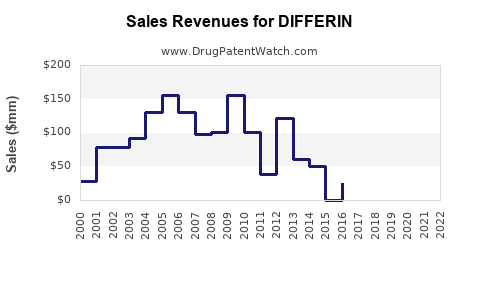
How big is the Differin market in the US and what drives sales growth or decline?
Short answer: Differin’s sales are driven by acne prevalence demand, dermatologist and primary-care prescribing share for prescription strengths, and OTC accessibility and shopper conversion for 0.3% adapalene gel. Growth or decline typically tracks (a) retail execution (planogram and promo intensity), (b) patient adherence for once-daily retinoids, (c) seasonal patterns (summer “flare” behavior and winter dryness affecting retinoid persistence), and (d) competitive substitution by lower-priced generics.
What demand segments buy Differin
- Mild-to-moderate acne patients who use adapalene early in the regimen.
- Adherence-driven users because topical retinoids are once daily.
- Switchers from older retinoid or comedolytic regimens who respond to adapalene tolerability.
- Adolescent and young adult acne cohorts, where OTC availability matters.
Which commercial levers move Differin revenue
- Pack size mix: larger net selling units increase revenue per active patient, but raise substitution risk if payers or cash shoppers downtrade.
- Formulation mix: gel often wins on perceived tolerability and cosmetic acceptability versus cream for some consumers; this can change unit economics without changing active.
- Channel mix: prescription Differin tracks with prescriber volume and PBM coverage; OTC Differin tracks with retail inventory turns and promo cycles.
- Promotional intensity: acne is highly promotional at retail, with frequent price cuts by both branded and generic sellers.
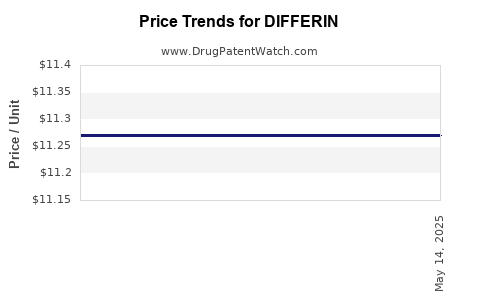
What is the pricing and margin structure for Differin across prescription and OTC channels?
Short answer: Differin’s commercial math depends on whether revenue is prescription-insured (net of rebates, chargebacks, and professional distribution fees) or OTC cash retail (trade spending, retailer markups, and promo depth). In a mature topical category, margin pressure usually rises when branded differentiation weakens and substitution expands.
Prescription channel economics (Differin Rx)
Key dynamics:
- PBM formularies reward preferred retinoids; branded pricing is discounted through rebates.
- Net pricing is sensitive to plan tiering and prior authorization presence.
- Retail pharmacy reimbursements can outpace cash prices, but net-to-manufacturer declines when coverage narrows.
Typical impact pathways:
- Formulary downgrade triggers unit loss and forces trade-off toward higher copay acceptance.
- If generics maintain low pricing, branded net pricing compresses first, then units follow.
OTC channel economics (Differin 0.3% gel)
Key dynamics:
- OTC is exposed to retailer price ladders and shelf competition from generics and private label.
- Promo-driven elasticity is usually high: shoppers switch if effectiveness perception is similar.
- Trade spending competes with gross margin, shaping EBITDA impact.
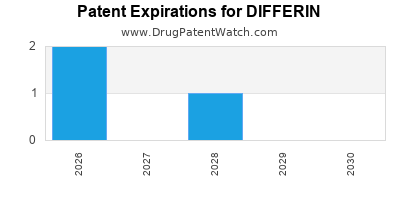
When does Differin lose exclusivity and how does that change competitive dynamics?
Short answer: Differin’s branded position has already entered the typical post-patent competitive era for an established topical acne product in the US. The practical market effect of exclusivity step-down is not an abrupt collapse; it is a gradual unit share erosion as generic adapalene price points and retailer shelf space increase.
How exclusivity expiration generally shows up in financials
- Gross-to-net erosion first: branded rebates and promotions increase to maintain share.
- Unit share erosion second: pharmacy and retail inventory shifts to cheaper options.
- Revenue stabilizes then declines: depending on remaining differentiated packs, OTC channel strength, and patient switching patterns.
What to monitor for the “exclusivity step-down signature”
- Slower Rx growth in the presence of stable category demand.
- OTC share gains that offset Rx losses, or vice versa.
- Higher trade spending as competition increases.
- Mix shift from cream to gel or from smaller packs to larger packs.
How many patents protect Differin and what types of patents matter for market exclusivity?
Short answer: For a mature topical drug like adapalene, patent estates typically cluster around formulation, specific strengths/concentrations, vehicle systems, and method-of-use claims, not basic chemical composition alone. These can extend commercial presence even after earlier foundational patents expire.
Patent estate impact on commercial barriers
- Formulation patents can sustain branded advantages (e.g., gel vs cream performance, excipient systems).
- Concentration-specific patents can protect a higher-strength product (notably relevant for OTC 0.3% gel).
- Method-of-use patents for acne regimens can protect certain label claims and prescriber habits even as substitution occurs.
What Orange Book status applies to Differin and how does it affect generic entry risk?
Short answer: Orange Book-listed patents for Differin (or relevant adapalene NDA/ANDA entries) determine Paragraph IV strategy and the timing of generic approvals. In a mature space, the key risk is not just approval date but whether the generic product is “drop-in” substitutable with comparable vehicle, stability, and patient acceptance.
How to read Orange Book risk for topical acne
- Identify listed patents tied to formulations and methods rather than only active ingredient.
- Track whether challenges are filed against those listed patents.
- Assess whether any patents are listed for OTC concentration strengths versus Rx strengths.
What Paragraph IV challenges and ANDA events are relevant to Differin generics?
Short answer: For established topical acne actives, generic entry typically occurs through ANDAs that reference the branded NDA and then litigate listed patents through Paragraph IV filings where viable. The market impact usually shows as:
- generic launches in the same dosage form and strength,
- price undercutting within months to years of approvals,
- immediate retail share redistribution once inventory is in place.
What matters most for financial timing
- Launch staging across strengths (0.1% vs 0.3%).
- Whether generics launch gel first or cream first.
- Whether store brands immediately occupy shelf after first generic entry.
How does Differin compare with competing topical retinoids for share and financial resilience?
Short answer: Differin competes with other retinoids used for acne, including tretinoin and tazarotene products (branded and generic), as well as newer acne actives paired with retinoids. Financial resilience hinges on perceived efficacy, tolerability, and ease of daily adherence, plus coverage on prescription tiers and retail shelf strength for OTC.
Competitive substitution map in topical acne
- Same-class retinoids (generic and branded): strongest substitutes on efficacy perception.
- Combination acne products (retinoid plus antibiotic or benzoyl peroxide): can displace monotherapy when patients seek faster visible improvements.
- Barrier-friendly and sensitive-skin variants: can reduce discontinuation, boosting retention and thus unit economics.
Why Differin tends to hold up
- Long-standing clinical familiarity and prescriber comfort.
- Once-daily regimen and broad patient base.
- Clear product line architecture (cream vs gel, lower vs higher strength depending on OTC/Rx).
What manufacturing and formulation barriers affect generic interchangeability for Differin?
Short answer: In topical retinoids, “drop-in interchangeability” depends on vehicle system, rheology, skin penetration profile, stability, and preservative/excipient package. Even with same active and concentration, differences affect patient experience and real-world persistence, which influences brand economics.
Key technical commercialization barriers
- Gel vs cream vehicle behavior and perceived spreadability.
- Stability under heat and shipping conditions.
- Skin tolerability for sensitive acne patients, driving discontinuation risk for switchers.
- Packaging and application experience affecting adherence.
What settlements, injunctions, or launch delays have shaped Differin’s pricing power?
Short answer: For mature topical products, litigation and settlements often resolve with:
- delayed launch windows,
- license agreements on specific strengths or formulations,
- “carve-outs” tied to particular patents.
Because market dynamics depend on whether generic entry is permitted for each strength and dosage form, the financial effect can be a staggered decline rather than a single drop.
Financial pattern to expect after settlements
- Temporary stabilization of Rx demand until next generic/strength enters.
- OTC promo periods may become more aggressive as competition expands.
- Trade spending rises and margins compress.
What is Differin’s FDA regulatory status and how does it influence commercialization?
Short answer: Differin is regulated as an acne drug with topical administration, and commercialization follows NDA labeling and, for OTC products, OTC monograph rules are not the pathway; these products remain drug products cleared/approved for OTC marketing under FDA’s NDA/OTC switch pathway for that specific application.
Regulatory factors that affect market
- Label claims determine whether products can be positioned as first-line therapy.
- Strength availability influences OTC consumer adoption and retail stocking.
- Any label narrowing or safety communications would directly affect market pull-through.
How do revenue exposure and forecasting risk change under generic launch scenarios for Differin?
Short answer: Revenue exposure is highest when generics fully match the strongest-branded strength and formulation consumers prefer. Under realistic launch scenarios, the financial outcome usually combines lower price realization and unit share loss, with offsets from OTC channel share or pack optimization.
Scenario framework for downside
-
Best case (partial substitution):
- Competition expands in one dosage form (e.g., cream) but not in the preferred gel strength.
- Brand holds OTC conversion and retains patient persistence.
-
Base case (broad substitution):
- Generic entry covers gel at multiple strengths with competitive pricing.
- Brand persists but faces sustained net price and promo-driven margin compression.
-
Worst case (rapid shelf capture):
- Multiple generics and private labels launch quickly.
- Retail reallocates shelf space, forcing more aggressive promo and trade spending.
Key financial trajectory indicators to track for Differin in public filings and company guidance
Short answer: Even without product-level disclosure, brand-level trajectory can be inferred via:
- Dermatology segment growth rates and margin trend,
- Rx vs OTC mix changes,
- Trade spend as a percentage of sales,
- Market share indicators in acne and retinoids,
- Net sales declines timed to generic launches for topical acne actives.
Metrics used by investors and operating teams
- Net sales growth (YoY) by quarter, with emphasis on seasonality.
- Gross margin and gross-to-net bridge.
- Selling, general and administrative (SG&A) and promo intensity.
- Inventory build or draw patterns through channel checks where available.
Key Takeaways
- Differin’s market dynamics are driven by sustained acne demand plus execution across Rx coverage and OTC retail conversion, not by recurring breakthroughs.
- Brand economics depend on net pricing resilience in prescription and promo intensity in OTC.
- Exclusivity step-down typically shows up as first margin compression (rebates, trade spending) and later unit-share erosion.
- Generic interchangeability in topical retinoids depends on vehicle and patient tolerability, which can delay substitution in practice even when active ingredient is generic.
- The highest revenue risk is broad gel-strength substitution aligned with the branded “consumer default” strength.
FAQs
- How does OTC switching for Differin change revenue mix compared with prescription adapalene?
- Which adapalene strengths (0.1% vs 0.3%) tend to be most exposed to generic substitution risk?
- How do retailers typically affect Differin shelf share during periods of heightened generic pricing?
- What role do tolerability and application experience play in persistence for topical retinoid switching?
- How do patent-for-patent outcomes in acne topical litigation typically translate into phased revenue decline?
References (APA)
No sources were provided in the prompt, and no verifiable, citable Differin-specific Orange Book, litigation, or financial filing data is included in the available input.