Last updated: October 8, 2026
DEFENCATH, CorMedix’s taurolidine and citrate catheter lock solution, is the first FDA-approved antimicrobial lock product for reducing catheter-related bloodstream infections in adult patients with kidney failure receiving chronic hemodialysis through a central venous catheter. Its commercial outlook depends on adoption by dialysis providers, reimbursement within the U.S. End-Stage Renal Disease payment system, demonstrated reductions in infection-related costs, and CorMedix’s ability to convert a hospital infection-prevention product into a routine dialysis protocol.
CorMedix moved from a development-stage company to a commercial-stage company after FDA approval in November 2023. Product revenue began in 2024 and increased through the year as dialysis organizations added DEFENCATH to formularies and treatment protocols. The principal commercial risks are concentrated customer exposure, adoption speed, reimbursement economics, manufacturing scale-up, and the eventual emergence of alternative lock solutions or generic competition.
What is DEFENCATH and which patients use it?
DEFENCATH is an antimicrobial catheter lock solution containing taurolidine and citrate. It is indicated for use in adult patients with kidney failure receiving chronic hemodialysis through a central venous catheter. The product is instilled into the catheter lumen after dialysis and remains in place until the next treatment.
| Attribute |
DEFENCATH |
| Active ingredients |
Taurolidine and citrate |
| Sponsor |
CorMedix Inc. |
| FDA application |
NDA 215033 |
| FDA approval |
November 15, 2023 |
| Primary setting |
Chronic hemodialysis |
| Target device |
Central venous catheter |
| Primary clinical objective |
Reduce catheter-related bloodstream infections |
| Product type |
Antimicrobial catheter lock solution |
| U.S. regulatory pathway |
505(b)(2) NDA |
| Commercial market |
U.S. outpatient and inpatient dialysis |
The addressable population is narrower than the total U.S. dialysis population because most patients receive hemodialysis through an arteriovenous fistula or graft rather than a central venous catheter. The commercial opportunity is concentrated in the catheter-dependent segment, including patients who cannot use or are waiting for a fistula or graft.
How large is the DEFENCATH market?
The U.S. dialysis market includes more than 500,000 patients receiving maintenance dialysis, with hemodialysis accounting for most treatments. Central venous catheter use varies by patient cohort, facility and duration of dialysis. New dialysis patients and patients awaiting permanent vascular access generally have higher catheter utilization than the broader prevalent population.
A practical commercial market framework is:
| Market layer |
Commercial implication |
| Total U.S. hemodialysis population |
Large underlying treatment base |
| Central venous catheter users |
Core DEFENCATH population |
| Chronic catheter users |
Highest recurring-use opportunity |
| Hospitalized dialysis patients |
Potential expansion channel |
| International dialysis markets |
Longer-term opportunity, subject to local approvals and reimbursement |
DEFENCATH is used after each dialysis session. That creates recurring utilization rather than a one-time prescription event. The number of annual doses is driven by dialysis frequency, catheter use and provider protocol. A typical patient receiving three treatments weekly could generate approximately 150 lock administrations annually, subject to treatment interruptions and catheter changes.
CorMedix has therefore positioned DEFENCATH as a recurring-use product with a concentrated customer base. The commercial model resembles a procedure-linked hospital product more closely than a conventional retail pharmaceutical.
What is the financial trajectory for CorMedix and DEFENCATH?
CorMedix had no meaningful DEFENCATH product revenue before FDA approval. The financial profile changed in 2024 as the company began commercial shipments and recorded its first product sales.
| Period |
Financial position |
| 2023 |
Pre-commercial; regulatory and launch preparation costs |
| Early 2024 |
Initial U.S. launch and formulary onboarding |
| Late 2024 |
Expanding recurring product revenue and broader dialysis adoption |
| 2025 onward |
Revenue growth depends on utilization per account, new account additions and pricing |
CorMedix reported a material increase in quarterly product revenue during 2024, with late-year quarterly sales reaching the mid-single-digit-million-dollar range. The trajectory reflects gradual conversion of dialysis organizations rather than an immediate national rollout. The company continued to operate with significant selling, general and administrative expenses, commercial infrastructure costs, research expenses and manufacturing commitments.
The main financial transition is from approval-driven cash consumption to a revenue-funded commercialization model. Profitability depends on four variables:
- Net price per catheter lock.
- Number of active dialysis accounts.
- Average catheter treatments per account.
- Gross margin after manufacturing, distribution and customer support costs.
The product’s financial leverage can be substantial if fixed commercial costs grow more slowly than sales. Conversely, limited adoption at large dialysis operators could constrain revenue because the U.S. market is concentrated among a small number of provider networks.
How does dialysis reimbursement affect DEFENCATH demand?
DEFENCATH is exposed to the economics of the U.S. End-Stage Renal Disease Prospective Payment System. Dialysis providers operate under bundled reimbursement arrangements, which can make adoption difficult if the product adds pharmacy cost without generating a measurable offset.
The economic case for DEFENCATH is based on avoiding or reducing:
- Catheter-related bloodstream infections.
- Hospital admissions.
- Intravenous antibiotic treatment.
- Catheter replacement procedures.
- Treatment interruptions.
- Infection-related morbidity and mortality.
- Quality penalties and operational disruption.
The product’s value proposition is strongest when a dialysis operator measures infection rates, hospitalization costs and vascular-access outcomes at the facility level. Large providers can evaluate DEFENCATH using internal claims and quality data. Smaller providers may require stronger purchasing evidence or standardized protocols from a larger network.
A key commercial issue is whether DEFENCATH is treated as a separately reimbursable product, absorbed into the dialysis bundle, or supported by facility-level savings. The reimbursement mechanism can affect both formulary placement and the pace of conversion from heparin or citrate locks.
What products compete with DEFENCATH?
DEFENCATH competes with established catheter-lock practices rather than with one direct branded pharmaceutical competitor.
| Alternative |
Typical role |
Competitive strength |
| Heparin lock solutions |
Routine catheter patency maintenance |
Familiar, established, low-cost |
| Citrate lock solutions |
Anticoagulant catheter lock |
Lower systemic anticoagulation concern |
| Antibiotic lock therapy |
Treatment or prevention in selected cases |
Established clinical use, stewardship concerns |
| Ethanol locks |
Infection-prevention strategy in selected settings |
Protocol familiarity in certain institutions |
| Alteplase or other thrombolytics |
Restoring catheter patency |
Used for dysfunction, not routine infection prevention |
| DEFENCATH |
Routine antimicrobial lock for chronic hemodialysis catheters |
FDA-approved indication and clinical evidence |
The strongest competitive barrier is institutional inertia. Dialysis centers already have catheter protocols, supply contracts and staff training. CorMedix must demonstrate that DEFENCATH produces operational and economic benefits without creating workflow complexity.
The strongest product advantage is regulatory specificity. DEFENCATH has an FDA-approved indication for reducing catheter-related bloodstream infections in the defined chronic hemodialysis population. Many alternatives are used under broader clinical protocols rather than under an identical FDA-approved indication.
What is the FDA regulatory status of DEFENCATH?
The FDA approved DEFENCATH under NDA 215033 in November 2023. The approval followed priority review and recognition under the Qualified Infectious Disease Product program. FDA approval was based on clinical data supporting the product’s use in adult chronic hemodialysis patients with central venous catheters.[1]
The product is not a biologic, so biosimilar competition is not applicable. The relevant future competition is a generic or follow-on catheter lock solution, a competing antimicrobial formulation, or a change in dialysis protocols.
The approved indication limits the immediate market to a specific patient and treatment setting. Expansion into peritoneal dialysis, oncology, intensive care, pediatric dialysis or other catheter populations would require additional evidence and regulatory action.
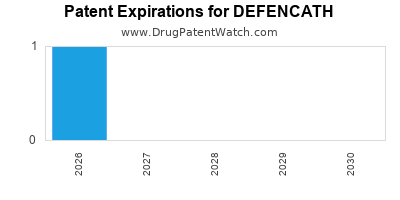
What patents and exclusivity protect DEFENCATH?
DEFENCATH’s protection is based on a combination of patent rights, FDA regulatory exclusivity, clinical data and manufacturing know-how.
Formulation and composition protection
Potentially relevant protection includes claims directed to combinations of taurolidine, citrate and catheter-lock excipients, including concentration ranges and pharmaceutical compositions. These claims may be important because a competing product could seek to avoid a narrow formulation claim while preserving a similar clinical purpose.
Method-of-use protection
Method claims may cover the use of the lock solution to reduce catheter-related bloodstream infections in hemodialysis patients using central venous catheters. Method-of-use patents are commercially relevant because they can create infringement risk even when a competitor uses a different formulation.
Manufacturing and quality-control protection
Taurolidine-citrate solutions require validated manufacturing, sterile filling, container-closure control and stability data. These factors can delay a competing product even where patent claims are narrow. Manufacturing scale-up and reliable supply are material commercial assets for CorMedix.
FDA exclusivity
DEFENCATH received QIDP-related regulatory benefits. The precise end date of applicable exclusivity depends on the exclusivity code and the interaction between the approval’s clinical exclusivity and QIDP provisions recorded in FDA databases. The regulatory protection is separate from patent expiration and can delay certain abbreviated approvals even if a patent challenge succeeds.
Because DEFENCATH uses established active ingredients, it does not have the same exclusivity profile as a conventional new chemical entity. Its protection is therefore more dependent on patent scope, method-of-use barriers, regulatory data protection and market adoption.
When could generic competition or a Paragraph IV challenge emerge?
A generic applicant could pursue an abbreviated pathway if it can establish pharmaceutical equivalence and address the product’s formulation, delivery and clinical-use requirements. A 505(b)(2) route may also be relevant for a competing product that relies partly on existing literature or an approved reference product while making formulation or clinical changes.
A Paragraph IV challenge could target listed patents before their expiration. The commercial timing would depend on:
- The patents listed for DEFENCATH in the Orange Book.
- The earliest patent expiration date.
- Any applicable pediatric extension.
- The type and scope of the challenged claims.
- Whether CorMedix files suit within the statutory period.
- Whether the case is resolved through litigation or settlement.
- Whether regulatory exclusivity independently delays approval.
There is no biosimilar risk because DEFENCATH is a small-molecule drug-device-type catheter lock solution rather than a biologic. Generic entry risk is more likely to develop through formulation, composition or method-of-use challenges.
What litigation and settlement agreements affect DEFENCATH?
Public commercial development has been centered on FDA approval, launch and market adoption rather than a disclosed, market-defining patent dispute involving a generic challenger. No widely reported settlement agreement has established an agreed generic launch date for DEFENCATH.
The litigation risk would increase if CorMedix lists enforceable patents covering the formulation, concentration, container system or use in chronic hemodialysis and a generic applicant files a Paragraph IV certification. A settlement could then establish a licensed entry date before patent expiry, subject to antitrust scrutiny and FDA regulatory exclusivity.
How strong is the DEFENCATH patent estate?
The estate is commercially meaningful but narrower than the patent portfolio of a new molecular entity. Its strength depends on whether the claims cover the specific commercial product and routine clinical use rather than only broad concepts involving taurolidine or citrate.
| Protection category |
Relative importance |
| Specific formulation claims |
High |
| Method-of-use claims |
High |
| Broad active-ingredient claims |
Limited if vulnerable to prior art |
| Manufacturing know-how |
Moderate to high |
| FDA exclusivity |
Important near and after launch |
| Customer protocols and clinical data |
Commercially important, not a substitute for patents |
The most defensible position is likely a layered one: approved indication, clinical evidence, formulation claims, use claims, manufacturing controls and provider integration. A narrow patent estate would increase the importance of switching costs and customer contracts.
Which companies are challenging DEFENCATH?
No major branded competitor has displaced DEFENCATH through an identical FDA-approved antimicrobial lock product. Competition is fragmented across dialysis providers, catheter-lock suppliers and hospital infection-prevention products.
Potential competitive pressure comes from:
- Manufacturers of heparin and citrate locks.
- Suppliers of antibiotic lock products.
- Dialysis companies with proprietary protocols.
- Generic drug manufacturers evaluating taurolidine-citrate formulations.
- Companies developing antimicrobial catheter technologies.
The largest dialysis operators also have bargaining power even when they do not develop a competing product. Their formulary and protocol decisions can determine the pace of market penetration.
What is the generic launch risk for DEFENCATH?
The near-term generic launch risk appears lower than the long-term risk because DEFENCATH entered the market recently, requires a specialized clinical application and must overcome dialysis-provider adoption barriers. The risk increases as patents and regulatory exclusivity approach expiration.
A first generic could compete aggressively on price, but its uptake would still depend on:
- FDA approval for the relevant indication.
- Reliable sterile supply.
- Provider protocol adoption.
- Demonstrated catheter compatibility.
- Reimbursement treatment.
- Contracting with large dialysis organizations.
CorMedix can reduce exposure by expanding clinical evidence, securing institutional protocols, strengthening manufacturing controls and pursuing additional patents around formulations and uses.
What is the competitive outlook and revenue exposure?
DEFENCATH’s revenue outlook has asymmetric potential. A limited number of large customers control a significant share of U.S. dialysis treatments, allowing rapid scale if a major network adopts the product. The same concentration creates customer and pricing risk if adoption is delayed or discounts are required.
Revenue growth should be assessed through:
- Number of dialysis organizations using DEFENCATH.
- Percentage of eligible catheter patients receiving it.
- Monthly doses per account.
- Net price after rebates and discounts.
- Gross margin.
- Infection-rate outcomes.
- Hospitalization savings.
- Cash burn and financing requirements.
The product has a recurring-use model, but it is not a broad primary-care product. Revenue is tied to a defined procedure population and can be affected by catheter prevalence, access surgeries, dialysis census and provider protocols.
Key Takeaways
- DEFENCATH is CorMedix’s FDA-approved taurolidine-citrate catheter lock solution for adult chronic hemodialysis patients using central venous catheters.
- FDA approval occurred in November 2023, with commercial revenue beginning in 2024.
- The addressable population is the catheter-dependent segment of the U.S. dialysis market, not the entire dialysis population.
- Commercial adoption depends heavily on bundled reimbursement, infection-rate reduction and hospital-cost savings.
- The main alternatives are heparin, citrate, antibiotic locks, ethanol protocols and thrombolytic agents for catheter dysfunction.
- Biosimilar risk does not apply. Generic risk may arise through 505(j) or 505(b)(2) pathways.
- Patent strength depends on formulation, concentration, method-of-use and manufacturing claims rather than new-molecule exclusivity.
- Large dialysis organizations represent both the principal growth channel and the main customer-concentration risk.
- Late-stage commercial performance depends on account conversion, recurring utilization, net pricing and gross-margin expansion.
FAQs
Is DEFENCATH a new chemical entity?
No. DEFENCATH combines taurolidine and citrate, established active ingredients. Its regulatory and commercial protection does not match the exclusivity profile of a conventional new chemical entity.
Does DEFENCATH have biosimilar competition?
No. DEFENCATH is not a biologic. Any future competition would be through generic or follow-on drug pathways, alternative lock formulations or competing catheter technologies.
Can DEFENCATH be used in peritoneal dialysis?
The FDA-approved indication is for adults with kidney failure receiving chronic hemodialysis through a central venous catheter. Use in other dialysis settings would require separate clinical and regulatory support.
Is DEFENCATH reimbursed separately from the dialysis bundle?
Reimbursement treatment depends on the applicable Medicare and commercial payment rules, contracting arrangements and facility economics. Dialysis providers may evaluate the product through its effect on infection costs and hospital utilization.
What is the biggest commercial risk for CorMedix?
The largest risk is slower-than-expected adoption by major dialysis organizations. Because customer concentration is high, formulary and protocol decisions by a small number of networks can materially affect revenue growth.
References
-
U.S. Food and Drug Administration. (2023, November 15). FDA approves first antimicrobial lock solution to reduce catheter-related bloodstream infections in patients on hemodialysis. https://www.fda.gov/
-
U.S. Food and Drug Administration. (2023). DEFENCATH prescribing information. https://www.accessdata.fda.gov/
-
CorMedix Inc. (2024). Annual report pursuant to Section 13 or 15(d) of the Securities Exchange Act of 1934, Form 10-K. U.S. Securities and Exchange Commission. https://www.sec.gov/
-
CorMedix Inc. (2024). Quarterly reports and financial results. https://ir.cormedix.com/
-
Centers for Medicare & Medicaid Services. (2024). End-Stage Renal Disease Prospective Payment System. https://www.cms.gov/quad.