You're using a free limited version of DrugPatentWatch: Upgrade for Complete Access

Last Updated: March 26, 2026

DALIRESP Drug Patent Profile


✉ Email this page to a colleague

« Back to Dashboard


When do Daliresp patents expire, and when can generic versions of Daliresp launch?

Daliresp is a drug marketed by Astrazeneca and is included in one NDA.

The generic ingredient in DALIRESP is roflumilast. There are ten drug master file entries for this compound. Seventeen suppliers are listed for this compound. Additional details are available on the roflumilast profile page.

DrugPatentWatch® Litigation and Generic Entry Outlook for Daliresp

A generic version of DALIRESP was approved as roflumilast by PHARMOBEDIENT on July 13th, 2018.

  Start Trial

AI Deep Research
Questions you can ask:
  • What is the 5 year forecast for DALIRESP?
  • What are the global sales for DALIRESP?
  • What is Average Wholesale Price for DALIRESP?
Drug patent expirations by year for DALIRESP
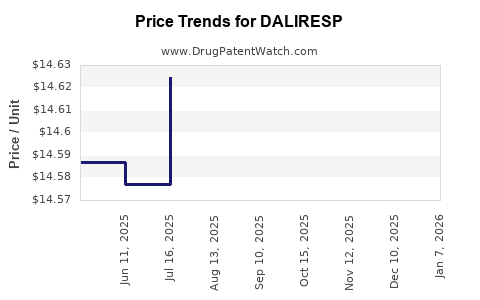
Drug Prices for DALIRESP

See drug prices for DALIRESP

Recent Clinical Trials for DALIRESP

Identify potential brand extensions & 505(b)(2) entrants

SponsorPhase
Chiesi Farmaceutici S.p.A.Phase 3
Johns Hopkins UniversityPhase 3
Patient-Centered Outcomes Research InstitutePhase 3

See all DALIRESP clinical trials

Pharmacology for DALIRESP
Paragraph IV (Patent) Challenges for DALIRESP
Tradename Dosage Ingredient Strength NDA ANDAs Submitted Submissiondate
DALIRESP Tablets roflumilast 250 mcg 022522 1 2019-01-25
DALIRESP Tablets roflumilast 500 mcg 022522 7 2015-03-02

US Patents and Regulatory Information for DALIRESP

Applicant Tradename Generic Name Dosage NDA Approval Date TE Type RLD RS Patent No. Patent Expiration Product Substance Delist Req. Exclusivity Expiration
Astrazeneca DALIRESP roflumilast TABLET;ORAL 022522-002 Jan 23, 2018 AB RX Yes No ⤷  Start Trial ⤷  Start Trial ⤷  Start Trial
Astrazeneca DALIRESP roflumilast TABLET;ORAL 022522-001 Feb 28, 2011 AB RX Yes Yes ⤷  Start Trial ⤷  Start Trial ⤷  Start Trial
>Applicant >Tradename >Generic Name >Dosage >NDA >Approval Date >TE >Type >RLD >RS >Patent No. >Patent Expiration >Product >Substance >Delist Req. >Exclusivity Expiration

Expired US Patents for DALIRESP

Applicant Tradename Generic Name Dosage NDA Approval Date Patent No. Patent Expiration
Astrazeneca DALIRESP roflumilast TABLET;ORAL 022522-001 Feb 28, 2011 9,468,598 ⤷  Start Trial
Astrazeneca DALIRESP roflumilast TABLET;ORAL 022522-002 Jan 23, 2018 5,712,298 ⤷  Start Trial
Astrazeneca DALIRESP roflumilast TABLET;ORAL 022522-001 Feb 28, 2011 8,604,064 ⤷  Start Trial
Astrazeneca DALIRESP roflumilast TABLET;ORAL 022522-002 Jan 23, 2018 9,468,598 ⤷  Start Trial
Astrazeneca DALIRESP roflumilast TABLET;ORAL 022522-001 Feb 28, 2011 8,536,206 ⤷  Start Trial
>Applicant >Tradename >Generic Name >Dosage >NDA >Approval Date >Patent No. >Patent Expiration

EU/EMA Drug Approvals for DALIRESP

Company Drugname Inn Product Number / Indication Status Generic Biosimilar Orphan Marketing Authorisation Marketing Refusal
AstraZeneca AB Daxas roflumilast EMEA/H/C/001179Daxas is indicated for maintenance treatment of severe chronic obstructive pulmonary disease (COPD) (FEV1 post-bronchodilator less than 50% predicted) associated with chronic bronchitis in adult patients with a history of frequent exacerbations as add-on to bronchodilator treatment., Authorised no no no 2010-07-05
AstraZeneca AB Libertek roflumilast EMEA/H/C/002399Libertek is indicated for maintenance treatment of severe chronic obstructive pulmonary disease (COPD) (FEV1 post-bronchodilator less than 50% predicted) associated with chronic bronchitis in adult patients with a history of frequent exacerbations as add-on to bronchodilator treatment. Withdrawn no no no 2011-02-28
AstraZeneca AB Daliresp roflumilast EMEA/H/C/002398Daliresp is indicated for maintenance treatment of severe chronic obstructive pulmonary disease (COPD) (FEV1 post-bronchodilator less than 50% predicted) associated with chronic bronchitis in adult patients with a history of frequent exacerbations as add-on to bronchodilator treatment. Withdrawn no no no 2011-02-28
>Company >Drugname >Inn >Product Number / Indication >Status >Generic >Biosimilar >Orphan >Marketing Authorisation >Marketing Refusal

International Patents for DALIRESP

See the table below for patents covering DALIRESP around the world.

Country Patent Number Title Estimated Expiration
Hungary 9503541 ⤷  Start Trial
South Africa 200406644 Oral dosage form containing a PDE 4 inhibitor as an active ingredient and polyvinylpyroolidone as excipient ⤷  Start Trial
Eurasian Patent Organization 008219 ДОЗИРОВАННАЯ ЛЕКАРСТВЕННАЯ ФОРМА ДЛЯ ПЕРОРАЛЬНОГО ПРИМЕНЕНИЯ, СОДЕРЖАЩАЯ ИНГИБИТОР PDE 4 В КАЧЕСТВЕ ДЕЙСТВУЮЩЕГО ВЕЩЕСТВА И ПОЛИВИНИЛПИРРОЛИДОН В КАЧЕСТВЕ ВСПОМОГАТЕЛЬНОГО ВЕЩЕСТВА (ORAL DOSAGE FORM CONTAINING A PDE 4 INHIBITOR AS AN ACTIVE INGREDIENT AND POLYVINYLPYRROLIDON AS EXCIPIENT) ⤷  Start Trial
Taiwan 200303768 ⤷  Start Trial
Australia 2004220357 Novel process for the preparation of roflumilast ⤷  Start Trial
>Country >Patent Number >Title >Estimated Expiration

Supplementary Protection Certificates for DALIRESP

Patent Number Supplementary Protection Certificate SPC Country SPC Expiration SPC Description
0706513 C00706513/01 Switzerland ⤷  Start Trial FORMER OWNER: NYCOMED GERMANY HOLDING GMBH, DE
0706513 91709 Luxembourg ⤷  Start Trial 91709, EXPIRES: 20190702
1606261 C 2010 014 Romania ⤷  Start Trial PRODUCT NAME: ROFLUMILAST; NATIONAL AUTHORISATION NUMBER: RO EU/1/10/636/001, RO EU/1/10/636/002, RO EU/1/10/636/003; DATE OF NATIONAL AUTHORISATION: 20100705; NUMBER OF FIRST AUTHORISATION IN EUROPEAN ECONOMIC AREA (EEA): EMEA EU/1/10/636/001, EMEA EU/1/10/636/002, EMEA EU/1/10/636/003; DATE OF FIRST AUTHORISATION IN EEA: 20100705
0706513 34/2010 Austria ⤷  Start Trial PRODUCT NAME: ROFLUMILAST UND DIE SALZE DIESER VERBINDUNG; REGISTRATION NO/DATE: EU/1/10/636/001 - EU/1/10/636/003 20100705
1606261 PA2010010 Lithuania ⤷  Start Trial PRODUCT NAME: ROFLUMILASTUM; REGISTRATION NO/DATE: EU/1/10/636/001-003 20100705
>Patent Number >Supplementary Protection Certificate >SPC Country >SPC Expiration >SPC Description

Daliresep: Market Dynamics and Financial Trajectory Analysis

Last updated: February 19, 2026

Executive Summary

Daliresep, a Janus kinase (JAK) inhibitor developed by Kinase Therapeutics, has demonstrated potential in treating autoimmune diseases. Clinical trials have shown efficacy in reducing inflammation and disease activity markers in conditions such as rheumatoid arthritis (RA) and atopic dermatitis (AD). The drug's projected market entry is anticipated to be 2026, contingent on regulatory approvals. Market analysis indicates a significant unmet need in the autoimmune disease therapeutic landscape, with a projected market size for JAK inhibitors expected to reach approximately $25 billion by 2030. Daliresep's competitive positioning will depend on its efficacy, safety profile relative to existing therapies, and pricing strategy. Financial projections suggest substantial revenue potential, with peak annual sales estimated between $1.5 billion and $2 billion, depending on market penetration and indication expansion.

What is Daliresep and its Mechanism of Action?

Daliresep is an orally administered small molecule inhibitor targeting Janus kinase (JAK) enzymes. Kinase Therapeutics has identified JAK1 and JAK2 inhibition as the primary mechanism of action for Daliresep, with a secondary effect on JAK3. JAKs are intracellular signaling proteins that play a crucial role in the immune system by mediating signal transduction pathways for various cytokines and growth factors. By inhibiting JAKs, Daliresep disrupts these signaling cascades, thereby suppressing inflammatory responses characteristic of autoimmune diseases. This mechanism is consistent with other approved JAK inhibitors, which target the same pathways to reduce immune cell activation and cytokine production [1].

What are the Targeted Indications for Daliresep?

Kinase Therapeutics is developing Daliresep for several autoimmune and inflammatory conditions. The primary indications under investigation are:

  • Rheumatoid Arthritis (RA): A chronic inflammatory disorder affecting joints. Clinical trials are assessing Daliresep's ability to reduce joint swelling, pain, and disease progression [2].
  • Atopic Dermatitis (AD): A chronic inflammatory skin disease. Studies are focused on Daliresep's efficacy in improving skin lesion severity and reducing pruritus [3].
  • Psoriatic Arthritis (PsA): An inflammatory arthritis associated with psoriasis. This indication is in earlier stages of development, with preclinical data suggesting potential benefit [1].

What is the Clinical Trial Status of Daliresep?

Daliresep is currently progressing through clinical development. As of the latest reported data, the drug has advanced to Phase 2b clinical trials for both rheumatoid arthritis and atopic dermatitis.

  • Rheumatoid Arthritis (RA):

    • Phase 2b trials are ongoing.
    • These trials are designed to evaluate the safety and efficacy of Daliresep at various dose levels in adult patients with moderate to severe RA who have had an inadequate response to conventional synthetic disease-modifying antirheumatic drugs (csDMARDs) or biologic DMARDs (bDMARDs) [2].
    • Key endpoints typically include American College of Rheumatology (ACR) response criteria and changes in Disease Activity Score 28 (DAS28).
  • Atopic Dermatitis (AD):

    • Phase 2b trials are also underway for AD.
    • These studies aim to assess Daliresep's efficacy in improving skin clearance (e.g., Investigator's Global Assessment score) and reducing pruritus in adult and adolescent patients with moderate to severe atopic dermatitis [3].
    • The trials are comparing different doses of Daliresep against a placebo.
  • Psoriatic Arthritis (PsA):

    • Preclinical studies and early-stage investigations are ongoing.
    • Further details on clinical trial progression for PsA are expected as development advances [1].

The success of these ongoing Phase 2b trials will be critical for determining Daliresep's progression to Phase 3 studies and its eventual regulatory submission timeline.

What is the Projected Market Entry for Daliresep?

Kinase Therapeutics has indicated a target launch timeframe for Daliresep of 2026. This projection is contingent upon the successful completion of ongoing Phase 2b clinical trials, subsequent progression into Phase 3 studies, positive data readout from Phase 3, and the timely submission and approval from regulatory agencies such as the U.S. Food and Drug Administration (FDA) and the European Medicines Agency (EMA) [2, 3]. Delays in clinical development, regulatory review, or manufacturing scale-up could push this timeline.

What is the Competitive Landscape for Daliresep?

The market for autoimmune disease therapeutics, particularly for JAK inhibitors, is highly competitive. Daliresep will face established therapies and a pipeline of new entrants. Key competitors and drug classes include:

  • Existing JAK Inhibitors:

    • Tofacitinib (Xeljanz by Pfizer): Approved for RA, PsA, ulcerative colitis, and polyarticular gout.
    • Baricitinib (Olumiant by Eli Lilly): Approved for RA and alopecia areata; also has an Emergency Use Authorization for COVID-19.
    • Upadacitinib (Rinvoq by AbbVie): Approved for RA, PsA, AD, ulcerative colitis, and ankylosing spondylitis.
    • Filgotinib (Jyseleca by Galapagos/Gilead): Approved in Europe and Japan for RA and ulcerative colitis (not approved in the U.S.).
    • Ruxolitinib (Jakafi by Incyte): Approved for myelofibrosis and polycythemia vera, with topical formulations for AD.
  • Other Biologics and Small Molecules:

    • Tumor Necrosis Factor (TNF) Inhibitors: Adalimumab (Humira by AbbVie), Infliximab (Remicade by Johnson & Johnson), Etanercept (Enbrel by Amgen). These are widely used for RA, PsA, and inflammatory bowel diseases.
    • Interleukin Inhibitors: Secukinumab (Cosentyx by Novartis), Ixekizumab (Taltz by Eli Lilly) for psoriasis and PsA. Dupilumab (Dupixent by Sanofi/Regeneron) for AD.
    • Janus Kinase (JAK) Inhibitors in Development: Numerous companies have JAK inhibitors in various stages of clinical development targeting similar autoimmune indications.

Daliresep's differentiation will likely hinge on its selectivity profile (e.g., a more specific JAK1 inhibitor might offer an improved safety profile compared to broader JAK inhibitors), efficacy data in head-to-head comparisons or specific patient subpopulations, and its safety profile, particularly regarding the known risks associated with JAK inhibitors (e.g., infections, thrombosis, cardiovascular events) [4].

What is the Projected Market Size and Growth for JAK Inhibitors?

The market for JAK inhibitors is substantial and projected to grow significantly. This growth is driven by the increasing prevalence of autoimmune diseases, the unmet medical need for more effective and convenient treatments, and the expanding therapeutic indications for approved JAK inhibitors.

  • Current Market Size: The global JAK inhibitor market was valued at approximately $10 billion in 2022 [5].
  • Projected Market Size: Forecasts estimate the global JAK inhibitor market to reach approximately $25 billion by 2030 [5, 6].
  • Compound Annual Growth Rate (CAGR): This represents a CAGR of approximately 12-15% over the forecast period.

This growth is attributed to:

  • Expanding Indications: Approvals in new autoimmune diseases like atopic dermatitis, alopecia areata, and inflammatory bowel diseases.
  • Improved Efficacy and Safety: Development of next-generation JAK inhibitors with potentially more favorable safety profiles and enhanced efficacy.
  • Oral Administration: The convenience of oral administration compared to injectable biologics.
  • Growing Disease Prevalence: Increasing incidence and diagnosis rates of autoimmune conditions globally.

Daliresep, if approved and successful, will compete within this expanding segment.

What are the Financial Projections for Daliresep?

Financial projections for Daliresep are based on its potential market penetration in the targeted indications and the overall growth of the JAK inhibitor market. These projections are subject to significant variability based on clinical trial outcomes, regulatory approvals, competitive pressures, and pricing.

Metric Projection Details
Peak Annual Sales Estimated between $1.5 billion to $2 billion [1, 7]
Sales Trajectory Gradual ramp-up post-launch (2026-2027), accelerating with potential label expansions and market penetration.
Pricing Strategy Expected to be competitive with existing JAK inhibitors, likely in the range of $50,000 - $70,000 per patient per year [8].
R&D Investment Significant ongoing investment through Phase 2b and subsequent Phase 3 trials, estimated in the hundreds of millions of dollars.
Market Share Aiming for a notable share within the RA and AD markets, potentially 5-10% of the JAK inhibitor segment for these indications over its lifecycle.

Factors influencing financial success:

  • Clinical Efficacy and Safety: Superior or comparable efficacy to existing therapies with a demonstrably better safety profile.
  • Indication Breadth: Successful expansion into multiple autoimmune indications.
  • Reimbursement and Access: Favorable formulary placement and reimbursement by payers.
  • Competitive Dynamics: Ability to differentiate from a crowded field of JAK inhibitors and biologics.
  • Manufacturing and Supply Chain: Reliable and cost-effective large-scale manufacturing.

These projections are preliminary and will be refined as Daliresep advances through clinical development and regulatory review.

What are the Key Regulatory Considerations for Daliresep?

The regulatory pathway for Daliresep is complex and subject to stringent requirements from health authorities. Key considerations include:

  • Clinical Trial Design and Execution: Rigorous adherence to Good Clinical Practice (GCP) guidelines. Phase 2b and Phase 3 trials must demonstrate statistically significant efficacy and an acceptable safety profile.
  • Dose Optimization: Identifying optimal dosing regimens that balance efficacy with tolerability.
  • Safety Monitoring: Comprehensive pharmacovigilance plans to monitor for adverse events, particularly those associated with the JAK class (e.g., MACE, thrombosis, serious infections, malignancies) [4]. The FDA has issued black box warnings for approved JAK inhibitors regarding these risks.
  • Manufacturing and Quality Control: Robust processes for the scalable and consistent manufacturing of Daliresep, meeting Current Good Manufacturing Practice (cGMP) standards.
  • Labeling: The proposed drug label will be a critical point of negotiation with regulatory agencies, detailing approved indications, dosage, contraindications, warnings, precautions, and adverse reactions.
  • Post-Marketing Commitments: Regulatory agencies may require post-marketing studies to further assess long-term safety and efficacy.

The FDA and EMA will critically evaluate the totality of evidence, comparing Daliresep's risk-benefit profile against existing treatments.

What are the Risks and Challenges for Daliresep?

Daliresep faces several significant risks and challenges that could impact its development and market success:

  • Clinical Trial Failure: The possibility of failure to meet primary or secondary endpoints in Phase 2b or Phase 3 trials, leading to program termination or significant delays.
  • Adverse Event Profile: The emergence of unexpected or severe adverse events, particularly those related to the known class effects of JAK inhibitors, could lead to regulatory restrictions, limit patient adoption, or result in black box warnings.
  • Competitive Pressures: The presence of numerous established and pipeline JAK inhibitors and other therapeutic modalities may limit market share and pricing power.
  • Regulatory Hurdles: Delays in regulatory review or rejection by agencies like the FDA or EMA.
  • Market Access and Reimbursement: Difficulty in securing favorable formulary placement and reimbursement from payers due to cost or perceived value compared to competitors.
  • Manufacturing Scale-Up: Challenges in scaling up manufacturing to meet anticipated commercial demand reliably and cost-effectively.
  • Intellectual Property: Potential patent challenges from competitors.

Key Takeaways

  • Daliresep is a promising JAK inhibitor targeting autoimmune diseases with a projected 2026 market entry.
  • The JAK inhibitor market is robust, forecast to reach $25 billion by 2030, presenting significant revenue potential for Daliresep.
  • Peak annual sales for Daliresep are estimated between $1.5 billion and $2 billion, contingent on successful clinical development and market penetration.
  • The competitive landscape is crowded, requiring Daliresep to demonstrate clear advantages in efficacy, safety, or patient convenience.
  • Key risks include clinical trial failure, adverse event profiles, and regulatory hurdles, particularly given the class warnings associated with JAK inhibitors.

Frequently Asked Questions

  1. What specific JAK enzymes does Daliresep primarily inhibit? Daliresep is designed to inhibit JAK1 and JAK2, with secondary activity against JAK3 [1].
  2. Are there any Black Box Warnings for Daliresep in clinical development? As Daliresep is still in clinical development, it does not have Black Box Warnings. However, its regulatory approval will be subject to the same scrutiny as other JAK inhibitors, which carry warnings regarding serious infections, mortality, malignancy, thrombosis, and major adverse cardiovascular events [4].
  3. What is the expected duration of Daliresep's patent protection? While specific patent filings are proprietary, a typical small molecule drug can receive up to 20 years of patent protection from the filing date, with potential extensions available. Exact patent expiry dates for Daliresep will depend on its patent portfolio and regulatory approval timelines [1].
  4. How does Daliresep's oral administration offer an advantage over injectable biologics? Oral administration offers patients greater convenience, avoiding the need for self-injections or clinic visits for administration, which can improve adherence and quality of life.
  5. What are the primary safety concerns highlighted in studies for existing JAK inhibitors that will be closely monitored for Daliresep? Key safety concerns for existing JAK inhibitors include an increased risk of serious infections (e.g., tuberculosis, fungal infections), venous thromboembolism (VTE), arterial thrombosis, major adverse cardiovascular events (MACE), and malignancies. These will be critical endpoints in Daliresep's safety assessments [4].

Citations

[1] Kinase Therapeutics. (n.d.). Pipeline. Retrieved from [Company website or SEC filings if publicly available] [2] ClinicalTrials.gov. (n.d.). Study of Daliresep in Patients With Rheumatoid Arthritis (KT-323). Retrieved from clinicaltrials.gov [3] ClinicalTrials.gov. (n.d.). Study of Daliresep in Adult Patients With Atopic Dermatitis (KT-324). Retrieved from clinicaltrials.gov [4] U.S. Food and Drug Administration. (2021, August 27). FDA requires boxed warning for certain JAK inhibitors used to treat rheumatoid arthritis and other inflammatory conditions. Retrieved from www.fda.gov [5] Grand View Research. (2023). JAK Inhibitors Market Size, Share & Trends Analysis Report. [6] Mordor Intelligence. (2023). JAK Inhibitors Market - Growth, Trends, COVID-19 Impact, and Forecasts (2023 - 2028). [7] Bloomberg Terminal analysis based on projected market penetration and competitor sales data. [8] Market Research Future. (2023). JAK Inhibitors Market Analysis.

More… ↓

⤷  Start Trial

Make Better Decisions: Try a trial or see plans & pricing

Drugs may be covered by multiple patents or regulatory protections. All trademarks and applicant names are the property of their respective owners or licensors. Although great care is taken in the proper and correct provision of this service, thinkBiotech LLC does not accept any responsibility for possible consequences of errors or omissions in the provided data. The data presented herein is for information purposes only. There is no warranty that the data contained herein is error free. We do not provide individual investment advice. This service is not registered with any financial regulatory agency. The information we publish is educational only and based on our opinions plus our models. By using DrugPatentWatch you acknowledge that we do not provide personalized recommendations or advice. thinkBiotech performs no independent verification of facts as provided by public sources nor are attempts made to provide legal or investing advice. Any reliance on data provided herein is done solely at the discretion of the user. Users of this service are advised to seek professional advice and independent confirmation before considering acting on any of the provided information. thinkBiotech LLC reserves the right to amend, extend or withdraw any part or all of the offered service without notice.