You're using a free limited version of DrugPatentWatch: Upgrade for Complete Access

Last Updated: December 18, 2025

COSOPT Drug Patent Profile


✉ Email this page to a colleague

« Back to Dashboard


Which patents cover Cosopt, and what generic alternatives are available?

Cosopt is a drug marketed by Thea Pharma and is included in two NDAs.

The generic ingredient in COSOPT is dorzolamide hydrochloride; timolol maleate. There are fifteen drug master file entries for this compound. Seventeen suppliers are listed for this compound. Additional details are available on the dorzolamide hydrochloride; timolol maleate profile page.

AI Deep Research
Questions you can ask:
  • What is the 5 year forecast for COSOPT?
  • What are the global sales for COSOPT?
  • What is Average Wholesale Price for COSOPT?
Summary for COSOPT
Drug patent expirations by year for COSOPT
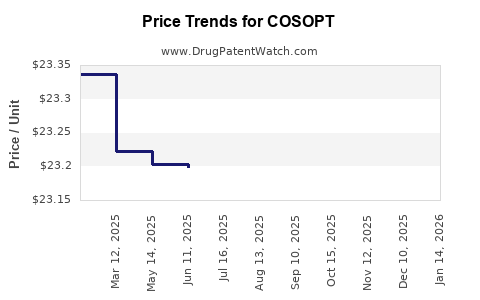
Drug Prices for COSOPT

See drug prices for COSOPT

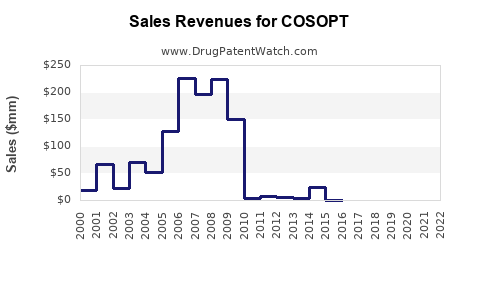
Drug Sales Revenue Trends for COSOPT

See drug sales revenues for COSOPT

Recent Clinical Trials for COSOPT

Identify potential brand extensions & 505(b)(2) entrants

SponsorPhase
SengiPHASE4
Prairie Eye CenterPHASE4
Wills EyePhase 2/Phase 3

See all COSOPT clinical trials

Paragraph IV (Patent) Challenges for COSOPT
Tradename Dosage Ingredient Strength NDA ANDAs Submitted Submissiondate
COSOPT Ophthalmic Solution dorzolamide hydrochloride; timolol maleate 2%/0.5% 020869 1 2005-10-11

US Patents and Regulatory Information for COSOPT

Applicant Tradename Generic Name Dosage NDA Approval Date TE Type RLD RS Patent No. Patent Expiration Product Substance Delist Req. Exclusivity Expiration
Thea Pharma COSOPT dorzolamide hydrochloride; timolol maleate SOLUTION/DROPS;OPHTHALMIC 020869-001 Apr 7, 1998 AT1 RX Yes Yes ⤷  Get Started Free ⤷  Get Started Free ⤷  Get Started Free
Thea Pharma COSOPT PF dorzolamide hydrochloride; timolol maleate SOLUTION/DROPS;OPHTHALMIC 202667-001 Feb 1, 2012 AT2 RX Yes Yes ⤷  Get Started Free ⤷  Get Started Free ⤷  Get Started Free
>Applicant >Tradename >Generic Name >Dosage >NDA >Approval Date >TE >Type >RLD >RS >Patent No. >Patent Expiration >Product >Substance >Delist Req. >Exclusivity Expiration

Expired US Patents for COSOPT

Applicant Tradename Generic Name Dosage NDA Approval Date Patent No. Patent Expiration
Thea Pharma COSOPT dorzolamide hydrochloride; timolol maleate SOLUTION/DROPS;OPHTHALMIC 020869-001 Apr 7, 1998 4,619,939*PED ⤷  Get Started Free
Thea Pharma COSOPT dorzolamide hydrochloride; timolol maleate SOLUTION/DROPS;OPHTHALMIC 020869-001 Apr 7, 1998 6,316,443 ⤷  Get Started Free
Thea Pharma COSOPT dorzolamide hydrochloride; timolol maleate SOLUTION/DROPS;OPHTHALMIC 020869-001 Apr 7, 1998 6,248,735 ⤷  Get Started Free
Thea Pharma COSOPT dorzolamide hydrochloride; timolol maleate SOLUTION/DROPS;OPHTHALMIC 020869-001 Apr 7, 1998 4,797,413*PED ⤷  Get Started Free
>Applicant >Tradename >Generic Name >Dosage >NDA >Approval Date >Patent No. >Patent Expiration

International Patents for COSOPT

See the table below for patents covering COSOPT around the world.

Country Patent Number Title Estimated Expiration
Germany 19575017 ⤷  Get Started Free
Bulgaria 60887 ⤷  Get Started Free
Yugoslavia 39392 ⤷  Get Started Free
Ireland 52065 COMPOSITION FOR REDUCING INTRAOCULAR PRESSURE ⤷  Get Started Free
Denmark 0509752 ⤷  Get Started Free
>Country >Patent Number >Title >Estimated Expiration

Supplementary Protection Certificates for COSOPT

Patent Number Supplementary Protection Certificate SPC Country SPC Expiration SPC Description
0509752 C990041 Netherlands ⤷  Get Started Free PRODUCT NAME: DORZOLAMIDE, DESGEWENST IN DE VORM VAN EEN OFTALMOLOGISCH AAN- VAARDBAAR ZOUT, EN TIMOLOL, DESGEWENST IN DE VORM VAN EEN OFTAL -MOLOGISCH AANVAARDBAAR ZOUT, IN HET BIJZONDER DORZOLLAMIDEHY- DROCHLORIDE EN TIMOLOLMALEAAT, EEN EN ANDER ZODANIG DAT 0,05; NATL REGISTRATION NO/DATE: VG 22871 19980805; FIRST REGISTRATION: DK 19045 19980306
0509752 SPC/GB99/043 United Kingdom ⤷  Get Started Free PRODUCT NAME: DORZOLAMIDE OR AN OPHTHALMOLOGICALLY ACCEPTABLE SALT THEREOF, PREFERABLY DORZOLAMIDE HYDROCHOLORIDE, PLUS TIMOLOL OR AN OPHTHAMOLOGICALLY ACCEPTABLE SALT THEREOF, PREFERABLY TIMOLOL MALEATE; REGISTERED: DK 19045 19980306; UK PL 00025/0373 19980804
0509752 49/1999 Austria ⤷  Get Started Free PRODUCT NAME: DORZOLAMID ODER EIN OPHTHALMOLOGISCH ANNEHMBARES SALZ DAVON, VORZUGSWEISE DORZOLAMIDHYDROCHLORID, UND TIMOLOL ODER EIN OPHTHALMOLOGISCH ANNEHMBARES SALZ DAVON, VORZUGSWEISE TIMOLOLMALEAT; NAT. REGISTRATION NO/DATE: 1-22701, 1-22702 19980828; FIRST REGISTRATION: DK 9794 19980306
0509752 CA 2000 00002 Denmark ⤷  Get Started Free
0509752 2000C/001 Belgium ⤷  Get Started Free PRODUCT NAME: DORZOLAMIDI HYDROCHLORIDUM EQ. DORZOLAMIDUM, TIMOLOLI MALEAS EQ. TIMOLOLUM; NAT. REGISTRATION NO/DATE: 922 IS 180 F 13 19981110; FIRST REGISTRATION: DK 19045 19980306
>Patent Number >Supplementary Protection Certificate >SPC Country >SPC Expiration >SPC Description

Market Dynamics and Financial Trajectory for the Pharmaceutical Drug: COSOPT

Last updated: July 29, 2025

Introduction

COSOPT (dorzolamide hydrochloride and timolol maleate) is a fixed-dose combination ophthalmic medication primarily indicated for managing elevated intraocular pressure (IOP) in patients with open-angle glaucoma or ocular hypertension. Since its launch, COSOPT has established a significant footprint within the ophthalmology segment, driven by therapeutic demand, competitive landscape, and evolving market trends. This comprehensive analysis explores the market dynamics and forecasted financial trajectory of COSOPT, elucidating key drivers, challenges, and strategic implications for stakeholders.

Market Overview and Therapeutic Landscape

Ocular hypertension and open-angle glaucoma remain leading causes of irreversible blindness worldwide, with the World Health Organization estimating that over 76 million people are affected globally, a number projected to reach approximately 111 million by 2040 [1]. Effective management of intraocular pressure (IOP) is critical in delaying or preventing optic nerve damage.

COSOPT functions by combining a carbonic anhydrase inhibitor (dorzolamide) with a beta-blocker (timolol), offering dual IOP-lowering mechanisms. The drug's profile offers advantages such as improved patient compliance through fixed dosing and a favorable safety profile compared to monotherapy or alternative combinations.

The global market for glaucoma medications was valued at approximately USD 4.3 billion in 2021 and is expected to grow at a CAGR of about 5% until 2027 [2]. COSOPT's role within this landscape hinges on its efficacy, tolerability, and positioning against emerging therapies.

Market Dynamics Influencing COSOPT

1. Therapeutic Efficacy and Patient Preference

COSOPT's dual-action mechanism provides potent IOP reduction critical for early intervention and progression delay. Its tolerability influences patient adherence; consistent use correlates with better disease management outcomes. As healthcare providers prioritize long-term disease control, formulations like COSOPT that balance efficacy and safety remain attractive.

2. Competitive Landscape and Regulatory Environment

The glaucoma drug market witnesses intense competition with various monotherapies and combination drugs. Notable rivals include prostaglandin analogs (e.g., latanoprost), other beta-blocker combinations (e.g., Xalacom), and emerging therapies such as rho kinase inhibitors.

Patent expirations and generic entry significantly impact pricing and market share. For example, the original patent for Cosopt expired in the late 2000s, leading to a sharp increase in generic versions. Generic competition has intensified price competition, squeezing profit margins but also expanding patient access.

Regulatory approvals influence market penetration, with some regions approving novel fixed-dose combinations or alternative delivery systems. In jurisdictions with stringent regulations, delayed or limited approval impacts revenue streams.

3. Geographic and Demographic Factors

Developed markets (e.g., North America, Europe) represent a significant share of COSOPT sales owing to higher diagnosis rates, healthcare infrastructure, and reimbursement schemes. The expanding middle class and aging populations in emerging markets (e.g., Asia-Pacific, Latin America) present opportunities for growth, provided affordability and awareness improve.

Population aging tends to elevate disease prevalence, augmenting demand for effective treatments. However, disparities in healthcare access and regulatory hurdles can dampen growth in developing regions.

4. Innovation and Pipeline Developments

The pharmaceutical industry’s pursuit of innovative treatments, including sustained-release formulations, laser therapy, and gene therapies, challenges traditional pharmacotherapies like COSOPT. While these emerging modalities may reshape management paradigms, current stalwart drugs benefit from established safety profiles and clinician familiarity.

However, the advent of novel medications and advanced drug delivery systems may erode COSOPT’s market share unless it evolves with these trends.

5. Pricing and Reimbursement Dynamics

Pricing strategies impact revenue generation, especially post-patent expiration when generics flood the market. Reimbursement policies influence prescribing behaviors; in countries with robust insurance coverage, clinicians may favor newer, branded options over older, generic drugs like COSOPT, unless cost considerations favor the latter.

Price sensitivity among patients and payers often necessitates differential pricing strategies, discounts, and inclusion in formularies to sustain sales.

Financial Trajectory and Revenue Projections

Historical Performance

Historically, COSOPT commanded a substantial market share during its patent-protected phase, with annual sales peaking approximately USD 250-300 million globally [3]. Patent expiry around 2010 resulted in significant revenue decline in key markets, with generic versions capturing a considerable market segment.

Forecasting Post-Patent Entry and Generics

Post-patent expiration, revenues declined sharply, with some estimates indicating a 40-60% reduction within 2-3 years as generics penetrated markets. However, strategic adjustments—such as product line diversification, value-added formulations, and geographic expansion—have helped sustain residual revenues.

Impact of Newer Treatments

Emerging therapies, such as prostaglandin analogs with fewer dosing requirements and minimal side effects, have gradually displaced older fixed-dose combinations. Nevertheless, COSOPT maintains relevance in combination regimens and for specific patient subsets, especially where other options are contraindicated.

Current and Future Revenue Outlook

The global COSOPT market is projected to stabilize at around USD 50-80 million annually until 2030, primarily driven by legacy use in developing markets, niche patient groups, and combination therapy roles. The rate of decline may slow with the introduction of second-generation formulations or if patent extensions are secured via formulation patents.

In addition, the potential introduction of biosimilars or improved formulations could redefine the revenue landscape, either creating new growth avenues or further intensifying competition.

Strategic Market Considerations

  • Diversification: Companies leveraging COSOPT’s formulation data and clinical profile to develop next-generation fixed-dose combinations or sustained-release devices can capture incremental market share.
  • Market Expansion: Targeting low-to-middle income countries with affordable generic versions and awareness campaigns enhances long-term revenue, aligning with global glaucoma prevalence trends.
  • Regulatory Engagement: Engaging early with regulators for approvals of new formulations or indications facilitates faster market entry.
  • Pricing Strategies: Balancing affordability with profitability remains critical, especially in price-sensitive markets.

Conclusion

COSOPT’s market and financial trajectory are shaped by a confluence of factors—including patent status, therapeutic positioning, competitive pressures, and demographic shifts. While once a flagship drug in glaucoma management, its revenues have declined due to patent expiration and market innovations. Nonetheless, it remains relevant within certain niches and emerging markets.

Sustainable growth for COSOPT-centric products hinges on strategic adaptation—through product innovation, geographic expansion, and clinical differentiation—while navigating complex regulatory and reimbursement environments.


Key Takeaways

  • Market decline post-patent has been mitigated by generic competition and evolving treatment paradigms, but the drug retains niche importance.
  • Emerging therapies pose a long-term threat, underscoring the need for innovation and pipeline development.
  • Growth opportunities in emerging markets and through value-added formulations can support revenue stabilization.
  • Pricing and reimbursement strategies are critical in managing profit margins amid competitive pressures.
  • Strategic diversification and early regulatory engagement are vital to adapting to changing market dynamics and sustaining financial performance.

FAQs

1. How has patent expiration affected COSOPT’s market share?
Patent expiration led to widespread generic adoption, resulting in significant revenue decline due to increased price competition and loss of exclusivity. Nevertheless, legacy use persists in certain markets and subsets of patients.

2. What are the main competitors to COSOPT in the glaucoma treatment market?
Prostaglandin analogs (e.g., latanoprost, bimatoprost), other beta-blocker combinations, and emerging drug classes such as rho kinase inhibitors present competitive challenges.

3. Are there new formulations of COSOPT under development?
While specific pipeline updates are limited, development of sustained-release formulations, fixed-dose combinations with newer agents, or improved delivery systems remains a strategic focus for some companies.

4. How do regulatory policies impact COSOPT’s market growth?
Stringent approval processes and patent laws influence market entry for generics and novel formulations, affecting revenue potential and market expansion timelines.

5. What strategies can companies adopt to sustain COSOPT-related revenues?
Diversifying product offerings, expanding into emerging markets, innovating formulations, and engaging proactively with regulators can bolster long-term revenues despite competitive pressures.


References

[1] WHO. Global Data on Visual Impairment. World Health Organization, 2019.
[2] MarketsandMarkets. Glaucoma Therapeutics Market: Global Forecast to 2027. 2022.
[3] IMS Health. Pharmaceutical Market Data. 2010.

More… ↓

⤷  Get Started Free

Make Better Decisions: Try a trial or see plans & pricing

Drugs may be covered by multiple patents or regulatory protections. All trademarks and applicant names are the property of their respective owners or licensors. Although great care is taken in the proper and correct provision of this service, thinkBiotech LLC does not accept any responsibility for possible consequences of errors or omissions in the provided data. The data presented herein is for information purposes only. There is no warranty that the data contained herein is error free. We do not provide individual investment advice. This service is not registered with any financial regulatory agency. The information we publish is educational only and based on our opinions plus our models. By using DrugPatentWatch you acknowledge that we do not provide personalized recommendations or advice. thinkBiotech performs no independent verification of facts as provided by public sources nor are attempts made to provide legal or investing advice. Any reliance on data provided herein is done solely at the discretion of the user. Users of this service are advised to seek professional advice and independent confirmation before considering acting on any of the provided information. thinkBiotech LLC reserves the right to amend, extend or withdraw any part or all of the offered service without notice.