Last updated: July 30, 2026
Clindamycin phosphate is a long-established, off-patent antibiotic whose US revenue trajectory is dominated by generic supply, payer pricing pressure, and formulation-level competition across topical, vaginal, and injectable segments. The market is fragmented, with recurring entry risk from ANDA filers and sustained discounting that compresses unit economics, particularly where multiple therapeutically equivalent products compete.
What is the current US market size for clindamycin phosphate and how is demand trending?
Featured snippet: Demand for clindamycin phosphate is steady-to-declining in real terms, with growth capped by generic competition and substitution toward formulary-favored antibiotic classes; volume is maintained by persistent indications in acne/skin infections, bacterial vaginosis, and certain dental and surgical prophylaxis/off-label uses.
Clindamycin phosphate is marketed in multiple dosage forms and routes:
- Topical (eg, clindamycin phosphate gel/solution/foam, used for acne vulgaris)
- Vaginal (eg, clindamycin phosphate vaginal cream, used for bacterial vaginosis)
- Oral (historically) (clindamycin hydrochloride has seen more branded presence; “clindamycin phosphate” is less prominent in oral branded product lines)
- Injectable (clindamycin phosphate IV used in serious anaerobic infections, perioperative settings, and special populations)
Segment dynamics that shape revenue
Top-line sales move with three factors:
-
Formulary access and substitution
Generic clindamycin phosphate products compete heavily under pharmacy benefit management. This limits pricing power and creates “winner takes more volume” dynamics at the NDC level rather than across the molecule.
-
Antibiotic stewardship
Use of clindamycin is constrained by evolving prescribing patterns. In many settings, clinicians substitute against resistance patterns, local antibiograms, and guideline updates.
-
Supply stability and manufacturing yield
The antibiotic manufacturing supply chain can cause short-lived price swings when a facility exits or a quality event triggers backorders. Over multiple years, however, generic competition returns to baseline price compression.
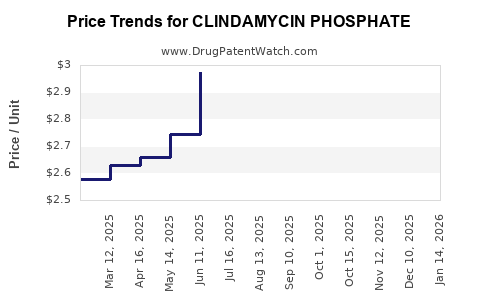
How do pricing and payer contracting dynamics affect clindamycin phosphate revenue?
Featured snippet: Revenue is primarily driven by wholesale acquisition price-to-net price compression and by payer contracting for generic NDCs, where net prices track competitive bids more than list price.
Key pricing mechanisms in generic antibiotics
- Net price compression due to PBM preferred formulary tiers.
- Channel inventory behavior where distributors accelerate turns for fast-moving NDCs, tightening margin volatility.
- Short-cycle rebate recalibration as new ANDA entries land and wholesalers rebalance shelf inventory.
What changes unit economics in practice
- Contract status of specific NDCs: identical label content, different manufacturer NDCs can show materially different realized revenue due to contracting.
- DAW vs interchangeability: clindamycin phosphate is routinely substitutable with therapeutically equivalent generics, limiting brand-like pricing behavior.
- Mix shift: growth in one segment (eg, topical for acne) does not automatically translate into aggregate revenue gains if the segment’s pricing declines faster than volume rises.
Which dosage forms drive the financial trajectory of clindamycin phosphate?
Featured snippet: Injectable clindamycin phosphate has episodic demand linked to inpatient prescribing patterns; topical and vaginal formulations are steadier but price-compressed by multiple generics and brand-absence economics.
Injectable (IV clindamycin phosphate)
- Typically tracks hospital formularies and infection service protocols.
- Exposed to drug supply disruptions and contract bid cycles for group purchasing organization (GPO) tenders.
- Revenue tends to be less sensitive to seasonality than outpatient topical products, but sensitive to inpatient case mix and antibiotic utilization policies.
Topical clindamycin phosphate (acne)
- Driven by dermatologist and primary care prescribing.
- Outpatient generic market dynamics yield consistent volume with sustained margin pressure.
- Competitive substitutions can shift to other topical antibiotics and combination regimens (eg, with benzoyl peroxide or retinoids), depending on guideline alignment and tolerability.
Vaginal clindamycin phosphate (bacterial vaginosis)
- More constrained “indication-specific” prescribing and distribution channels.
- Revenue stability depends on repeat treatment patterns, prescriber preferences, and competitive availability.
What patents protect clindamycin phosphate, and when do exclusivities expire?
Featured snippet: The active ingredient clindamycin phosphate is widely off exclusivity; most market protection is not active-ingredient exclusivity but rather formulation-specific, manufacturing-process, and label/packaging IP, many of which expire or are effectively irrelevant for generic block.
Practical view for market entry and litigation
For clindamycin phosphate, the relevant IP risk tends to be:
- ANDA litigation history for specific NDCs (not usually for the molecule universally).
- Case-by-case formulation patents tied to a specific dosage form strength, release characteristics, or manufacturing method.
Because the product is mature and generic-dominant, financial trajectory is more affected by:
- the availability and cost of supply,
- contracting and substitution, and
- new ANDA entries,
than by any remaining broad patent estate for clindamycin phosphate itself.
How does ANDA/Paragraph IV litigation risk affect generic entry for clindamycin phosphate?
Featured snippet: Generic entry risk is ongoing at the NDC level, but the overall market is already populated with multiple ANDA products, so litigation has limited ability to create long-term pricing power for any single seller.
What typically drives litigation for older antibiotics
- Patent challenges to formulation or manufacturing patents listed in Orange Book for specific strengths/forms.
- Settlement agreements that can result in delayed launches or co-existence under license.
Commercial impact channel
Even where launches are delayed, net revenue dynamics often remain pressured because:
- alternative NDCs inside the same molecule and form can be substituted,
- competitors adjust contracting bids, and
- wholesalers diversify across suppliers.
What is the Orange Book status of clindamycin phosphate products?
Featured snippet: Orange Book listings for clindamycin phosphate are dominated by generic-era listings and expired ingredient patents; current status typically shows few, narrow, product-specific remaining protections.
How Orange Book status translates into pricing
- Where listed patents have expired or are not enforceable against the generic at issue, competitive entry accelerates.
- Where a settlement controls specific NDCs, the market can see short-term pricing stabilization for the covered product, then normalization after the restricted launch window ends.
How strong is the patent estate for clindamycin phosphate and what is the commercial implication?
Featured snippet: The patent estate for clindamycin phosphate is not a structural barrier to generic competition; commercial implications are dominated by manufacturing cost curves and contracting rather than by sustained exclusivity.
Patent estate drivers
- Narrow, dosage-form-specific IP tends to fragment protection.
- Portfolio overlap across companies rarely prevents market-wide generic substitution.
Bottom line for financial trajectory
- Expect low brand-like margin behavior and persistent price competition.
- Company differentiation comes from supply reliability, contracting reach, and execution quality, not from IP moats at the molecule level.
Which companies compete in clindamycin phosphate and how is the competitive landscape evolving?
Featured snippet: Competition is largely between generic manufacturers and distributors; ongoing entries and tender wins decide market share more than product innovation.
Competitive posture that matters commercially
- Hospital/GPO tender presence for IV formulations.
- Retail pharmacy PBM contracting for topical and vaginal products.
- NDC portfolio breadth across strengths and packaging sizes.
What to watch for in market share shifts
- Manufacturing capacity expansions that unlock supply for key tenders.
- Quality events that remove specific NDCs from the market, creating temporary price premiums that fade once supply returns.
- Rebate renegotiations triggered by new generic launches.
How do settlement agreements and licensing deals influence clindamycin phosphate revenue?
Featured snippet: Settlement-driven “launch timing” can temporarily stabilize pricing for specific NDCs, but it rarely changes long-term financial trajectory because multiple competing suppliers remain active and substitutable.
Typical commercial outcomes
- Delayed entry of a challenger can protect an existing supplier’s share for a finite period.
- Licensed co-marketing can maintain category supply but with reduced per-unit margins for all participants once new competition begins.
- Scope-limited coverage: settlements often apply to a specific dosage form/strength/patent combination, leaving other NDCs exposed.
When does clindamycin phosphate lose exclusivity and what does that mean for forecasts?
Featured snippet: For most clindamycin phosphate NDCs, exclusivity is already lost; forecast sensitivity comes mainly from new ANDA launches, not from a molecule-wide exclusivity countdown.
Forecast implications
- Model revenue with:
- unit volume stability (prescribing persistence),
- net price drift down with each meaningful entry,
- margin swings tied to supply disruptions and tender resets.
How does clindamycin phosphate compare with other antibiotics used for similar indications?
Featured snippet: Therapeutic substitution is common across antibiotic classes, so net category share depends on local guideline preference and formulary tiering rather than clindamycin-specific brand strength.
Cross-class competitive factors
- Resistance and guideline updates can redirect prescribing.
- Combination regimen preferences in acne can reduce monotherapy clindamycin share.
- BV management patterns influence vaginal clindamycin utilization versus alternative BV regimens.
What generic entry risks exist for clindamycin phosphate by route and formulation?
Featured snippet: Entry risks are highest where a specific dosage form/strength has fewer suppliers or where a tender favored one supplier for a period; otherwise, the category is already highly genericized.
Injectable risk profile
- Multiple generic suppliers already exist in most markets; new entry risk mainly impacts pricing and tender competitiveness, not market existence.
Topical risk profile
- NDC-level competition across vehicles and pack sizes can shift rapidly.
- Premium pricing is generally unsustainable once PBM contracting broadens.
Vaginal risk profile
- Specialist prescribing patterns can protect volume, but the generic category limits price durability.
What are the key financial KPIs to track for clindamycin phosphate companies?
Featured snippet: Track NDC-level net sales, tender wins, and gross-to-net compression; adjust for supply events and new supplier entries.
KPI set
- Net sales by dosage form (IV, topical, vaginal)
- Gross-to-net ratio changes with rebate/contract renegotiations
- Share-of-shelf proxy via distributor listings and tender allotments
- Backorder frequency as a leading indicator of revenue volatility
- NDC count and portfolio mix to detect erosion from new entrants
Key Takeaways
- Clindamycin phosphate’s financial trajectory is shaped by generic competition, payer contracting, and supply dynamics, not by remaining molecule-level exclusivity.
- Revenue trends tend to show volume resilience with persistent net price compression and margin pressure across injectable, topical, and vaginal segments.
- Litigation and Orange Book protections are typically NDC-specific and narrow, so they rarely prevent long-term price normalization once additional ANDA launches occur.
- Competitive advantage is operational: tender execution, manufacturing reliability, and NDC portfolio breadth.
FAQs
1) Why do clindamycin phosphate net prices keep falling even when demand is stable?
Generic substitution and PBM/GPO contracting reset net prices downward as new NDCs enter and preferred tiers rotate.
2) Does clindamycin phosphate have meaningful biosimilar risk?
No. Clindamycin phosphate is a small-molecule antibiotic; biosimilar frameworks do not apply.
3) Which channel drives the most volatility for injectable clindamycin phosphate?
Hospital procurement cycles and supply disruptions tied to manufacturing quality or capacity constraints.
4) Can formulation changes protect clindamycin phosphate revenue?
Only at the NDC level and only for limited periods if formulation-specific IP remains enforceable against generic manufacturing and marketing.
5) What is the most realistic forecast assumption for clindamycin phosphate over the next 3–5 years?
Steady-to-slight volume changes with ongoing net price compression, moderated by supply stability and tender outcomes.
References
- FDA. “Orange Book: Approved Drug Products with Therapeutic Equivalence Evaluations.” U.S. Food and Drug Administration. https://www.accessdata.fda.gov/scripts/cder/daf/
- U.S. Food and Drug Administration. “Drugs@FDA.” https://www.accessdata.fda.gov/scripts/cder/daf/
- FDA. “ANDA Approval: Generic Drug Information.” U.S. Food and Drug Administration. https://www.fda.gov/drugs/generic-drugs/and a-approval-generic-drug-information