Last updated: September 9, 2026
Climara Pro is a mature menopausal hormone-therapy product containing estradiol and levonorgestrel in a once-weekly transdermal patch. Its commercial position depends more on formulation complexity, patch adherence, physician preference, and generic availability than on remaining primary-drug exclusivity. Bayer does not publicly report Climara Pro revenue separately, so the product’s financial trajectory must be assessed through market structure, regulatory records, patent status, and Bayer’s broader women’s-health portfolio.
What is Climara Pro and how does it work?
Climara Pro is a transdermal hormone-replacement therapy containing 0.045 mg of estradiol and 0.015 mg of levonorgestrel delivered daily through a weekly patch. Bayer markets the product in the United States under NDA 021058.[1]
The product combines:
| Component |
Function |
| Estradiol |
Estrogen replacement for menopausal symptoms |
| Levonorgestrel |
Progestin intended to reduce the risk of endometrial hyperplasia associated with unopposed estrogen |
| Transdermal patch |
Weekly delivery that avoids first-pass hepatic metabolism |
The FDA-approved indications include treatment of moderate-to-severe vasomotor symptoms associated with menopause, treatment of moderate-to-severe vulvar and vaginal atrophy, and prevention of postmenopausal osteoporosis in appropriate patients.[1]
Climara Pro is positioned differently from estrogen-only patches such as Climara and from oral combined hormone-therapy products. Its principal clinical value is the combination of estrogen and progestin in a single weekly patch for patients with an intact uterus.
What is the FDA regulatory status of Climara Pro?
Climara Pro was approved by the FDA in 2003. It is a prescription drug regulated through the abbreviated new drug application pathway for generic equivalents and through the original NDA for Bayer’s branded product.[1]
FDA regulatory characteristics
| Item |
Status |
| Active ingredients |
Estradiol and levonorgestrel |
| Dosage form |
Transdermal system |
| Administration |
Once weekly |
| Reference NDA |
021058 |
| Regulatory category |
Combination hormonal transdermal system |
| Primary regulatory concern |
Systemic estrogen and progestin safety |
| Substitution pathway |
ANDA-based generic approval |
The label carries class warnings associated with systemic estrogen and estrogen-plus-progestin therapy. These include risks involving cardiovascular disease, stroke, venous thromboembolism, breast cancer, endometrial cancer, and probable dementia in certain older populations.[1]
The boxed-warning profile constrains prescriber adoption and supports lower-dose and shorter-duration use. Climara Pro is therefore exposed to both generic price pressure and clinical caution around menopausal hormone therapy.
When does Climara Pro lose exclusivity?
Climara Pro’s key commercial exclusivity periods have expired. The product was approved more than two decades ago, and its regulatory exclusivity no longer prevents generic competition.
The relevant distinction is between regulatory exclusivity and patent protection:
| Exclusivity category |
Commercial position |
| New chemical entity exclusivity |
Expired |
| NDA approval exclusivity |
Expired |
| Formulation and delivery patents |
Any remaining claims do not block all generic entry if FDA-listed protections have expired or are successfully challenged |
| Method-of-use patents |
Potentially relevant only to specifically claimed uses |
| Regulatory exclusivity for biologics |
Not applicable |
The Orange Book is the controlling public source for patents and exclusivity listed against NDA 021058. Product-specific patent expiration dates should be verified against the current FDA Orange Book record rather than inferred from the original approval date.[2]
What patents protect Climara Pro?
Climara Pro’s historic patent protection centered on transdermal systems capable of delivering an estrogen and a progestin at controlled rates. Such claims can cover:
- Patch composition and adhesive matrix design
- Reservoir or matrix construction
- Release-rate control
- Estradiol and levonorgestrel combinations
- Use of the product for menopausal symptoms
- Manufacturing and quality-control characteristics
The practical value of those patents has declined because Climara Pro is a mature product and generic applicants can challenge listed patents under Paragraph IV or design products that avoid expired claims.
A patent family covering the delivery system does not automatically provide an indefinite barrier to generic competition. The commercial question is whether an enforceable, unexpired claim is listed in the Orange Book and whether an ANDA applicant certifies against it.
Are there Paragraph IV challenges to Climara Pro?
Paragraph IV litigation is the principal mechanism by which a generic applicant can challenge an unexpired Orange Book-listed patent for Climara Pro. A generic applicant may certify that the listed patent is invalid, unenforceable, or will not be infringed.
The filing of a Paragraph IV certification can trigger patent litigation and, in some cases, a 30-month stay of FDA approval under the Hatch-Waxman Act.[3]
Public market implications are as follows:
- If no unexpired patent blocks approval, an ANDA may proceed after applicable regulatory requirements are met.
- If litigation is filed, generic entry may be delayed by the statutory stay or court proceedings.
- If the patent holder does not sue within the statutory period, the stay may not be available.
- A settlement can provide an agreed entry date before patent expiration.
No material current revenue protection should be attributed to a Paragraph IV case without identifying a specific ANDA, Orange Book patent, court docket, and settlement agreement. Climara Pro’s age makes broad product-level exclusivity unlikely.
What generic entry risks exist for Climara Pro?
Generic risk is substantial because Climara Pro has an old active ingredient combination, expired regulatory exclusivity, and a dosage form that can be evaluated through FDA bioequivalence and product-performance requirements.
The main barriers are technical rather than molecule-based.
Why transdermal generics are harder than oral generics
Generic developers must address:
- Estradiol and levonorgestrel delivery rates
- Adhesion over the full seven-day period
- Drug release under heat and moisture conditions
- Skin permeation
- Residual drug content
- Patch size and application characteristics
- Adhesive tolerability
- Manufacturing consistency
- Potential differences in backing layers and liners
These requirements increase development cost and manufacturing complexity. They do not, however, preserve brand-level pricing once FDA-approved alternatives are available.
The likely generic launch pattern is gradual substitution rather than an immediate collapse in all branded demand. Some physicians and patients continue using the branded patch because of perceived adhesion, tolerability, supply reliability, or familiarity. Payers typically encourage generic substitution through formulary placement and lower copay tiers.
How strong is the Climara Pro patent estate?
The patent estate is commercially mature and structurally weaker than the estate of a recently launched specialty drug.
| Patent-strength factor |
Assessment |
| Composition of matter |
Weak or unavailable as a barrier because the active ingredients are established |
| Regulatory exclusivity |
Expired |
| Transdermal formulation |
Historically important, but subject to expiration and design-around risk |
| Manufacturing know-how |
Potentially useful but difficult to enforce against generic manufacturers |
| Method of use |
Narrower value; may not prevent all generic indications |
| Brand recognition |
Provides residual commercial value but is not legal exclusivity |
| Supply-chain capability |
Can support continuity but does not prevent substitution |
The strongest remaining protection is likely operational: reliable patch manufacturing, quality consistency, distribution, and physician familiarity. Those advantages can sustain a branded product but generally cannot support high historical pricing.
What is the market outlook for menopausal hormone therapy?
The menopausal hormone-therapy market is divided among oral products, transdermal patches, gels, sprays, vaginal products, and nonhormonal treatments.
Competitive products
Climara Pro competes with:
- Estrogen-only transdermal patches for patients without a uterus
- Combined estradiol and progestin patches
- Oral estradiol and progestin products
- Oral conjugated estrogens and medroxyprogesterone acetate
- Estradiol gels and sprays
- Vaginal estrogen products for primarily genitourinary symptoms
- Nonhormonal treatments for vasomotor symptoms
Its most direct competitors are other combined systemic hormone therapies. Its once-weekly dosing is a commercial differentiator compared with products requiring daily administration, but the patch format also creates visible adhesion and skin-tolerability issues.
The market has potential support from renewed clinical interest in individualized menopausal care. That demand is offset by boxed-warning concerns, duration limits, patient risk stratification, and competition from lower-cost generic products.
What is the financial trajectory of Climara Pro?
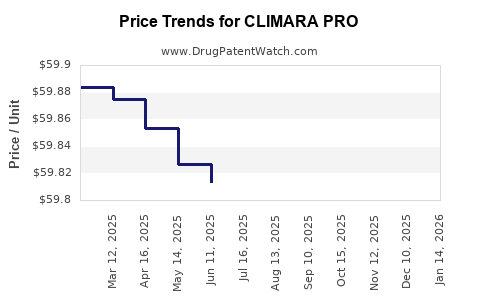
Bayer does not disclose Climara Pro revenue as a standalone line item in its public financial reporting. The product is reported, if at all, within broader pharmaceutical or women’s-health categories. A product-level revenue forecast therefore cannot be derived from Bayer’s annual reports without proprietary prescription, net-sales, or channel data.[4]
Financial trajectory by phase
| Period |
Financial dynamic |
| Launch and early growth |
Premium pricing supported by novel combined transdermal delivery |
| Mature branded period |
Stable demand from established prescribers and patients |
| Post-exclusivity period |
Generic substitution and payer pressure reduce price and share |
| Current mature phase |
Revenue depends on residual brand loyalty, supply reliability, and niche prescribing |
| Long-term outlook |
Likely low-growth or declining unless supported by market-wide HRT expansion |
The principal financial risks are:
- Generic price erosion
- Lower branded prescription volume
- Reduced reimbursement
- Product discontinuation or supply interruptions
- Declining use of systemic hormone therapy in higher-risk patients
- Competition from newer nonhormonal therapies
- Limited ability to differentiate a mature combination product
The main supports are:
- Once-weekly dosing
- Established clinical familiarity
- A single patch that combines estrogen and progestin
- Continued demand for systemic treatment of vasomotor symptoms
- Patient preference for transdermal delivery
Climara Pro should be valued as a mature cash-flow product rather than as a growth asset. Its contribution to Bayer’s overall financial results is unlikely to be material at group level unless included in a broader women’s-health portfolio.
What licensing deals affect Climara Pro?
No major recent licensing transaction specifically tied to Climara Pro is identified in Bayer’s principal public financial disclosures. The product is associated with Bayer’s own pharmaceutical portfolio rather than a publicly highlighted external licensing platform.[4]
Any transfer of regional rights, manufacturing rights, or commercialization rights would need to be evaluated separately by jurisdiction. A brand may have different commercial owners or distributors outside the United States even when Bayer retains global intellectual-property rights.
What is the Orange Book status of Climara Pro?
The FDA Orange Book should be used to determine:
- Whether NDA 021058 remains listed
- Which patents are listed against the product
- Patent-use codes
- Expiration dates
- Whether pediatric exclusivity has affected any listed term
- Whether generic approvals have been granted
Orange Book status is jurisdiction-specific in practical effect. U.S. patent and regulatory conclusions do not establish freedom to market in Canada, Europe, Japan, or other markets. International rights must be checked through national patent offices and local regulatory databases.[2]
What generic launch scenarios are most likely?
Scenario 1: Continued generic substitution
This is the base case. Generic patches gain formulary preference, while Bayer retains a smaller branded segment supported by patients who prefer the reference product.
Scenario 2: Brand persistence in a quality-sensitive niche
Climara Pro retains share if generic products experience adhesion, tolerability, supply, or reimbursement problems. This scenario supports stable but limited revenue.
Scenario 3: Accelerated decline
Revenue falls sharply if multiple generic suppliers enter, payers impose mandatory substitution, and prescribers shift toward lower-cost oral or transdermal alternatives.
Scenario 4: Category expansion
Growth in menopause treatment increases total demand, but the benefit to Climara Pro depends on its formulary position and ability to compete with generic combined therapies. Category expansion alone does not restore patent-era economics.
How does Climara Pro compare with other Bayer hormone products?
| Product |
Hormonal composition |
Delivery |
Primary commercial distinction |
| Climara Pro |
Estradiol plus levonorgestrel |
Weekly patch |
Combined systemic therapy |
| Climara |
Estradiol only |
Weekly patch |
Estrogen replacement without progestin |
| Oral estrogen/progestin products |
Estrogen plus progestin |
Daily oral |
Lower manufacturing complexity and broad generic availability |
| Vaginal estrogen products |
Local estrogen |
Cream, tablet, ring, or insert |
Primarily local genitourinary treatment |
Climara Pro has a narrower target population than estrogen-only therapy because it is generally intended for postmenopausal patients with an intact uterus who require both estrogen and endometrial protection.
What patent litigation affects Climara Pro?
A defensible litigation assessment requires a specific defendant, ANDA number, listed patent, filing date, court, and docket status. Product-level assumptions are unreliable because patent litigation may involve one generic applicant, one formulation claim, or one use code rather than the entire product.
The commercial litigation risk is therefore best characterized as residual and transaction-specific. The central exposure is generic substitution after regulatory approval, not a known broad litigation event that preserves the brand’s market position.
Key Takeaways
- Climara Pro is a mature once-weekly estradiol and levonorgestrel transdermal system.
- Its U.S. NDA is 021058, and FDA approval dates to 2003.
- New chemical entity and regulatory exclusivity have expired.
- Remaining patent value depends on current Orange Book listings and the enforceability of formulation or method-of-use claims.
- Generic risk is high because the active ingredients and product concept are established.
- Transdermal adhesion, release rate, skin permeation, and manufacturing consistency create technical barriers but do not recreate molecule-level exclusivity.
- Bayer does not separately disclose Climara Pro revenue, preventing a verified standalone sales estimate from public company filings.
- The product’s financial trajectory is mature to declining, with residual value driven by brand familiarity, weekly dosing, supply reliability, and patient preference.
- Menopause-treatment growth could expand the category, but generic substitution is likely to capture much of that growth.
- The principal diligence items are current Orange Book listings, ANDA approvals, Paragraph IV certifications, litigation dockets, settlement terms, and regional commercialization rights.
FAQs
Is Climara Pro still commercially available?
Availability can vary by country, wholesaler, pharmacy, and supply period. The FDA label and current product-distribution records should be used to distinguish active marketing from temporary supply disruption or regional discontinuation.
Is Climara Pro bioequivalent to generic estradiol and levonorgestrel patches?
An FDA-approved generic must satisfy applicable ANDA bioequivalence and product-performance requirements. Therapeutic substitution and pharmacy substitution depend on state law, payer policy, and the specific approved product.
Does Climara Pro have biosimilar competition?
No. Climara Pro is a chemically synthesized small-molecule combination delivered through a transdermal system. Biosimilar regulation applies to biological products, not to this product category.
Does Climara Pro require a progestin?
Patients with an intact uterus who receive systemic estrogen are commonly evaluated for endometrial protection. Climara Pro includes levonorgestrel, but treatment selection depends on the patient’s medical history and prescribing judgment.
Can formulation patents block generic Climara Pro entry?
They can delay or restrict entry only if an unexpired, enforceable patent claim covers the generic product or its approved use and the patent is listed or otherwise enforceable under applicable law. Expired formulation patents do not block launch.
References
- U.S. Food and Drug Administration. (2024). Climara Pro: Estradiol and levonorgestrel transdermal system prescribing information.
- U.S. Food and Drug Administration. (2024). Approved drug products with therapeutic equivalence evaluations: Orange Book.
- U.S. Food and Drug Administration. (2023). Abbreviated new drug application approvals and patent certifications under the Hatch-Waxman Act.
- Bayer AG. (2024). Annual report 2023.