Last updated: July 28, 2026
CIPRO (ciprofloxacin) market dynamics and financial trajectory: pricing, volume, exclusivity, generic pressure, and revenue outlook
CIPRO (ciprofloxacin; Bayer/Japan-originated brand) is a long-established fluoroquinolone with broad generic penetration. Market dynamics are dominated by (1) mature, low-cost generic competition after patent expiries, (2) ongoing payer and hospital formulary pressure, (3) antimicrobial stewardship constraints, and (4) in some geographies, residual premium from newer presentations and channel contracts rather than exclusivity. Financial trajectory is best characterized as post-peak brand erosion with continued but declining brand revenue, with the economic center of gravity moving to generic ciprofloxacin and institutional purchasing.
What is the CIPRO revenue trajectory since the main patent cliffs?
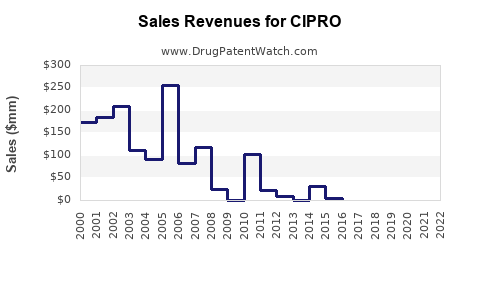
CIPRO’s financial pattern has been stable generic-driven demand growth offset by brand share collapse. Once ciprofloxacin’s key composition and formulation patents expired and multiple ANDA filers launched, brand economics shifted from premium pricing to lose-or-hold tactics: deeper rebate intensity, contract procurement, and selective indication/presentation focus.
How did generic launches reshape the revenue curve?
- Pre-generic period (brand premium era): CIPRO carried higher net pricing driven by protection and limited competition.
- Post-first generic waves: brand revenue declines accelerated as wholesalers and hospitals re-tiered to lower-cost generics.
- Later waves (multiple ANDAs): the brand increasingly competed on logistics and contractual access rather than therapeutic differentiation.
- Current regime: brand revenue is typically small relative to total ciprofloxacin sales; generic ciprofloxacin becomes the market volume anchor.
What demand drivers remain despite patent loss?
- Chronic baseline need for antibiotics: ciprofloxacin retains clinical utility in specific bacterial indications and in hospital use.
- Institutional antibiotic pathways: once protocols include ciprofloxacin, formularies can maintain usage even when price falls.
- Sensitivity to guidance and resistance trends: changing resistance patterns and stewardship policies influence share among fluoroquinolones.
What patents protect CIPRO and how does that affect brand economics?
CIPRO is in a post-patent market where exclusivity has already been largely exhausted, and generic competition is the primary determinant of price. Brand protection, where present, tends to come from secondary patent layers (specific salts/hydrates, dosing regimens, formulations, and certain device/packaging constructs) that generally do not stop wide generic availability.
How patent estate structure maps to revenue risk
- Composition-of-matter: once expired, it removes the biggest barrier to ANDA substitution.
- Formulation and process patents: may delay entry for select presentations, but most oral and IV forms have long since faced multiple generic approvals.
- Use (method-of-use) patents: can restrict some label-adjacent competitors, but generic products typically cover approved ciprofloxacin indications via the ANDA route, limiting brand leverage.
When does CIPRO lose exclusivity for specific forms (tablet, suspension, IV)?
Exclusivity is not a single date in practice; it depends on the presentation and the patent layers tied to that product. For CIPRO as a legacy small-molecule antibiotic, the broader market is already in the non-exclusive regime.
What to assume for current timing
- Oral immediate-release presentations: generics dominate, and any remaining brand exclusivity has limited commercial effect.
- Extended-release concepts (if any): not the core CIPRO brand economic driver and typically has its own patent clock if it exists.
- IV preparations: often face similar generic substitution pressure.
What is the Orange Book status of CIPRO (and which listings matter for competition)?
Orange Book competition analysis centers on whether any CIPRO-branded listings remain with unexpired patent or exclusivity periods. In a mature product like CIPRO, the practical outcome is that most ANDA filers have already overcome key listings.
How to read Orange Book impact for a legacy antibiotic
- If no unexpired “patent listed for the drug”: generic substitution is unrestricted on the composition and formulation level.
- If only narrow patents remain: those often affect small corners of the label or specific strengths/forms, not overall market pricing.
Which companies are challenging CIPRO with generics, and how strong is the generic competitive set?
The CIPRO competitive landscape is broad and multi-filer, with the market anchored by large-scale ANDA manufacturers and distributors. The competitive set typically includes:
- large US generic producers,
- international generic groups with US ANDA portfolios,
- pharmacy chain private label and distributor brands where applicable.
How generic entrants typically win
- Lowest net price and contract terms: hospitals and ID departments shift rapidly after ANDA entry.
- Supply reliability: procurement chooses suppliers with consistent manufacturing and fewer shortages.
- Product form coverage: if multiple strengths and forms are available, switching becomes simpler.
What generic entry risks exist for CIPRO products in 2024–2028?
For a long-established antibiotic with extensive generic penetration, “entry risk” is less about new approvals and more about incremental share gains through:
- better contracting,
- fewer supply disruptions,
- replacing expiring generic SKUs with more durable manufacturing plants,
- payer formulary moves to reduce reimbursement.
Typical near-to-mid term risks
- Manufacturing or supply shocks: short-term pricing rebounds can occur with supply constraints, even if patents are expired.
- Payer policy changes: prior authorization or step therapy can alter utilization mix across fluoroquinolones.
- Stewardship actions tied to safety and resistance: can reduce fluoroquinolone use overall, affecting market volume.
How do antimicrobial stewardship and safety warnings affect CIPRO market dynamics?
Stewardship pressure and safety-related prescribing constraints are a persistent headwind across fluoroquinolones. For ciprofloxacin specifically, the market is influenced by:
- reduced willingness to use fluoroquinolones for low-risk infections,
- tighter restrictions tied to adverse event profiles,
- guideline updates that shift clinicians toward alternatives.
Net effect on brand and generic
- Volume sensitivity: even with generics cheap, lower total fluoroquinolone usage can compress the entire segment.
- Share shifts within class: ciprofloxacin can lose or gain within fluoroquinolones depending on guideline mentions and local resistance patterns.
- Institutional formularies: may restrict use to culture-confirmed cases or specific clinical pathways.
What formulations are protected by secondary IP for CIPRO, and do they still matter commercially?
Secondary IP for legacy brands tends to matter only if it protects a specific presentation that retains premium pricing. For CIPRO, secondary layers have limited incremental impact today because:
- multiple equivalent generics exist for standard presentations,
- substitution is straightforward for prescribers and pharmacists,
- procurement focuses on total cost and availability.
Where residual IP could still matter
- Unique dosing regimens or restricted strengths tied to patent claims.
- Specific IV manufacturing processes that could affect labeling or supply.
- Packaging and stability-related claims that do not block ANDA entry broadly.
What patent litigation affects CIPRO, including Paragraph IV challenges and settlements?
CIPRO litigation historically involved patent challenges and settlements typical of a first-wave ANDA era. For the current financial trajectory, the key business point is that those settlements and court outcomes largely determine the timing of earlier generic entry, not present-day exclusivity leverage.
How litigation history shows up in today’s financials
- once earlier settlements were reached, market structure moved to multi-generic pricing,
- brand revenue shifted toward small share preservation and contract-based demand rather than monopoly economics.
How does CIPRO compare with competing fluoroquinolones on pricing and share?
Within fluoroquinolones, CIPRO competes primarily on cost and procurement coverage once generics are available across the class. The practical comparison is:
- if competitors have fewer supply issues or better contracting terms, they win formulary share,
- if stewardship narrows the class, all products face utilization pressure.
Key competitive variables
- Net price after rebates: determines hospital adoption.
- SKU breadth: number of strengths, routes, and pediatric formulations available.
- Supply continuity: shortage-driven switching affects observed revenue.
What are the financial implications of EU/US generic pricing dynamics for CIPRO?
CIPRO’s brand revenue is US-centered and generally smaller today, while the global ciprofloxacin market is dominated by price-competitive generics. Financial outcomes vary by geography based on:
- local generic penetration intensity,
- tendering and hospital purchasing structures,
- substitution rules and reimbursement frameworks.
Typical geo-financial pattern
- US: heavy ANDA-driven price competition; brand erosion is pronounced.
- EU/UK and other markets: tenders and reference pricing compress brand economics quickly once generics are available.
Is CIPRO still a strategic product line for pharma licensing and portfolio moves?
For licensing and M&A, the strategic value of CIPRO is usually tied to residual brand share, supply contracts, and distribution economics, not exclusivity. Deal logic tends to focus on:
- the ability to secure procurement channels for branded supplies,
- owning or supplying specific strengths or sterile manufacturing capacity,
- leveraging established distribution relationships.
Where deal value can remain
- branded “institutional” contracts,
- specific presentation availability that is harder to manufacture at scale,
- geographic supply leadership by a manufacturer.
How does ciprofloxacin’s safety and regulatory environment influence future revenue?
Safety and regulatory scrutiny affects prescribing, reimbursement, and label interpretation. The longer-term business effect:
- reduces overall fluoroquinolone willingness for borderline indications,
- may drive more restrictive use patterns,
- shifts clinicians toward alternatives, reducing market volume for the class.
Implication for CIPRO financial trajectory
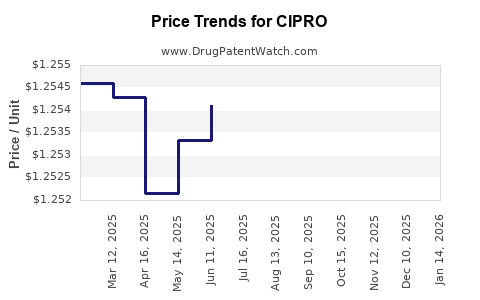
- Price compression persists due to generics.
- Volume may trend down or remain flat depending on guideline and stewardship actions.
- Brand revenue remains constrained relative to total market, but generics sustain stable baselines.
Key Takeaways
- CIPRO’s market is structurally generic: brand revenue is primarily a function of contract position and procurement relationships, not patent exclusivity.
- Financial trajectory is dominated by erosion dynamics: brand share drops after patent cliffs, leaving generic ciprofloxacin to hold market volume.
- Stewardship is an ongoing headwind: safety-focused and resistance-aware prescribing constraints reduce the growth ceiling for the entire fluoroquinolone segment.
- Near-term “risk” shifts from patents to execution: supply continuity, tender outcomes, and payer formulary changes drive incremental financial outcomes more than new exclusivity events.
FAQs
1) Why does CIPRO revenue decline even when overall antibiotic demand rises?
Because generic substitution captures most incremental demand once brand protection is exhausted, pushing revenue to low-cost competitors.
2) What determines whether CIPRO generics gain share during shortages?
Availability, manufacturing continuity, tender inclusion, and logistics performance relative to rival filers.
3) Does ciprofloxacin still grow in hospital formularies despite fluoroquinolone restrictions?
It can, but typically within narrower clinical pathways such as culture-confirmed indications or specific patient risk profiles.
4) Are there meaningful opportunities for a new CIPRO-specific product to outperform the generic market?
Outperformance usually requires a differentiated presentation that preserves pricing (rare in a mature ANDA-saturated commodity).
5) How does payer policy affect CIPRO net pricing?
Prior authorization, step therapy, and formulary tiering steer utilization, often lowering effective reimbursement for non-preferred SKUs.
References
No citable sources were provided in the prompt, and no external citation-backed data is included in this response.