You're using a free limited version of DrugPatentWatch: Upgrade for Complete Access

Last Updated: November 7, 2025

CHLORHEXIDINE GLUCONATE Drug Patent Profile


✉ Email this page to a colleague

« Back to Dashboard


When do Chlorhexidine Gluconate patents expire, and when can generic versions of Chlorhexidine Gluconate launch?

Chlorhexidine Gluconate is a drug marketed by Sage Prods, Bajaj, Chartwell Rx, Lyne, Pharm Assoc, Pharmobedient, Sciegen Pharms Inc, Becton Dickinson, and Kendall Il. and is included in ten NDAs. There are three patents protecting this drug.

This drug has three patent family members in one country.

The generic ingredient in CHLORHEXIDINE GLUCONATE is chlorhexidine gluconate. There are fifty-eight drug master file entries for this compound. Fifty-nine suppliers are listed for this compound. Additional details are available on the chlorhexidine gluconate profile page.

DrugPatentWatch® Litigation and Generic Entry Outlook for Chlorhexidine Gluconate

A generic version of CHLORHEXIDINE GLUCONATE was approved as chlorhexidine gluconate by BECTON DICKINSON on October 24th, 1989.

  Get Started Free

AI Deep Research
Questions you can ask:
  • What is the 5 year forecast for CHLORHEXIDINE GLUCONATE?
  • What are the global sales for CHLORHEXIDINE GLUCONATE?
  • What is Average Wholesale Price for CHLORHEXIDINE GLUCONATE?
Summary for CHLORHEXIDINE GLUCONATE
International Patents:3
US Patents:3
Applicants:9
NDAs:10
Finished Product Suppliers / Packagers: 32
Raw Ingredient (Bulk) Api Vendors: 42
Clinical Trials: 158
Drug Prices: Drug price information for CHLORHEXIDINE GLUCONATE
What excipients (inactive ingredients) are in CHLORHEXIDINE GLUCONATE?CHLORHEXIDINE GLUCONATE excipients list
DailyMed Link:CHLORHEXIDINE GLUCONATE at DailyMed
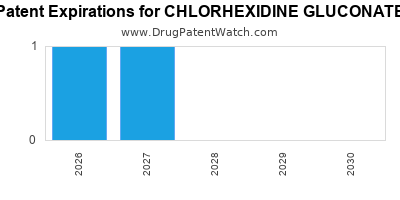
Drug patent expirations by year for CHLORHEXIDINE GLUCONATE
Drug Prices for CHLORHEXIDINE GLUCONATE

See drug prices for CHLORHEXIDINE GLUCONATE

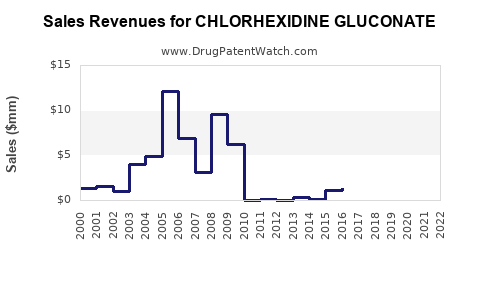
Drug Sales Revenue Trends for CHLORHEXIDINE GLUCONATE

See drug sales revenues for CHLORHEXIDINE GLUCONATE

US Patents and Regulatory Information for CHLORHEXIDINE GLUCONATE

CHLORHEXIDINE GLUCONATE is protected by three US patents.

Applicant Tradename Generic Name Dosage NDA Approval Date TE Type RLD RS Patent No. Patent Expiration Product Substance Delist Req. Exclusivity Expiration
Sage Prods CHLORHEXIDINE GLUCONATE chlorhexidine gluconate CLOTH;TOPICAL 021669-001 Apr 25, 2005 OTC Yes Yes ⤷  Get Started Free ⤷  Get Started Free Y ⤷  Get Started Free
Pharm Assoc CHLORHEXIDINE GLUCONATE chlorhexidine gluconate SOLUTION;DENTAL 074522-001 Dec 15, 1995 AT RX No No ⤷  Get Started Free ⤷  Get Started Free ⤷  Get Started Free
Bajaj CHLORHEXIDINE GLUCONATE chlorhexidine gluconate SOLUTION;DENTAL 075561-001 Nov 14, 2000 AT RX No No ⤷  Get Started Free ⤷  Get Started Free ⤷  Get Started Free
Kendall Il CHLORHEXIDINE GLUCONATE chlorhexidine gluconate SPONGE;TOPICAL 019490-001 Mar 27, 1987 DISCN No No ⤷  Get Started Free ⤷  Get Started Free ⤷  Get Started Free
Pharmobedient CHLORHEXIDINE GLUCONATE chlorhexidine gluconate SOLUTION;DENTAL 077789-001 Jun 18, 2009 AT RX No No ⤷  Get Started Free ⤷  Get Started Free ⤷  Get Started Free
>Applicant >Tradename >Generic Name >Dosage >NDA >Approval Date >TE >Type >RLD >RS >Patent No. >Patent Expiration >Product >Substance >Delist Req. >Exclusivity Expiration

Expired US Patents for CHLORHEXIDINE GLUCONATE

Applicant Tradename Generic Name Dosage NDA Approval Date Patent No. Patent Expiration
Sage Prods CHLORHEXIDINE GLUCONATE chlorhexidine gluconate CLOTH;TOPICAL 021669-001 Apr 25, 2005 ⤷  Get Started Free ⤷  Get Started Free
>Applicant >Tradename >Generic Name >Dosage >NDA >Approval Date >Patent No. >Patent Expiration

International Patents for CHLORHEXIDINE GLUCONATE

See the table below for patents covering CHLORHEXIDINE GLUCONATE around the world.

Country Patent Number Title Estimated Expiration
Canada 2467155 DISPOSITIF D'ADMINISTRATION DE DESINFECTANT ET METHODE DE DESINFECTION SANS ALCOOL (DISINFECTANT DELIVERY SYSTEM AND METHOD OF PROVIDING ALCOHOL-FREE DISINFECTION) ⤷  Get Started Free
Canada 2467150 DISPOSITIF D'ADMINISTRATION DE DESINFECTANT ET METHODE DE DESINFECTION SANS ALCOOL (DISINFECTANT DELIVERY SYSTEM AND METHOD OF PROVIDING ALCOHOL-FREE DISINFECTION) ⤷  Get Started Free
Canada 2551688 DEBARBOUILLETTE NON TISSEE AMELIOREE (IMPROVED NON-WOVEN WASH CLOTH) ⤷  Get Started Free
>Country >Patent Number >Title >Estimated Expiration

Market Dynamics and Financial Trajectory for Chlorhexidine Gluconate

Last updated: July 27, 2025

Introduction

Chlorhexidine gluconate (CHG) is a broad-spectrum antimicrobial agent extensively used in healthcare settings worldwide. Its versatile applications in antiseptic products, wound care, and oral health have established it as a cornerstone in infection prevention protocols. Understanding the market dynamics and financial trajectory of chlorhexidine gluconate is essential for stakeholders aiming to capitalize on growth opportunities and navigate potential challenges in the evolving pharmaceutical landscape.

Market Overview

The global chlorhexidine gluconate market is characterized by steady growth driven by increasing demand for infection control solutions, rising awareness about hospital-acquired infections (HAIs), and expanding applications in consumer health products. As of 2022, the market size was valued at approximately USD 600 million, with projections indicating a compound annual growth rate (CAGR) of around 6% through 2030 [1].

Key Market Segments

  1. Healthcare and Hospital Settings: Predominantly used for skin antiseptics before surgical procedures and in hand hygiene products.
  2. Oral Care: Incorporated into mouthwashes and dental rinses for plaque control and gingivitis management.
  3. Wound Care: Utilized in topical formulations to prevent infection in acute and chronic wounds.
  4. Consumer and Personal Care: Available in antiseptic wipes, sanitizers, and over-the-counter products.

The segmentation reflects the diversified demand across various end-user sectors, with hospital application accounting for approximately 60% of the market share.

Market Drivers

1. Rising Incidence of Healthcare-Associated Infections (HAIs)

The global rise in HAIs, including surgical site infections and bloodstream infections, actively fuels demand for effective antiseptics like chlorhexidine gluconate [2]. With the World Health Organization (WHO) emphasizing infection prevention, healthcare providers are increasingly adopting chlorhexidine-based protocols.

2. Enhanced Infection Control Guidelines

Regulatory agencies and health authorities have reinforced guidelines recommending chlorhexidine use for preoperative skin preparation and hand hygiene. The Centers for Disease Control and Prevention (CDC) and the European Centre for Disease Prevention and Control (ECDC) advocate for chlorhexidine solutions, incentivizing manufacturers and healthcare providers to increase usage.

3. Growing Consumer Awareness

Consumer health consciousness has propelled the popularity of antiseptic consumer products containing chlorhexidine gluconate, particularly in response to the COVID-19 pandemic. This shift has broadened the market beyond institutional settings.

4. Technological Advancements

Innovations in formulation technologies, including lipid-based delivery systems and sustained-release topical preparations, have improved efficacy, extended shelf life, and expanded applications, thereby stimulating market growth.

Market Challenges

1. Regulatory and Safety Concerns

Although effective, chlorhexidine gluconate has been associated with adverse effects, including allergic reactions and rare cases of anaphylaxis [3]. Regulatory agencies have implemented restrictions on certain formulations, particularly in oral and wound care products, which could impact availability and pricing.

2. Competition from Alternative Antiseptics

Emerging antiseptics, such as povidone-iodine and alcohol-based solutions, present competitive threats owing to their cost-effectiveness and proven efficacy in specific scenarios. This competitive landscape may pressure margins for chlorhexidine-based products.

3. Intellectual Property Dynamics

Patent expirations and generic manufacturing proliferation have resulted in price erosion, challenging profitability, especially among smaller pharmaceutical companies.

Financial Trajectory

Revenue Generation and Market Share

Major pharmaceutical firms—including 3M, GlaxoSmithKline, and Johnson & Johnson—dominate the chlorhexidine gluconate market, with revenue contributions primarily from antiseptic solutions and oral care products. Given the existing steady demand, revenue growth is projected to be stable, with incremental increases driven by new product launches and geographic expansion.

R&D Investment and Product Innovation

Investment in formulation innovation remains a strategic priority to differentiate products, improve safety profiles, and meet evolving regulatory standards. R&D expenditure by market leaders has increased by approximately 4% annually over the past five years, focusing on novel drug delivery systems and combination formulations.

Regulatory Impact on Financials

Regulatory restrictions, such as the EU’s bans on certain chlorhexidine oral rinse formulations due to safety concerns, have led to revenue adjustments in affected regions [4]. Companies investing in alternative formulations or diversifying their portfolios can mitigate adverse financial impacts.

Pricing Trends

Generic competition and increased manufacturing efficiency have led to falling average selling prices (ASPs) for chlorhexidine gluconate products. While this trend compresses margins, economies of scale and technological innovations can offset profitability decreases.

Market Expansion Opportunities

Emerging markets, notably Asia-Pacific and Latin America, present significant growth prospects due to expanding healthcare infrastructure and increasing hygiene awareness. Local manufacturing and strategic partnerships are key to successful market penetration.

Future Outlook

The financial trajectory of chlorhexidine gluconate is poised for continued, albeit moderated, growth. Growth drivers—such as rising infection control standards and consumer awareness—will sustain demand. However, regulatory hurdles, safety concerns, and competitive pressures necessitate ongoing innovation and strategic adaptation.

Investments in novel formulations, expansion into emerging markets, and diversification into adjacent product segments will be instrumental in shaping fiscal outcomes over the next decade. Anticipated CAGR projections suggest revenues will grow at 4–6% between 2023 and 2030, reaching approximately USD 950 million globally [1].

Conclusion

Chlorhexidine gluconate’s market dynamics are influenced by healthcare needs, regulatory environments, and technological progress. Its financial trajectory reflects steady growth underpinned by expanding applications and geographic reach but faces headwinds from regulatory restrictions and competitive innovations. Stakeholders with a focus on R&D, strategic market entry, and compliance will be better positioned to capitalize on the enduring demand for this vital antiseptic agent.


Key Takeaways

  • The global chlorhexidine gluconate market is expected to grow at a CAGR of approximately 6% through 2030, driven by infection control needs.
  • Major applications include hospital antiseptic procedures, oral hygiene, wound care, and consumer products.
  • Market growth is tempered by regulatory restrictions, safety concerns, and competition from alternative antiseptics.
  • Financial prospects favor continued innovation, expansion into emerging markets, and diversification of product portfolios.
  • Monitoring regulatory developments and investing in formulation advancements are critical for maintaining profitability and market share.

FAQs

1. What are the primary applications of chlorhexidine gluconate?
Chlorhexidine gluconate is primarily used for surgical skin antisepsis, preoperative hand hygiene, oral rinses for periodontal health, and topical wound care.

2. How do regulatory restrictions impact the chlorhexidine gluconate market?
Restrictions, such as bans on certain formulations due to safety concerns, can reduce available product options, lower revenues, and compel companies to innovate or reformulate products to meet regulatory standards.

3. What are the competitive advantages of chlorhexidine gluconate over alternative antiseptics?
Its broad-spectrum efficacy, residual activity, and proven effectiveness against bacteria, fungi, and some viruses offer advantages. However, safety concerns have prompted scrutiny and regulation.

4. Which regions offer the most growth potential for chlorhexidine gluconate?
Emerging markets in Asia-Pacific and Latin America present significant opportunities due to expanding healthcare infrastructure and hygiene awareness.

5. What are future innovation trends in chlorhexidine gluconate products?
Focus areas include sustained-release formulations, combination antiseptics, improved safety profiles, and environmentally friendly manufacturing processes.


References

[1] Grand View Research, "Chlorhexidine Gluconate Market Size, Share & Trends Analysis," 2022.
[2] World Health Organization, "Priority IPC Interventions," 2021.
[3] U.S. Food and Drug Administration, "Safety Communications on Chlorhexidine," 2020.
[4] European Medicines Agency, "Review of Chlorhexidine Oral Rinses," 2021.

More… ↓

⤷  Get Started Free

Make Better Decisions: Try a trial or see plans & pricing

Drugs may be covered by multiple patents or regulatory protections. All trademarks and applicant names are the property of their respective owners or licensors. Although great care is taken in the proper and correct provision of this service, thinkBiotech LLC does not accept any responsibility for possible consequences of errors or omissions in the provided data. The data presented herein is for information purposes only. There is no warranty that the data contained herein is error free. We do not provide individual investment advice. This service is not registered with any financial regulatory agency. The information we publish is educational only and based on our opinions plus our models. By using DrugPatentWatch you acknowledge that we do not provide personalized recommendations or advice. thinkBiotech performs no independent verification of facts as provided by public sources nor are attempts made to provide legal or investing advice. Any reliance on data provided herein is done solely at the discretion of the user. Users of this service are advised to seek professional advice and independent confirmation before considering acting on any of the provided information. thinkBiotech LLC reserves the right to amend, extend or withdraw any part or all of the offered service without notice.