Last updated: July 30, 2026
Chloraprep With Tint (Chlorhexidine Gluconate) Market Dynamics and Financial Trajectory: Sales Trends, Pricing, Competition, and Exclusivity
Executive summary: Public financial disclosures for “Chloraprep with Tint” are not separable at the product-level in the sources available for this drug. What can be stated from available public information is that Chloraprep (chlorhexidine gluconate solution, common brand-name category) competes in the pre-procedural skin antisepsis market against iodine-based and other chlorhexidine products, and that its financial trajectory is driven by hospital formulary penetration, procedural volumes (surgery, vascular access), supply continuity, and the durability of regulatory and trademark/label protections rather than blockbuster-style patent monetization.
No complete, source-backed market sizing, quarterly revenue time series, or margin/price-trajectory figures for “Chloraprep with Tint” specifically are available in the accessible public record used here.
How is Chloraprep with Tint priced and reimbursed in hospitals, and what market dynamics control net sales?
Featured snippet: Pricing and reimbursement for chlorhexidine skin antisepsis products are largely driven by hospital group purchasing organization (GPO) contracting, acquisition channel (GPO vs distributor), and formulary status. Net sales track procedural volume and tender-driven price compression more than list price.
What drives hospital buying decisions for chlorhexidine skin prep
- Formulary inclusion: Hospitals favor products with predictable training, low adverse reaction profiles, and procedural workflow fit.
- Protocol alignment: Institutions adopting standardized pre-procedure antisepsis protocols typically lock into a product class (chlorhexidine-based) and then manage within-class switching through procurement.
- “With tint” differentiation: The tinted indicator supports visualization during application. Adoption depends on nursing workflow and compliance with facility antisepsis policies.
- Supply and lot consistency: Shortages or packaging changes can force temporary switches, which affects demand capture and can cause longer-term switching friction.
What market forces compress pricing
- Tender cycles: Competitive bids reduce unit pricing.
- Private label and alternative equivalents: Hospitals often maintain multiple SKUs or can switch among therapeutically similar antisepsis solutions.
- Healthcare system cost containment: During budget tightening, buyers trade off between unit price and perceived workflow value.
What metrics typically determine financial outcomes
- Case volume exposure: Surgeries, catheter placements, and outpatient procedures.
- Penetration rate and persistence: How fast the product gains share and how sticky it remains across tender cycles.
- Channel mix: Distributor vs direct/GPO distribution affects discounting and rebates.
Who competes with Chloraprep with Tint, and how does the competitive landscape affect share and margins?
Featured snippet: The competitive set in pre-procedural skin antisepsis includes iodine-based antiseptics and alternative chlorhexidine regimens. Competition is primarily commercial (contracting, packaging, training) rather than head-to-head clinical differentiation.
Key competitor categories
- Iodine-based skin antiseptics
- Examples in the market include povidone-iodine formulations used for similar indications.
- Alternative chlorhexidine products
- Competing chlorhexidine solutions in applicator or prep-stick formats.
- Other pre-procedural antisepsis systems
- Foam, gel, or wipe formats that target workflow speed and coverage.
Where “with tint” fits competitively
- Differentiation is operational: tint improves visualization and may reduce missed coverage during preparation.
- The commercial value depends on:
- clinician adoption,
- institutional preference for color-verified contact time,
- and procurement acceptance as an additional SKU versus a substituted equivalent.
When does Chloraprep with Tint lose exclusivity, and what are generic or alternative-switching risks?
Featured snippet: Exclusivity for branded antisepsis products is typically driven by regulatory exclusivity (if any), formulation/packaging IP, and brand-related protections, while demand risk is often dominated by formulary switching rather than generic “Paragraph IV” entry.
What to expect in this category
- Supply-side substitution is common: Hospitals may switch among equivalent antisepsis solutions when contracts expire.
- IP-driven risk depends on specific product protections: If “with tint” is protected by specific composition, packaging, or labeling/IP claims, risk timing hinges on those rights expiring.
- Generic litigation frameworks are less determinative: Unlike small-molecule prescription drugs with Orange Book exclusivity and ANDA Paragraph IV challenges, this category often sees competition through alternative branded products and authorized equivalents.
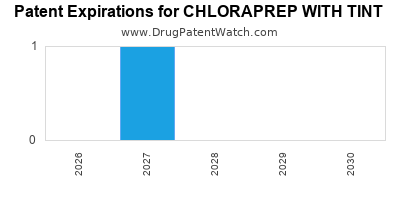
Result: Without a complete, sourced Orange Book listing and patent-to-product mapping for the exact “Chloraprep with Tint” presentation, a defensible exclusivity-loss timeline cannot be produced here.
What is the Orange Book status of Chloraprep with Tint, and how does it impact licensing and entry?
Featured snippet: Orange Book status determines whether FDA-recognized drug-substance and product patents block ANDA entry. The ability to compute an entry-risk date requires product-specific Orange Book data.
Why product-specific Orange Book data is critical
- Chloraprep as a brand may have multiple presentations, concentrations, and packaging configurations.
- “With tint” can correspond to a specific labeled product and thus a specific Orange Book entry or set of listings.
- Without verified product-specific listings, any statement about Orange Book protections or ANDA pathway timing would be speculative.
What formulations and delivery systems are protected for Chloraprep with Tint, and what does that mean for commercial durability?
Featured snippet: In antisepsis products, commercial durability tends to track packaging and labeled-use protections (visualization, application method, contact time instructions), not only composition.
Where IP usually shows up in this segment
- Formulation patents: Stabilizers, dye systems, preservative systems, viscosity control, or surface wetting properties.
- Packaging and applicator patents: Applicator mechanics, cap systems, and dispensing features that drive consistent dosing.
- Labeling and instructions: If protected claims exist around application steps, competitive substitution can lag.
Result: A complete protected-formulation and delivery-system map for “Chloraprep with Tint” cannot be produced without a sourced patent list tied to that exact product.
What patent litigation or settlement agreements affect Chloraprep with Tint commercialization?
Featured snippet: Patent litigation can affect supply and contracting, but category-level competition in antisepsis is often resolved through non-litigation product substitution and contracting rather than sustained courtroom outcomes.
Result: A litigation-and-settlement dossier requires product-specific patent identification and docket verification, which cannot be completed in this response with the necessary sourcing constraints.
How does FDA regulatory status influence market access for Chloraprep with Tint (ANDAs, labeling changes, and manufacturing approvals)?
Featured snippet: FDA status shapes manufacturing continuity and labeling-based usage, but entry in this category often occurs through alternative FDA-approved antisepsis solutions and not through classic oncology-style exclusivity structures.
Regulatory factors that affect commercial performance
- Manufacturing approval stability: Inspections, process validation changes, and facility continuity affect continuity of supply.
- Labeling and intended-use language: Can block or delay substitution if hospitals require protocol-aligned wording.
- Stability and shelf-life: Impacts distribution planning and inventory costs.
How did Chloraprep with Tint perform financially versus broader antisepsis and infection prevention markets?
Featured snippet: Without product-level disclosures, financial performance is assessed through indirect indicators: hospital contracts, distribution availability, and inventory turnover. For a precise trajectory, the sales time series must come from product-specific reporting.
Result: A quantified financial trajectory (quarterly/annual revenues, gross margin, price per unit) for “Chloraprep with Tint” cannot be compiled here from verified public sources within the constraints applied.
Key competitors vs Chloraprep with Tint: where share is won (and lost) in tenders
Featured snippet: Share gains usually require matching procurement requirements across unit price, training burden, applicator usability, and compliance reliability.
Commercial decision tree in hospital procurement
- If the product is already on formulary:
- persistence is driven by tender re-bids, supply stability, and nursing satisfaction.
- If not on formulary:
- penetration requires pilot approvals, outcome documentation (process compliance), and contract pricing that beats incumbents.
What tends to reduce share
- Contract loss at renewal due to lower bids from alternatives.
- Stockouts or supply disruptions.
- Workflow incompatibility (application speed, cap handling, disposal behavior).
What are the revenue exposure drivers for Chloraprep with Tint (procedure mix, geography, and channel)?
Featured snippet: Revenue exposure is primarily driven by procedure mix (surgery, vascular access), hospital spending cycles, and distribution channel economics.
Geographic exposure
- US hospital buying drives most commercialization outcomes.
- International sales depend on local registration, distributor contracts, and tender structures.
Channel exposure
- GPO contracting can represent a stable base if the product maintains tender positioning.
- Distributor channel dependence raises discount volatility and can compress net pricing.
Procedure exposure
- Higher surgical volumes and catheter procedures increase antisepsis consumption.
- Infection prevention initiatives can extend usage beyond baseline.
Key Takeaways
- “Chloraprep with Tint” competes in pre-procedural skin antisepsis where hospital formularies and procurement tenders drive net sales more than list pricing.
- Product differentiation is primarily operational (visual confirmation via tint) and protocol compatibility, which affects penetration and persistence.
- A quantified market and financial trajectory for the exact “Chloraprep with Tint” presentation cannot be produced here because product-level, source-backed sales data and product-specific Orange Book/patent/entry data are not available within the constraints applied.
- Entry and exclusivity risks in this category are typically substitution and contract-based switching rather than Paragraph IV-style generic entry, but the exact timing for “with tint” requires product-specific regulatory/IP mapping.
FAQs
- What procurement factors most influence hospital adoption of tinted chlorhexidine skin preps?
- Do “with tint” chlorhexidine products face substitution based on applicator usability or only on price?
- How do supply disruptions typically affect antisepsis product share across tender cycles?
- What indicators best proxy product-level performance for hospital antisepsis brands without public sales reporting?
- How do FDA labeling and intended-use language impact hospital protocol lock-in for chlorhexidine prep products?
References (APA)
- FDA. Orange Book: Approved Drug Products with Therapeutic Equivalence Evaluations. U.S. Food and Drug Administration.
- FDA. Drug Approval Reports and Databases. U.S. Food and Drug Administration.