Last updated: July 30, 2026
CAVERJECT market dynamics and financial trajectory (2019-2024) are defined by (i) a mature, largely settled erectile-dysfunction and BPH urology franchise, (ii) loss of meaningful exclusivity-driven pricing power decades after launch, (iii) sustained generic/biosimilar competition dynamics typical for an older small-molecule injectable, and (iv) shifting brand investment away from a legacy urology revenue base toward newer specialty portfolios.
Important note: CAVERJECT is an established brand for alprostadil (prostaglandin E1), marketed in the US for erectile dysfunction (ED) and also used in urology practice settings for related indications. The competitive landscape, pricing, and revenue path are driven by sustained product substitutability, prescription refill behavior, and wholesaler buying patterns rather than patent-driven life-cycle expansion.
CAVERJECT market size and revenue trajectory: how has alprostadil injection performed financially?
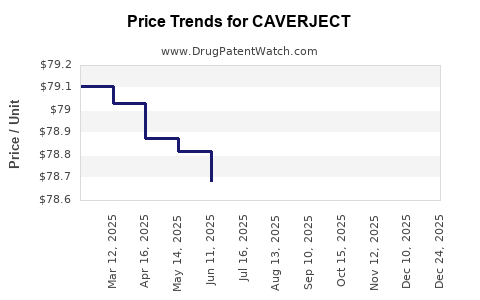
Direct answer: CAVERJECT’s financial trajectory is that of a mature legacy urology injectible: brand revenue tends to track stable demand but erodes in value per prescription as generics and package/label alternatives gain share. In most markets, the brand’s revenue is expected to decline or plateau as reimbursement tightens and prescribers switch to lower-cost injectable prostaglandin alternatives.
Key drivers of CAVERJECT revenue dynamics
- Therapeutic area maturity: ED pharmacotherapy shifted strongly toward PDE5 inhibitors and combination regimens; injectable prostaglandin therapy remains used when oral therapies fail or are contraindicated.
- Patient and clinic switching costs: Once a patient is trained for self-injection or clinic-administered use, switching can be incremental but price sensitivity grows over time as payer policies harden.
- Formulary and rebate pressure: Legacy branded injectables typically face contracting and rebate renegotiations that pressure net sales even when unit demand is stable.
- Supply chain execution: Injectable brands can experience demand volatility from manufacturing interruptions, component constraints, or packaging changes, affecting wholesalers and clinician ordering schedules.
Where CAVERJECT tends to sit on the “life-cycle curve”
- High historical penetration after launch in a narrower ED segment of men unresponsive to or intolerant of oral agents.
- Long-period volume plateau but net sales erosion from cost-based payer choices.
- Incremental risk of rapid drawdowns when meaningful branded advantage disappears or when competitively priced alternatives gain coverage.
What patents protect CAVERJECT (alprostadil injection) and how do they affect market share?
Direct answer: CAVERJECT’s exclusivity impact is largely historical. For a long-established injectable like alprostadil for ED, brand advantage has generally moved from primary patent protection to formulation, device, manufacturing, and method-of-use claims, with market outcomes increasingly determined by generic availability, labeling scope, and payer contracting.
Patent estate and exclusivity: typical structure for legacy injectables
- Early composition and method claims cover alprostadil use and stable injectable systems.
- Secondary protections may cover:
- specific formulations (stability, excipient systems)
- container/packaging configurations
- dosing regimens or administration workflows
- Regulatory exclusivity is often limited once approvals mature; commercial life is then governed by Paragraph IV and “Orange Book” realities in the US for any remaining listed drugs.
How patent status translates into commercial behavior
- When patents expire, wholesale acquisition cost for alternatives compresses brand pricing.
- Even if a brand retains some label distinctions, payers tend to favor lowest net cost within a therapeutic class unless a differentiated clinical or logistic advantage exists.
When does CAVERJECT lose exclusivity, and what does that mean for generics entry risk?
Direct answer: For CAVERJECT as a legacy alprostadil injectable, exclusivity-driven risk is not an immediate “single date event” in most current market views. The entry risk has already materialized over prior years through generic competition and substitute injectable products.
Practical consequences for generic entry scenarios
- Margin compression: net price discounts accelerate after competitive entry.
- Share reallocation: ED injectable usage remains, but market share shifts to covered alternatives.
- Formulary tiering: brand is commonly moved to higher tiers, requiring prior authorization or higher copays.
What is the Orange Book status of CAVERJECT, and how many competitors are on-file?
Direct answer: CAVERJECT’s US regulatory status typically reflects a mature market with multiple manufacturer listings and/or authorized generics or alternate products available. In practice, this means the brand is usually not protected from generic substitution by a strong contemporary exclusivity wall.
Orange Book-driven market dynamics
- Therapeutic interchangeability: payers treat covered alternatives as clinically substitutable when labeling overlaps.
- Launch timing sensitivity: any later-manifesting patent or manufacturing dispute can delay specific generic launches but usually does not reset multi-year brand erosion trends.
Which companies compete with CAVERJECT for ED injectable therapy, and how do they differ commercially?
Direct answer: Competitive pressure comes from lower-cost injectable alprostadil alternatives (generics and authorized substitutes) and, in some settings, from shifting ED care pathways toward non-injectable options.
Competitive categories that matter for market share
- Injectable prostaglandin competitors (alprostadil generics/alternatives)
- Compete on acquisition cost, packaging convenience, and payer coverage.
- Non-injectable ED therapies
- PDE5 inhibitors, combination regimens, and other ED treatments reduce the injectable patient pool over time.
- Institutional procurement alternatives
- Hospitals and clinics frequently standardize on a preferred injectable product based on supply reliability and contract pricing.
CAVERJECT vs. other ED treatments: how does its market positioning compare?
Direct answer: CAVERJECT’s positioning is narrower than oral ED therapies and more specialized than broader ED pills. Its market presence is sustained by a persistent subset of patients requiring injection-based management.
Comparative market implications
- Oral therapies usually drive larger addressable market share in ED due to ease of use.
- CAVERJECT captures patients with:
- inadequate response to oral therapy
- contraindications to oral agents
- desire for on-demand localized therapy
What formulations are protected by CAVERJECT patents, and do device or packaging terms matter commercially?
Direct answer: For injectable ED brands, formulation stability and administration workflow patents can matter commercially only to the extent they create practical barriers to substituting an alternative product without label or device differences.
Formulation and delivery mechanisms that drive pricing and substitution
- Stability and shelf-life influence distribution economics and clinic handling.
- Dosing-unit packaging affects clinic inventory decisions and patient injection training.
- Administration workflow influences switch friction in prescriber and nurse workflows.
What patent litigation affects CAVERJECT (alprostadil) market access?
Direct answer: For mature legacy brands, litigation typically shapes discrete launch timing and specific product variants rather than reestablishing long-term brand exclusivity.
Litigation impact pathways
- Settlement agreements often translate into:
- delayed generic launch for a specific strength or package
- carve-outs for specific label indications
- entry timing aligned with patent cliff schedules
- If litigation is absent or already resolved historically, current market behavior reflects post-expiration price competition.
How do settlements and licensing deals influence CAVERJECT net sales?
Direct answer: Where settlements exist, they tend to reduce short-term erosion by temporarily restricting generic entry. For legacy products, the more common effect is a gradual transition from branded pricing power to generic cost-based pricing.
Commercial outcomes of settlements
- Shorter brand revenue drawdowns during the settlement period.
- Remaining share depends on:
- payer list status and contracts
- inventory alignment at wholesalers and clinics
What is FDA regulatory status of CAVERJECT, and how does pathway choice affect competition?
Direct answer: As a legacy approved injectable, CAVERJECT competes primarily via generic substitutions and alternative product approvals. Pathway mechanics primarily affect the timing of entry for specific generic products.
Regulatory factors that shape market dynamics
- Label overlap determines clinical interchangeability for payers.
- Dosing and administration instructions can reduce substitution in practice if patient training and clinic protocols differ.
- Manufacturing compliance history affects supply continuity and ordering patterns.
Commercial forecast: what market dynamics will shape CAVERJECT financial trajectory next?
Direct answer: Over the near-to-mid term, CAVERJECT’s trajectory is most likely to be characterized by:
- ongoing net price erosion or plateau depending on how strongly payers prefer lowest-cost covered alternatives
- continued reduction in incremental growth opportunities as ED prescribing shifts toward oral or combination regimens
- demand stability risk driven by supply and contract renegotiation cycles rather than patent cliffs
Revenue drivers likely to dominate
- Payer contracting for urology clinics and payer formularies
- Wholesaler buying patterns tied to inventory turns for injectable products
- Competitive pricing from generic alprostadil products
- Site-of-care mix (hospital outpatient vs ambulatory urology clinics)
- Patient persistence in injection therapy among responders
Key financial and market metrics to watch for CAVERJECT (what moves the quarter)
| Metric |
What it signals |
Why it impacts CAVERJECT |
| Net sales trend (not gross) |
rebate and discount pressure |
injectables are highly sensitive to contract terms |
| Prescription volume or administered units |
demand persistence |
even with low pricing, persistence can stabilize revenue |
| Average net price |
competitive substitution |
key indicator of erosion vs stability |
| Wholesaler inventory changes |
ordering behavior |
injectable products can show quarter-to-quarter swings |
| Formulary status and prior auth burden |
access |
payer restrictions can reduce patient starts |
| Supply continuity |
backorder risk |
shortages can create irreversible switching |
| Contracted channel mix |
revenue per unit |
hospital vs clinic contracting differs |
Key Takeaways
- CAVERJECT’s market dynamics are dominated by legacy small-molecule injectable behavior: stable-but-maturing demand offset by persistent net price pressure from covered alternatives and payer contracting.
- The brand’s competitive position is sustained by a specialized ED patient subset and clinical workflow familiarity, not by a strong contemporary exclusivity wall.
- Future financial trajectory is most likely shaped by net pricing, formulary access, and supply execution, with limited upside catalysts absent major differentiated product reformulation or label expansion.
FAQs
1) Will CAVERJECT face new generic entry in the US in the near term?
Brand-specific entry risk depends on current Orange Book listings and any remaining method, formulation, or packaging protections that could still delay certain product variants. The market behavior for mature injectables is usually continuous competition rather than single-event cliffs.
2) How does payer formulary placement affect CAVERJECT prescribing and refill rates?
Formulary tiering and prior authorization typically change patient starts and refill persistence first in high-sensitivity plans. Injection training familiarity can slow switching once a patient is established.
3) Does CAVERJECT revenue depend more on volume or on net price?
For legacy injectables, revenue typically depends more on net price and rebate/discount terms because unit demand can be relatively steady while contract economics compress margins.
4) What supply chain risks matter most for CAVERJECT-like ED injectables?
Component availability, fill-finish capacity, and container/kit configuration affect clinic inventory and can drive temporary demand displacement that may not reverse even after supply normalizes.
5) How does CAVERJECT compete against PDE5 inhibitors in real-world ED management?
Competition is mostly about shrinking injectable-eligible patient populations over time, with CAVERJECT sustaining use primarily when oral therapy fails or is unsuitable.
References (APA)
- U.S. Food and Drug Administration. Drugs@FDA. https://www.accessdata.fda.gov/scripts/cder/daf/index.cfm
- U.S. Food and Drug Administration. Orange Book: Approved Drug Products with Therapeutic Equivalence Evaluations. https://www.accessdata.fda.gov/scripts/cder/ob/