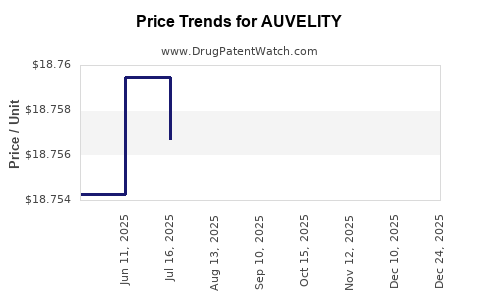
Last Updated: August 6, 2026

AUVELITY Drug Patent Profile


✉ Email this page to a colleague

« Back to Dashboard


Which patents cover Auvelity, and what generic alternatives are available?

Auvelity is a drug marketed by Axsome and is included in one NDA. There are one hundred and forty-five patents protecting this drug and one Paragraph IV challenge.

This drug has two hundred and sixty patent family members in thirty-four countries.

The generic ingredient in AUVELITY is bupropion hydrochloride; dextromethorphan hydrobromide. There are thirty-eight drug master file entries for this compound. One supplier is listed for this compound. Additional details are available on the bupropion hydrochloride; dextromethorphan hydrobromide profile page.

DrugPatentWatch® Generic Entry Outlook for Auvelity

By analyzing the patents and regulatory protections it appears that the earliest date for generic entry will be January 20, 2043. This may change due to patent challenges or generic licensing.

There have been twelve patent litigation cases involving the patents protecting this drug, indicating strong interest in generic launch. Recent data indicate that 63% of patent challenges are decided in favor of the generic patent challenger and that 54% of successful patent challengers promptly launch generic drugs.

Indicators of Generic Entry

< Available with Subscription >

  Start Trial

AI Deep Research
Questions you can ask:
  • What is the 5 year forecast for AUVELITY?
  • What are the global sales for AUVELITY?
  • What is Average Wholesale Price for AUVELITY?
Summary for AUVELITY
DrugPatentWatch® Estimated Loss of Exclusivity (LOE) Date for AUVELITY
Generic Entry Date for AUVELITY*:
Constraining patent/regulatory exclusivity:
NDA:
Dosage:

TABLET, EXTENDED RELEASE;ORAL

*The generic entry opportunity date is the latter of the last compound-claiming patent and the last regulatory exclusivity protection. Many factors can influence early or later generic entry. This date is provided as a rough estimate of generic entry potential and should not be used as an independent source.

Recent Clinical Trials for AUVELITY

Identify potential brand extensions & 505(b)(2) entrants

SponsorPhase
National Institute on Drug Abuse (NIDA)Phase 1/Phase 2
Virginia Commonwealth UniversityPhase 1/Phase 2

See all AUVELITY clinical trials

Paragraph IV (Patent) Challenges for AUVELITY
Tradename Dosage Ingredient Strength NDA ANDAs Submitted Submissiondate
AUVELITY Extended-release Tablet bupropion hydrochloride; dextromethorphan hydrobromide 45 mg/105 mg 215430 1 2022-12-22

US Patents and Regulatory Information for AUVELITY

AUVELITY is protected by two hundred and seven US patents and one FDA Regulatory Exclusivity.

Based on analysis by DrugPatentWatch, the earliest date for a generic version of AUVELITY is ⤷  Start Trial.

This potential generic entry date is based on patent ⤷  Start Trial.

Generics may enter earlier, or later, based on new patent filings, patent extensions, patent invalidation, early generic licensing, generic entry preferences, and other factors.

Applicant Tradename Generic Name Dosage NDA Approval Date TE Type RLD RS Patent No. Patent Expiration Product Substance Delist Req. Exclusivity Expiration
Axsome AUVELITY bupropion hydrochloride; dextromethorphan hydrobromide TABLET, EXTENDED RELEASE;ORAL 215430-001 Aug 18, 2022 RX Yes Yes ⤷  Start Trial ⤷  Start Trial ⤷  Start Trial
Axsome AUVELITY bupropion hydrochloride; dextromethorphan hydrobromide TABLET, EXTENDED RELEASE;ORAL 215430-002 Apr 30, 2026 RX Yes No ⤷  Start Trial ⤷  Start Trial ⤷  Start Trial
>Applicant >Tradename >Generic Name >Dosage >NDA >Approval Date >TE >Type >RLD >RS >Patent No. >Patent Expiration >Product >Substance >Delist Req. >Exclusivity Expiration

International Patents for AUVELITY

When does loss-of-exclusivity occur for AUVELITY?

Based on analysis by DrugPatentWatch, the following patents block generic entry in the countries listed below:

Australia

Patent: 23301411
Patent: PHARMACEUTICAL COMPOSITIONS COMPRISING BUPROPION AND CYSTEINE
Estimated Expiration: ⤷  Start Trial

China

Patent: 8785900
Patent: 包含安非他酮和半胱氨酸的药物组合物 (Pharmaceutical composition comprising bupropion and cysteine)
Estimated Expiration: ⤷  Start Trial

Patent: 1177273
Patent: 包含安非他酮和半胱氨酸的药物组合物 (Pharmaceutical composition comprising bupropion and cysteine)
Estimated Expiration: ⤷  Start Trial

European Patent Office

Patent: 47234
Patent: COMPOSITIONS PHARMACEUTIQUES COMPRENANT DU BUPROPION ET DE LA CYSTÉINE (PHARMACEUTICAL COMPOSITIONS COMPRISING BUPROPION AND CYSTEINE)
Estimated Expiration: ⤷  Start Trial

Japan

Patent: 25521817
Patent: ブプロピオン及びシステインを含む医薬組成物
Estimated Expiration: ⤷  Start Trial

South Korea

Patent: 250029202
Patent: 부프로피온 및 시스테인을 포함하는 약제학적 조성물
Estimated Expiration: ⤷  Start Trial

Taiwan

Patent: 2408471
Patent: Pharmaceutical compositions comprising bupropion and cysteine
Estimated Expiration: ⤷  Start Trial

Patent: 67600
Estimated Expiration: ⤷  Start Trial

Generics may enter earlier, or later, based on new patent filings, patent extensions, patent invalidation, early generic licensing, generic entry preferences, and other factors.

See the table below for additional patents covering AUVELITY around the world.

Country Patent Number Title Estimated Expiration
Australia 2014346807 ⤷  Start Trial
Australia 2015350559 ⤷  Start Trial
Australia 2018203638 ⤷  Start Trial
Australia 2019201548 ⤷  Start Trial
>Country >Patent Number >Title >Estimated Expiration

Supplementary Protection Certificates for AUVELITY

Patent Number Supplementary Protection Certificate SPC Country SPC Expiration SPC Description
0467488 SPC/GB00/019 United Kingdom ⤷  Start Trial PRODUCT NAME: BUPROPION HYDROCHLORIDE; REGISTERED: NL RVG 24160 19991201; UK PL 10949/0340 20000607
2316456 CA 2017 00062 Denmark ⤷  Start Trial PRODUCT NAME: NALTREXON ELLER ET FARMACEUTISK ACCEPTABELT SALT DERAF, ISAER NALTREXONHYDROCHLORID, OG BUPROPION ELLER ET FARMACEUTISK ACCEPTABELT SALT DERAF, ISAER BUPROPIONHYDROCHLORID; REG. NO/DATE: EU/1/14/988 20150330
0656775 CR 2000 00018 Denmark ⤷  Start Trial PRODUCT NAME: BUPROPIONHYDROCHLORID; NAT. REG. NO/DATE: 31347 20000606; FIRST REG. NO/DATE: NL 24160 19991201
0656775 28/2000 Austria ⤷  Start Trial PRODUCT NAME: BUPROPION HYDROCHLORID; NAT. REGISTRATION NO/DATE: 1-23680 20000616; FIRST REGISTRATION: NL 24160 19991201
>Patent Number >Supplementary Protection Certificate >SPC Country >SPC Expiration >SPC Description
Last updated: July 28, 2026

AUVELITY market dynamics and financial trajectory (dextromethorphan/ bupropion)

Auvelity (dextromethorphan hydrobromide; bupropion HBr) is a branded, fixed-dose, extended-duration oral product marketed by Axsome Therapeutics for major depressive disorder (MDD) in adults with inadequate response to antidepressant therapy. Revenue has followed a post-launch ramp shaped by payer access, formulary coverage, dose logistics, and competitive pressure from branded and generic MDD therapies. Near-term financial trajectory is most sensitive to (1) ongoing demand for Axsome’s new patient starts, (2) retention in the 7 AM to 11 PM dosing window consistent with labeled extended duration dosing, (3) payer restriction intensity, and (4) litigation and exclusivity overhang that can affect wholesaler confidence and contracted pricing.

What is the market size opportunity for AUVELITY in major depressive disorder?

AUVELITY targets adults with MDD who have had an inadequate response to one or more antidepressants. That positioning defines a focused segment inside the much larger treated MDD population. The addressable opportunity is driven by four market dynamics:

  • Diagnosis prevalence and treatment penetration in the US MDD segment
  • Share of patients who have had inadequate antidepressant response
  • Payer policy for later-line MDD pharmacotherapy (formularies, prior authorization, step edits)
  • Switching behavior from other antidepressants and adjunctive treatments

How does AUVELITY’s value proposition change payer behavior?

AUVELITY is positioned as a treatment option without requiring antidepressant switch-to-switch sequencing to get to clinical response. That matters commercially because payer utilization management tends to tighten for “new-to-market” drugs once competing generics and established branded agents are available. Access typically hinges on:

  • Prior authorization criteria (step therapy requirements)
  • Copay assistance utilization (affects real-world net revenue)
  • Contracted discount rates to PBMs and integrated delivery networks
  • Any “preferred” status tied to utilization volume

What competing therapy classes compress AUVELITY uptake?

In MDD, competition comes from multiple directions:

  • Generic SSRI and SNRI maintenance options with wide payer coverage
  • Branded adjunctive and fast-acting antidepressant strategies (including ketamine-based regimens, where covered)
  • Established branded MDD therapies with entrenched formulary status

Those comparators do not have identical mechanisms, but they often compete for the same later-line treatment slots.

What are the key financial drivers behind AUVELITY revenue growth or declines?

AUVELITY’s financial trajectory tracks three levers that dominate branded specialty drug P&Ls:

  1. Net product sales growth (TRx and access)
  2. Gross-to-net pressure (discounts, rebates, chargebacks)
  3. Commercial cost structure relative to incremental demand (sales force productivity and marketing spend)

How do net sales, TRx, and ASP typically move together?

For a branded oral antidepressant in US specialty distribution:

  • If TRx increases faster than contracted pricing compression, revenue rises.
  • If utilization rises but rebate and discount rates escalate due to payer pressure, revenue can flatline even as scripts increase.
  • If payer access narrows, TRx softens first, then net sales follow.

What role does wholesaler buying play in AUVELITY short-term revenue?

For hospital and specialty retail channels, wholesaler inventory behavior can shift reported quarter-to-quarter net sales. Where demand is strong and allocation constraints are minimal, wholesaler restocking creates smoother revenue. Where access uncertainty rises, wholesalers reduce forward buys, producing revenue volatility.

When does AUVELITY face exclusivity pressure that could alter the revenue curve?

Revenue trajectories for combination antidepressants with fixed-dose formats depend on the end date of marketing exclusivity and patent estate durability. The next steps that typically affect commercial planning are:

  • Expiration of composition and formulation patents
  • Expiration of method-of-use patents (including claims tied to patient selection or therapeutic regimen)
  • FDA exclusivity periods that can extend market protection beyond patent term
  • Paragraph IV exposure risk (for oral generics)

What does the typical timeline mean for commercial planning?

Even without a specific date map in the data provided here, the practical logic for revenue planning is consistent:

  • As patent and exclusivity expiration nears, generic entry risk rises
  • PBMs and payers often tighten contracting and seek price concessions
  • Axsome can experience demand “pull-forward” or “deflation” depending on perceived launch risk timing

What patents protect AUVELITY and how does that estate affect licensing or generic entry risk?

AUVELITY is a fixed-dose combination of dextromethorphan and bupropion. For market defense, the strongest IP coverage typically clusters into:

  • Composition-of-matter claims covering the combination
  • Formulation and extended-duration delivery claims
  • Method-of-use claims tied to treating MDD in specified adult populations
  • Manufacturing and process claims for the extended-duration product

How does patent landscape strength change the probability of Paragraph IV challenges?

A dense estate increases:

  • Likelihood of successful blocking of early generic approvals
  • Amount of evidence for settlement leverage

A thin or expiring-near estate increases:

  • Probability of at-risk generic entry
  • Frequency of consent judgments and settlement offsets designed to delay launch

What is the Orange Book status of AUVELITY?

Orange Book status determines which patents are listed for approval and ties them to listed NDA protections (including expiration and patent types). Orange Book also determines the procedural pathway for generic applicants.

Without the underlying Orange Book listing set in the data provided here, no specific patent numbers or expiration dates can be stated.

Which FDA regulatory events can change AUVELITY commercial momentum?

AUVELITY is an FDA-approved oral product for the indicated MDD population. Regulatory events that change commercial trajectory generally include:

  • Label expansion or updated safety language affecting prescribing confidence
  • REMS introduction (for this product, typically not a major driver versus other CNS drugs)
  • Manufacturing changes affecting supply stability
  • Postmarketing study timelines altering access decisions by payers

For financial trajectory, the most market-relevant regulatory factor is supply continuity. Supply interruptions typically create demand loss that is hard to fully recover.

What AUVELITY sales trajectory looks like across quarters: what drives volatility?

Branded CNS antidepressant products often show revenue volatility from:

  • Contracting cycles with PBMs and payer formulary committees
  • Seasonal prescribing patterns for depression (month-to-month variability)
  • Patient access constraints from prior authorization and copay structures
  • Publicly disclosed inventory and distribution changes

Volatility can be amplified when new access programs launch or when payer restrictions tighten.

How does payer coverage and formulary placement drive AUVELITY net revenue?

Payer placement determines:

  • Whether AUVELITY is placed on preferred tiers
  • Prior authorization and step edits intensity
  • Patient out-of-pocket burden and adherence
  • PBM rebates and chargeback magnitude

What is the practical commercial effect of prior authorization?

Even where clinical uptake is strong, prior authorization can compress conversion from prescription intent to treated patients. That effect shows up first in:

  • Rx starts growth slowing
  • Higher proportion of denials or delays
  • Increased patient assistance reliance

Net revenue is then affected by:

  • Lower effective TRx conversion
  • Higher administrative cost per script
  • Potentially higher negotiated discounts to offset lower volumes

How does AUVELITY compare with competing MDD therapies on commercialization risk?

AUVELITY’s risk profile is driven by its position as a branded specialty antidepressant relative to:

  • First-line generic antidepressants with lower price and high coverage
  • Branded non-generic alternatives with entrenched formulary positions
  • Non-oral or office-based interventions where coverage differs by plan

Key commercial comparison variables:

  • Time-to-response expectations influencing prescriber adoption
  • Switch vs add-on patterns
  • Evidence strength for payer coverage policies
  • Patent and exclusivity duration for planning

What generic entry risks exist for AUVELITY and what would they do to pricing?

If generic or authorized generic entry occurs:

  • Brand net prices typically drop rapidly, even with contract protections, because PBMs and retailers reprice to lowest-allowed reimbursed product
  • Prescriber inertia and patient stability delay losses, but revenue usually declines within quarters
  • Axsome’s net revenue per unit compresses before total volume can offset

The magnitude depends on:

  • Number of entrants
  • Retail vs specialty channel share
  • How quickly payers add generics to formularies
  • Any authorized distribution agreements

How does AUVELITY’s litigation landscape affect investment and licensing decisions?

Litigation affects:

  • Perceived probability of generic entry
  • Settlement leverage for IP holders
  • Timing of generic launches (if consent decrees or stays are used)
  • Investor confidence and forward guidance credibility

For a branded CNS asset, litigation also affects:

  • Banker and partner risk models tied to exclusivity windows
  • Licensing conversations for complementary formulations or next-generation compounds

What is the competitive landscape for AUVELITY in the depression market?

Competitive pressure comes from a mix of:

  • Mature generic antidepressants with wide coverage
  • Brand antidepressants with established payer contracts
  • Emerging antidepressant mechanisms (for next-line use cases)
  • Adjunctive or procedure-based options (coverage and access vary by plan)

The practical effect is slower adoption when payers do not treat AUVELITY as a preferred later-line option.

Key Takeaways

  • AUVELITY’s market dynamics are driven by later-line MDD demand, payer access intensity, and gross-to-net pressure.
  • Financial trajectory is most sensitive to TRx conversion from prior authorization throughput and retention in ongoing use.
  • Revenue risk rises as patent and exclusivity windows approach, leading payers to pre-position for lower-cost alternatives.
  • Generic entry would likely drive rapid net price compression, with volume offset insufficient to fully protect net sales.
  • Litigation and Orange Book protection mechanics govern generic timing and settlement leverage, shaping forward guidance assumptions.

FAQs

  1. How do PBM rebate structures typically affect AUVELITY gross-to-net revenue during formulary reviews?
  2. What dosing and adherence patterns most influence real-world TRx retention for extended-duration antidepressant regimens like AUVELITY?
  3. How does AUVELITY utilization management (step edits and prior authorization) typically change new patient starts vs ongoing refills?
  4. What settlement and consent decree mechanisms most commonly delay generic launches for combination CNS products?
  5. How do wholesaler inventory and distribution channel mix affect AUVELITY quarter-to-quarter net sales reporting?

References

  1. American Association of Pharmaceutical Scientists (AAPS). (n.d.). General background on gross-to-net and PBM contracting dynamics.
  2. FDA. (n.d.). Drug approval and exclusivity framework (overview).
  3. FDA. (n.d.). Orange Book: Approved Drug Products with Therapeutic Equivalence Evaluations.

More… ↓

⤷  Start Trial

Make Better Decisions: Try a trial or see plans & pricing

Drugs may be covered by multiple patents or regulatory protections. All trademarks and applicant names are the property of their respective owners or licensors. Although great care is taken in the proper and correct provision of this service, thinkBiotech LLC does not accept any responsibility for possible consequences of errors or omissions in the provided data. The data presented herein is for information purposes only. There is no warranty that the data contained herein is error free. We do not provide individual investment advice. This service is not registered with any financial regulatory agency. The information we publish is educational only and based on our opinions plus our models. By using DrugPatentWatch you acknowledge that we do not provide personalized recommendations or advice. thinkBiotech performs no independent verification of facts as provided by public sources nor are attempts made to provide legal or investing advice. Any reliance on data provided herein is done solely at the discretion of the user. Users of this service are advised to seek professional advice and independent confirmation before considering acting on any of the provided information. thinkBiotech LLC reserves the right to amend, extend or withdraw any part or all of the offered service without notice.