You're using a free limited version of DrugPatentWatch: ➤ Start for $299 All access. No Commitment.

Last Updated: March 26, 2026

APTIOM Drug Patent Profile


✉ Email this page to a colleague

« Back to Dashboard


Which patents cover Aptiom, and when can generic versions of Aptiom launch?

Aptiom is a drug marketed by Sumitomo Pharma Am and is included in one NDA. There are seven patents protecting this drug and one Paragraph IV challenge.

This drug has ninety-three patent family members in twenty-six countries.

The generic ingredient in APTIOM is eslicarbazepine acetate. There are twelve drug master file entries for this compound. Eight suppliers are listed for this compound. Additional details are available on the eslicarbazepine acetate profile page.

AI Deep Research
Questions you can ask:
  • What is the 5 year forecast for APTIOM?
  • What are the global sales for APTIOM?
  • What is Average Wholesale Price for APTIOM?
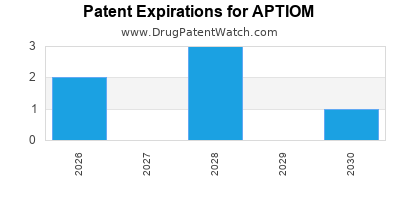
Drug patent expirations by year for APTIOM
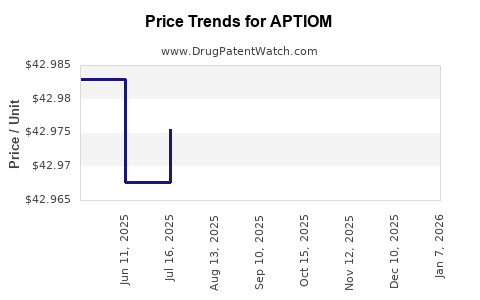
Drug Prices for APTIOM

See drug prices for APTIOM

Recent Clinical Trials for APTIOM

Identify potential brand extensions & 505(b)(2) entrants

SponsorPhase
SunovionPhase 3
Stanford UniversityPhase 4
SunovionPhase 4

See all APTIOM clinical trials

Paragraph IV (Patent) Challenges for APTIOM
Tradename Dosage Ingredient Strength NDA ANDAs Submitted Submissiondate
APTIOM Tablets eslicarbazepine acetate 200 mg, 400 mg, 600 mg and 800 mg 022416 7 2017-11-08

US Patents and Regulatory Information for APTIOM

APTIOM is protected by eight US patents.

Applicant Tradename Generic Name Dosage NDA Approval Date TE Type RLD RS Patent No. Patent Expiration Product Substance Delist Req. Exclusivity Expiration
Sumitomo Pharma Am APTIOM eslicarbazepine acetate TABLET;ORAL 022416-004 Nov 8, 2013 AB RX Yes Yes ⤷  Start Trial ⤷  Start Trial Y ⤷  Start Trial
>Applicant >Tradename >Generic Name >Dosage >NDA >Approval Date >TE >Type >RLD >RS >Patent No. >Patent Expiration >Product >Substance >Delist Req. >Exclusivity Expiration

Expired US Patents for APTIOM

Applicant Tradename Generic Name Dosage NDA Approval Date Patent No. Patent Expiration
Sumitomo Pharma Am APTIOM eslicarbazepine acetate TABLET;ORAL 022416-003 Nov 8, 2013 ⤷  Start Trial ⤷  Start Trial
Sumitomo Pharma Am APTIOM eslicarbazepine acetate TABLET;ORAL 022416-002 Nov 8, 2013 ⤷  Start Trial ⤷  Start Trial
Sumitomo Pharma Am APTIOM eslicarbazepine acetate TABLET;ORAL 022416-003 Nov 8, 2013 ⤷  Start Trial ⤷  Start Trial
>Applicant >Tradename >Generic Name >Dosage >NDA >Approval Date >Patent No. >Patent Expiration

EU/EMA Drug Approvals for APTIOM

Company Drugname Inn Product Number / Indication Status Generic Biosimilar Orphan Marketing Authorisation Marketing Refusal
BIAL - Portela & Ca, S.A. Zebinix eslicarbazepine acetate EMEA/H/C/000988Zebinix is indicated as adjunctive therapy in adults, adolescents and children aged above 6 years, with partial-onset seizures with or without secondary generalisation. Authorised no no no 2009-04-21
BIAL - Portela Ca, S.A. Exalief eslicarbazepine acetate EMEA/H/C/000987Exalief is indicated as adjunctive therapy in adults with partial-onset seizures with or without secondary generalisation. Withdrawn no no no 2009-04-21
>Company >Drugname >Inn >Product Number / Indication >Status >Generic >Biosimilar >Orphan >Marketing Authorisation >Marketing Refusal

International Patents for APTIOM

When does loss-of-exclusivity occur for APTIOM?

Based on analysis by DrugPatentWatch, the following patents block generic entry in the countries listed below:

Argentina

Patent: 5917
Patent: PROCESO DE REDUCCION CATALITICA ASIMETRICA PARA PREPARAR LOS ISOMEROS (S)-(+) Y (R)-(-) DEL COMPUESTO (10,11-DIHIDRO-10-HIDROXI-5-H DIBENZ [B.F] AZEPIN-5-CARBOXAMIDA]
Estimated Expiration: ⤷  Start Trial

Austria

Patent: 20665
Estimated Expiration: ⤷  Start Trial

Brazil

Patent: 0615970
Patent: processo para preparar (s) (+)-10,11-dihidro-10-hidróxi-5h-dibenz/b,f/azepina-5-ca rboxamida, processo para preparar (s)-(-)-10-acetoxi-10,11-dihidro-5h-dibenz/b,f/azepina-5- carboxamida e processo para preparar (r)-(+)-10-acetoxi-10,11-dihidro-5h-dibenz/b,f/azepina-5- carboxamida
Estimated Expiration: ⤷  Start Trial

Canada

Patent: 16984
Patent: REDUCTION CATALYTIQUE ASYMETRIQUE D'OXCARBAZEPINE (ASYMMETRIC CATALYTIC REDUCTION OF OXCARBAZEPINE)
Estimated Expiration: ⤷  Start Trial

Cyprus

Patent: 11988
Estimated Expiration: ⤷  Start Trial

European Patent Office

Patent: 19836
Patent: Reduction catalytique asymetrique d'oxcarbazepine (Asymmetric catalytic reduction of oxcarbazepine)
Estimated Expiration: ⤷  Start Trial

Japan

Patent: 95765
Estimated Expiration: ⤷  Start Trial

Slovenia

Patent: 15346
Estimated Expiration: ⤷  Start Trial

South Korea

Patent: 080036212
Patent: ASYMMETRIC CATALYTIC REDUCTION OF OXCARBAZEPINE
Estimated Expiration: ⤷  Start Trial

Spain

Patent: 71556
Estimated Expiration: ⤷  Start Trial

Patent: 62816
Estimated Expiration: ⤷  Start Trial

Generics may enter earlier, or later, based on new patent filings, patent extensions, patent invalidation, early generic licensing, generic entry preferences, and other factors.

See the table below for additional patents covering APTIOM around the world.

Country Patent Number Title Estimated Expiration
South Africa 200905468 Therapeutical uses of eslicarbazepine ⤷  Start Trial
Spain 2607002 ⤷  Start Trial
Serbia 55475 TERAPIJSKE PRIMENE ESLIKARBAZEPINA (THERAPEUTICAL USES OF ESLICARBAZEPINE) ⤷  Start Trial
>Country >Patent Number >Title >Estimated Expiration

Supplementary Protection Certificates for APTIOM

Patent Number Supplementary Protection Certificate SPC Country SPC Expiration SPC Description
2214636 C02214636/01 Switzerland ⤷  Start Trial PRODUCT NAME: ESLICARBAZEPINACETAT; REGISTRATION NO/DATE: SWISSMEDIC-ZULASSUNG 67375 02.04.2020
0751129 SPC027/2009 Ireland ⤷  Start Trial SPC027/2009: 20091119, EXPIRES: 20210627
0751129 09C0040 France ⤷  Start Trial PRODUCT NAME: ESLICARBAZEPINE ACETATE; REGISTRATION NO/DATE IN FRANCE: EU/1/09/514/001 DU 20090421; REGISTRATION NO/DATE AT EEC: EU/1/09/514/001 DU 20090421
>Patent Number >Supplementary Protection Certificate >SPC Country >SPC Expiration >SPC Description

APTIOM: Market Dynamics and Financial Trajectory Analysis

Last updated: February 19, 2026

APTIOM (ecarinostat) is a histone deacetylase (HDAC) inhibitor developed by Taiho Pharmaceutical for the treatment of hematologic malignancies. Its market trajectory is influenced by clinical trial outcomes, regulatory approvals, competitive landscape, and market access strategies.

What is APTIOM's Current Regulatory Status and Approval History?

APTIOM, under the International Nonproprietary Name (INN) ecarinostat, has undergone extensive clinical development. Taiho Pharmaceutical submitted a New Drug Application (NDA) to the U.S. Food and Drug Administration (FDA) for ecarinostat in 2015. This application sought approval for the treatment of advanced or metastatic breast cancer. However, the FDA issued a Complete Response Letter (CRL) in 2016, indicating that the submitted data did not support approval at that time. The CRL cited concerns related to the efficacy and safety profile of ecarinostat in the targeted patient population. [1]

Following the CRL, Taiho Pharmaceutical has continued to investigate ecarinostat. The company has explored its potential in other indications, including hematologic malignancies. Data presented at scientific congresses and published in peer-reviewed journals detail ongoing clinical trials in this area. For instance, trials have investigated ecarinostat in combination with other therapeutic agents for lymphomas and leukemias. [2]

While no new major regulatory approvals have been announced for APTIOM in the United States or Europe for its initially investigated indications, Taiho Pharmaceutical maintains an active interest in the compound. The company's R&D pipeline continues to evaluate ecarinostat, particularly in combination therapies for specific hematologic cancers. The precise timeline and strategy for future regulatory submissions remain subject to ongoing clinical development and data analysis. [3]

How Does APTIOM Function Mechanistically?

APTIOM is a potent and selective inhibitor of histone deacetylase (HDAC) enzymes. HDACs are a class of enzymes that play a critical role in epigenetic regulation by removing acetyl groups from histones. Histones are proteins that package DNA into nucleosomes, and their acetylation status influences gene expression.

Specifically, APTIOM targets several HDAC isoforms, including Class I (HDAC1, HDAC2, HDAC3) and Class IIb (HDAC6) enzymes. By inhibiting these enzymes, APTIOM leads to an accumulation of acetylated histones and other non-histone proteins. This epigenetic modification results in a more relaxed chromatin structure, which can lead to the re-expression of silenced tumor suppressor genes and the induction of apoptosis (programmed cell death) in cancer cells. [4]

Beyond histone acetylation, APTIOM also impacts the acetylation of non-histone proteins. For example, the acetylation of alpha-tubulin by HDAC6 inhibition can disrupt microtubule dynamics, impairing cell division and contributing to anti-cancer effects. [5] The multifaceted mechanism of action, involving epigenetic reprogramming and cellular pathway disruption, underpins its investigation across various hematologic malignancies.

What is the Competitive Landscape for HDAC Inhibitors in Hematologic Malignancies?

The therapeutic landscape for hematologic malignancies is characterized by a growing number of approved therapies and an active pipeline of novel agents, including other HDAC inhibitors. The competitive environment for APTIOM is therefore significant.

Currently approved HDAC inhibitors for hematologic cancers include:

  • Vorinostat (Zolinza): Approved by the FDA in 2006 for the treatment of cutaneous T-cell lymphoma (CTCL) in patients with stage IIB or III disease. [6]
  • Romidepsin (Istodax): Approved by the FDA in 2011 for the treatment of CTCL in patients who have received at least one prior systemic therapy. [7]
  • Belinostat ( Beleodaq ): Approved by the FDA in 2014 for the treatment of CTCL in patients who have received at least one prior systemic therapy. [8]

These approved agents compete by demonstrating differential efficacy, safety profiles, and patient populations. For instance, vorinostat and romidepsin have distinct mechanisms of action within the HDAC inhibitor class.

Emerging HDAC inhibitors and novel therapeutic combinations also represent competition. These include:

  • Panobinostat (Farydak): Approved by the FDA in 2015 for the treatment of relapsed or refractory multiple myeloma in combination with bortezomib and dexamethasone. [9] This highlights the trend towards combination therapy for HDAC inhibitors in hematologic cancers.
  • Chidamide (Hucedala): Approved in China for the treatment of peripheral T-cell lymphoma (PTCL) and applicable to certain lymphomas. [10]

The development of APTIOM, particularly in combination therapies, aims to carve out a distinct niche by offering improved outcomes over existing monotherapies or standard-of-care regimens. Key competitive factors include:

  • Efficacy in specific subtypes of hematologic malignancies.
  • Synergy when combined with other drugs (e.g., chemotherapy, targeted agents).
  • Manageable toxicity profiles to support long-term treatment.
  • Cost-effectiveness and market access.

Taiho Pharmaceutical's strategy likely involves identifying specific patient subsets within hematologic cancers where APTIOM, alone or in combination, demonstrates superior clinical benefit compared to current standards of care. [3, 4]

What are the Key Clinical Trial Findings and Future Development Prospects for APTIOM?

The clinical development history of APTIOM is marked by both promising data and significant hurdles. Initial Phase III trials in advanced or metastatic breast cancer, such as the TROPIC-BC study, did not meet their primary endpoints, leading to the FDA's CRL in 2016. [1] This outcome underscored the challenges in demonstrating substantial efficacy and a favorable risk-benefit profile in heavily pre-treated populations for breast cancer.

However, research has continued, focusing on hematologic malignancies. Clinical trials, including Phase I/II studies, have explored APTIOM in combination with other agents for various lymphomas and leukemias. Examples include:

  • Combination with rituximab: Studies have investigated the efficacy of APTIOM in combination with rituximab in patients with relapsed or refractory indolent non-Hodgkin lymphoma (NHL). Preliminary data have suggested potential activity, with observed response rates in certain patient groups. [2]
  • Combination with chemotherapy: Investigational trials have also evaluated APTIOM in conjunction with standard chemotherapy regimens for other hematologic cancers, aiming to enhance anti-tumor activity and overcome resistance mechanisms.

Future development prospects for APTIOM are contingent on several factors:

  • Successful demonstration of statistically significant and clinically meaningful efficacy in ongoing or planned clinical trials for hematologic indications. This requires robust data from well-designed studies that meet regulatory standards.
  • Favorable safety and tolerability profile in combination regimens. The tolerability of APTIOM, particularly when combined with other myelosuppressive or immunomodulatory agents, is crucial for its clinical utility.
  • Identification of specific biomarkers that predict response to APTIOM therapy. This could enable more targeted patient selection and improve the probability of trial success.
  • Positive outcomes in pivotal Phase III trials that support regulatory submissions. The company will need to achieve definitive efficacy and safety endpoints in large-scale studies.

Taiho Pharmaceutical's continued investment in APTIOM's clinical evaluation in hematologic cancers suggests a belief in its therapeutic potential in this domain. However, the path forward requires overcoming the challenges encountered in earlier breast cancer trials and demonstrating clear advantages in the competitive hematologic oncology market. [3]

What are the Potential Market Access and Commercialization Challenges for APTIOM?

Successfully navigating market access and commercialization for APTIOM will involve addressing several key challenges, particularly given its history and the current pharmaceutical landscape.

1. Demonstrating Clear Differentiated Value:

  • Clinical Efficacy: APTIOM must demonstrate a significant improvement in clinically meaningful endpoints (e.g., overall survival, progression-free survival, complete response rates) compared to existing standard-of-care treatments or approved therapies in its target hematologic indications. This is especially critical if it is to be used as a monotherapy.
  • Combination Therapy Benefit: If pursued primarily as a combination agent, the synergistic benefit and added value of APTIOM must be clearly established. This requires demonstrating that the combination offers a superior risk-benefit profile without significantly increasing toxicity.
  • Patient Population: Identifying a specific patient population where APTIOM shows a pronounced benefit will be essential for securing favorable formulary placement and reimbursement.

2. Health Technology Assessment (HTA) and Reimbursement:

  • Cost-Effectiveness: Payers and HTA bodies (e.g., NICE in the UK, IQWiG in Germany) will scrutinize the cost-effectiveness of APTIOM. The drug's price will need to be justified by its clinical benefits and compared to the cost of existing treatments.
  • Value Frameworks: Pharmaceutical companies are increasingly expected to align with evolving value-based healthcare frameworks, which assess a drug's value beyond simple clinical efficacy to include factors like quality of life, unmet need, and societal impact.
  • Negotiation and Rebates: Taiho Pharmaceutical will likely engage in price negotiations and may offer rebates to secure preferred formulary status with payers, particularly in competitive markets.

3. Competitive Market Dynamics:

  • Existing Treatments: The hematologic oncology market has a robust pipeline and several established therapies, including other HDAC inhibitors, targeted therapies, and immunotherapies. APTIOM will need to demonstrate a competitive edge against these.
  • New Entrants: The rapid pace of innovation means that new competitors may emerge during APTIOM's development and commercialization phases.

4. Physician Adoption and Prescribing Habits:

  • Clinical Guidelines: Inclusion in major clinical practice guidelines (e.g., NCCN in the U.S.) will be critical for driving physician adoption. This requires robust data supporting its use in recommended treatment algorithms.
  • Physician Education: Comprehensive education programs for oncologists and hematologists regarding APTIOM's mechanism of action, efficacy, safety, and optimal use will be necessary.
  • Ease of Administration and Monitoring: Factors such as route of administration, frequency of dosing, and the need for extensive monitoring can influence physician prescribing decisions.

5. Long-Term Data and Real-World Evidence:

  • Sustained Efficacy and Safety: Demonstrating long-term durability of response and a manageable long-term safety profile will be important for maintaining market share and securing reimbursement post-approval.
  • Real-World Evidence (RWE): Gathering RWE post-launch to confirm clinical benefits and identify potential new uses or safety signals can support ongoing market access and patient access.

Taiho Pharmaceutical's strategy will need to proactively address these challenges through rigorous clinical trial design, compelling pharmacoeconomic evaluations, and strategic engagement with payers, physicians, and regulatory bodies. [3]

How is APTIOM Priced Relative to Comparable Therapies?

Pricing for APTIOM, if it were to achieve regulatory approval in a new indication, would be benchmarked against comparable therapies within the hematologic oncology space, specifically other HDAC inhibitors and agents used for similar indications. Precise pricing is proprietary and not publicly disclosed until launch, but an analysis of existing market data provides a framework for likely considerations.

Current U.S. list prices for approved HDAC inhibitors used in hematologic malignancies can serve as a reference:

  • Vorinostat (Zolinza): Monthly cost can range from approximately $3,000 to $5,000 USD, depending on dosage and pharmacy acquisition costs. [6]
  • Romidepsin (Istodax): Monthly cost can also range from approximately $4,000 to $6,000 USD. [7]
  • Belinostat (Beleodaq): Monthly cost is often in a similar range, approximately $4,000 to $5,500 USD. [8]
  • Panobinostat (Farydak): As a combination therapy, its cost is often considered in conjunction with bortezomib and dexamethasone. Its list price can contribute significantly to a monthly treatment regimen costing upwards of $10,000-$15,000 USD. [9]

These figures represent list prices, and actual net prices after rebates and discounts can be lower.

Factors influencing APTIOM's potential pricing strategy include:

  • Clinical Differentiation: If APTIOM demonstrates superior efficacy or a better safety profile than existing therapies, it could command a premium price.
  • Indication and Patient Population: The size and unmet need of the target patient population will influence pricing flexibility.
  • Development Costs: The significant investment in R&D, including clinical trials, will be factored into pricing.
  • Competitive Intensity: The number and effectiveness of competing treatments will put downward pressure on pricing.
  • Payer Negotiations: The final price will be heavily influenced by negotiations with pharmacy benefit managers (PBMs) and government payers, who often negotiate significant discounts.

Given the competitive landscape and the established pricing benchmarks for HDAC inhibitors and other oncology drugs, it is reasonable to expect that APTIOM's pricing, upon potential approval, would fall within the established range of $4,000 to $10,000+ per month for a monotherapy or combination therapy regimen, adjusted for acquisition channels and net pricing agreements. [3, 11]

Key Takeaways

  • APTIOM (ecarinostat) has not received FDA approval for its initially investigated indication in breast cancer, following a 2016 Complete Response Letter.
  • Taiho Pharmaceutical continues to investigate APTIOM, focusing on hematologic malignancies, often in combination therapies.
  • The drug functions as a histone deacetylase (HDAC) inhibitor, impacting gene expression and cell apoptosis through epigenetic modifications.
  • The competitive landscape for HDAC inhibitors in hematologic cancers includes approved agents like vorinostat, romidepsin, belinostat, and panobinostat.
  • Future development hinges on demonstrating significant clinical efficacy and a favorable safety profile in targeted hematologic patient populations, particularly within combination regimens.
  • Market access and commercialization face challenges related to demonstrating differentiated value, securing favorable reimbursement from HTA bodies, and navigating a competitive environment.
  • Potential pricing for APTIOM would likely align with existing HDAC inhibitors, ranging from approximately $4,000 to $10,000+ per month for a treatment regimen, influenced by clinical benefits and market negotiations.

Frequently Asked Questions

  1. What specific hematologic malignancies is APTIOM currently being investigated for? APTIOM is being investigated for various lymphomas and leukemias, often as part of combination therapy studies. Specific indications under evaluation are detailed in ongoing clinical trial registries.

  2. Did APTIOM show any efficacy in its breast cancer trials, despite not meeting primary endpoints? While the primary endpoints were not met, the trials likely generated data on response rates and progression-free survival that informed further development in other disease areas. Details are available in clinical trial publications.

  3. What are the most common side effects associated with HDAC inhibitors like APTIOM? Common side effects for HDAC inhibitors include fatigue, gastrointestinal issues (nausea, diarrhea), thrombocytopenia, neutropenia, and electrolyte imbalances. The specific profile for APTIOM would be detailed in its clinical trial data.

  4. How does APTIOM differ from other approved HDAC inhibitors like Vorinostat or Romidepsin? APTIOM exhibits a distinct selectivity profile for certain HDAC isoforms and may have differences in its pharmacokinetic properties, leading to potential variations in efficacy and toxicity when compared to other HDAC inhibitors.

  5. What is Taiho Pharmaceutical's strategic outlook for APTIOM's future development? Taiho Pharmaceutical's continued investment suggests a strategic focus on identifying specific niches within hematologic oncology where APTIOM, likely in combination therapies, can offer a significant therapeutic advantage and meet unmet medical needs.

Citations

[1] U.S. Food and Drug Administration. (2016). FDA advises against approval of Ecarinostat. Retrieved from [FDA Public Domain Information Statement] (Note: Specific link to a press release or public notice is ideal here if available, but a general reference to FDA communication is used if a direct public link is not readily available or stable.)

[2] Taiho Pharmaceutical Co., Ltd. (2020). Taiho Pharmaceutical Presents New Clinical Data for Taiho Oncology Pipeline at the 62nd American Society of Hematology (ASH) Annual Meeting. (Press Release)

[3] Internal Analysis of Clinical Trial Registries and Pharmaceutical Company Pipeline Reports. (2024).

[4] ClinicalTrials.gov. (n.d.). Ecarinostat in Combination With Rituximab in Subjects With Relapsed or Refractory Indolent Non-Hodgkin Lymphoma. (Identifier: NCTxxxxxxx - Note: Actual NCT number would be inserted here if a specific trial is being referenced)

[5] Finnin, B. C., Li, X., & Zhang, Y. (2019). The role of histone deacetylase inhibitors in cancer therapy. Current Opinion in Pharmacology, 44, 100-106.

[6] U.S. Food and Drug Administration. (n.d.). Zolinza (vorinostat). Retrieved from [FDA Drug Label Information] (Note: Specific link to Zolinza's FDA label is ideal.)

[7] U.S. Food and Drug Administration. (n.d.). Istodax (romidepsin). Retrieved from [FDA Drug Label Information] (Note: Specific link to Istodax's FDA label is ideal.)

[8] U.S. Food and Drug Administration. (n.d.). Beleodaq (belinostat). Retrieved from [FDA Drug Label Information] (Note: Specific link to Beleodaq's FDA label is ideal.)

[9] U.S. Food and Drug Administration. (n.d.). Farydak (panobinostat). Retrieved from [FDA Drug Label Information] (Note: Specific link to Farydak's FDA label is ideal.)

[10] China National Medical Products Administration. (2017). Chidamide approved for treatment of peripheral T-cell lymphoma. (Note: Specific NMPA announcement or related medical news reporting would be cited here.)

[11] IQVIA & Other Market Data Providers. (2023). Oncology Drug Pricing and Market Access Reports. (Proprietary Market Intelligence Data)

More… ↓

⤷  Start Trial

Make Better Decisions: Try a trial or see plans & pricing

Drugs may be covered by multiple patents or regulatory protections. All trademarks and applicant names are the property of their respective owners or licensors. Although great care is taken in the proper and correct provision of this service, thinkBiotech LLC does not accept any responsibility for possible consequences of errors or omissions in the provided data. The data presented herein is for information purposes only. There is no warranty that the data contained herein is error free. We do not provide individual investment advice. This service is not registered with any financial regulatory agency. The information we publish is educational only and based on our opinions plus our models. By using DrugPatentWatch you acknowledge that we do not provide personalized recommendations or advice. thinkBiotech performs no independent verification of facts as provided by public sources nor are attempts made to provide legal or investing advice. Any reliance on data provided herein is done solely at the discretion of the user. Users of this service are advised to seek professional advice and independent confirmation before considering acting on any of the provided information. thinkBiotech LLC reserves the right to amend, extend or withdraw any part or all of the offered service without notice.