Last updated: July 27, 2025
Introduction
Aminocaproic acid (ACA), a potent antifibrinolytic agent, has established a significant foothold within hemostasis management across various clinical settings. Approved primarily for controlling bleeding associated with hyperfibrinolytic states, ACA’s evolution in the pharmaceutical landscape reflects ongoing medical needs, regulatory frameworks, and pricing strategies. This article examines the complex market dynamics shaping ACA’s trajectory, alongside its financial prospects within the broader pharmaceutical ecosystem.
Market Overview and Clinical Demand
Aminocaproic acid’s core indication involves mitigating excessive bleeding episodes stemming from surgeries, trauma, or hematologic disorders. Its mechanism—reversible inhibition of plasminogen activation—renders it effective against hyperfibrinolytic conditions such as primary fibrinolysis, post-surgical bleeding, and certain bleeding disorders (e.g., post-tooth extraction in hemophilia patients).
The global antifibrinolytic drugs market, estimated at over USD 800 million in 2022, is expected to grow at a CAGR of approximately 6% (source [1]), driven by rising surgical procedures, aging populations, and the increasing incidence of bleeding disorders. ACA’s segment remains competitive, complemented by newer agents like tranexamic acid; however, ACA retains preference in specific indications due to its proven efficacy and regulatory approvals in key markets such as the US, Europe, and Japan.
Regulatory and Patent Landscape
ACA’s regulatory landscape is relatively mature, with longstanding approvals that facilitate steady market access. Notably, generic formulations dominate the market, keeping prices under pressure but ensuring widespread accessibility. The expiration of patents for branded formulations has intensified price competition, limiting revenue growth potential for innovator companies. For instance, American Regent’s Amicar—a widely recognized brand—faced patent expiry in the early 2000s, leading to proliferation of generics.
Emerging markets, particularly in Asia, demonstrate expanding regulatory approvals, bolstering sales volumes. Conversely, in the US and Europe, stringent pharmacovigilance regulations and off-label use monitoring influence market development.
Market Drivers and Restraints
Drivers:
- Growing surgical procedures: The increase in major surgeries, including cardiac, orthopedic, and trauma services, elevates demand.
- Aging population: Older adults are more susceptible to bleeding complications and require hemostatic interventions.
- Bleeding disorder prevalence: Conditions like hemophilia and fibrinolytic states demand effective antifibrinolytics.
- Global expansion: Improved healthcare infrastructure in emerging markets broadens ACA’s reach.
Restraints:
- Competing agents: Tranexamic acid, being more potent and having a better safety profile in some contexts, has eroded ACA’s market share.
- Safety concerns: Potential thromboembolic risks associated with ACA necessitate cautious use, impacting market acceptance.
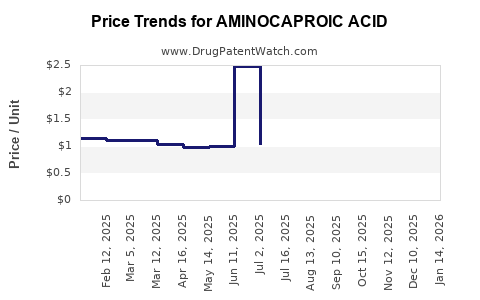
- Pricing pressures: Generic proliferation translates to thin profit margins, restricting revenue growth.
- Limited indications: Unlike broader spectrum anticoagulants, ACA’s narrow approval scope constrains market expansion.
Competitive Landscape
Several pharmaceutical companies dominate ACA production through generics, including American Regent, Hospira (a Pfizer division), and Teva Pharmaceuticals. These companies focus on cost-effective manufacturing, ensuring accessibility in price-sensitive markets.
The emergence of tranexamic acid (TXA) has particularly challenged ACA. Due to its higher potency, longer shelf-life, and wider approval base, TXA has become the antifibrinolytic of choice globally. Nevertheless, ACA maintains niche applications, especially where specific patient profiles or institutional protocols favor its use.
Financial Trajectory and Revenue Projections
Given the current market conditions—prevalence of generics, increased surgical volume, and emerging market penetration—the financial outlook for ACA remains moderate but stable:
- Revenue stability: For leading producers, revenues hover around USD 50–100 million annually, with modest growth prospects.
- Margins: Limited due to price erosion but compensated by high-volume sales in emerging markets.
- Innovation and pipeline: No substantial new formulations or indications are on the immediate horizon, constraining significant revenue jumps.
Long-term financial forecasts predict a compound annual growth rate (CAGR) of approximately 2-3% over the next five years, primarily driven by volume expansion rather than price increases. Companies integrating ACA into comprehensive bleeding management portfolios stand to benefit from cross-selling and institutional protocols.
Emerging Opportunities and Challenges
Opportunities:
- Combination therapies: Synergistic use with other hemostatic agents to enhance efficacy.
- New indications: Off-label expansion in trauma or cardiopulmonary settings could broaden usage, pending safety validation.
- Biosimilars and generics: Entry of low-cost generics in emerging markets will sustain volume growth.
Challenges:
- Safety and efficacy concerns: Long-standing data support ACA’s use, but side effect profiles demand ongoing surveillance.
- Competitive landscape: The rise of TXA and other advanced agents limits ACA’s market share.
- Pricing pressures: High generic competition continues to compress margins.
Conclusion
Aminocaproic acid’s market remains characterized by stability, driven by medical necessity and widespread approval. However, its growth trajectory faces headwinds from increasing competition, evolving safety profiles, and regulatory considerations. Companies adept at leveraging emerging markets, optimizing cost efficiencies, and exploring novel combination therapies may sustain or modestly expand their financial footprint.
Key Takeaways
- ACA sustains a stable niche in antifibrinolytic treatment, primarily benefiting from predictable demand in surgical and bleeding disorder management.
- Generic competition has intensified pricing pressures, limiting margin expansion but ensuring broad access.
- The rise of tranexamic acid presents a significant competitive challenge, relegating ACA predominantly to specialized indications.
- Emerging markets offer increased volume potential; companies should focus on regulatory approvals and distribution channels in these regions.
- Future growth hinges on expanding indications, enhancing safety profiles, and integrating ACA within multimodal hemostatic strategies.
FAQs
1. What are the main clinical indications for aminocaproic acid?
ACA is primarily indicated for controlling bleeding associated with hyperfibrinolytic states, such as post-surgical hemorrhage, traumatic bleeding, and bleeding in hemophilia patients.
2. How does aminocaproic acid compare to tranexamic acid?
While both are antifibrinolytics, tranexamic acid is more potent, has a longer half-life, and is approved for a broader range of conditions, making it more popular globally. ACA remains favored in specific contexts based on clinical protocols or institutional preferences.
3. What is the impact of generic competition on ACA’s market?
It leads to significant price erosion, limiting revenue growth but ensuring widespread affordability and access. It also discourages large investments in new formulations or indications.
4. Are there new developments or formulations in the pipeline for ACA?
Currently, no major innovations or additional indications are in advanced development stages. The focus remains on optimizing existing formulations and expanding regulatory approvals in emerging markets.
5. What are future opportunities for ACA manufacturers?
Opportunities include expanding use in niche indications, leveraging emerging markets for volume growth, exploring combination therapies, and ensuring safety profiles to maintain institutional trust.
Sources:
[1] MarketsandMarkets. "Antifibrinolytic Drugs Market," 2022.