Last updated: April 25, 2026
What is the global market footprint for albendazole?
Albendazole is a long-established, off-patent anthelmintic used for helminth infections in humans and animals. The market is defined by (1) endemic disease burden in low- and middle-income geographies, (2) procurement programs, and (3) intense generic competition. Pricing is driven by tender cycles, donor-funded purchasing, and local regulatory approvals rather than brand differentiation.
Market structure (practical view)
- Human medicines: Predominantly generic oral tablets/suspensions supplied into national programs and private distribution.
- Veterinary medicines: Powder/granule and oral formulations for livestock and companion animals in markets where livestock health programs and parasite control are recurring.
- Winners in commercial terms: manufacturers with (a) low-cost supply chains, (b) large-scale API and solid-dosage capacity, (c) portfolio breadth across dose forms and strengths, and (d) regulatory filing throughput for multiple markets.
Demand drivers
- Infection prevalence (roundworms, hookworms, tapeworms, strongyloides, and related indications where albendazole is used).
- Public health procurement cadence (batch purchasing tied to school-age deworming and mass drug administration cycles).
- Availability of combination regimens (where albendazole is used alongside other antiparasitics, affecting per-dose volume allocation).
How does regulatory and procurement shape pricing power?
Albendazole’s financial trajectory is constrained by generic substitution and by tender-based purchasing. That yields a market where gross margin is largely determined by manufacturing cost, regulatory overhead per jurisdiction, and logistics.
Pricing mechanics
- Low differentiation: Multiple approved generic equivalents compete on bioavailability compliance and price.
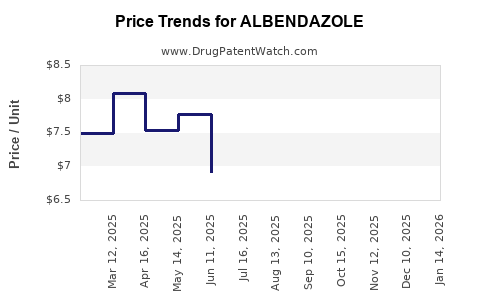
- Tender pressure: Bulk procurement typically sets a clearing price that compresses unit margins.
- Regulatory friction: Companies that can rapidly maintain registrations and meet pharmacovigilance requirements sustain supply continuity, which is often more valuable than premium pricing.
Procurement channels
- Public sector and donor-supported programs (volume-driven, price-discovery through bids).
- Private retail and hospital channels (typically higher variability, but still heavily generic-led).
What is the financial trajectory profile for albendazole?
Albendazole’s financial path follows an “off-patent maturity” pattern: stable global unit demand with recurring procurement cycles, while revenue growth is mostly volume-led. Profitability tends to be pressured over time as new suppliers enter and prices trend toward cost-plus levels.
Core trajectory characteristics
- Revenue growth: Mostly linked to population coverage, program frequency, and geographic expansion of procurement rather than brand-led growth.
- Margin profile: Wide variance by cost position and scale. Large suppliers can defend margins longer via scale economics and API vertical integration.
- CAPEX and compliance spend: Ongoing rather than occasional. Players that treat compliance as a continuous cost base protect throughput and supply continuity.
Typical industry outcomes in this category
- Consolidation among large generic manufacturers and API-led suppliers.
- Persistent price erosion in regions where tenders open to more bidders.
- Stable demand, but earnings volatility driven by raw material costs, exchange rates, and tender award timing.
How do manufacturing and API economics influence albendazole profitability?
Albendazole is manufactured as a solid oral medicine. The financial outcome depends on (1) API sourcing and conversion yields, (2) polymorph control and batch acceptance, (3) stability and formulation validation, and (4) supply chain reliability for timely tender fulfillment.
Cost drivers
- API procurement and synthesis economics.
- Conversion costs: granulation/compression, coating, packaging line utilization.
- Regulatory batch testing and stability commitments.
- Working capital tied to procurement lead times.
Margin sensitivities
- Unit pricing tends to move faster than input costs, so periods of strong demand can coexist with weak profitability if supply is misaligned or if tender competition intensifies.
- Quality failures (batch rejection) can create disproportionate losses in off-patent markets due to rework and missed shipment windows.
What does the competitive landscape imply for market share movement?
Albendazole’s market dynamics are dominated by generic equivalence and supply reliability. Market share shifts happen through:
- New approvals and registrations enabling tender eligibility.
- Consistent production capacity that avoids stockouts during program windows.
- Price aggressiveness at bid time, tempered by the supplier’s ability to sustain margins.
Competition by commercial model
- Scale manufacturers: compete on cost, breadth of strengths, and distribution reach.
- Niche or regionally focused entrants: compete on responsiveness to local tenders and filing speed.
- API-to-finished integrated players: often sustain competitiveness through lower landed cost and tighter quality control.
How does indication mix affect revenue durability?
Albendazole revenue durability is supported by broad antiparasitic coverage rather than a narrow indication set. Even where clinical practice shifts within helminthiasis management, albendazole remains a commonly used option due to guideline alignment and established efficacy.
Indication resilience
- Broad use in intestinal helminth infections.
- Continued role in mass deworming programs for school-age populations, where albendazole is frequently selected for its dosing profile and program logistics.
What are the main market risks that affect financial outcomes?
The risk profile is less about patent expiry and more about market access, procurement behavior, and supply chain continuity.
Key risks
- Price erosion: entry of additional generic suppliers reduces average net pricing.
- Tender concentration: losing a major bid can cause sharp short-term revenue dips because orders are lumpy.
- Regulatory and quality events: batch failures or compliance findings can pause shipments and damage inclusion in procurement panels.
- Input price swings: API and excipient costs can move out of sync with tender contract pricing.
- Policy shifts: changes in deworming strategies and selection criteria for antiparasitics can alter dosing volume allocation.
Where does albendazole sit in patent and exclusivity reality?
Albendazole is an established molecule with no meaningful worldwide patent-led revenue protection structure in the way modern specialty drugs enjoy. This structurally pushes the financial outcome toward generic-market norms: large volume, low margin, and high execution importance in manufacturing and compliance.
How can stakeholders model albendazole’s financial trajectory?
A practical modeling approach is to treat albendazole as a “program plus retail” generic commodity with differentiated execution.
Revenue model
- Volume = (endemic population covered) x (dose frequency per program cycle) + (private consumption baseline).
- Net revenue = Volume x (tender-clearing price blended with private channel pricing).
- Price decay = gradual erosion driven by supplier count and bid aggressiveness.
Cost and margin model
- COGS = API + conversion + QC + packaging + logistics.
- Gross margin = driven by scale utilization, yield, and QA pass rates.
- Operating expense = regulatory filings, pharmacovigilance, sales execution, and working capital costs.
Key indicators to monitor for albendazole financial direction
For business and investment use, track indicators that move revenue and margin before annual financial reporting:
- Tender participation and award outcomes in major endemic purchasing regions.
- Net pricing trends versus public list prices (tender vs retail gap).
- Manufacturing compliance: batch release timelines, stability results, and any regulator actions.
- Registration pipeline health in priority countries (approval lead time and renewal timing).
- API supply stability and synthesis yield metrics.
- Exchange rate and freight impacts on landed cost for bulk procurement.
Market and financial outlook summary (directional)
Albendazole’s financial trajectory is expected to remain stable on volume, with revenue growth driven by program coverage and geographic distribution rather than product differentiation. Profitability will remain sensitive to cost position and to tender-cycle outcomes. Competitive intensity in generics typically caps sustained pricing power, turning execution and regulatory throughput into the primary determinants of earnings.
Key Takeaways
- Albendazole’s market is mature and generic-dominated; pricing power is limited and tender cycles drive net revenue.
- Financial growth is largely volume-led (program coverage and access), while margins depend on manufacturing cost, quality throughput, and regulatory execution.
- Competitive share shifts occur via registrations, supply reliability, and bid pricing rather than innovation-led differentiation.
- The risk profile is procurement and compliance focused: losing tender inclusion or experiencing quality issues can materially disrupt revenue and margins.
FAQs
-
Is albendazole’s market growth innovation-led or procurement-led?
Procurement-led. Volume demand is tied to endemic disease programs and tender cycles, with innovation playing a minimal role in market economics.
-
What most determines albendazole margins in practice?
Manufacturing cost position, batch acceptance rate, scale utilization, and logistics tied to shipment windows for tenders.
-
Why can albendazole revenue look stable even as prices fall?
Unit volume can increase through broader coverage or recurring program cycles, offsetting price erosion.
-
What is the biggest commercialization risk for a generic albendazole supplier?
Losing inclusion in major procurement tenders or shipment timing due to quality/compliance failures or capacity constraints.
-
Does indication mix materially change albendazole’s financial durability?
It changes demand composition, but overall durability remains anchored by broad helminth coverage and recurring deworming use.
References (APA)
[1] World Health Organization. (2011). Preventive chemotherapy in human helminthiasis: Coordinated use of anthelminthic drugs in control interventions (Third edition). WHO.
[2] World Health Organization. (2023). Weekly epidemiological record: Updates on mass drug administration and preventive chemotherapy guidance. WHO.
[3] European Medicines Agency. (n.d.). Public assessment reports and product information for albendazole-containing medicines. EMA.
[4] US Food and Drug Administration. (n.d.). Orange Book: Approved Drug Products with Therapeutic Equivalence Evaluations (albendazole entries). FDA.