Last updated: February 20, 2026
What is the Role of Acetic Acid in Pharmaceutical Applications?
Acetic acid, a simple carboxylic acid known for its role in vinegar, has limited direct application as a pharmaceutical active ingredient. Its primary medical use involves its derivative, formic acid derivatives, or in the synthesis of pharmaceutical compounds. It is also used in topical treatments, disinfectants, and as a solvent.
In medicine, acetic acid solutions at specific concentrations are employed for procedures like vaginal acetic acid for detection of cervical lesions ([1]). It is also a precursor in the manufacturing of pharmaceuticals such as glyceryl esters and acetic acid derivatives used in anti-inflammatory drugs.
What Are the Market Drivers and Constraints?
Market Drivers
- Medical Diagnostic Use: The use in colposcopy procedures to visualize cervical intraepithelial neoplasia (CIN) triggers steady demand.
- Pharmaceutical Synthesis: The demand for acetic acid derivatives in drug manufacturing sustains industry activity.
- Industrial Growth: Increased manufacturing of acetylated pharmaceuticals and disinfectants drives overall demand.
- Regulatory Environment: Approved applications in medical diagnostics and sterilization maintain a predictable usage pattern.
Market Constraints
- Limited Direct Pharmacological Use: Acetic acid does not function as a primary therapeutic agent, limiting its standalone pharmaceutical market size.
- Environmental and Safety Regulations: Stringent disposal and handling restrictions influence production costs.
- Competition from Alternatives: Other solvents and diagnostic agents compete with acetic acid derivatives.
What Are the Market Trends and Future Outlook?
Industry Size and Growth
The global chemical industry reports a steady growth in acetic acid consumption, with estimates of approximately 11.5 million metric tons used industrially in 2020 ([2]). The pharmaceutical sector accounts for a modest but consistent fraction, driven by diagnostic and synthetic applications.
Investment and Production Capacity
Major global producers include Eastman Chemical, Celanese, and Mitsubishi, with total capacity exceeding 20 million metric tons annually ([3]). Over the next five years, capacities are expected to expand at a compounded annual growth rate (CAGR) of approximately 3-4% driven by demand in emerging markets.
Innovation and New Applications
Research explores acetic acid derivatives with improved bioavailability for anti-inflammatory and antimicrobial applications. These innovations could increase demand for high-purity acetic acid inputs.
Price Dynamics
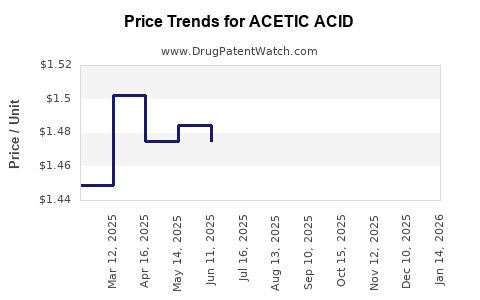
Average industrial acetic acid prices fluctuate between $400 and $600 per ton (2022 figures). Prices are impacted by raw material costs, mainly methanol, and global supply-demand factors.
Regulatory Impact
Stringent environmental standards impact production costs, especially in the European Union and North America, where emissions standards for chemical plants are strict ([4]).
How Does the Financial Trajectory Look?
Revenue Estimation
Given the modest pharmaceutical segment, revenue attributable purely to pharma applications is estimated at $500 million to $1 billion annually. The larger chemical market surpasses $40 billion globally, with acetic acid representing less than 2-3% of that total.
Profitability
Major producers report operating margins around 10-15%, reflecting stable demand but high capital and compliance costs.
Investment Outlook
Investments focus on:
- Increasing production efficiency.
- Developing high-value derivatives.
- Expanding capacity in emerging markets.
Risks
- Price volatility driven by raw material costs.
- Regulatory risk affecting production methods.
- Competitive pressure from alternative chemicals and solvents.
Summary Table
| Aspect |
Data |
| Global market size (chemical segment) |
>$40 billion (2022) |
| Acetic acid demand (2020) |
11.5 million metric tons |
| Key producers |
Eastman, Celanese, Mitsubishi |
| Price range (2022) |
$400 - $600 per ton |
| CAGR (next 5 years) |
3-4% |
| Estimated pharma revenue |
$500 million – $1 billion |
| Operating margins |
10-15% |
Key Takeaways
- The pharmaceutical application of acetic acid is limited but essential in diagnostics and chemical synthesis.
- Industry growth is moderate, supported by demand in diagnostics and manufacturing.
- Capacity expansion and innovation in derivatives could elevate future demand.
- Price stability is influenced by raw materials and regulatory pressures.
- The overall market remains small relative to the broader chemical industry but demonstrates consistent stability.
FAQs
1. Is acetic acid a primary drug in medicine?
No. It is used mainly in diagnostic procedures and as a chemical precursor, not as a standalone therapeutic.
2. Which industries are the largest consumers of acetic acid?
The chemical manufacturing sector dominates, with secondary use in pharmaceuticals, disinfectants, and plastics.
3. What regulatory challenges affect acetic acid production?
Environmental regulations like the EU's REACH and Clean Air Act in the US impose strict emissions standards, impacting manufacturing costs.
4. How does raw material price fluctuation impact acetic acid prices?
Most acetic acid is derived from methanol; fluctuations in methanol prices translate directly into acetic acid pricing.
5. What are the prospects for innovation involving acetic acid derivatives?
Research into bioavailable anti-inflammatory and antimicrobial derivatives could expand commercial applications.
References
[1] National Center for Biotechnology Information. (2022). Use of acetic acid in medical diagnostics. PubMed.
[2] IHS Chemical. (2021). Global acetic acid market report.
[3] ICIS. (2022). 2022 Acetic Acid Capacity and Market Outlook.
[4] European Chemicals Agency. (2022). Regulatory standards for chemical manufacturing.