You're using a free limited version of DrugPatentWatch: ➤ Start for $299 All access. No Commitment.

Last Updated: December 12, 2025

Tropicamide - Generic Drug Details


✉ Email this page to a colleague

« Back to Dashboard


What are the generic sources for tropicamide and what is the scope of freedom to operate?

Tropicamide is the generic ingredient in four branded drugs marketed by Alcon, Alcon Labs Inc, Sandoz, Pharmafair, Epic Pharma Llc, Rising, Alcon Pharms Ltd, Bausch And Lomb, Miza Pharms Usa, Somerset Theraps Llc, and Watson Labs, and is included in fifteen NDAs. Additional information is available in the individual branded drug profile pages.

There are seven drug master file entries for tropicamide. Six suppliers are listed for this compound.

Summary for tropicamide
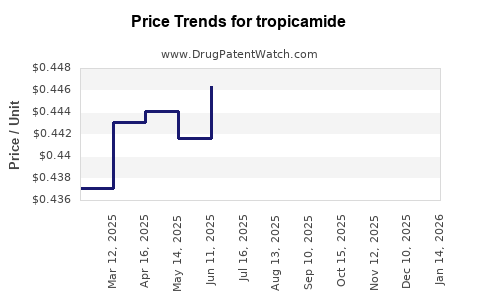
Drug Prices for tropicamide

See drug prices for tropicamide

Recent Clinical Trials for tropicamide

Identify potential brand extensions & 505(b)(2) entrants

SponsorPhase
Unither Pharmaceuticals, FrancePHASE1
Euromed Pharma Services SRLPHASE3
Consorzio per Valutazioni Biologiche e FarmacologichePHASE3

See all tropicamide clinical trials

Pharmacology for tropicamide
Drug ClassAnticholinergic
Mechanism of ActionCholinergic Antagonists
Medical Subject Heading (MeSH) Categories for tropicamide
Anatomical Therapeutic Chemical (ATC) Classes for tropicamide

US Patents and Regulatory Information for tropicamide

Applicant Tradename Generic Name Dosage NDA Approval Date TE Type RLD RS Patent No. Patent Expiration Product Substance Delist Req. Exclusivity Expiration
Pharmafair MYDRIAFAIR tropicamide SOLUTION/DROPS;OPHTHALMIC 088230-001 Sep 16, 1983 DISCN No No ⤷  Get Started Free ⤷  Get Started Free ⤷  Get Started Free
Alcon MYDRIACYL tropicamide SOLUTION/DROPS;OPHTHALMIC 012111-004 Approved Prior to Jan 1, 1982 DISCN No No ⤷  Get Started Free ⤷  Get Started Free ⤷  Get Started Free
Alcon Pharms Ltd TROPICAMIDE tropicamide SOLUTION/DROPS;OPHTHALMIC 089172-001 Dec 28, 1990 DISCN No No ⤷  Get Started Free ⤷  Get Started Free ⤷  Get Started Free
Alcon Labs Inc MYDRIACYL tropicamide SOLUTION/DROPS;OPHTHALMIC 084306-001 Approved Prior to Jan 1, 1982 AT RX Yes Yes ⤷  Get Started Free ⤷  Get Started Free ⤷  Get Started Free
Miza Pharms Usa TROPICAMIDE tropicamide SOLUTION/DROPS;OPHTHALMIC 087636-001 Jul 30, 1982 DISCN No No ⤷  Get Started Free ⤷  Get Started Free ⤷  Get Started Free
>Applicant >Tradename >Generic Name >Dosage >NDA >Approval Date >TE >Type >RLD >RS >Patent No. >Patent Expiration >Product >Substance >Delist Req. >Exclusivity Expiration

Market Dynamics and Financial Trajectory for Tropicamide

Last updated: July 27, 2025

Introduction

Tropicamide is a synthetic anticholinergic agent primarily used as a mydriatic and cycloplegic agent in ophthalmology. Its capacity to induce pupil dilation and ocular paralysis facilitates comprehensive eye examinations and diagnostic procedures. Over the past decade, the landscape of tropicamide's market has evolved significantly driven by technological advances, increasing prevalence of ocular disorders, and regulatory factors. This article examines the current market dynamics and projects the financial trajectory of tropicamide, offering strategic insights for stakeholders.

Market Overview

The global ophthalmic drugs market is expansive, with a segment dedicated to diagnostic agents like tropicamide. Its usage spans across clinics, hospitals, and specialty eye care centers. Historically, tropicamide's market share has been substantial within ophthalmic diagnostic agents owing to its rapid onset and favorable safety profile compared to alternatives like atropine.

The global ophthalmic drug market was valued at approximately $29 billion in 2022, with diagnostic agents constituting a significant fragment, projected to grow annually at 5–6% through 2030[1]. Tropicamide, as a critical instrument in ocular diagnostics, benefits indirectly from this growth trajectory, particularly as awareness of eye health escalates worldwide.

Market Drivers

Rising Prevalence of Ocular Disorders

The surge in disorders such as myopia, astigmatism, age-related macular degeneration, and diabetic retinopathy fuels demand for diagnostic eye procedures. According to the World Health Organization (WHO), at least 2.2 billion people globally have a vision impairment or blindness, many of which necessitate detailed diagnostic assessments using agents like tropicamide[2].

Increasing Aging Population

The demographic shift toward an aging population amplifies the necessity for routine eye examinations. The global population aged 65 and above is expected to reach 1.5 billion by 2050, propelling the need for ocular diagnostic agents among seniors who are more susceptible to eye conditions[3].

Technological Advancements

Advances in ophthalmic imaging and diagnostic devices have enhanced the precision and scope of eye examinations. The integration of digital imaging and automated visual field testing has increased reliance on agents like tropicamide for optimal imaging.

Expanding Healthcare Infrastructure

Emerging markets are witnessing infrastructural investments aimed at improving eye care services. Increased healthcare accessibility accelerates the adoption of diagnostic agents in these regions, expanding the market footprint of tropicamide.

Regulatory Approvals and Product Innovations

Regulatory bodies such as the FDA and EMA actively approve and facilitate the marketing of tropicamide formulations, fostering market confidence. Moreover, the development of preservative-free and combination formulations enhances safety profiles, boosting market feasibility.

Market Challenges

Competition from Alternative Agents

Atropine, cyclopentolate, and phenylephrine present stiff competition due to their potent cycloplegic properties. The preference for agents with longer duration or different onset times can influence tropicamide utilization rates.

Regulatory Constraints

Stringent regulatory requirements in different markets can delay product approvals or limit label claims, impacting market penetration.

Pricing and Reimbursement Policies

Cost-effectiveness and reimbursement policies vary globally, influencing adoption rate, especially in low- and middle-income economies.

Off-Label Usage and Safety Concerns

Potential off-label use and side effects such as hypersensitivity reactions or systemic anticholinergic effects exert pressure on market growth and necessitate ongoing safety evaluations.

Financial Trajectory and Market Forecast

Current Market Size and Trends

Tropicamide’s global market was estimated to be worth $400 million in 2022, accounting for roughly 12–15% of the ophthalmic diagnostic agent segment. North America and Europe currently dominate, owing to high healthcare standards and extensive ophthalmic diagnostics.

Projected Growth (2023–2030)

Given the compounded annual growth rate (CAGR) of approximately 5–6%, the market for tropicamide could reach $670–$750 million by 2030. Growth will likely be propelled by increased adoption in emerging markets and integration with advanced diagnostic systems.

Regional Dynamics

  • North America and Europe: Mature markets with steady but slower growth driven by technological upgrades and aging demographics.
  • Asia-Pacific: Highest growth potential, with CAGR exceeding 7%, supported by expanding ophthalmic infrastructure and rising awareness.
  • Latin America and Middle East: Moderate growth due to increasing healthcare investments.

Impact of Novel Formulations

Innovations such as preservative-free, long-acting, or combination formulations could add incremental revenues, particularly in sensitive populations (e.g., pediatric or allergic patients). Patents or exclusivity on such formulations can drive premium pricing.

Market Entry and Competitive Strategies

Large pharmaceutical companies strategize via strategic acquisitions, licensing, or the development of biosimilar versions. Market entry barriers include regulatory hurdles, established competitor products, and procurement channels in different regions.

Key Market Players

Leading companies involved in tropicamide’s production include:

  • Akorn, Inc.
  • Alcon Laboratories
  • Bausch & Lomb
  • Allergan (AbbVie)
  • Santen Pharmaceutical

These firms focus on expanding their pipelines with optimized delivery systems and real-world safety data to secure market share.

Regulatory and Patent Landscape

Patent protection on proprietary formulations and delivery mechanisms influences market exclusivity. Patent expirations open avenues for generics, intensifying competition and impacting pricing strategies.

Regulatory oversight, especially regarding safety profiles, labeling, and clinical evidence, remains critical in maintaining market access and reputation. Countries like the US and EU have clear pathways for approval, but emerging economies often face complex regulatory environments.

Conclusion & Strategic Outlook

The market for tropicamide is poised for sustained growth driven by demographic trends, technological progress, and expanding healthcare access in developing regions. Companies focusing on innovative formulations, expanding regional footprints, and collaborative research will be better placed to capitalize on emerging opportunities.

Stakeholders should monitor regulatory developments and technological innovations, which could significantly influence market dynamics and profitability. Balancing investment in R&D with strategic alliances and market penetration will be key to leveraging the full potential of the tropicamide market.


Key Takeaways

  • Market growth is steady and expected to reach approximately $750 million by 2030, driven by global demographic shifts and technological advances.
  • Emerging markets offer the highest growth opportunities, fueled by expanding healthcare infrastructure and increasing awareness.
  • Competitive dynamics favor companies investing in innovation, notably preservative-free formulations and combination therapies.
  • Regulatory landscapes vary, necessitating adaptive strategies for timely market access, particularly with patent expirations and biosimilar entries.
  • Monitoring safety and efficacy data remains critical, as safety concerns could influence clinician preferences and regulatory decisions.

FAQs

Q1: What are the primary uses of tropicamide in ophthalmology?
A1: Tropicamide is mainly used as a mydriatic and cycloplegic agent to dilate pupils and temporarily immobilize the eye's focusing system, facilitating eye examinations and diagnostic procedures.

Q2: How does tropicalamide compare to other agents like atropine?
A2: Tropicamide has a faster onset (about 15-20 minutes) and shorter duration (4-6 hours), making it preferable for outpatient diagnostics. Atropine has a longer duration, which can cause prolonged side effects.

Q3: Which regions are expected to see the highest growth for tropicamide?
A3: The Asia-Pacific region is projected to experience the highest CAGR (>7%), driven by expanding ophthalmic care infrastructure and increasing eye health awareness.

Q4: How do patent expirations influence the tropicamide market?
A4: Patent expirations facilitate generic manufacturing, increasing competition, lowering prices, and potentially saturating the market, while also enabling market entry for new formulations.

Q5: What strategic moves should companies consider in this evolving market?
A5: Firms should invest in innovative, patient-friendly formulations, expand into emerging markets, establish strategic partnerships, and closely monitor regulatory changes to sustain growth.


References

[1] MarketWatch. Global Ophthalmic Drugs Market Size, 2022.
[2] WHO. Vision and Eye Health Data, 2021.
[3] United Nations. World Population Prospects, 2022.

More… ↓

⤷  Get Started Free

Make Better Decisions: Try a trial or see plans & pricing

Drugs may be covered by multiple patents or regulatory protections. All trademarks and applicant names are the property of their respective owners or licensors. Although great care is taken in the proper and correct provision of this service, thinkBiotech LLC does not accept any responsibility for possible consequences of errors or omissions in the provided data. The data presented herein is for information purposes only. There is no warranty that the data contained herein is error free. We do not provide individual investment advice. This service is not registered with any financial regulatory agency. The information we publish is educational only and based on our opinions plus our models. By using DrugPatentWatch you acknowledge that we do not provide personalized recommendations or advice. thinkBiotech performs no independent verification of facts as provided by public sources nor are attempts made to provide legal or investing advice. Any reliance on data provided herein is done solely at the discretion of the user. Users of this service are advised to seek professional advice and independent confirmation before considering acting on any of the provided information. thinkBiotech LLC reserves the right to amend, extend or withdraw any part or all of the offered service without notice.