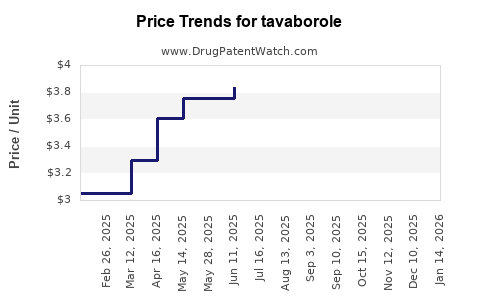
Last updated: August 26, 2026
Tavaborole, marketed as Kerydin, is a prescription topical solution for toenail onychomycosis. The product reached the U.S. market in 2014 through Anacor Pharmaceuticals, was acquired by Pfizer in 2016, and was later licensed to Almirall for U.S. commercialization. Its commercial trajectory has been constrained by low treatment success rates, long treatment duration, limited reimbursement, and competition from generic and branded antifungal products. Tavaborole is now a mature, low-growth asset with material generic erosion risk and limited strategic value outside niche dermatology portfolios. [1][2][3]
What is tavaborole and how does it generate revenue?
Tavaborole is a small-molecule oxaborole antifungal sold in the United States as Kerydin 5% topical solution. It is applied once daily to affected toenails for 48 weeks. The FDA approved it in July 2014 for toenail onychomycosis caused by Trichophyton rubrum or Trichophyton mentagrophytes. [1]
| Product |
Active ingredient |
Dosage form |
U.S. indication |
Original developer |
| Kerydin |
Tavaborole 5% |
Topical solution |
Toenail onychomycosis |
Anacor Pharmaceuticals |
| Jublia |
Efinaconazole 10% |
Topical solution |
Toenail onychomycosis |
Valeant, now Bausch Health |
| Penlac |
Ciclopirox 8% |
Topical lacquer |
Toenail onychomycosis |
Multiple manufacturers |
| Lamisil |
Terbinafine |
Oral tablet and topical products |
Dermatophyte fungal infections |
Novartis, now generic |
Tavaborole inhibits fungal leucyl-tRNA synthetase, disrupting protein synthesis. The treatment is administered without nail debridement, which supports ease of use but does not eliminate the long treatment period or adherence problem. [1]
When did tavaborole lose exclusivity?
Tavaborole’s regulatory exclusivity ended years before the product’s commercial maturity. The principal commercial risk shifted from branded competition to generic entry as patents and regulatory barriers weakened.
Tavaborole exclusivity timeline
| Event |
Date |
Commercial significance |
| FDA approval of Kerydin |
July 7, 2014 |
Established U.S. regulatory approval |
| Anacor acquisition by Pfizer |
June 2016 |
Pfizer obtained Kerydin rights through the Anacor transaction |
| U.S. commercialization rights transferred to Almirall |
2018 |
Product moved to a specialty dermatology platform |
| First generic approvals |
Early 2020s |
Created direct price and formulary pressure |
| Current market status |
Mature product |
Generic substitution and low category growth dominate |
Kerydin did not receive the type of long-duration exclusivity associated with biologics or first-in-class specialty medicines. It is a small molecule, so biosimilar exclusivity does not apply. The key regulatory question is generic approval under an abbreviated new drug application, not biosimilar interchangeability.
The FDA Orange Book should be used for the current patent listing and exclusivity position because listed patents and their litigation status can change. The original Kerydin label identifies the approved product and dosing regimen but does not provide a complete forward-looking commercial analysis. [1][4]
What patents protect tavaborole and Kerydin?
The core tavaborole patent estate was built around oxaborole compounds, pharmaceutical compositions, and antifungal use. Publicly associated patent families include Anacor-originated patents covering tavaborole and related boron-containing compounds.
| Patent category |
Protected subject matter |
Commercial relevance |
| Compound patents |
Tavaborole and related oxaboroles |
Core molecule protection |
| Composition patents |
Pharmaceutical compositions containing tavaborole |
Potential formulation barrier |
| Method-of-use patents |
Treatment of fungal nail infections |
Relevant to labeled use |
| Manufacturing patents |
Synthesis and purification of oxaborole compounds |
May increase generic development cost |
| Device or packaging rights |
Topical solution delivery and packaging |
Usually weaker than compound protection |
A commonly cited U.S. patent associated with tavaborole is U.S. Patent No. 8,759,347. Patent scope, terminal disclaimers, pediatric extensions, and Orange Book listings must be assessed from the current USPTO and FDA records before relying on a specific expiration date. A product-level patent expiration date cannot be stated reliably without reconciling the full Orange Book listing with patent prosecution records. [4][5]
The estate is best characterized as moderate in historical importance but limited in defensive strength after generic entry. A compound patent can delay direct substitution, but formulation and method-of-use claims generally provide less protection when an ANDA applicant can design around them or certify that the patents are not infringed.
What is the Orange Book status of Kerydin?
Kerydin is an FDA-approved small-molecule prescription product. Its Orange Book status is relevant to three issues:
- Whether patents are listed against the approved product.
- Whether those patents create a 30-month stay after a Paragraph IV notification.
- Whether the listed patents cover the active ingredient, formulation, method of use, or another product attribute.
An Orange Book listing does not guarantee a commercially enforceable exclusivity period. Generic applicants may file Paragraph III certifications, Paragraph IV certifications, or section viii statements that carve out patented uses. A section viii strategy can be particularly important for topical products when the generic label excludes a patented indication or use.
Which companies are challenging tavaborole exclusivity?
The principal competitive threat comes from generic manufacturers rather than biosimilar developers. Generic topical antifungal manufacturers can compete through ANDA approvals, pharmacy substitution, payer formulary placement, and lower acquisition cost.
Potential competitive groups include:
- Generic dermatology companies with topical manufacturing capacity.
- Large generic suppliers such as Taro, Teva, Perrigo, and related manufacturers.
- Contract manufacturers seeking abbreviated approval for topical solutions.
- Branded competitors selling efinaconazole, ciclopirox, or oral terbinafine.
The existence of a generic approval does not establish that a particular company prevailed in Paragraph IV litigation. Public litigation records should be reviewed through the FDA, PACER, and district court docket systems before assigning a specific patent challenge or settlement outcome to a manufacturer.
What generic entry risks exist for Kerydin?
Generic entry risk is high because tavaborole has several characteristics that favor substitution:
- It is a small molecule.
- The product is a simple topical solution rather than a complex device-drug combination.
- The treatment has a long 48-week course.
- The product has limited differentiation from other topical antifungals.
- Payers can pressure pharmacies and prescribers to use lower-cost alternatives.
- Patients may not remain on treatment long enough to preserve branded loyalty.
The main generic launch scenarios are:
| Scenario |
Effect on Kerydin |
| One approved generic |
Moderate price reduction and selective payer substitution |
| Several approved generics |
Rapid net-price decline and pharmacy-led substitution |
| Authorized generic |
Slower erosion but lower branded net sales |
| Patent settlement with delayed entry |
Temporary revenue preservation |
| Formulation or device workaround |
Reduced durability of formulation patents |
Topical generic competition can produce a sharper revenue decline than prescription volume decline because discounts, rebates, and pharmacy substitution affect net price quickly.
How strong is the tavaborole patent estate?
The tavaborole estate is moderate-to-weak from a late-life commercial perspective.
Strengths
- The original active ingredient was protected through Anacor-originated compound and use patents.
- Tavaborole has a distinct oxaborole mechanism.
- Manufacturing know-how may create development and scale-up barriers.
- Topical formulation equivalence can require product-specific analytical and clinical work.
Weaknesses
- The molecule is a small chemical entity.
- The product has no biologic exclusivity.
- A generic can potentially avoid narrow method-of-use claims.
- The 48-week regimen limits commercial differentiation.
- Competing treatments are widely available.
- Formulation claims may be vulnerable to design-around strategies.
The remaining value is therefore more dependent on brand access, payer contracts, sales force efficiency, and manufacturing cost than on a broad exclusionary patent moat.
How does tavaborole compare with Jublia and other onychomycosis drugs?
Jublia, or efinaconazole, is the closest branded comparator. Both are topical solutions used for toenail onychomycosis and require prolonged daily treatment. Jublia has historically benefited from stronger brand recognition and commercial investment, while Kerydin entered a market with an established topical incumbent and low overall treatment persistence.
| Factor |
Kerydin |
Jublia |
Oral terbinafine |
| Active ingredient |
Tavaborole |
Efinaconazole |
Terbinafine |
| Route |
Topical |
Topical |
Oral |
| Treatment period |
48 weeks |
Approximately 48 weeks |
Usually shorter |
| Monitoring burden |
Low |
Low |
Higher due to systemic exposure |
| Generic risk |
High |
High but estate-dependent |
Very high |
| Commercial differentiation |
Mechanism and solution formulation |
Brand scale and market presence |
Efficacy and lower treatment duration |
Oral terbinafine remains a major economic substitute because it is inexpensive and generally requires a shorter treatment course. Its systemic safety considerations limit use in some patients, creating a residual market for topical therapies.
What is tavaborole’s financial trajectory?
Public company disclosures do not consistently report Kerydin revenue as a standalone line item. Pfizer historically reported products within broader operating segments, while Almirall has reported portfolio and regional performance at an aggregate level. A precise product-level revenue series therefore cannot be established from public filings alone. [2][3]
The financial trajectory can be divided into four phases:
Launch phase: 2014 to 2016
Anacor positioned tavaborole as a differentiated topical treatment with a novel mechanism. Commercial uptake was limited by the size of the onychomycosis market, the long treatment course, and competition from Jublia and low-cost therapies.
Pfizer ownership phase: 2016 to 2018
Pfizer acquired Anacor for its broader dermatology and immunology portfolio, particularly crisaborole. Kerydin became a non-core product relative to Pfizer’s larger assets. Large-company ownership provided distribution capacity but did not resolve the product’s underlying adherence and reimbursement constraints. [2]
Almirall commercialization phase: 2018 onward
Almirall’s dermatology focus made Kerydin more strategically aligned with its portfolio. The product could generate cash flow through an established prescription base, but its long-term growth prospects remained limited. [3]
Generic erosion phase: early 2020s onward
Generic approvals increased pressure on gross-to-net pricing, formulary access, and pharmacy retention. The likely financial profile is declining branded revenue, lower promotional spending, and a shift from growth investment to lifecycle management.
What licensing deals affect tavaborole?
The principal transaction was the transfer of Kerydin commercialization rights from Pfizer to Almirall in the United States. The deal reflected portfolio rationalization by Pfizer and dermatology expansion by Almirall. The transaction did not create a new therapeutic market; it changed the commercial owner and likely improved portfolio focus. [3]
The value of any licensing arrangement depends on:
- Remaining patent life.
- Territory covered.
- Responsibility for manufacturing and supply.
- Existing inventory and channel commitments.
- Royalty or milestone obligations.
- Generic litigation exposure.
- Net sales after rebates and patient assistance.
Because public disclosures do not provide a complete product-level royalty and milestone schedule, transaction economics should not be treated as a direct measure of current Kerydin value.
What FDA regulatory status does tavaborole have?
Kerydin has FDA approval under NDA 205526 for topical treatment of toenail onychomycosis caused by specified Trichophyton species. The approved product is a 5% topical solution used once daily for 48 weeks. [1]
Generic tavaborole products, where approved, follow the ANDA pathway. They must demonstrate pharmaceutical equivalence and bioequivalence or otherwise satisfy FDA requirements applicable to topical products. The regulatory pathway is less complex than a new molecular entity approval but can still involve formulation, analytical, and manufacturing challenges.
What manufacturing and intellectual-property barriers remain?
Manufacturing barriers are moderate. Tavaborole is not a biologic and does not require cell-line development or cold-chain production. The principal technical issues are:
- Consistent active-ingredient synthesis.
- Control of boron-containing intermediates.
- Solution stability.
- Impurity control.
- Container-closure compatibility.
- Uniform dosing through the treatment period.
- Demonstration of topical product equivalence.
These barriers can delay entry but are unlikely to support durable premium pricing once multiple generic manufacturers obtain approval.
What revenue exposure does tavaborole create for Almirall?
Kerydin is unlikely to be a major revenue driver for Almirall relative to larger dermatology products. Its financial importance is better measured through incremental cash contribution, sales-force leverage, and portfolio breadth than through high-growth revenue expectations.
The principal exposure is downside risk:
- Branded net sales can decline faster than prescription demand.
- Generic substitution can reduce pharmacy access.
- Patient support programs can increase the gross-to-net discount.
- Promotional spending may become uneconomic.
- Manufacturing and inventory obligations can compress margins during volume decline.
The asset may remain profitable at reduced scale if production costs are low and commercial expenses are tightly controlled. It is unlikely to justify major new clinical investment unless a new formulation, combination product, or expanded indication creates additional exclusivity.
What is the outlook for tavaborole investors and competitors?
Tavaborole is a mature dermatology asset with declining strategic leverage. The most plausible outlook is:
- Continued use in patients seeking nonoral therapy.
- Ongoing competition from efinaconazole, ciclopirox, and oral terbinafine.
- Increasing generic substitution.
- Lower branded pricing and reduced promotional investment.
- Possible residual value through licensing, authorized generic supply, or specialty-pharmacy distribution.
A competitor seeking to enter the market should focus on Orange Book claims, ANDA certification strategy, topical equivalence requirements, manufacturing economics, and payer contracting. An acquirer should value Kerydin on post-generic cash flow rather than peak branded sales.
Key Takeaways
- Tavaborole is the active ingredient in Kerydin, a 5% topical solution approved in 2014 for toenail onychomycosis.
- Anacor developed the product, Pfizer acquired it in 2016, and Almirall later obtained U.S. commercialization rights.
- The product has no biosimilar pathway because tavaborole is a small molecule.
- Generic entry is the dominant commercial risk.
- The patent estate includes compound, composition, method-of-use, and potentially manufacturing-related protection, but its late-life defensive value is limited.
- Public filings do not provide a reliable standalone Kerydin revenue series.
- The expected financial profile is mature or declining branded revenue, lower promotional spending, and residual cash generation after generic substitution.
- The strongest commercial substitutes are Jublia, ciclopirox, and oral terbinafine.
FAQs
Is tavaborole still commercially available?
Kerydin has been marketed as a prescription tavaborole 5% topical solution. Availability can vary by distributor, pharmacy, payer, and generic supply conditions.
Is tavaborole more effective than terbinafine?
Tavaborole provides a topical option without systemic terbinafine exposure. Oral terbinafine generally has a shorter treatment course and is often less expensive, but it carries systemic safety and monitoring considerations.
Does tavaborole have biosimilar competition?
No. Tavaborole is a small-molecule drug, so competition occurs through generic drug applications rather than biosimilar applications.
Can a generic tavaborole launch before all Kerydin patents expire?
A generic applicant may pursue Paragraph IV certification, a Paragraph III certification, or a section viii label carve-out. Commercial launch depends on patent litigation, settlement terms, court outcomes, and any applicable regulatory stay.
Is tavaborole an attractive licensing asset?
It is more suitable for a low-cost dermatology portfolio or specialty-generic strategy than for a growth-oriented branded pharmaceutical investment. Its value depends on remaining exclusivity, generic penetration, manufacturing cost, and net pricing.
References
- U.S. Food and Drug Administration. (2014). Kerydin (tavaborole) topical solution prescribing information. https://www.accessdata.fda.gov
- Pfizer Inc. (2016). Annual report 2016. https://www.pfizer.com/investors/financial-reports
- Almirall, S.A. (2018). Annual report 2018. https://www.almirall.com/investors
- U.S. Food and Drug Administration. (n.d.). Orange Book: Approved drug products with therapeutic equivalence evaluations. https://www.accessdata.fda.gov/scripts/cder/ob/
- United States Patent and Trademark Office. (n.d.). Patent Center. https://patentcenter.uspto.gov/