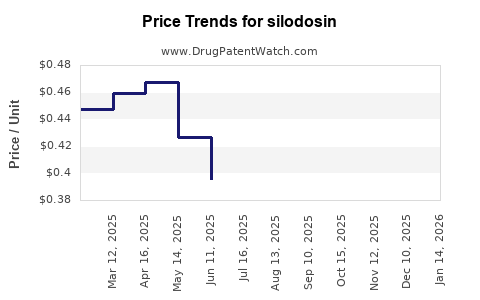
Last updated: September 7, 2026
Silodosin is a selective alpha-1A adrenergic receptor antagonist used to treat the urinary symptoms of benign prostatic hyperplasia (BPH). The product is marketed in Japan as Urief and in the United States as Rapaflo. Its commercial profile has shifted from branded specialty medicine to mature generic therapy. Core U.S. exclusivity has ended, generic silodosin is available, and future revenue depends primarily on prescription retention, payer positioning, geographic expansion, and manufacturing cost rather than patent protection.
What is silodosin and which companies market it?
Silodosin is an oral alpha-1A blocker that relaxes smooth muscle in the prostate and bladder neck. The U.S. product is available as 4 mg and 8 mg capsules. The recommended U.S. dose is 8 mg once daily with a meal, with a 4 mg dose used for patients with moderate renal impairment. Silodosin is not indicated for hypertension, distinguishing it commercially from broader alpha-blockers such as tamsulosin and doxazosin. (U.S. Food and Drug Administration [FDA], 2023a)
| Item |
Silodosin profile |
| Active ingredient |
Silodosin |
| Primary indication |
Signs and symptoms of BPH |
| U.S. brand |
Rapaflo |
| Japanese brand |
Urief |
| U.S. original developer |
Kissei Pharmaceutical |
| U.S. commercial partner |
Watson Pharmaceuticals, later Actavis and Allergan |
| Dosage form |
Oral capsule |
| U.S. strengths |
4 mg and 8 mg |
| Therapeutic class |
Selective alpha-1A adrenergic antagonist |
| Current market status |
Mature branded-generic market |
Kissei developed silodosin and retained important commercial exposure in Japan and selected international markets. Watson obtained U.S. commercialization rights before the Rapaflo launch. Watson later became Actavis, and Actavis became part of Allergan. AbbVie acquired Allergan in 2020, but silodosin is not a material driver of AbbVie’s consolidated revenue compared with its major immunology, oncology, neuroscience, and aesthetics products. (Kissei Pharmaceutical Co., Ltd., 2024; AbbVie Inc., 2024)
When did silodosin lose exclusivity?
Silodosin lost its principal U.S. market exclusivity after the expiration of the core patent and the end of regulatory exclusivity. Rapaflo received FDA approval in October 2008, while the U.S. product was commercially launched in 2009. Some commercial materials refer to the U.S. launch as 2009 rather than the approval year. (FDA, 2023a)
The relevant commercial sequence is:
| Event |
Approximate timing |
Commercial effect |
| U.S. FDA approval of Rapaflo |
October 2008 |
Established U.S. branded market |
| U.S. commercial launch |
2009 |
Began branded revenue generation |
| Initial branded protection period |
2008-2010s |
Delayed generic substitution |
| Generic entry preparation and approvals |
2020s |
Increased price pressure |
| Current market |
2024-2025 |
Generic-dominated, low-growth category |
Unlike a biologic, silodosin does not face biosimilar substitution rules. It is a conventional small-molecule drug subject to abbreviated new drug application, or ANDA, competition. The key commercial question is therefore generic substitution and pharmacy purchasing, not biosimilar interchangeability.
What patents protect silodosin and Rapaflo?
The historic silodosin patent estate was built around the active compound and related quinoline derivatives, pharmaceutical compositions, and therapeutic use. Public U.S. product information and Orange Book records should be used to verify the exact patent numbers and listed expiration dates for any litigation or transaction analysis. The commercially relevant conclusion is that the main U.S. protection has expired or no longer prevents ordinary generic competition.
| Patent category |
Historical relevance |
Current market effect |
| Composition-of-matter patents |
Protected silodosin and related chemical structures |
Core protection has expired |
| Pharmaceutical composition patents |
Covered capsule formulations and excipients |
Limited protection after generic entry |
| Method-of-use patents |
Covered treatment of BPH symptoms |
Narrower commercial effect than composition patents |
| Manufacturing patents |
May cover intermediates, processes, or impurity controls |
Can affect cost and supply but rarely block all generic entry |
| Regulatory exclusivity |
Protected initial approval period |
Expired |
The patent estate is therefore weak as a barrier to U.S. generic launch. Any remaining formulation or manufacturing patents would have to be evaluated claim by claim. They are unlikely to restore branded exclusivity for the active ingredient as a whole.
What formulations are protected by silodosin patents?
The commercially important formulation is the oral capsule. Product labeling identifies 4 mg and 8 mg capsules containing silodosin. Food increases exposure, so the label directs administration with a meal. That pharmacokinetic requirement creates a product-use consideration but does not, by itself, create a meaningful barrier to conventional generic capsules. (FDA, 2023a)
Potentially relevant formulation issues include:
- Dose strength and capsule composition.
- Dissolution and bioequivalence specifications.
- Stability and impurity controls.
- Packaging and storage requirements.
- Food-effect instructions.
- Manufacturing processes for the active pharmaceutical ingredient.
These issues can influence ANDA approval and manufacturing economics. They do not create a substitute for expired composition-of-matter protection.
What is the Orange Book status of Rapaflo?
Rapaflo is an FDA-approved small-molecule product with Orange Book history. The Orange Book is relevant for identifying listed patents, expiration dates, pediatric exclusivity, and generic competition pathways. Silodosin’s current commercial status indicates that the Orange Book listings no longer provide a durable barrier to generic substitution.
Paragraph IV litigation would have been the principal U.S. pathway for challenging unexpired listed patents. A generic applicant filing a Paragraph IV certification asserts that a listed patent is invalid, unenforceable, or not infringed. The Hatch-Waxman framework can trigger litigation and, in certain circumstances, a 30-month stay of approval. (FDA, 2023b)
For silodosin, the commercial significance of Paragraph IV activity has declined because:
- The leading patent protection has aged out.
- Generic approval is available.
- Rapaflo has limited remaining brand pricing power.
- The BPH market contains established alternatives.
- Generic manufacturers can compete through price and pharmacy access.
A definitive litigation review requires docket-level verification in the relevant district courts and the current Orange Book patent table. No major, market-defining active Paragraph IV dispute is central to silodosin’s current U.S. trajectory.
Which companies are challenging Rapaflo?
Silodosin generic competition is supplied through the normal ANDA market rather than through a biosimilar pathway. FDA-approved generic manufacturers may include large multisource suppliers, specialty generic companies, and vertically integrated manufacturers. The competitive set can change as approvals, withdrawals, and commercial launches occur.
The most relevant competitor groups are:
| Competitor group |
Examples |
Competitive mechanism |
| Generic silodosin manufacturers |
ANDA holders approved by FDA |
Price substitution and formulary access |
| Tamsulosin manufacturers |
Multiple generic suppliers |
Lower-cost alpha-blocker alternative |
| Doxazosin and terazosin manufacturers |
Generic suppliers |
Therapeutic substitution |
| Finasteride and dutasteride suppliers |
Generic 5-alpha-reductase inhibitor companies |
Alternative or combination treatment |
| Branded combination products |
Selected branded suppliers |
Convenience and adherence positioning |
The main competitive threat is not a single generic challenger. It is the cumulative effect of multiple generic suppliers and established BPH therapies.
How does silodosin compare with tamsulosin?
Silodosin and tamsulosin both target alpha-1 receptors, but silodosin has greater selectivity for the alpha-1A subtype concentrated in the prostate and lower urinary tract. Tamsulosin has broader commercial penetration and a substantially larger generic prescribing base.
| Factor |
Silodosin |
Tamsulosin |
| Market maturity |
Mature |
Highly mature |
| U.S. brand |
Rapaflo |
Flomax |
| Generic availability |
Yes |
Yes |
| Prostate selectivity |
High alpha-1A selectivity |
Alpha-1A and alpha-1D activity |
| Common commercial advantage |
Urologist familiarity and targeted mechanism |
Low price, broad availability, established use |
| Key adverse-effect concern |
Ejaculatory dysfunction |
Dizziness, orthostatic effects, ejaculatory dysfunction |
| Growth outlook |
Limited |
Stable, high-volume generic market |
Silodosin can retain a niche among patients and urologists who value alpha-1A selectivity or who have an inadequate response or tolerability issue with another alpha-blocker. Its premium pricing is difficult to sustain after generic entry.
What is the financial trajectory for silodosin?
Silodosin revenue followed the standard lifecycle of a small-molecule branded drug:
- Launch and adoption: Revenue grew as Rapaflo and Urief gained prescriptions in the U.S. and Japan.
- Maturity: Sales stabilized as the product entered established BPH treatment algorithms.
- Patent erosion: Generic competition reduced price and brand volume.
- Post-exclusivity market: Revenue shifted toward low-margin generic supply and regional brand sales.
Public company reporting does not consistently disclose silodosin revenue as a separate line item. Kissei reports product and regional performance at broader portfolio levels, while Allergan and AbbVie report much larger consolidated businesses. As a result, precise current global silodosin revenue cannot be reliably derived from public annual reports without company-level segment allocations.
What factors determine silodosin revenue?
The key revenue drivers are:
- Generic prescription volume.
- Net price after rebates and pharmacy discounts.
- Japanese reimbursement and prescribing trends.
- U.S. brand retention among urologists.
- Distribution agreements.
- Manufacturing cost and API availability.
- Competition from tamsulosin and other BPH drugs.
- Treatment persistence and refill rates.
- Geographic expansion in markets where generic penetration is lower.
The U.S. revenue trajectory is structurally negative for the branded product because generic substitution compresses both volume and net price. Japan may remain more important for Kissei because Urief has a longer commercial history and a stronger domestic franchise. Even there, growth depends on market share, reimbursement, and the broader size of the BPH population.
What generic entry risks exist for silodosin?
Generic entry risk is high in the United States and other markets where silodosin patents have expired. The main scenarios are:
| Scenario |
Probability profile |
Financial effect |
| Multiple generic suppliers |
High in mature markets |
Rapid price erosion |
| Limited generic supply |
Possible during shortages or manufacturing disruption |
Temporary price stabilization |
| Brand retention through contracts |
Possible but limited |
Preserves a narrow premium segment |
| Formulation-based differentiation |
Limited |
May support niche positioning |
| New indication expansion |
Low without clinical development |
Could extend demand but not core exclusivity |
| International launch in underpenetrated markets |
Market-dependent |
May offset mature-market decline |
The biggest operational risks are API supply disruption, quality-control findings, and dependence on a small number of approved manufacturers. Manufacturing patents may protect a particular process, but they generally do not prevent competitors from producing silodosin through alternative processes.
How strong is the silodosin patent estate?
The estate is commercially weak for lifecycle protection and moderate for technical know-how. Its principal assets protected the active compound and early product commercialization. Those assets supported the launch but do not provide a durable current barrier.
| Dimension |
Assessment |
| Composition-of-matter protection |
Expired or commercially ineffective |
| Formulation protection |
Narrow and limited |
| Method-of-use protection |
Narrow, with limited blocking value |
| Manufacturing know-how |
Potentially valuable for yield and purity |
| Regulatory exclusivity |
Expired |
| Generic entry barrier |
Low |
| Litigation leverage |
Low |
| Remaining licensing value |
Regional or supply-related rather than exclusivity-based |
Licensing opportunities are more likely to concern regional commercialization, supply, or authorized generic distribution than a global exclusivity transaction. The economic value of any deal would depend on territory, reimbursement, manufacturing cost, and access to distribution channels.
What patent litigation and settlements affect silodosin?
Silodosin’s central U.S. commercial risk is no longer active patent litigation. The important litigation period would have occurred around generic challenges to listed Rapaflo patents. After core patent expiry and generic approval, settlement agreements have limited ability to preserve broad market exclusivity.
Any historical settlement should be assessed for:
- The generic’s licensed entry date.
- Authorized-generic rights.
- Supply obligations.
- Cash or non-cash consideration.
- Territory restrictions.
- Antitrust exposure.
- Whether the agreement delayed or accelerated generic launch.
The absence of a current blocking dispute means that market performance is driven by generic economics, not litigation timing.
What is the FDA regulatory status of silodosin?
Rapaflo remains an FDA-approved prescription product for the signs and symptoms of BPH. Generic silodosin products must demonstrate pharmaceutical equivalence and bioequivalence through the ANDA pathway. The FDA label includes renal dosing restrictions and a warning concerning intraoperative floppy iris syndrome in patients undergoing cataract surgery. (FDA, 2023a)
Silodosin has no biosimilar pathway because it is a chemically synthesized small molecule. Regulatory risk centers on:
- ANDA approval and labeling.
- Bioequivalence.
- Manufacturing compliance.
- Drug-supply continuity.
- Postmarketing safety reporting.
- Label consistency across generic products.
Key Takeaways
- Silodosin is a mature alpha-1A blocker for BPH, marketed as Rapaflo in the U.S. and Urief in Japan.
- The U.S. product received FDA approval in 2008 and entered commercial use in 2009.
- Core patent and regulatory exclusivity have expired, leaving a low barrier to generic competition.
- Generic erosion, rather than biosimilar risk, is the central commercial issue.
- The U.S. branded revenue trajectory is structurally downward after generic entry.
- Japan remains strategically important for Kissei, but mature-market growth is limited.
- Formulation and manufacturing know-how may retain value, but they do not recreate composition-of-matter exclusivity.
- Current investment value lies in manufacturing efficiency, regional distribution, supply reliability, and prescription retention.
- Silodosin has no obvious current patent-based catalyst comparable to a new indication, reformulation, or exclusivity restoration.
FAQs About Silodosin Market and Patent Risk
Is silodosin still under patent protection?
The core U.S. protection that supported Rapaflo commercialization has expired or no longer blocks generic entry. Narrow formulation or manufacturing rights may exist in particular jurisdictions, but they do not provide broad active-ingredient exclusivity.
Is Rapaflo still commercially important?
Rapaflo remains an FDA-approved brand, but its commercial importance is lower than during the protected period. Generic substitution and competition from tamsulosin limit pricing power and brand growth.
Can silodosin be challenged through a Paragraph IV filing?
Yes. A generic applicant can use a Paragraph IV certification against an unexpired listed patent. The practical importance of that route is limited where the principal listed patents have expired and generic products are already approved.
Does silodosin have biosimilar competition?
No. Silodosin is a small-molecule drug, so competition occurs through ANDAs and generic substitution rather than the biosimilar pathway.
What is the main long-term risk to silodosin revenue?
The main risk is continued price and volume erosion from multiple generic manufacturers, compounded by competition from tamsulosin and other established BPH therapies.
References
- AbbVie Inc. (2024). 2023 annual report. https://www.abbvie.com
- Kissei Pharmaceutical Co., Ltd. (2024). Annual report and corporate information. https://www.kissei.co.jp
- U.S. Food and Drug Administration. (2023a). Rapaflo prescribing information. https://www.accessdata.fda.gov
- U.S. Food and Drug Administration. (2023b). Approved drug products with therapeutic equivalence evaluations: Orange Book. https://www.fda.gov/drugs/drug-approvals-and-databases/approved-drug-products-therapeutic-equivalence-evaluations-orange-book
- U.S. Food and Drug Administration. (2024). Drugs@FDA: FDA-approved drugs. https://www.accessdata.fda.gov/scripts/cder/daf/