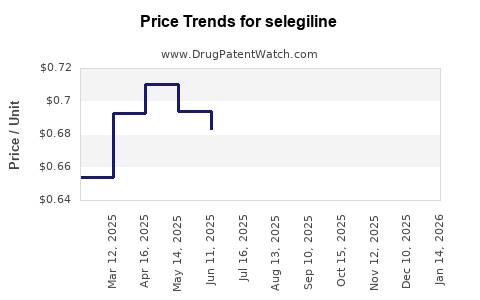
Last updated: September 7, 2026
Selegiline is a mature, low-cost monoamine oxidase inhibitor marketed in several formulations for Parkinson's disease and major depressive disorder. The oral products, including Eldepryl and generic selegiline tablets or capsules, have no meaningful compound-patent protection. The transdermal product, EMSAM, preserved higher-value commercial positioning through delivery-system and formulation protection, but its exclusivity has largely eroded. Selegiline revenue is not reported as a separate line item by major manufacturers, making product-level market sizing difficult.
What is selegiline used for and which products are FDA approved?
Selegiline is a selective monoamine oxidase type B inhibitor at lower oral doses. It increases dopaminergic activity and is used as an adjunct treatment in Parkinson's disease. At higher transdermal doses, it is approved for major depressive disorder.
| Product |
Active ingredient |
Route |
FDA indication |
Original sponsor or marketer |
| Eldepryl |
Selegiline hydrochloride |
Oral capsule |
Adjunct treatment for Parkinson's disease |
Somerset Pharmaceuticals |
| Generic selegiline |
Selegiline hydrochloride |
Oral tablet or capsule |
Parkinson's disease |
Multiple generic manufacturers |
| Zelapar |
Selegiline hydrochloride |
Orally disintegrating tablet |
Adjunct treatment for Parkinson's disease |
Bristol-Myers Squibb originally; later commercialized by other companies |
| EMSAM |
Selegiline |
Transdermal patch |
Major depressive disorder |
Somerset Pharmaceuticals, later acquired by Mylan |
The FDA approved Eldepryl in 1989 and EMSAM in 2006. Zelapar received approval in 2006. EMSAM remains the only FDA-approved selegiline product for major depressive disorder in the United States. Its prescribing information includes dietary and drug-interaction restrictions that vary by dose. [1-3]
How large is the selegiline market?
Selegiline is a mature generic market with a small branded specialty segment.
Oral selegiline competes primarily on price, availability, pharmacy distribution, and physician familiarity. Tablets and capsules are inexpensive relative to newer Parkinson's disease therapies. The transdermal patch has historically commanded a higher price because it provides nonoral delivery and is approved for depression, but that premium has been pressured by generic competition and payer management.
Public companies generally do not disclose selegiline revenue separately. EMSAM sales have been immaterial relative to the revenues of large pharmaceutical companies, while generic oral selegiline sales are distributed across manufacturers and wholesalers. As a result, a precise global selegiline market size or annual revenue forecast cannot be derived from public company filings alone.
Main commercial demand drivers
- Parkinson's disease prevalence and long-term dopaminergic treatment.
- Demand for low-cost adjunctive therapy.
- Patients with difficulty swallowing oral medicines.
- Depression patients who have failed or cannot tolerate conventional antidepressants.
- Use of transdermal delivery where gastrointestinal or adherence concerns influence prescribing.
Main market constraints
- Low price competition for oral products.
- Availability of alternative Parkinson's therapies, including rasagiline, safinamide, dopamine agonists, levodopa combinations, and COMT inhibitors.
- Strict interaction and dietary restrictions at higher transdermal doses.
- Generic EMSAM competition.
- Limited physician adoption of older monoamine oxidase inhibitor therapies because of safety-management complexity.
When does selegiline lose exclusivity?
Selegiline's core compound protection expired decades ago. The commercial protection that mattered most was tied to specific dosage forms and delivery systems.
| Exclusivity layer |
Commercial status |
| Selegiline active ingredient |
Expired |
| Oral Parkinson's disease formulations |
Generic competition established |
| Orally disintegrating formulation |
Historical formulation protection; commercial exclusivity no longer material |
| EMSAM transdermal system |
Historical formulation and delivery patents; meaningful exclusivity largely expired or eroded |
| Regulatory exclusivity |
No current U.S. new-chemical-entity exclusivity |
| Biosimilar exclusivity |
Not applicable because selegiline is a small molecule |
The U.S. Hatch-Waxman framework permits generic competition after relevant patents and regulatory exclusivities expire or are successfully challenged. Selegiline no longer has the profile of a protected innovative small molecule. Its remaining commercial value lies in formulation, manufacturing, brand recognition, and supply reliability rather than molecule-level exclusivity. [4]
What patents protect selegiline products?
The historical patent estate falls into four categories: the selegiline compound, oral dosage forms, orally disintegrating tablets, and transdermal delivery systems.
Compound patents
The original selegiline patents are expired. Generic manufacturers can produce selegiline hydrochloride without licensing the original compound owner, subject to FDA approval and compliance with applicable manufacturing requirements.
Oral formulation patents
Oral products received protection for dosage forms and administration methods rather than for the underlying compound. These protections have no current ability to block ordinary generic selegiline tablets or capsules.
Zelapar formulation patents
Zelapar used an orally disintegrating dosage form intended to dissolve on the tongue. Its commercial differentiation was based on administration convenience and absorption characteristics. Any original U.S. formulation exclusivity is historical, and Zelapar does not have the market position of a protected growth product.
EMSAM transdermal patents
EMSAM used a transdermal delivery system designed to deliver selegiline through the skin. The relevant intellectual-property themes included:
- Adhesive patch construction.
- Controlled delivery of selegiline.
- Drug loading and release rates.
- Patch composition and stability.
- Use of transdermal selegiline for depression.
The key commercial effect of these patents was to delay direct patch competition after EMSAM's approval. That protection did not extend indefinitely. Generic transdermal products have entered or been authorized in the U.S. market, reducing the ability of the original sponsor to maintain a durable price premium.
FDA Orange Book entries, approved abbreviated new drug applications, and current patent certifications should be checked for transaction-specific diligence because listing status can change after patent expiration, delisting, administrative updates, or litigation settlements. The core conclusion remains stable: no active compound-level barrier prevents generic selegiline production. [5]
What is the Orange Book status of EMSAM and oral selegiline?
The Orange Book distinguishes between FDA approval, patent listings, and actual commercial availability.
Oral selegiline products are genericized and do not depend on active innovator exclusivity. EMSAM was listed as a branded transdermal product, with its historical patent estate forming the basis for generic-entry timing. The existence of an Orange Book patent listing does not independently establish that a patent is enforceable or that a generic cannot launch. Generic applicants can file Paragraph IV certifications, pursue litigation, or enter after expiration.
For current regulatory diligence, the relevant records are:
- FDA Orange Book patent and exclusivity listings.
- Drugs@FDA approval histories.
- FDA-approved product labeling.
- Approved ANDA records for selegiline tablets, capsules, and patches.
- FDA drug shortage and product-discontinuation databases.
Which companies have challenged or competed with selegiline?
Selegiline competition has developed through both generic manufacturers and branded alternatives.
| Company or product group |
Competitive role |
| Multiple generic manufacturers |
Oral selegiline tablets and capsules |
| Mylan, later part of Viatris |
EMSAM commercialization and generic transdermal competition |
| Somerset Pharmaceuticals |
Original EMSAM sponsor |
| Teva and other generic companies |
Historical and current generic-channel competition, depending on product and market |
| Azilect, marketed by Teva |
Competing MAO-B inhibitor containing rasagiline |
| Xadago, marketed by Supernus |
Competing Parkinson's adjunct containing safinamide |
The most important direct comparison is between selegiline and other MAO-B inhibitors. Rasagiline and safinamide have had more recent branded commercial positioning, while selegiline benefits from low cost and long clinical familiarity. Selegiline's transdermal depression indication is differentiated, but its safety restrictions and generic availability limit pricing power.
How strong is the selegiline patent estate?
The selegiline patent estate is weak from an investment and licensing perspective.
| Criterion |
Assessment |
| Compound protection |
None of current commercial significance |
| Oral formulation protection |
Expired or commercially ineffective |
| Transdermal protection |
Historical value; largely expired or weakened by generic entry |
| Method-of-use protection |
Limited current blocking power |
| Manufacturing barriers |
Moderate for transdermal systems, low for oral products |
| Regulatory exclusivity |
None of material current value |
| Litigation leverage |
Low compared with newly approved branded products |
| Licensing value |
Concentrated in supply, manufacturing, or regional rights |
The patch remains technically more difficult to manufacture than a standard tablet because of adhesive performance, drug uniformity, release control, packaging, and stability. Those requirements can create qualification and supply barriers even when patents do not. They do not recreate a durable monopoly.
What Paragraph IV and generic-entry risks exist?
The principal Paragraph IV risk applied to EMSAM and other protected formulations rather than to the selegiline molecule itself. Once generic applicants challenged or bypassed relevant patch patents, the innovator's ability to preserve market share depended on brand loyalty, payer contracts, shortages, and product differentiation.
Generic-entry scenarios are straightforward:
- Oral selegiline remains exposed to multiple generic suppliers.
- Generic EMSAM reduces net pricing and prescription retention for the branded patch.
- Additional patch suppliers can create price compression but may not immediately achieve commercial scale.
- Manufacturing deviations or supply interruptions can temporarily support branded demand.
- No biosimilar pathway applies because selegiline is a chemically synthesized small molecule.
A new entrant would face regulatory requirements for pharmaceutical equivalence, bioequivalence or equivalent delivery performance, stability, device or patch quality, and current good manufacturing practice compliance.
What patent litigation and settlement agreements affect selegiline?
Selegiline's major litigation risk is historical rather than an active, high-value patent dispute. EMSAM-related generic challenges were associated with the ordinary Hatch-Waxman pattern: ANDA filing, patent certification, potential infringement litigation, and possible launch after settlement or court resolution.
Publicly visible commercial risk today is more likely to arise from:
- Product discontinuation.
- FDA manufacturing observations.
- Patch adhesion or delivery failures.
- Shortages of active pharmaceutical ingredient.
- Labeling disputes.
- Contract-manufacturing changes.
- State substitution and payer formulary decisions.
No current selegiline litigation has the financial profile of major disputes involving recently launched oncology, immunology, or rare-disease products. Transaction parties should verify active docket status in PACER and current Orange Book listings rather than relying on historical EMSAM litigation summaries.
What is the financial trajectory for selegiline manufacturers?
The financial trajectory is mature-to-declining for branded EMSAM and stable-to-low-growth for generic oral products.
Branded EMSAM
EMSAM's revenue trajectory has been shaped by:
- Initial specialty pricing after 2006 approval.
- Limited uptake caused by dietary and interaction restrictions.
- Loss of exclusivity and generic patch competition.
- Reduced negotiating power with payers.
- Absence of a broader franchise around selegiline.
The product is unlikely to become a material growth asset without a new formulation, expanded indication, or major commercial repositioning.
Generic oral selegiline
Generic oral products have a different economic model:
- Low unit prices.
- Thin margins.
- Volume-driven revenue.
- Competition among manufacturers.
- Potential supply value during shortages.
- Limited marketing expense.
A manufacturer with efficient API sourcing and reliable regulatory compliance can earn recurring revenue, but the product is unlikely to generate substantial standalone growth.
Transdermal manufacturing
The patch offers more potential margin than tablets but also carries higher technical and quality-control costs. The value proposition depends on manufacturing yield, adhesive performance, payer coverage, and the number of approved competitors.
How does selegiline compare with rasagiline and safinamide?
| Factor |
Selegiline |
Rasagiline |
Safinamide |
| Drug class |
MAO-B inhibitor |
MAO-B inhibitor |
MAO-B inhibitor with additional pharmacology |
| U.S. oral market |
Generic |
Generic and branded history |
Primarily branded |
| Transdermal depression product |
Yes, EMSAM |
No |
No |
| Price positioning |
Low for oral products |
Low to moderate depending on product |
Higher branded positioning |
| Patent strength |
Weak or expired |
Older patents largely expired |
Stronger historical branded protection |
| Commercial outlook |
Mature generic |
Mature generic |
More recent branded-product economics |
| Main advantage |
Low cost and nonoral patch |
Dosing familiarity and generic access |
Differentiated Parkinson's adjunct profile |
Selegiline's commercial advantage is cost and formulation diversity. Its disadvantage is the absence of durable exclusivity.
What geographic markets matter for selegiline?
The United States is strategically important because EMSAM created a differentiated transdermal indication and because FDA approval supports a structured generic pathway. Europe and other markets contain selegiline oral products, but regulatory status, brand names, reimbursement, and availability vary by country.
Commercial diligence should separate:
- Oral selegiline hydrochloride markets.
- Transdermal selegiline markets.
- Hospital versus retail distribution.
- Prescription versus reimbursement status.
- API supply by region.
- Local patent and data-exclusivity rules.
A U.S. patent conclusion cannot be applied automatically to Europe, Japan, Canada, or emerging markets. The molecule's age means that regulatory and manufacturing factors usually matter more than patent term in most territories.
Key Takeaways
- Selegiline is a mature generic small molecule with no meaningful active compound exclusivity.
- Oral selegiline is exposed to established generic competition and has limited pricing power.
- EMSAM created a higher-value transdermal niche, but its historical formulation protection has largely eroded.
- No biosimilar risk applies because selegiline is a small-molecule drug.
- Current commercial value is concentrated in supply reliability, manufacturing capability, patch technology, and niche clinical demand.
- Selegiline revenue is not separately reported by major manufacturers, preventing a reliable standalone market-size estimate from public filings.
- The financial outlook is stable-to-declining, with limited potential for material growth absent a new delivery system or indication.
FAQs
Is selegiline still under patent?
The original selegiline compound patents are expired. Historical formulation and transdermal patents provided additional protection, but they do not create a broad current monopoly over selegiline.
Can a generic company manufacture EMSAM?
A generic company can seek FDA approval for a selegiline transdermal system by meeting applicable pharmaceutical-equivalence, delivery-performance, stability, and manufacturing requirements. Current Orange Book listings and patent certifications determine the remaining regulatory pathway.
Is selegiline more commercially valuable as a patch or tablet?
The patch has higher potential revenue per prescription because it is a differentiated delivery system. Tablets have broader generic volume but substantially lower pricing and margins.
Does selegiline have biosimilar competition?
No. Selegiline is a chemically synthesized small molecule. Competition proceeds through generic-drug pathways, not biosimilar applications.
What could increase selegiline revenue?
Revenue could increase through a new delivery system, an expanded psychiatric or neurologic indication, improved payer coverage, geographic expansion, or supply disruption affecting competing products. None of these drivers is inherent in the current mature product portfolio.
References
- U.S. Food and Drug Administration. (2006). EMSAM (selegiline transdermal system) prescribing information.
- U.S. Food and Drug Administration. (1989). Eldepryl (selegiline hydrochloride) approval history and labeling.
- U.S. Food and Drug Administration. (2006). Zelapar (selegiline hydrochloride) prescribing information.
- U.S. Food and Drug Administration. (2024). Approved drug products with therapeutic equivalence evaluations.
- U.S. Food and Drug Administration. (2024). Drugs@FDA: FDA-approved drugs database.