Last updated: July 30, 2025
Introduction
PILOCARPINE, a parasympathomimetic alkaloid primarily used to treat glaucoma and xerostomia, remains a significant pharmaceutical agent with a distinct market presence. Its unique therapeutic profile, compounded by broader trends in eye care and oral health management, influences both current market dynamics and its future financial trajectory. Understanding these elements is vital for pharmaceutical companies, investors, and healthcare policymakers aiming to navigate the evolving landscape.
Therapeutic Indications and Market Drivers
Primary Applications
PILOCARPINE’s main indications include:
- Glaucoma: Used to enhance aqueous humor outflow, reducing intraocular pressure (IOP) in conditions like open-angle and angle-closure glaucoma.
- Xerostomia: Prescribed to stimulate salivary secretion in patients with dry mouth resulting from radiotherapy, Sjögren’s syndrome, or medication side effects.
Market Drivers
Several factors propel the demand for PILOCARPINE:
- Increasing Incidence of Glaucoma: The global prevalence, estimated at over 76 million in 2020 and projected to reach 112 million by 2040 (WHO), fuels the need for long-term management therapies such as PILOCARPINE.
- Rise in Oral Mucosal Disorders: A growing population of cancer survivors and aging demographics favoring salivary gland stimulants underpin demand for xerostomia treatments.
- Off-Label and Adjunct Uses: Ongoing research suggests potential applications in neurodegenerative diseases, psychiatric conditions, and as a diagnostic agent, broadening its market scope.
Market Dynamics
Competitive Landscape
Despite being a low-cost, established agent, PILOCARPINE faces competition from:
- Other Glaucoma Drugs: Including prostaglandin analogs (e.g., latanoprost), beta-blockers (e.g., timolol), and newer drugs offering improved efficacy or fewer side effects.
- Alternative Xerostomia Treatments: Such as saliva substitutes and other cholinergic agents like cevimeline.
Generic formulations dominate the market in developed economies, constraining revenue growth for branded PILOCARPINE products. Conversely, in regions with limited generic penetration, branded drugs maintain significant market share.
Regulatory Environment
Regulatory pathways influence market dynamics substantially:
- Patent Expiry: PILOCARPINE’s patent protections mostly expired by the 1990s, resulting in widespread generic availability.
- Approval of New Indications: Regulatory approval for expanded uses can open additional revenue streams.
Supply Chain and Manufacturing Considerations
As a plant alkaloid extract, PILOCARPINE production relies on sustainable sourcing of Pilo-carpine-rich plant material, often from Pilocarpus microphyllus. Supply chain disruptions due to agricultural variability or environmental policies could impact manufacturing costs and availability.
Pricing and Reimbursement Policies
Market penetration, especially in emerging markets, hinges on reimbursement frameworks and affordability. Insurance coverage and government healthcare programs directly influence sales volume.
Financial Trajectory
Current Revenue Streams
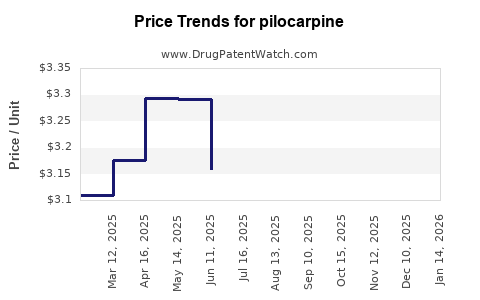
- Developed Markets: Driven by generic sales, with revenues stabilizing due to intense price competition.
- Emerging Markets: Exhibit growth potential owing to increasing glaucoma awareness and limited competition from newer, proprietary drugs.
Growth Opportunities
- Niche Indications: Development of formulations tailored for specific patient groups (e.g., sustained-release variants for xerostomia).
- Combination Therapies: Incorporating PILOCARPINE with other agents to enhance efficacy or reduce side effects.
- Novel Delivery Systems: Transdermal patches or ocular inserts could improve compliance and expand usage.
Challenges to Growth
- Market Saturation: Widespread generic availability limits margins.
- Regulatory Constraints: Stringent approval processes may hinder expansion into new indications.
- Competitive Alternatives: Emerging drugs with better safety profiles may erode market share.
Forecast and Projections
Given the current landscape, the global PILOCARPINE market is expected to grow modestly at a CAGR of approximately 2-3% over the next five years, driven by emerging markets and niche applications. Revenues are projected to stabilize or decline slightly in mature markets unless new formulations or indications are successfully developed.
Emerging Trends Impacting Future Outlook
- Personalized Medicine: Genetic profiling to identify responsive patient subsets could optimize treatment outcomes.
- Growing Focus on Oral and Ocular Care: Aging populations and increasing awareness are likely to sustain demand.
- Digital and Telehealth Initiatives: Remote monitoring and administration may influence treatment adherence and, by extension, sales.
Key Challenges and Strategic Considerations
- Price Pressure: Heightened competition among generics necessitates cost optimization.
- Research and Development (R&D): Investment in innovative delivery systems or novel therapeutic combinations is essential for differentiation.
- Regulatory Navigation: Proactive engagement with authorities for expanded indications can unlock new market segments.
Conclusion
The market for PILOCARPINE exhibits stability in established regions, but growth is primarily driven by emerging markets and potential new therapeutic uses. Pharmaceutical companies must navigate a landscape characterized by intense generic competition, regulatory challenges, and evolving healthcare policies. Strategic focus on formulation innovation, portfolio expansion, and geographic diversification remains crucial for realizing its full financial potential.
Key Takeaways
- PILOCARPINE’s primary markets are mature in glaucoma and xerostomia, with growth driven mainly by emerging markets.
- Generic competition suppresses overall revenue potential, prompting a focus on niche applications and formulations.
- Regulatory approval for new indications and delivery systems can provide growth catalysts.
- Supply chain sustainability and pricing strategies significantly influence market penetration and profitability.
- Investing in innovation and geographic expansion is vital for maintaining and enhancing PILOCARPINE’s financial trajectory.
FAQs
1. What are the primary therapeutic uses of PILOCARPINE?
PILOCARPINE is mainly prescribed for glaucoma management by reducing intraocular pressure and for xerostomia treatment by stimulating salivary secretion.
2. How does patent expiration affect PILOCARPINE’s market?
Patent expiry in the 1990s led to widespread generic manufacturing, increasing competition and decreasing the drug’s pricing power within developed markets.
3. Are there any emerging indications for PILOCARPINE?
While current uses are well-established, research on PILOCARPINE’s role in neurodegenerative conditions and as a diagnostic tool presents potential future opportunities.
4. What are the main challenges facing the PILOCARPINE market?
The key challenges include fierce price competition from generics, limited patent protections, regulatory hurdles in expanding indications, and competition from newer agents.
5. What strategic actions can enhance PILOCARPINE’s market prospects?
Developing innovative delivery systems, pursuing novel therapeutic indications, optimizing manufacturing, and expanding into underserved geographic markets are critical strategies.
Sources
[1] World Health Organization. "Global prevalence of glaucoma." 2020.
[2] MarketWatch. "Pharmaceuticals: Glaucoma Drugs Market Analysis." 2022.
[3] U.S. FDA Databases. "Drug approvals and patent information." 2022.
[4] IMS Health. "Generic Drug Sales Data." 2021.