Last updated: September 7, 2026
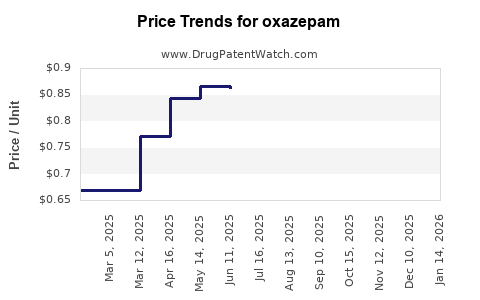
Oxazepam is a mature, generic benzodiazepine with limited commercial growth potential. Its original brand, Serax, lost meaningful exclusivity decades ago, and current U.S. supply is primarily generic. No material unexpired U.S. composition-of-matter or formulation patent estate appears to protect oxazepam as of 2025. Financial performance is driven by low unit prices, generic competition, controlled-substance compliance, manufacturing continuity, and periodic supply disruptions rather than innovation or patent pricing.
Standalone global revenue for oxazepam is not publicly disclosed by major manufacturers. The product is commercially relevant as a low-cost legacy medicine, but it is unlikely to be a material growth driver for any large pharmaceutical company.
What is oxazepam and how is it used?
Oxazepam is an oral benzodiazepine and active metabolite of diazepam and temazepam. In the United States, the approved tablet strengths are generally 10 mg, 15 mg, and 30 mg.
The FDA-approved U.S. labeling identifies three principal uses:
- Management of anxiety disorders or short-term relief of anxiety symptoms
- Relief of symptoms associated with acute alcohol withdrawal
- Treatment of anxiety, tension, agitation, and irritability in selected patients with depression
Oxazepam is also used in clinical practice for insomnia associated with anxiety, although prescribing depends on the applicable label and local medical practice. The drug has a relatively slower onset than some benzodiazepines and is metabolized primarily by conjugation, a characteristic that has historically supported use in certain patients with impaired hepatic oxidative metabolism.[1]
Oxazepam carries class warnings for abuse, misuse, addiction, dependence, and withdrawal. The FDA labeling warns against combined use with opioids because of the risk of profound sedation, respiratory depression, coma, and death.[1]
What dosage forms and strengths are commercially available?
The principal commercial form is the immediate-release oral tablet. Oxazepam is not generally marketed as an injectable, inhaled, transdermal, long-acting depot, or extended-release product in the United States.
| Product attribute |
Oxazepam position |
| Active ingredient |
Oxazepam |
| Primary dosage form |
Immediate-release oral tablet |
| Common strengths |
10 mg, 15 mg, 30 mg |
| U.S. prescription status |
Prescription-only |
| Controlled-substance classification |
Schedule IV |
| Main therapeutic categories |
Anxiety, alcohol withdrawal, selected depressive symptoms |
| Principal commercial source |
Generic manufacturers |
| Branded U.S. product |
Serax historical brand; generic supply dominates |
When did oxazepam lose exclusivity?
Oxazepam lost meaningful market exclusivity long before the current generic era. The original U.S. Serax product was approved in the 1960s, and generic oxazepam has been available for many years. Any original patent protection for the active ingredient would have expired decades ago.
The product has no current small-molecule exclusivity comparable to a new chemical entity, pediatric exclusivity, orphan-drug exclusivity, or 180-day first generic exclusivity that would materially restrict ordinary generic competition.
What is the patent expiration date for oxazepam?
There is no commercially important, unexpired U.S. composition-of-matter patent that protects oxazepam itself. The relevant primary exclusivity period ended decades ago.
A precise original patent expiration date is not a meaningful commercial marker because:
- Oxazepam was approved before the modern Hatch-Waxman patent-listing framework.
- Any original compound patent protection has expired.
- Generic manufacturers have operated in the market for many years.
- Current competitive conditions are controlled by FDA approvals, manufacturing economics, and state and federal controlled-substance requirements.
What patents protect oxazepam today?
The practical answer is that oxazepam has no material active U.S. patent estate protecting the core drug product.
The FDA Orange Book is the principal source for patents and exclusivity associated with approved prescription drug products. Current commercial oxazepam tablets are generic products, and the product does not present the type of listed patent thicket associated with newer branded drugs.[2]
Are formulation patents a risk for oxazepam?
Formulation-patent risk is low. The standard product is an immediate-release tablet using conventional excipients and manufacturing techniques. There is no widely commercialized extended-release oxazepam formulation with a meaningful branded patent position.
Potentially protectable subject matter could include:
- A novel release profile
- A specific combination product
- A new delivery system
- A specialized solid-state form
- A new manufacturing process
- A new clinical use
None of these categories currently appears to create a major U.S. barrier to ordinary generic oxazepam tablets. A company developing a differentiated formulation would face uncertain clinical demand because the existing product is inexpensive and physicians have many alternative benzodiazepines.
Are method-of-use patents relevant?
Method-of-use patents are not a significant current barrier for standard oxazepam prescriptions. The core indications are old and widely known. A new patent directed to a narrow patient population or a new dosing method would require credible clinical and regulatory support and would face difficult commercial economics.
Generic applicants could use a Section viii statement to carve out patented methods from labeling where applicable. Given the age of oxazepam and the absence of a prominent active method-of-use estate, this issue is not central to current market entry.
What is the FDA regulatory status of oxazepam?
Oxazepam is an FDA-approved prescription benzodiazepine. Generic versions are approved through abbreviated new drug applications, or ANDAs, that generally rely on the reference listed drug for safety and effectiveness.
The FDA’s regulatory framework imposes several obligations:
- Demonstration of pharmaceutical equivalence
- Demonstration of bioequivalence
- Compliance with current good manufacturing practices
- Controlled-substance security and recordkeeping
- Pharmacovigilance and adverse-event reporting
- Labeling consistent with benzodiazepine class warnings
The drug is listed as a Schedule IV controlled substance under the federal Controlled Substances Act.[3] That classification increases operating costs relative to ordinary noncontrolled generic tablets. Manufacturers, distributors, pharmacies, and prescribers face additional requirements involving quotas, inventory controls, suspicious-order monitoring, prescription rules, and record retention.
What is the Orange Book status of oxazepam?
Oxazepam is represented in FDA drug databases through its historical reference product and approved generic equivalents. The Orange Book identifies reference-listed drugs, therapeutic equivalents, patents, exclusivity, and approval information.[2]
The commercial implication is straightforward: generic oxazepam tablets can compete through ANDA approvals without waiting for a current branded patent term to expire. Any applicant-specific litigation or certification issue would depend on the particular reference product and the patents listed at the time of filing.
How many patents cover oxazepam?
No material number of active U.S. patents currently protects the standard oxazepam tablet market. The commercial patent count should be treated as effectively zero for core product protection.
This does not eliminate all intellectual-property risk. Patents could theoretically cover a new formulation, manufacturing process, combination therapy, or narrow indication. Those rights would not normally prevent generic manufacturers from selling conventional immediate-release oxazepam tablets unless the protected feature was required for the approved product.
Which companies are challenging oxazepam patents?
No major current Paragraph IV patent challenge is publicly central to the U.S. oxazepam market. The reason is structural: the product is already generic, the original brand exclusivity is expired, and no high-value active patent dispute defines market access.
Generic manufacturers that have marketed or obtained approval for oxazepam products have included multiple established U.S. generic suppliers over time. The supplier set can change because companies discontinue low-margin products, transfer ANDAs, or exit controlled-substance categories.
What generic launch risks exist?
A new generic entrant would face low patent risk but meaningful commercial execution risk:
| Risk |
Commercial effect |
| Low average selling price |
Limits gross-margin potential |
| Multiple approved suppliers |
Increases price competition |
| Controlled-substance compliance |
Raises operating and distribution costs |
| Small market size |
Reduces scale benefits |
| Manufacturing concentration |
Creates shortage exposure |
| Pharmacy purchasing pressure |
Compresses net pricing |
| Product discontinuation |
Can create temporary price increases |
A successful launch would likely require reliable supply, efficient tablet manufacturing, competitive wholesaler terms, and a portfolio strategy that spreads overhead across several generic products.
How strong is the oxazepam patent estate?
The patent estate is weak from a defensive and pricing perspective but favorable for generic entry.
| Patent-estate factor |
Assessment |
| Core composition patent |
Expired |
| New chemical entity exclusivity |
Expired |
| Active Orange Book product patent |
No material protection identified |
| Formulation protection |
Limited commercial relevance |
| Method-of-use protection |
No major current barrier identified |
| Manufacturing patents |
Potentially narrow and nonblocking |
| Generic entry risk |
High |
| Branded pricing power |
Minimal |
Oxazepam therefore has a low legal barrier to entry. Its principal barriers are operational rather than intellectual property-based.
What is the market size and financial trajectory for oxazepam?
Public companies generally do not report oxazepam revenue separately. Sales are usually aggregated within broader generic portfolios, making product-level revenue estimates unreliable without prescription, volume, or channel data.
The financial trajectory is best characterized as mature, low-growth, and price-sensitive:
- Historical brand revenue declined after generic entry.
- Generic volume persists because of low cost and established clinical familiarity.
- Nominal market revenue is constrained by generic price erosion.
- Temporary supply shortages can raise prices but rarely create durable value.
- Demand is unlikely to expand materially without a new indication or delivery technology.
Oxazepam can still produce positive contribution margin for a manufacturer with efficient production and existing controlled-substance infrastructure. It is less attractive as a standalone investment because the product has limited differentiation and weak pricing power.
What drives oxazepam revenue?
The main revenue drivers are:
- Prescription volume
- Number of active suppliers
- Contracting with wholesalers and pharmacy chains
- Availability of competing benzodiazepines
- Manufacturing interruptions
- Changes in state prescribing controls
- Demand from alcohol-withdrawal treatment settings
- Generic reimbursement rates
The largest financial risk is margin compression. The largest short-term upside is a supply disruption affecting competitors, but such upside is volatile and can attract new supply.
How does oxazepam compare with competing benzodiazepines?
Oxazepam competes with generic lorazepam, diazepam, clonazepam, temazepam, alprazolam, and chlordiazepoxide. It also competes indirectly with nonbenzodiazepine treatments for anxiety, insomnia, and alcohol withdrawal.
| Drug |
Common commercial position |
Competitive relationship |
| Oxazepam |
Mature generic; anxiety and alcohol withdrawal |
Low-cost established option |
| Lorazepam |
Broad acute anxiety and hospital use |
Strong substitute |
| Diazepam |
Long duration and multiple dosage forms |
Strong substitute |
| Chlordiazepoxide |
Alcohol withdrawal use |
Direct therapeutic competitor |
| Temazepam |
Insomnia |
Indication-specific competitor |
| Alprazolam |
Anxiety and panic disorder |
Strong outpatient competitor |
| Clonazepam |
Panic disorder and seizure indications |
Longer-duration alternative |
Oxazepam’s pharmacokinetic profile can support clinical selection in certain patients, but commercial differentiation is limited because prescribers can choose from several inexpensive generic alternatives.
What biosimilar risk affects oxazepam?
Biosimilar risk is not applicable. Oxazepam is a chemically synthesized small-molecule drug, not a biologic. Its competitive threat comes from generic versions and therapeutic substitution, not biosimilar competition.
What licensing deals affect oxazepam?
No major current licensing transaction is central to the oxazepam market. The product is old, generic, and widely available through ordinary ANDA-based commercialization. Licensing could occur for a regional marketing right, an ANDA transfer, or a manufacturing arrangement, but those transactions are unlikely to carry the economics associated with an innovative branded medicine.
What patent litigation and settlement agreements affect oxazepam?
No major current U.S. patent litigation or Paragraph IV settlement appears to define oxazepam’s commercial outlook. The absence of a live branded patent dispute reduces legal uncertainty for generic manufacturers.
The more relevant disputes would concern:
- ANDA ownership or transfer
- Manufacturing quality
- Controlled-substance distribution
- Supply contracts
- Product liability
- Labeling and pharmacovigilance
These matters can affect individual companies but do not create a broad market exclusivity event.
What geographic markets are commercially relevant?
The United States is a regulated generic market with strong price competition and controlled-substance compliance obligations. Europe and other developed markets also have long-established generic oxazepam products, although brand names, reimbursement systems, prescription rules, and approved indications vary by country.
Market attractiveness depends on:
- National reimbursement pricing
- Local generic-registration requirements
- Controlled-drug scheduling
- Import and supply-chain rules
- Local manufacturing capacity
- Procurement concentration
- Physician familiarity with benzodiazepines
Oxazepam is more likely to be commercially viable as part of a multinational generic portfolio than as a single-product international launch.
What manufacturing and intellectual-property barriers exist?
Manufacturing barriers are moderate despite minimal patent barriers. Suppliers must maintain validated processes, consistent assay and dissolution performance, stable supply of active pharmaceutical ingredient, and compliance with controlled-substance requirements.
A manufacturer may also need to manage:
- API supplier qualification
- Batch-release testing
- Tablet-content uniformity
- Stability data
- DEA registration and quota controls in the United States
- Serialization and distribution requirements
- Inspection risk
- Product shortage reporting
These requirements favor established generic companies with existing infrastructure. They do not create durable exclusivity, but they can prevent smaller entrants from achieving acceptable economics.
Key Takeaways
- Oxazepam is a mature generic benzodiazepine with no material active U.S. patent barrier for standard tablets.
- The original Serax brand exclusivity expired decades ago.
- FDA-approved generic tablets are the dominant commercial supply.
- Oxazepam is a Schedule IV controlled substance, increasing compliance and distribution costs.
- Product-level revenue is not publicly disclosed by major manufacturers.
- The financial profile is mature, low-growth, and exposed to generic price erosion.
- Generic entry risk is high because composition, formulation, and principal method-of-use protection are exhausted.
- Supply reliability, manufacturing efficiency, and portfolio scale matter more than patent strategy.
- Biosimilar risk is not relevant.
- No major current Paragraph IV litigation or settlement agreement defines the market.
FAQs
Is oxazepam still under patent?
No material U.S. patent protection remains for the core oxazepam molecule or conventional immediate-release tablet. Any new formulation or manufacturing patent would be separate from the expired core protection.
Can a generic company launch oxazepam without a Paragraph IV challenge?
Generally, yes. A generic applicant does not need to challenge an expired composition patent. The applicable ANDA certification depends on the patents and exclusivity listed for the selected reference product when the application is filed.
Is oxazepam more profitable than lorazepam?
There is no public product-level evidence supporting that conclusion. Both are mature generic benzodiazepines, and profitability depends mainly on supplier concentration, contract pricing, manufacturing cost, and supply reliability.
Could a new oxazepam extended-release product obtain market exclusivity?
Potentially, if it met FDA approval requirements and qualified for patent protection or another form of exclusivity. Commercial demand would remain uncertain because physicians already have multiple low-cost benzodiazepine alternatives.
Why can oxazepam prices rise despite expired patents?
Prices can rise temporarily because of manufacturing interruptions, API shortages, supplier exits, wholesaler inventory constraints, or controlled-substance quota limitations. These increases reflect supply conditions rather than patent-based pricing power.
References
- U.S. Food and Drug Administration. (2020). Oxazepam prescribing information. DailyMed.
- U.S. Food and Drug Administration. (2025). Approved drug products with therapeutic equivalence evaluations: Orange Book.
- U.S. Drug Enforcement Administration. (2024). Controlled substance schedules.
- U.S. Food and Drug Administration. (2025). Drugs@FDA: FDA-approved drugs database.
- U.S. Food and Drug Administration. (2024). Approved drug products and abbreviated new drug application requirements.