Last updated: July 30, 2026
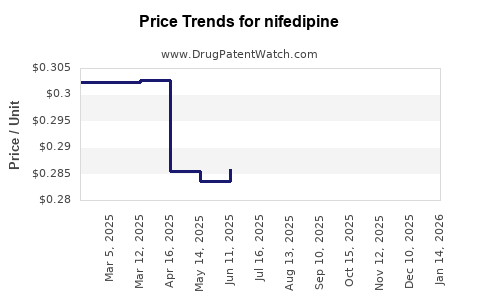
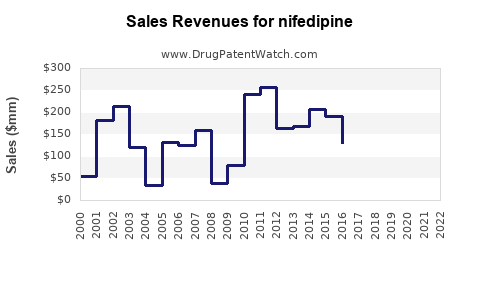
Nifedipine is a broadly genericized small-molecule calcium channel blocker with limited late-cycle patent shelter. Market performance is driven by (1) mature generic supply, (2) regional reimbursement and pricing controls, (3) formulation mix (immediate-release vs extended-release), and (4) safety-driven substitution patterns. Financial trajectory from a commercial perspective is dominated by low net pricing and volume migration rather than meaningful brand-like pricing power.
How big is the nifedipine market and what is driving growth?
Direct answer: Growth is mostly volume-led and formulation-mix driven, with price erosion from generic entry offsetting any demand expansion in chronic hypertension and angina care.
What demand categories matter most for nifedipine
Nifedipine is used across:
- Hypertension
- Chronic stable angina
- Coronary spasm
- Other off-label or guideline-adjacent vasospastic indications depending on country practice
The commercial demand base is stable because nifedipine is embedded in long-standing treatment algorithms in many markets, including where generics dominate formularies.
Key demand growth levers
- Substitution from other dihydropyridine CCBs: In systems with automated formulary switching or channel substitution, nifedipine can capture share when pricing is favorable.
- Extended-release adoption: Many markets prefer controlled-release for adherence. That supports pricing above immediate-release in some regions, even as overall class pricing remains low.
- Treatment access expansion in emerging markets: As healthcare access grows, generic CCB volume rises.
Market sizing reality (business takeaway)
For investors and licensors, nifedipine is not a high-margin growth story. The base case is:
- Net revenue growth tracks volume with modest lift from ER formulations
- Any absolute dollar growth is constrained by ongoing price compression
What are the main formulation and pricing dynamics for immediate-release vs extended-release nifedipine?
Direct answer: ER products generally command higher prices and better persistence than IR, but both are exposed to generic price competition. The winner is usually the manufacturer with stable supply, compliant dissolution specs, and favorable national formulary placement.
Immediate-release vs extended-release: commercial implications
- Immediate-release (IR): More exposed to price cuts; utilization can be sensitive to clinician preference and pill burden considerations.
- Extended-release (ER): Tends to have steadier demand because of adherence and dosing convenience. Price is higher but margin is still capped by generic crowding.
Switching and interchangeability
In most markets, nifedipine generics are treated as interchangeable, so:
- Prescribers may initiate therapy with one product
- Pharmacies can substitute to the lowest-cost compliant product
- ER brands can be displaced by lower-cost ER generics if procurement policies tighten
What is the revenue and profit trajectory for nifedipine under generic-led pricing pressure?
Direct answer: The long-run trajectory is typically declining gross margins and stable-to-slow net revenue growth, with earnings driven by scale, cost-of-goods, and regional portfolio management.
How generic pricing changes cash flow
Generic competitive dynamics generally follow this pattern:
- Initial erosion after new entrants
- Margin compression across the remaining players
- Continued price pressure when multiple suppliers ramp in parallel
- Occasional stabilization when consolidation or supply disruptions occur
Financial characteristics of nifedipine portfolios
Commercial outcomes tend to depend on whether a company can win:
- Distribution contracts
- Formulary inclusion
- Tender-based procurement
- ER-specific demand capture
Key cost drivers:
- API and intermediate sourcing
- Manufacturing utilization (batch throughput)
- Quality system compliance cost
- Regulatory maintenance
How do major regions affect nifedipine sales and pricing?
Direct answer: Regional reimbursement and tender systems determine whether nifedipine behaves like a volume engine (emerging markets) or a price-downward “commodity” (mature procurement-heavy systems).
United States
- Market is genericized; pricing is driven by large distributors, group purchasing, and pharmacy reimbursement structure.
- Competitive entry and frequent multiple-source availability keep prices low.
Europe
- Tendering and reference pricing systems suppress pricing power.
- National formularies and local manufacturer ecosystems drive market shares.
- ER vs IR mix and local bioequivalence acceptance matter.
China and broader Asia
- Volume growth can be strong where hypertension prevalence is rising and diagnosis rates increase.
- However, competitive intensity also increases as local generics proliferate.
- Product-specific quality and dossier strength influence share.
Latin America and MENA
- Tendering and reimbursement volatility can swing unit volumes.
- Profitability depends on logistics, shelf-life strategy, and local agent strength.
What generic entry and supply-chain factors shape nifedipine market stability?
Direct answer: Supply stability and specification control determine which suppliers can sustain market share after commoditization.
Supply-chain and manufacturing risks that affect revenue
- Batch yield and defect rates in solid dosage forms can reduce sellable volume.
- Dissolution profile consistency is central for ER products; failures can cause withdrawals or lost tenders.
- API sourcing risks can trigger price spikes or shortages, temporarily improving margins for qualified suppliers.
Procurement cycles
Revenue can show step-function patterns:
- Winning a tender can create short-term unit surges
- Losing a tender can cause abrupt declines
- Multi-year contracts reduce volatility but can lock in price disadvantage
How does nifedipine compare with other calcium channel blockers commercially?
Direct answer: Nifedipine typically competes as a low-cost generic against other dihydropyridine CCBs such as amlodipine, felodipine, and diltiazem-class alternatives (where relevant). Amlodipine often has the strongest brand persistence historically, leaving nifedipine to compete on price and ER preference.
Competitive positioning (practical view)
- Against amlodipine: Nifedipine must win on specific prescriber preference, ER formulation fit, or tender pricing.
- Against other CCBs: Nifedipine benefits from broad historical use and formulary inclusion but rarely dominates class economics.
What does the “financial trajectory” look like for a generic manufacturer of nifedipine?
Direct answer: For manufacturers, the typical trajectory is revenue growth from share capture in selected tenders offset by margin compression from generic price competition. Earnings improve when supply reliability and regulatory readiness protect contracts.
Profit drivers by business model
- Low-cost scale manufacturing
- Revenue growth comes from commodity volume
- Profit depends on COGS and plant utilization
- Quality and dossier strength strategy
- Targets higher-reliability procurement
- Can sustain modest pricing premiums in ER subsets
- Portfolio stacking
- Nifedipine works best as part of a CCB or hypertension bundle to spread fixed costs
What is the patent and exclusivity landscape impact on nifedipine business prospects?
Direct answer: Nifedipine is widely generic; commercialization economics are largely unrelated to new exclusivity events. Near-term financial upside generally comes from operational execution and formulation mix, not patent extension.
What this means for R&D and licensing
- New product strategy must focus on differentiation that survives generic interchangeability rules (for example, ER performance, patient adherence design, or line extensions where accepted).
- Licensing opportunities are more likely to involve formulation/process advantages than new molecular entity exclusivity.
What litigation and regulatory dynamics could affect nifedipine pricing or availability?
Direct answer: In mature generic markets, the most meaningful disruptions are typically regulatory inspections, quality events, and supply issues rather than recurrent patent litigation.
Common business-impacting regulatory events
- Manufacturing site inspection outcomes
- Recalls tied to stability or dissolution-profile variance
- Bioequivalence-related documentation changes
- Labeling or formulation substitution policy changes
These events can temporarily shift market share to unaffected suppliers.
How do wholesalers, pharmacies, and formularies influence nifedipine net pricing?
Direct answer: Nifedipine net price is set by reimbursement and procurement mechanics more than by list price.
Net price formation
- Pharmacy reimbursement typically reflects:
- Lowest available compliant generic
- Contract pricing with wholesalers
- Tender-driven pricing in institutional settings
Formulary placement and substitution rules
- If substitution is allowed, market share flows to the lowest-cost or most reliably supplied product.
- If prior authorization is used (varies by country), clinicians may retain choice longer, supporting limited pricing differences.
What are the most probable generic launch scenarios for nifedipine going forward?
Direct answer: Expect continued entry of multi-source generics, with competitive intensity highest in high-volume strengths and ER SKUs. Risk is concentrated in those SKUs where multiple suppliers expand at once.
Business scenario map
- Scenario A (base case): Additional generic entrants reduce prices further; volumes stay stable; profits depend on cost reduction.
- Scenario B (supply disruption): One or more suppliers face quality issues; remaining players gain volume; margins improve temporarily.
- Scenario C (tender tightening): Procurement contracts reduce allowable prices; all suppliers compress margins; only lowest COGS or best-supply players survive.
- Scenario D (ER mix shift): ER formulations capture incremental share; modest price lift persists even as generic ER entrants increase.
Which companies are positioned to win in nifedipine’s commoditized market?
Direct answer: The companies with (1) manufacturing scale, (2) strong quality track records, and (3) tender execution in ER formulations are best positioned to maintain or expand share. In commoditized antihypertensives, winning is operational.
What to look for in commercial due diligence
- Share in ER SKUs and tender wins in institutional channels
- Track record of inspection outcomes and recall frequency
- API and intermediate supply security
- Ability to sustain stable dissolution profile and batch consistency
- Distribution footprint and ability to respond to procurement cycles
Key takeaways
- Nifedipine’s financial trajectory is generic-led: low net pricing, stable or slow revenue growth, and earnings tied to scale and cost control.
- Extended-release formulations can provide modest margin resilience through adherence-driven persistence, but they remain exposed to generic competition.
- Regional reimbursement and tender systems dominate net revenue outcomes in the US and Europe; emerging markets can add volume but increase competitive intensity.
- Patent and exclusivity effects are not the primary determinant of near-term commercial performance; operational execution and supply reliability are.
FAQs
1) Does extended-release nifedipine have better commercial performance than immediate-release?
Often yes on a per-unit basis due to adherence and prescriber preference, but overall profitability still depends on generic competition and tender pricing.
2) What typically drives quarterly volatility in nifedipine sales for generic manufacturers?
Tender cycles, tender re-awards, supply interruptions, and quality events at manufacturing sites.
3) Are nifedipine ER generics more sensitive to regulatory or quality requirements?
Yes, ER products are sensitive to dissolution and release-profile consistency, raising the operational bar for manufacturers.
4) How does substitution policy affect nifedipine market share?
Where pharmacy substitution is allowed, market share tends to shift quickly toward the lowest-cost reliably supplied generic.
5) What business strategy is most effective for entering nifedipine now?
A cost-and-supply strategy focused on high-volume strengths and ER SKUs, backed by strong dossier readiness and procurement execution.
References
- U.S. Food and Drug Administration. Orange Book: Approved Drug Products with Therapeutic Equivalence Evaluations. FDA.
- European Medicines Agency. EPAR and European public assessment reports for nifedipine-containing products. EMA.
- World Health Organization. Guidelines for hypertension management and use of calcium channel blockers. WHO.