Last updated: August 6, 2026
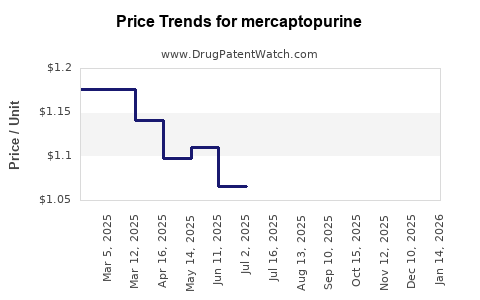
Mercaptopurine is a mature, low-price oncology drug with limited commercial growth potential. Its market is sustained by long-term maintenance therapy for acute lymphoblastic leukemia (ALL), especially in pediatric patients, and by continued use in selected inflammatory bowel disease patients. Revenue is distributed across generic tablet suppliers, while branded value remains limited. The principal commercial risks are supply interruptions, low manufacturing margins, hospital purchasing pressure, and substitution by thiopurine alternatives rather than patent expiry.
What is the current market position of mercaptopurine?
Mercaptopurine is a purine antimetabolite used primarily in combination regimens for ALL. The U.S. product is generally supplied as a 50 mg tablet. The drug is also used off-label for Crohn's disease and ulcerative colitis, although azathioprine and biologic therapies are more prominent in many treatment pathways [1, 2].
The market has four defining characteristics:
| Market characteristic |
Commercial effect |
| Generic availability |
Prevents sustained branded pricing |
| Low daily dose and tablet strength |
Limits absolute revenue per patient |
| Chronic maintenance use in ALL |
Provides recurring demand |
| Small patient population |
Restricts total market size |
| Limited manufacturer base at times |
Creates shortage and procurement risk |
| Mature active pharmaceutical ingredient |
Reduces technical differentiation |
Mercaptopurine is clinically important but commercially narrow. It is not a high-growth oncology product. Demand depends more on treatment volumes, pediatric oncology protocols, and supply reliability than on price expansion or new indications.
How large is the mercaptopurine market?
No publicly reported, audited global revenue figure isolates mercaptopurine sales across all generic manufacturers, distributors, hospitals, and countries. Public company filings generally aggregate the product into broader generic pharmaceutical or oncology portfolios.
A defensible market assessment is therefore based on prescription use, treatment duration, pricing, and supplier structure rather than a single reported market-size figure.
The U.S. market is likely concentrated in:
- Pediatric and adult ALL maintenance therapy.
- Hospital and specialty-pharmacy procurement.
- Generic 50 mg tablets.
- Limited branded or specialist formulations in non-U.S. markets.
- Off-label inflammatory bowel disease use.
The long treatment duration in ALL supports stable unit demand. Patients commonly receive maintenance treatment for extended periods under protocol-driven care, but the number of eligible patients is small compared with markets for common solid-tumor drugs. The result is a market with recurring volume but low aggregate revenue.
What drives mercaptopurine demand?
The main demand drivers are:
- Incidence and survival of pediatric ALL.
- Adoption of pediatric cooperative-group treatment protocols.
- Continued use of oral maintenance regimens.
- Availability of affordable 50 mg tablets.
- Clinical preference for thiopurine therapy in selected patients.
- Stocking requirements at pediatric oncology centers.
The main demand constraints are treatment substitution, genetic toxicity concerns, laboratory-monitoring requirements, and increasing use of alternative immunomodulators in inflammatory bowel disease.
TPMT and NUDT15 testing can affect treatment selection and dose intensity. Patients with reduced enzyme activity may require dose reduction or alternative therapy, reducing the number of patients who can receive standard mercaptopurine dosing [1, 3].
What is the financial trajectory for mercaptopurine?
Mercaptopurine has a mature-to-declining revenue profile in branded terms and a stable-to-low-growth profile in unit terms.
| Period |
Financial trajectory |
Primary explanation |
| Historical branded period |
Higher pricing and concentrated sales |
Limited competition and legacy brand positioning |
| Initial generic period |
Sharp price erosion |
Multiple abbreviated new drug applications |
| Current mature market |
Low revenue per prescription |
Generic substitution and procurement pricing |
| Medium term |
Stable or modestly declining units |
Protocol persistence offset by treatment alternatives |
| Downside scenario |
Revenue volatility and shortages |
Supplier exits or manufacturing disruption |
| Upside scenario |
Temporary pricing improvement |
Shortage, competitor withdrawal, or formulation differentiation |
The financial model is structurally different from that of a patented oncology product. A supplier does not need blockbuster volume to participate, but it also cannot normally rely on high gross margins. Profitability depends on:
- API procurement cost.
- Manufacturing scale.
- Packaging and serialization costs.
- Regulatory compliance.
- Contracting with wholesalers and hospitals.
- Ability to maintain reliable supply.
- The number of active competitors.
- Whether the product is listed on government or hospital contracts.
A shortage can temporarily improve net pricing, but shortage-driven gains are difficult to sustain. The more durable commercial opportunity is operational: a supplier with dependable manufacturing, validated API sources, and strong hospital distribution can gain share even without a new patent.
Which companies manufacture or market mercaptopurine?
Mercaptopurine is supplied through a mix of branded-product owners, generic drug manufacturers, contract manufacturers, and local-market distributors. The U.S. supply chain has included generic manufacturers and repackagers whose product availability can change over time.
The principal commercial categories are:
| Supplier category |
Position in the market |
| Legacy branded sponsor |
Retains name recognition but limited pricing power |
| Large generic manufacturer |
Competes on scale, contracts, and supply continuity |
| Specialty generic company |
May target oncology and shortage-sensitive products |
| Repackager |
Purchases finished product and distributes under a repackaged label |
| Non-U.S. manufacturer |
Supplies national markets under local registrations |
| Hospital or institutional supplier |
Competes through tenders and formulary contracts |
The relevant competitive advantage is usually supply reliability rather than clinical differentiation. Companies with only one low-volume product can face unattractive economics if regulatory, quality, or API costs rise.
Because generic product listings and market participation can change, current commercial status should be verified through FDA Drugs@FDA, the Orange Book, National Drug Code records, and manufacturer labeling [4, 5].
What is the FDA regulatory status of mercaptopurine?
Mercaptopurine is an established FDA-approved drug. The historical U.S. product Purinethol was approved under NDA 009053 for acute lymphatic leukemia and related indications. Current U.S. prescribing information identifies mercaptopurine as a thiopurine antimetabolite used in ALL treatment [1, 6].
The FDA regulatory profile is mature:
| Regulatory issue |
Status |
| U.S. approval |
Established product |
| Principal indication |
Acute lymphoblastic or lymphatic leukemia |
| Dosage form |
50 mg tablet in the conventional U.S. product |
| Regulatory pathway for competitors |
ANDA or applicable abbreviated pathway |
| Pediatric use |
Important clinical use in ALL protocols |
| Genetic testing relevance |
TPMT and NUDT15 status can affect dosing |
| Regulatory exclusivity |
No meaningful current new-drug exclusivity expected |
| Biosimilar pathway |
Not applicable |
Mercaptopurine is a small molecule, not a biologic. Biosimilar competition is therefore irrelevant. Competitive entry occurs through generic drug applications, manufacturing changes, and alternative thiopurine products.
What patents protect mercaptopurine?
The original compound and its basic therapeutic use are long past the ordinary patent term. No commercially important composition-of-matter patent should be expected to block generic mercaptopurine tablets in the United States.
Potential intellectual-property categories include:
- Historical compound patents.
- Legacy process patents.
- Crystalline-form or impurity-control patents.
- Formulation patents.
- Oral-suspension patents in selected jurisdictions.
- Method-of-use patents for specific dosing or patient populations.
- Manufacturing and analytical know-how that may not be publicly patent-protected.
The practical U.S. market is governed by generic availability, not by an active foundational patent estate. Patent databases may still contain expired historical filings, continuations, foreign rights, or patents assigned to companies that no longer have commercial significance.
Does mercaptopurine have Orange Book protection?
The Orange Book is the controlling public source for listed patents and regulatory exclusivity associated with FDA-approved products [5]. For a mature generic product such as mercaptopurine, the commercial question is whether any unexpired patent is listed against a currently marketed reference product.
No active patent barrier is generally recognized as preventing ANDA competition for standard mercaptopurine tablets. Any current listing should be checked against the specific reference standard, dosage form, NDA, and marketed status. A patent listing would not necessarily block approval because a generic applicant could use a Paragraph IV certification, a section viii statement, or wait for the patent term to expire.
When did mercaptopurine lose exclusivity?
Mercaptopurine lost practical market exclusivity decades ago. The original product predates the modern Hatch-Waxman framework, and standard generic competition has long been available.
| Exclusivity type |
Current significance |
| Original compound patent |
Expired |
| Original regulatory exclusivity |
Expired |
| New chemical entity exclusivity |
Not relevant to this mature product |
| Pediatric exclusivity |
No current commercial effect |
| Orphan-drug exclusivity |
No current market-blocking effect for standard product |
| Listed patent exclusivity |
No generally recognized barrier to ordinary generic entry |
| Biosimilar exclusivity |
Not applicable |
The key distinction is between legal exclusivity and commercial scarcity. Mercaptopurine has little legal protection, but a small supplier base can still create temporary commercial leverage.
Are there Paragraph IV challenges for mercaptopurine?
Paragraph IV litigation is unlikely to be a major current market issue because mercaptopurine tablets have been generic for many years. Paragraph IV certifications are most commercially important when an ANDA applicant seeks entry before expiration of a listed patent. The absence of a meaningful active patent estate reduces the incentive for high-value patent litigation.
Potential disputes would more likely involve:
- Product quality.
- Manufacturing compliance.
- Drug-shortage obligations.
- Labeling.
- Bioequivalence.
- Distribution or contracting.
- Patent claims directed to a newer formulation rather than ordinary tablets.
Any litigation search should distinguish historical Paragraph IV cases from current disputes involving marketed mercaptopurine products. A historical patent case would not necessarily affect current supply or generic launch timing.
What formulations are protected by mercaptopurine patents?
The conventional 50 mg tablet is a mature formulation with limited differentiation. Formulation-related commercial opportunities could arise from:
- Oral suspensions.
- Pediatric-friendly liquid dosage forms.
- Improved stability.
- Reduced dosing errors.
- Unit-dose packaging.
- Taste-masked formulations.
- Modified-release products.
- Combination products.
The most commercially relevant unmet need is pediatric administration. Children receiving ALL maintenance therapy may have difficulty swallowing tablets, and dose adjustments can require accurate manipulation. A stable oral liquid could command a premium if it provides reliable dosing and broad distribution.
That opportunity is constrained by formulation economics. A liquid product requires stability data, packaging validation, microbial-control measures, dosing-device qualification, and additional supply-chain controls. It also competes with tablet crushing, pharmacy compounding, and established alternatives.
What generic entry risks exist for mercaptopurine?
Generic entry risk is already realized for the standard tablet. The forward-looking risk is supplier disruption rather than a new wave of patent-enabled entry.
High-probability risks
- Additional price competition if a new manufacturer enters.
- Loss of profitability after a major wholesaler contract.
- API interruption.
- Manufacturing-site warning letters or remediation.
- Product discontinuation by a low-volume supplier.
- Hospital tender pressure.
- Substitution by azathioprine or newer therapies.
Moderate commercial opportunities
- Capturing share during a competitor shortage.
- Supplying pediatric oncology centers.
- Developing an oral liquid.
- Offering dependable unit-dose or institutional packaging.
- Entering markets with limited local competition.
- Providing a dual-source API and finished-dose supply chain.
A new standard tablet entrant would likely face a difficult return-on-investment case unless it has a low-cost manufacturing platform or a contracted customer base.
How does mercaptopurine compare with azathioprine and other thiopurines?
| Attribute |
Mercaptopurine |
Azathioprine |
Thioguanine |
| Main oncology role |
ALL maintenance |
Limited leukemia use; broader immunosuppressive use |
Selected hematologic use |
| IBD use |
Off-label |
More established |
Limited |
| Market maturity |
Very mature generic |
Very mature generic |
Mature but narrower |
| Pediatric oncology relevance |
High |
Lower in ALL maintenance |
Protocol-dependent |
| Commercial growth |
Low |
Low to moderate by indication |
Low |
| Key differentiation |
Protocol familiarity |
Broader immunosuppressive use |
Specific hematologic applications |
| Main risk |
Supply and substitution |
Safety and alternative therapy |
Narrow clinical demand |
Mercaptopurine remains protected from rapid displacement in ALL because treatment protocols, pediatric oncology experience, and long-term maintenance practice support continued use. In inflammatory bowel disease, competition from biologics, small-molecule immunomodulators, and azathioprine limits expansion.
What is the geographic coverage of mercaptopurine?
Mercaptopurine is available in multiple national markets, but dosage forms, brand names, approved indications, and supplier participation differ by country. The commercial center of gravity is the United States and other developed markets with established ALL treatment protocols.
Geographic performance is shaped by:
- National reimbursement.
- Pediatric oncology infrastructure.
- Local generic-registration requirements.
- Government procurement.
- Availability of 50 mg tablets.
- Access to oral-liquid formulations.
- Local API and finished-dose manufacturing.
- Currency and tender pricing.
In emerging markets, low price supports access but can reduce supplier incentives. In smaller countries, a single registered supplier may create meaningful supply vulnerability even when no patent barrier exists.
What manufacturing and intellectual-property barriers affect the market?
Manufacturing barriers are more relevant than patent barriers. Mercaptopurine is an older small molecule, but reliable supply still requires control of:
- API purity and impurity profiles.
- Batch reproducibility.
- Potency uniformity.
- Stability in the finished dosage form.
- Containment and worker-safety procedures for cytotoxic materials.
- Packaging and serialization.
- Validation of pediatric dosing devices for liquid products.
Cytotoxic manufacturing can carry higher compliance and occupational-control costs than ordinary oral solid-dose production. These costs can discourage smaller manufacturers from entering a low-revenue product, which helps explain why a mature generic can experience shortages.
What is the investment outlook for mercaptopurine?
Mercaptopurine is unlikely to support a standalone growth thesis based on volume expansion or patent protection. Its investment value is more likely to arise from portfolio effects.
A company may benefit if it:
- Already has an oncology-generic manufacturing platform.
- Can produce multiple low-volume shortage-sensitive drugs.
- Has institutional contracts.
- Owns a differentiated pediatric formulation.
- Controls API supply.
- Operates in markets with limited competition.
- Can bundle mercaptopurine with complementary oncology products.
The base case is stable, low-margin revenue. The upside case depends on supply consolidation or formulation differentiation. The downside case is permanent margin compression, supplier exit, or substitution by competing therapies.
Key Takeaways
- Mercaptopurine is a mature generic oncology drug with recurring but limited demand.
- Pediatric ALL maintenance is the core commercial driver.
- Standard 50 mg tablets have little practical patent protection.
- Biosimilar competition does not apply because mercaptopurine is a small molecule.
- Paragraph IV litigation is unlikely to materially affect the current market.
- Revenue is constrained by generic pricing, small patient volume, and hospital procurement.
- Supply reliability and manufacturing compliance matter more than patent ownership.
- A pediatric oral liquid or other differentiated formulation offers the clearest commercial opportunity.
- The product is more valuable as part of a broader generic oncology portfolio than as a standalone growth asset.
FAQs
Is mercaptopurine still profitable for pharmaceutical manufacturers?
It can be profitable at portfolio scale, particularly where a manufacturer has efficient production and institutional contracts. Standalone economics are less attractive because price competition is high and patient volume is limited.
Can a company obtain a new patent on mercaptopurine?
A new patent may be possible for a genuinely novel formulation, manufacturing process, delivery system, or dosing method. The original compound itself is not a viable source of new exclusivity.
Does mercaptopurine face biosimilar competition?
No. Mercaptopurine is a chemically synthesized small molecule. Competition occurs through generic drug applications rather than the FDA biosimilar pathway.
Why can an old generic drug experience shortages?
Low prices, limited suppliers, API disruptions, manufacturing deviations, and low expected returns can cause manufacturers to reduce production or exit the market.
Is an oral-liquid mercaptopurine product commercially attractive?
It may be attractive for pediatric oncology if it provides stable dosing, reliable shelf life, and broad reimbursement. Its value would come from formulation and supply execution rather than protection of the underlying mercaptopurine molecule.
References
-
U.S. Food and Drug Administration. (2024). Mercaptopurine tablets: Prescribing information. FDA.
-
National Cancer Institute. (2024). Childhood acute lymphoblastic leukemia treatment. National Institutes of Health.
-
U.S. Food and Drug Administration. (2020). Table of pharmacogenetic associations. FDA.
-
U.S. Food and Drug Administration. (2024). Drugs@FDA: FDA-approved drugs database. FDA.
-
U.S. Food and Drug Administration. (2024). Approved drug products with therapeutic equivalence evaluations, Orange Book. FDA.
-
U.S. Food and Drug Administration. (1953). Purinethol approval history, NDA 009053. FDA.