Last updated: September 7, 2026
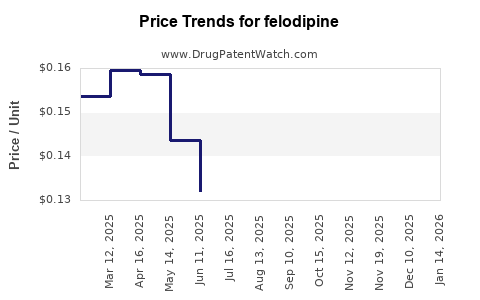
Felodipine is a mature, off-patent dihydropyridine calcium-channel blocker marketed primarily as an extended-release tablet for hypertension. Its commercial profile is defined by low-cost generic competition, limited manufacturer differentiation, and declining branded relevance. The original brand, Plendil, was developed by AstraZeneca and lost meaningful U.S. exclusivity decades ago. Current revenue is concentrated in generic sales and regional markets rather than in a protected branded franchise.
What is felodipine and how is it used?
Felodipine is an orally administered dihydropyridine calcium-channel blocker. The FDA-approved indication is treatment of hypertension, either alone or with other antihypertensive drugs. The U.S. product is an extended-release tablet designed for once-daily administration. Available strengths include 2.5 mg, 5 mg, and 10 mg tablets, although commercial availability varies by manufacturer and market.[1]
Felodipine reduces peripheral vascular resistance through selective arterial vasodilation. It is not generally used as a first-line growth product in modern hypertension portfolios because generic amlodipine and other antihypertensive agents have broader use, higher prescribing familiarity, and stronger formulary positioning.
Felodipine product profile
| Attribute |
Felodipine |
| Drug class |
Dihydropyridine calcium-channel blocker |
| Primary indication |
Hypertension |
| Dosage form |
Extended-release oral tablet |
| Common strengths |
2.5 mg, 5 mg, 10 mg |
| Original brand |
Plendil |
| Original developer |
AstraZeneca predecessor companies |
| FDA status |
Approved, genericized |
| U.S. market status |
Mature multisource generic market |
| Biosimilar risk |
Not applicable; felodipine is a small molecule |
| Main commercial constraint |
Low price and limited differentiation |
When did felodipine lose exclusivity?
Felodipine lost effective U.S. market exclusivity after expiration of the patents associated with the original product and approval of generic versions. The commercial exclusivity period ended long before the current generic market developed.
Plendil received FDA approval in the early 1990s. FDA records identify the product as an extended-release felodipine tablet approved under New Drug Application 019834.[2] The product’s original compound and formulation protection are no longer commercially meaningful in the United States.
Felodipine exclusivity timeline
| Event |
Approximate timing |
Commercial effect |
| Original product development |
1980s |
Establishment of branded cardiovascular franchise |
| FDA approval of Plendil |
Early 1990s |
Start of U.S. branded sales |
| Original patent protection |
Expired years ago |
Removal of core patent barrier |
| Generic approvals |
1990s and later |
Price competition and loss of brand share |
| Current market |
Mature generic stage |
Low unit economics and limited innovation |
The original patents were directed to felodipine compounds and pharmaceutical compositions. Those rights have expired under the standard U.S. patent term framework. Any remaining intellectual-property value would generally depend on narrow process, formulation, or foreign rights rather than on broad U.S. exclusivity.
What patents protect felodipine?
No active U.S. patent estate is generally recognized as a material barrier to generic felodipine tablets. The important patent categories were:
- Compound patents covering felodipine and related dihydropyridines.
- Pharmaceutical-composition patents covering oral dosage forms.
- Extended-release formulation technology.
- Manufacturing and crystallization claims, where applicable.
- Method-of-use claims related to hypertension treatment.
The practical patent position is weak because the fundamental compound and commercial dosage form have been available for decades.
What formulations are protected by felodipine patents?
The primary technical distinction is the extended-release formulation. Felodipine has low aqueous solubility and is sensitive to formulation design, dissolution behavior, and food-related pharmacokinetic effects. The original branded product used controlled-release technology to support once-daily dosing.
Formulation patents can be commercially relevant when they cover:
- Controlled dissolution over a defined time period.
- Particle-size distribution.
- Solid-state forms.
- Matrix or coating systems.
- Specific excipient combinations.
- Manufacturing processes that produce consistent release profiles.
Those claims do not create a durable market barrier when alternative formulations have already been approved through abbreviated new drug applications. Current generic competition indicates that the technical requirements for an acceptable extended-release product have been met by multiple manufacturers.
What is the Orange Book status of felodipine?
The Orange Book identifies approved felodipine drug products and associated therapeutic-equivalence information. The original Plendil product is no longer protected by meaningful listed U.S. exclusivity. Generic felodipine extended-release tablets are generally evaluated through the abbreviated new drug application pathway and may receive therapeutic-equivalence designations depending on the specific product and reference listing.[3]
Orange Book and regulatory position
| Regulatory issue |
Felodipine status |
| Reference product |
Plendil extended-release tablets |
| Approval pathway for generics |
ANDA |
| Current branded exclusivity |
Expired |
| Paragraph IV relevance |
Historically relevant, not a current central market issue |
| Therapeutic equivalence |
Determined at the individual product level |
| Pediatric exclusivity |
No current commercial significance |
| REMS |
No major felodipine-specific REMS barrier generally associated with the product |
Which companies manufacture generic felodipine?
Generic felodipine has been marketed by multiple U.S. and international companies over time. Manufacturer participation changes as companies discontinue low-volume products, transfer rights, or consolidate portfolios. The market has included large generic suppliers and regional pharmaceutical manufacturers.
Potential commercial participants have included companies such as:
- Teva Pharmaceuticals
- Mylan, now part of Viatris
- Sandoz
- Dr. Reddy's Laboratories
- Other contract and regional generic suppliers
A manufacturer’s presence in historical FDA records does not establish current commercial availability. Felodipine is a low-priority product for many large generic companies because the market has limited growth and weak pricing power.
How strong is the felodipine patent estate?
The current U.S. patent estate is weak from a market-defense perspective.
| Patent factor |
Assessment |
| Core compound protection |
Expired |
| Branded formulation protection |
Expired or commercially displaced |
| Generic blocking patents |
No major active barrier generally evident |
| Manufacturing complexity |
Moderate |
| Regulatory complexity |
Moderate for extended-release equivalence |
| Switching cost |
Low |
| Litigation leverage |
Low |
| Opportunity for lifecycle management |
Limited |
The main residual barriers are regulatory and operational rather than patent-based. A manufacturer must demonstrate acceptable bioequivalence, control dissolution performance, maintain supply reliability, and compete in a low-price market. Those requirements can delay entry for an individual applicant but do not protect the incumbent franchise.
Are there Paragraph IV challenges or felodipine patent lawsuits?
Felodipine has had the type of generic patent activity associated with older branded drugs, including potential Paragraph IV certifications against listed patents during the initial generic-entry period. That phase is no longer a major determinant of current U.S. market access.
There is no widely recognized current U.S. litigation campaign involving a live, commercially significant Plendil patent estate. The absence of active high-value litigation is consistent with the product’s age, generic penetration, and expired core patents.
Litigation and settlement outlook
| Issue |
Current commercial significance |
| New Paragraph IV filings |
Low |
| Brand-generic patent settlement risk |
Low |
| Injunction risk |
Low |
| Launch-at-risk exposure |
Low |
| Product-liability exposure |
More relevant than patent litigation |
| Supply and quality disputes |
More relevant than exclusivity disputes |
What is the financial trajectory for felodipine?
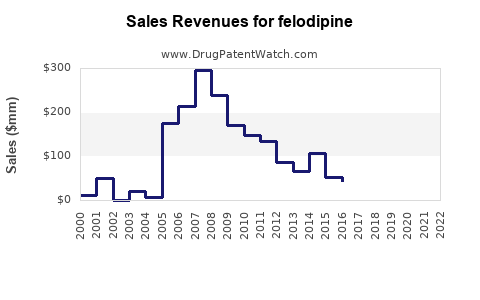
Felodipine’s financial trajectory follows the standard lifecycle for an older cardiovascular drug:
- Branded growth during initial adoption.
- Revenue erosion after generic entry.
- Rapid price compression as additional suppliers enter.
- Stabilization at low generic revenue levels.
- Periodic supply disruptions or manufacturer exits caused by weak margins.
AstraZeneca does not generally report felodipine as a separate current revenue line in its major financial disclosures. The drug is not a material contributor to the company’s contemporary revenue base. Its financial relevance is historical rather than strategic.[4]
Revenue trajectory
| Lifecycle phase |
Revenue pattern |
Main driver |
| Pre-generic period |
Higher price and branded margins |
Clinical adoption and brand promotion |
| Initial generic entry |
Sharp decline |
Loss of exclusivity |
| Multisource generic phase |
Continued price erosion |
Substitution and formulary pressure |
| Mature market |
Low, fragmented revenue |
Volume persistence and low prices |
| Long-term outlook |
Flat to declining |
Therapeutic substitution and manufacturer exits |
Public companies typically do not disclose standalone felodipine sales because the product is immaterial to consolidated revenue. Market estimates from commercial databases can differ substantially based on whether they measure manufacturer sales, pharmacy revenue, shipment volume, or global retail value.
How does felodipine compare with amlodipine?
Amlodipine is the stronger commercial comparator. Both drugs are dihydropyridine calcium-channel blockers, but amlodipine has broader prescribing use and a more durable position in hypertension treatment.
| Factor |
Felodipine |
Amlodipine |
| Class |
Dihydropyridine calcium-channel blocker |
Dihydropyridine calcium-channel blocker |
| Dosing |
Extended-release formulation |
Long-acting immediate-release tablet |
| Generic availability |
Extensive |
Extensive |
| Prescriber familiarity |
Lower |
Higher |
| Market scale |
Smaller |
Larger |
| Formulation complexity |
Higher |
Lower |
| Commercial pricing |
Low |
Low |
| Strategic growth potential |
Limited |
Limited but larger base |
| Substitution pressure |
High |
Lower relative to felodipine |
Amlodipine’s wider use reflects long half-life, simple once-daily administration, extensive clinical experience, combination-product availability, and strong guideline familiarity. Felodipine remains clinically usable but lacks a clear commercial advantage.
What generic entry risks exist for felodipine?
Generic entry risk is no longer an emerging risk. It is the established market structure.
The principal commercial risks are:
- Additional price reductions from new suppliers.
- Loss of a manufacturer after low-margin pricing.
- Shortages caused by limited active suppliers.
- Procurement concentration among wholesalers and health systems.
- Substitution by amlodipine, angiotensin receptor blockers, and fixed-dose combinations.
- Increased regulatory costs relative to product revenue.
- Reduced incentives to maintain multiple strengths.
For a new entrant, the largest risk is not patent infringement. It is insufficient margin after manufacturing, testing, distribution, rebates, and regulatory costs.
What manufacturing and intellectual-property barriers affect felodipine?
Felodipine does not require biologic manufacturing, sterile production, or complex delivery-device technology. The core manufacturing process is conventional small-molecule oral solid-dose production.
The remaining technical issues include:
- Consistent active pharmaceutical ingredient quality.
- Control of particle size and solid-state properties.
- Reproducible extended-release dissolution.
- Stability under storage conditions.
- Bioequivalence across strengths.
- Control of food-related pharmacokinetic effects.
- Reliable supply of active pharmaceutical ingredient.
These factors can create execution risk, but they do not support a strong exclusivity strategy. Manufacturing know-how may provide modest operational value without blocking competitors.
What is the global market outlook for felodipine?
Felodipine remains available in selected international markets, including countries where physicians continue to use older calcium-channel blockers. Geographic value differs sharply.
Geographic commercial profile
| Region |
Market condition |
| United States |
Mature generic market with limited branded value |
| Western Europe |
Generic and reimbursement-driven market |
| China and other Asian markets |
Potentially larger unit demand, but competitive pricing |
| Emerging markets |
Variable availability and tender-driven pricing |
| Global branded market |
Limited |
Regulatory approval, local reimbursement, tender participation, and supply continuity determine international sales. Expired U.S. patents do not eliminate the need to assess country-specific patents, trademarks, registration rights, and local manufacturing requirements.
Key Takeaways
- Felodipine is an old, genericized antihypertensive with no meaningful current U.S. exclusivity.
- Plendil’s original compound and formulation protection no longer support a durable commercial moat.
- The FDA market is centered on extended-release generic tablets approved through the ANDA pathway.
- Current patent litigation and Paragraph IV activity have low commercial importance.
- AstraZeneca does not identify felodipine as a material standalone revenue contributor.
- Amlodipine is the principal commercial comparator and has broader market penetration.
- The main risks are price erosion, supply contraction, manufacturer exit, and therapeutic substitution.
- Any commercial opportunity is volume-based and operational, not driven by patent protection.
FAQs About Felodipine Patents, Revenue, and Generic Competition
Does felodipine have FDA market exclusivity?
No meaningful U.S. market exclusivity remains for felodipine. The product has been genericized for many years.
Is felodipine a biologic or does it face biosimilar competition?
Felodipine is a synthetic small-molecule drug. It does not face biosimilar competition. Generic competition proceeds through ANDAs and therapeutic-equivalence determinations.
Can a new formulation of felodipine receive patent protection?
A genuinely novel extended-release formulation, solid form, manufacturing process, or combination product could potentially receive patent protection. The commercial value would depend on claim breadth, non-obviousness, regulatory approval, and the ability to prevent design-around products.
Is Plendil still commercially important?
Plendil has limited commercial importance in the United States. Generic felodipine products, regional brands, and therapeutic alternatives account for the practical market opportunity.
What would cause felodipine prices to rise?
Prices could rise temporarily if manufacturers exit, an active pharmaceutical ingredient supplier experiences an interruption, or demand shifts toward a limited number of approved suppliers. Long-term pricing power remains constrained by the absence of meaningful exclusivity and the availability of competing antihypertensive drugs.
References
- U.S. Food and Drug Administration. (2024). Felodipine extended-release tablets prescribing information.
- U.S. Food and Drug Administration. (2024). Drugs@FDA: FDA-approved drugs, Plendil (NDA 019834).
- U.S. Food and Drug Administration. (2024). Approved drug products with therapeutic equivalence evaluations: Orange Book.
- AstraZeneca PLC. (2024). Annual report and Form 20-F.